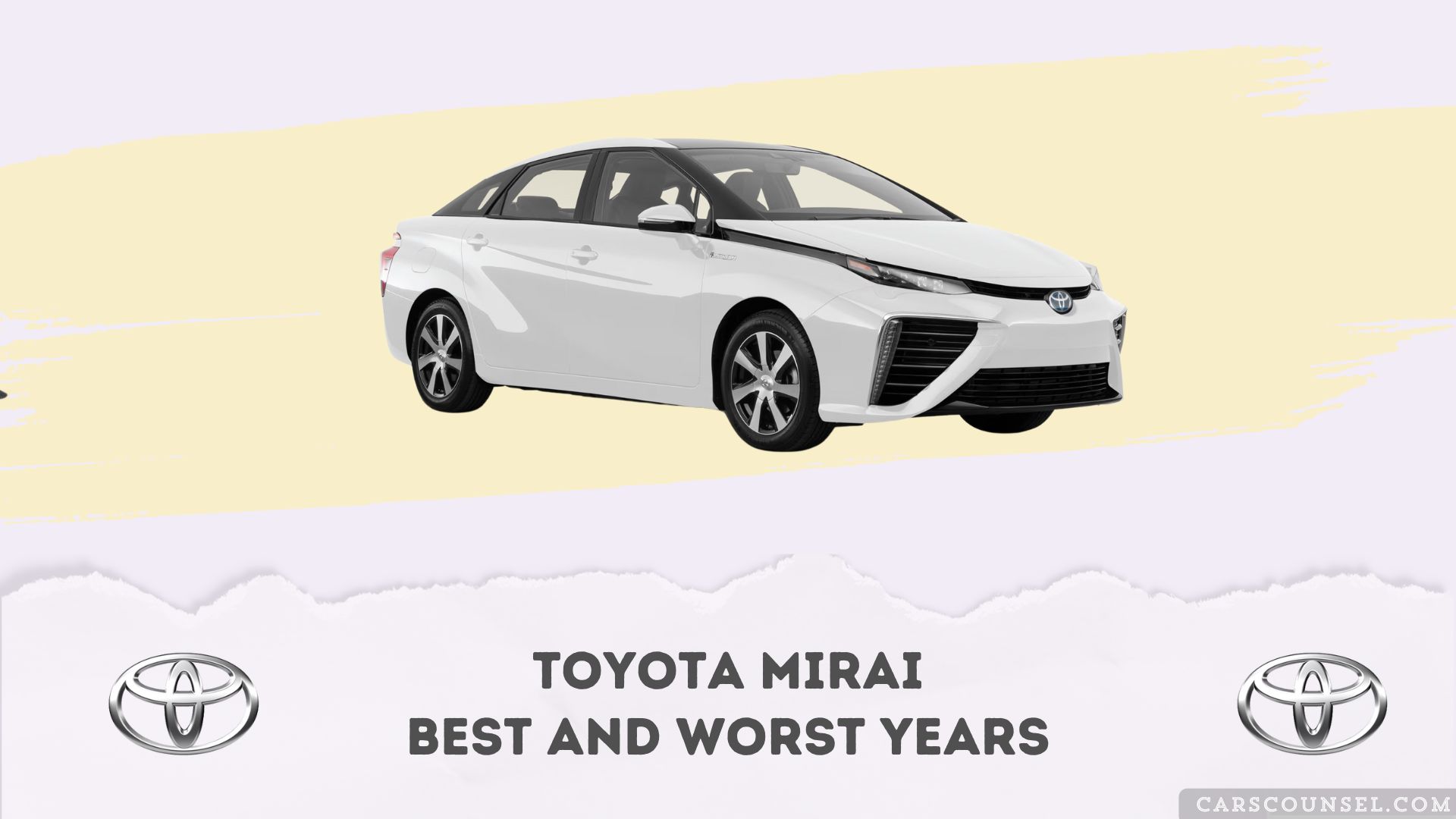
The best Toyota Mirai years are 2021 through 2023, offering updated fuel cell technology and improved range. Buyers should approach the 2016 and 2017 models carefully due to early sensor issues and steep depreciation.
These rankings are comparative. No hydrogen vehicle is entirely free from infrastructure limitations. Proper maintenance and verifying open recalls remain essential for a positive ownership experience.
Reliability varies significantly between the first and second generations. The 2021 redesign brought major platform and efficiency upgrades that separate newer models from older counterparts.
Quick Navigation
Best and Worst Toyota Mirai Years at a Glance
| Model Year | Verdict | Main Reason |
|---|---|---|
| 2021 – 2023 | Best Late-Generation Choice | Redesigned platform, better range, mature tech |
| 2018 – 2020 | Good Choice | Reliable first-gen, but infrastructure limits remain |
| 2016 – 2017 | Approach Carefully | Early fuel cell sensor faults, heavy depreciation |
| 2024 – 2025 | Too New to Judge | Insufficient long-term ownership data |
Key Takeaways
- The 2021 through 2023 models represent the best choices, featuring a complete redesign and improved hydrogen efficiency.
- First-generation models from 2016 and 2017 require careful inspection for early fuel cell voltage sensor faults.
- Toyota provides a comprehensive 10-year or 100,000-mile warranty on the fuel cell stack and hybrid components.
- Steep depreciation affects all model years, making older examples inexpensive but potentially costly if out of warranty.
- Always verify local hydrogen fueling infrastructure before purchasing any Mirai, regardless of the model year.
How We Evaluated the Toyota Mirai Model Years
Our analysis considers official recalls, manufacturer service campaigns, and verified owner complaints. We also evaluate generation changes and powertrain revisions.
Consumer complaints are not confirmed failure rates. A recall does not automatically make a vehicle unreliable. Recent models simply have less long-term ownership history available.
Best Toyota Mirai Years
2021 – 2023: Best Late-Generation Choice
The second generation launched for the 2021 model year with a completely new rear-wheel-drive platform. This redesign significantly improved driving dynamics and interior quality.
These years offer an increased driving range and a more refined fuel cell system. They remain the strongest options for buyers seeking modern hydrogen technology.
2018 – 2020: Good Choice
Late first-generation models benefit from Toyota ironing out early production bugs. The fuel cell stack proved durable during these years, assuming proper maintenance.
While mechanically sound, these years still suffer from the original generation’s limited cargo space and older infotainment interface. Pre-purchase inspections remain vital.
Best Toyota Mirai Year by Buyer Type
Best Overall: 2022
The 2022 model year offers the best balance of second-generation refinements, established reliability, and slightly better used-market availability compared to the initial 2021 launch year.
Best Budget Option: 2019
For buyers wanting a reliable first-generation model without the steepest initial depreciation hits, the 2019 model year provides a mature platform at a lower entry price.
Years to Approach Carefully
2016 – 2017: Approach Carefully
Early first-generation models introduced Toyota’s hydrogen technology to the masses. However, some owners reported issues with the fuel cell voltage sensor and abnormal system warnings.
These faults can force the vehicle into a reduced-power limp mode. While many were addressed under warranty, out-of-warranty examples require extreme caution and specialized diagnostics.
Worst Toyota Mirai Years
We do not classify any specific Mirai model year as an absolute “Avoid.” However, the 2016 model year presents the highest risk for early adopters.
First-year models experienced the most significant teething issues regarding hydrogen system sensors. Combined with massive depreciation, a faulty out-of-warranty 2016 model presents substantial financial risk.
Toyota Mirai Reliability by Generation
First Generation (2016 – 2020)
The original Mirai proved that hydrogen fuel cells could be reliable daily drivers. However, early years faced sensor calibration issues that occasionally triggered system shutdowns.
Later years in this generation improved software stability. The front-wheel-drive layout and unconventional packaging limited interior space, but the core powertrain remained generally robust.
Second Generation (2021 – Present)
Toyota moved to a rear-wheel-drive architecture for the second generation. This improved weight distribution and allowed for a third hydrogen tank, extending the driving range.
The fuel cell stack was made smaller, lighter, and more efficient. Long-term data is still accumulating, but initial reliability feedback for this generation is highly favorable.
Common Toyota Mirai Problems
Fuel Cell System Sensors
Some early models experienced faults with the fuel cell voltage sensor. This can cause the system to detect abnormal voltage and trigger a warning light.
When this occurs, the vehicle may enter a fail-safe limp mode. Toyota issued technical service bulletins and software updates to address these early calibration issues.
12-Volt Battery Drain
Like many electrified vehicles, the Mirai relies on a standard 12-volt battery to boot up the main computer systems. Parasitic drain can kill this battery.
If the 12-volt battery dies, the vehicle will not start, even if the hydrogen tanks are full. Owners should monitor the auxiliary battery health regularly.
Hydrogen Infrastructure Limitations
While not a mechanical defect, the lack of reliable hydrogen stations remains the most common owner complaint. Station outages can severely limit the vehicle’s usability.
What to Check Before Buying a Used Toyota Mirai
- Verify the vehicle’s VIN to ensure all fuel cell software updates and recalls have been completed by a certified dealer.
- Confirm the remaining balance on the 10-year or 100,000-mile fuel cell stack and hybrid component warranty.
- Check the health of the 12-volt auxiliary battery, as a weak battery will prevent the main hydrogen system from initializing.
- Inspect the hydrogen tank inspection dates, as high-pressure tanks require periodic visual inspections and have a mandated 15-year service life.
- Test the infotainment system and ensure the navigation accurately displays local hydrogen fueling stations.
- Arrange an independent pre-purchase inspection with a technician certified to handle high-pressure hydrogen systems.
Related Buying Guides
- Toyota Prius years to avoid: The Prius offers a highly reliable hybrid alternative for buyers who lack access to local hydrogen fueling infrastructure.
- Toyota Crown best and worst years: The Crown provides a premium, comfortable sedan experience with traditional hybrid powertrains that do not require specialized fueling stations.
- Toyota Highlander years to avoid: Families needing more cargo space and passenger room than the Mirai offers should consider the Highlander hybrid SUV.
Frequently Asked Questions
What is the most reliable Toyota Mirai year?
The 2022 model year is currently the most reliable choice. It benefits from the second-generation redesign and has accumulated enough ownership history to prove its durability.
Are Toyota Mirais expensive to maintain?
Routine maintenance is relatively low, but out-of-warranty fuel cell repairs are extremely expensive. Always verify the status of the 10-year powertrain warranty before purchasing.
How long do Toyota Mirai fuel cell stacks last?
Toyota designs the fuel cell stack to last the lifetime of the vehicle. The components are backed by a 10-year or 100,000-mile warranty for added peace of mind.
Why did the 2016 Mirai receive warnings?
The 2016 model year had early software calibration issues with the voltage sensors. These could trigger false warnings and limp modes, though most were updated under warranty.
Can I buy a used Toyota Mirai outside California?
It is highly discouraged. Hydrogen fueling infrastructure is almost entirely limited to California and a few specific stations in Hawaii. You will struggle to find fuel elsewhere.
Do hydrogen tanks expire?
Yes, high-pressure hydrogen tanks have a mandated 15-year service life from their date of manufacture. Check the tank labels to ensure they are not nearing expiration.
Which Toyota Mirai Year Should You Buy?
The best Toyota Mirai years are 2021 through 2023. These second-generation models offer superior range, better driving dynamics, and modernized technology.
Buyers on a budget can consider 2018 through 2020 models, provided they verify the warranty status. Avoid early 2016 examples unless they have complete service records.
Always confirm local hydrogen station availability before purchasing. Finally, verify the VIN for open recalls and arrange a specialized pre-purchase inspection.

