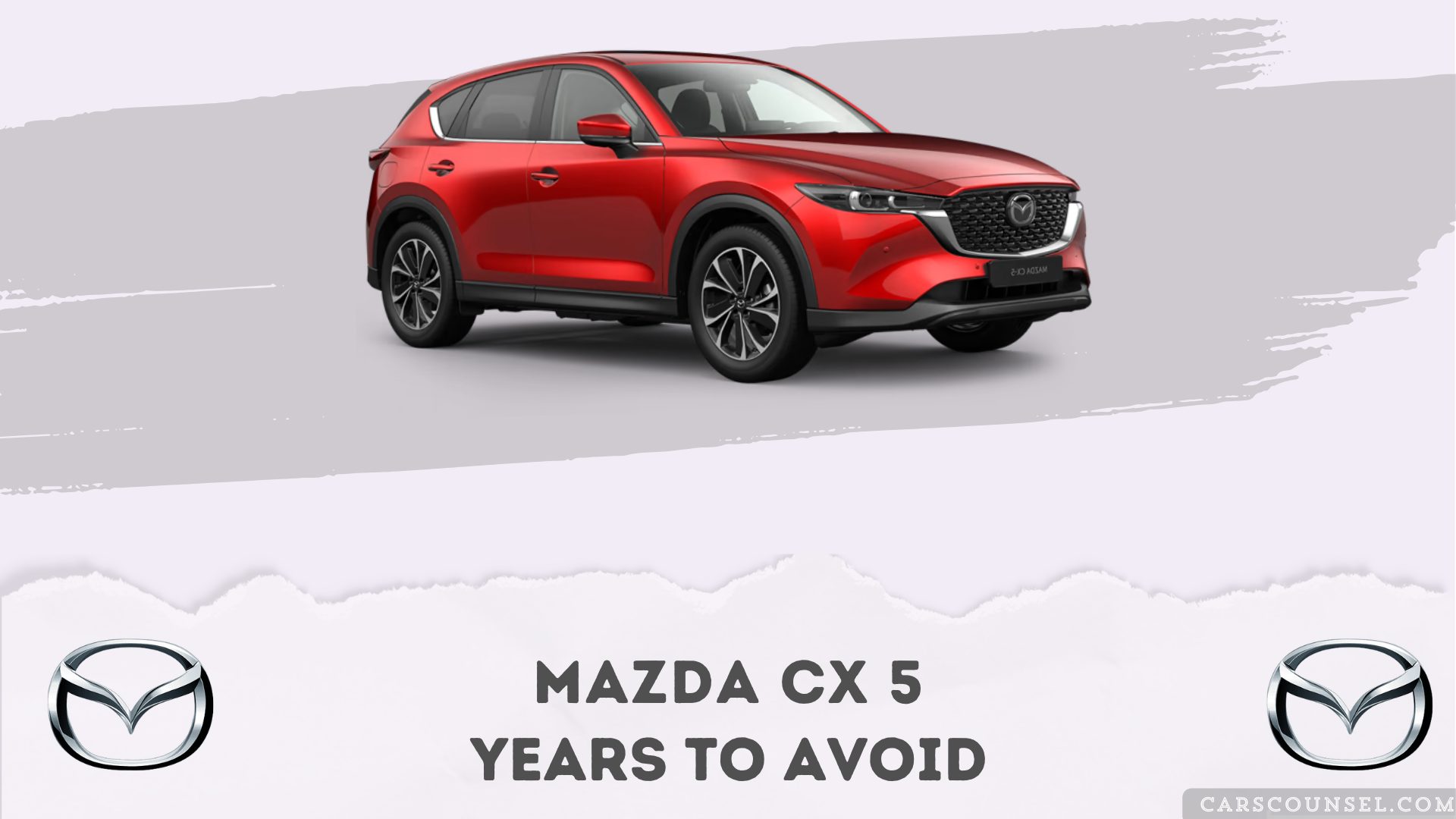
The best Mazda CX-5 years are 2020 through 2023, offering mature reliability and refined features. Buyers should avoid the 2016 model year due to widespread electrical component failures and high complaint volumes.
Rankings are comparative, and no used vehicle is flawless. Long-term dependability always depends on maintenance records, accident history, and current mechanical condition rather than the model year alone.
Meaningful differences exist between generations. The 2017 redesign introduced a vastly improved interior and infotainment dial, while recent models added turbocharged engines and standard all-wheel drive across most trims.
Quick Navigation
Best and Worst Mazda CX-5 Years at a Glance
| Model Year or Range | Verdict | Main Reason | Buyer Guidance |
|---|---|---|---|
| 2020–2023 | Best Choice | Mature platform with excellent reliability scores | Prioritize for long-term ownership |
| 2024 | Best Late-Generation Choice | Strong build quality with limited long-term exposure | Verify remaining warranty |
| 2017 | Best Older Choice | Complete redesign with superior interior and controls | Check infotainment and brake wear |
| 2018 | Good With Inspection | Solid mechanics but affected by a fuel pump recall | Confirm recall completion via VIN |
| 2019 | Good Choice | Reliable powertrain with minor isolated complaints | Review service history carefully |
| 2013–2015 | Approach Carefully | Early infotainment glitches and premature brake wear | Inspect brakes and electronics |
| 2016 | Avoid | Widespread LED daytime running light failures | Seek later models with the dial interface |
| 2025 | Too New to Judge | Insufficient long-term ownership data | Wait for more reliability data |
Key Takeaways
- 2020 through 2023 are the strongest choices for overall reliability and refinement.
- Avoid the 2016 model year due to expensive LED headlight failures and high complaint volumes.
- The 2017 redesign eliminated frustrating touchscreens in favor of a reliable command dial.
- Early models from 2013 through 2015 require careful inspection for premature brake wear.
- Always verify the VIN to ensure the 2018 fuel pump recall was completed.
How We Evaluated the Mazda CX-5 Model Years
Our analysis considers official NHTSA recalls, manufacturer service campaigns, consumer complaint patterns, and powertrain changes. We evaluate problem severity and repair complexity rather than raw complaint totals alone.
Complaints are not confirmed failure rates. A recall does not automatically make a vehicle unreliable if the remedy is freely available. Recent models have less ownership history, so their long-term durability remains partially unproven.
Best Mazda CX-5 Years
2020–2023: Best Choice
These years represent the most refined iteration of the second generation. Mazda resolved early infotainment bugs, and the naturally aspirated 2.5-liter engine proves exceptionally durable. Standard all-wheel drive on most trims adds year-round capability.
2024: Best Late-Generation Choice
The 2024 model maintains excellent build quality and introduces minor feature updates. While long-term exposure remains limited, its mature powertrain and strong initial reliability scores make it a comparatively safe choice for used buyers.
2017: Best Older Choice
The 2017 redesign brought a premium interior and replaced the laggy touchscreen with a physical command dial. This change drastically reduced electrical complaints. Buyers gain modern safety features at a lower price point than newer models.
Best Year by Buyer Type
Best Overall: 2022
The 2022 model hits the sweet spot for depreciation, proven reliability, and modern safety features. It avoids the earliest second-generation growing pains while remaining more affordable than 2023 or 2024 examples.
Best Family Alternative: Mazda CX-9
Buyers needing three rows should look at the Mazda CX-9. It shares similar design language and powertrain architecture but offers significantly more passenger space.
Best Smaller Alternative: Mazda CX-30
For urban drivers who find the CX-5 slightly too large, the Mazda CX-30 provides a smaller footprint, a premium cabin, and standard all-wheel drive.
Years to Approach Carefully
2013–2015: Approach Carefully
The first-generation models suffer from laggy touchscreen systems and frequent reports of premature brake wear. Some owners also report windshields that crack unusually easily. These years are acceptable only if priced accordingly and thoroughly inspected.
2018: Good With Inspection
The 2018 model is mechanically sound but was included in a major manufacturer recall regarding a faulty fuel pump that could cause engine stalling. Buyers must verify that the dealer has already installed the updated pump assembly.
2019: Good Choice
The 2019 model year is generally reliable, though it has slightly more infotainment complaints than later years. It introduced cylinder deactivation on some engines, which has performed well but adds minor complexity to the fuel system.
Worst Mazda CX-5 Years
2016: Avoid
The 2016 model year registers the highest volume of complaints for the nameplate. The most severe issue involves the LED daytime running lights burning out prematurely. Because the LEDs are integrated, repairs are exceptionally expensive.
While Mazda issued a warranty extension for certain vehicles, many used examples remain unfixed. Combined with ongoing brake wear complaints, buyers looking for other years to avoid should note that the fully redesigned 2017 model is vastly superior.
Mazda CX-5 Reliability by Generation
First Generation (2013–2016)
The original CX-5 established the brand’s Skyactiv powertrain, which proved mechanically robust. However, early models struggled with electrical gremlins, fragile windshields, and rapid brake pad depletion. The 2016 model year specifically suffers from severe lighting component failures.
Second Generation (2017–Present)
The 2017 redesign vastly improved cabin materials and replaced the touchscreen with a center console dial, eliminating most electrical complaints. The introduction of a turbocharged engine in 2019 added performance without sacrificing the platform’s core durability.
Common Mazda CX-5 Problems
LED Daytime Running Light Failure
Affecting primarily 2014 through 2016 models equipped with LED headlights, the daytime running lights can burn out prematurely. Because the LEDs are not replaceable separately, owners often face costly full headlight assembly replacements.
Premature Brake Wear
Many owners of 2013 through 2016 models report brake pads and rotors wearing out much faster than expected. While not a safety defect, it increases routine maintenance costs and requires careful inspection during a pre-purchase evaluation.
Fuel Pump Failure (Recall)
Certain 2018 models were recalled due to a defective fuel pump impeller that could deform and cause the engine to stall. This issue is resolved through a free dealer repair, but buyers must verify completion.
Repair-Cost Overview
| Problem | Commonly Affected Years | Approximate Repair Range | Important Notes |
|---|---|---|---|
| LED DRL Failure | 2014–2016 | $800 – $1,500 | Requires full assembly replacement if not covered by warranty extension. |
| Premature Brake Service | 2013–2016 | $300 – $600 | Cost for pads and rotors per axle; varies by parts brand. |
| Fuel Pump Replacement | 2018 | Free | Must be completed under the official safety recall campaign. |
Repair costs vary significantly by region, labor rates, parts choice, and vehicle configuration. Always consult a qualified mechanic for an accurate estimate.
What to Check Before Buying a Used Mazda CX-5
- Verify the VIN to confirm all safety recalls, especially the fuel pump and LED lighting campaigns, are completed.
- Inspect the brake rotors for deep scoring or premature wear, particularly on 2013–2016 models.
- Test the infotainment system command dial on 2017 and newer models to ensure smooth screen navigation.
- Check the windshield for pitting or stress cracks, which are unusually common on early generations.
- Review service records to confirm regular transmission fluid exchanges and engine oil changes.
- Arrange an independent pre-purchase inspection to evaluate suspension components and drivetrain operation.
Related Buying Guides
- Mazda 3 years to avoid: The CX-5 shares its underlying architecture and engines with the Mazda 3 compact car.
- Mazda CX-50 best and worst years: A rugged, slightly larger alternative built on the same fundamental platform.
- Mazda 6 years to avoid: Mazda’s midsize sedan offers similar driving dynamics for buyers who prefer a car over an SUV.
Frequently Asked Questions
Which Mazda CX-5 year is the most reliable?
The 2020 through 2023 model years are the most reliable. They benefit from a mature platform, resolved infotainment issues, and excellent long-term ownership data compared to earlier generations.
Why should I avoid the 2016 Mazda CX-5?
The 2016 model has the highest complaint volume, largely due to widespread LED daytime running light failures. Repairing this issue is expensive if the vehicle has not received the official warranty extension fix.
Do Mazda CX-5s have transmission problems?
No, the automatic transmission is generally very reliable. Early reports of whining noises were isolated, and widespread transmission failure is not a recognized defect pattern for this vehicle.
What is the best alternative to the Mazda CX-5?
The Honda CR-V and Toyota RAV4 are direct competitors. Within the brand, the Mazda CX-30 is an excellent smaller alternative with a premium interior.
Did Mazda fix the touchscreen issues?
Yes. Starting with the 2017 redesign, Mazda replaced the laggy touchscreen with a physical command dial on the center console. This change vastly improved usability and eliminated most electrical complaints.
How long do Mazda CX-5s usually last?
Well-maintained examples frequently reach high mileage. Longevity ultimately depends on strict adherence to service intervals, rust prevention, and addressing minor issues before they cause major component damage.
Which Mazda CX-5 Year Should You Buy?
Target the 2020 through 2023 Mazda CX-5 model years for the best balance of modern features and proven reliability. Avoid the 2016 model year entirely due to expensive lighting defects.
Always verify open recalls and arrange an independent inspection before purchasing. Proper maintenance remains the most critical factor in ensuring long-term dependability for any used compact SUV.

