The Audi S3 is a turbocharged compact performance sedan sold in the U.S. market. U.S. production began in 2015 and continues through the 2025 model year.
A sales gap occurred in 2021 during the platform transition from the 8V to the 8Y generation.
Timing system identification is essential for accurate maintenance planning and engine reliability.
A timing belt requires scheduled replacement at defined intervals, while a timing chain is designed to last the engine’s service life.
Misidentifying the system can result in missed service or unnecessary repair costs.
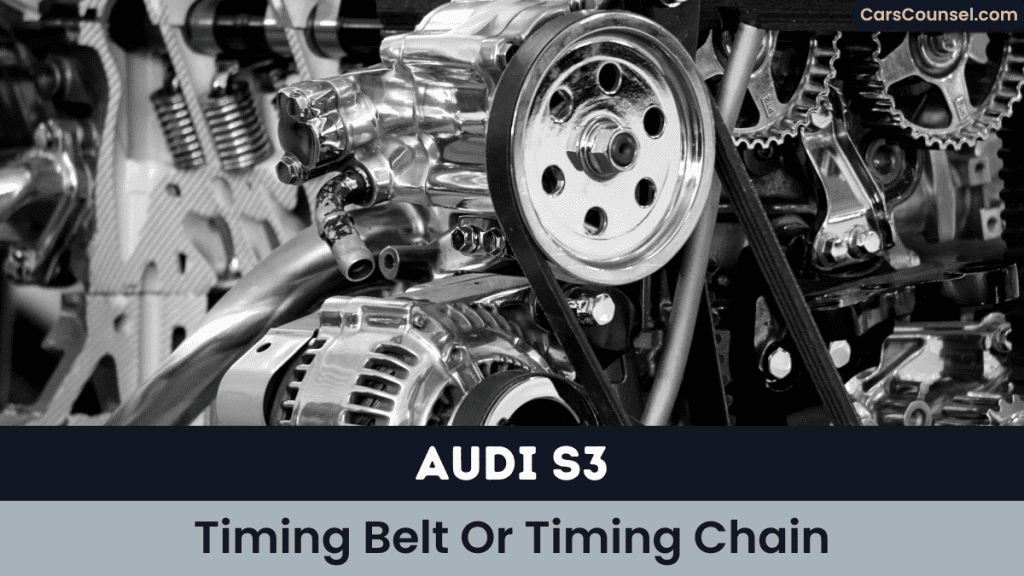
Two generation platforms cover the full U.S. production run. The first-generation U.S. variant, the 8V, ran from 2015 through 2020.
The second, the 8Y, entered the U.S. market as a 2022 model year vehicle and continues through 2025.
Quick Navigation
Does the Audi S3 Have a Timing Belt or Timing Chain?
All U.S.-market Audi S3 models use a timing chain. This applies to every production year from 2015 through 2025. No U.S.-market S3 has ever used a timing belt.
2025 Audi S3 Timing Belt Or Timing Chain
| Specification | Detail |
|---|---|
| Engine Option(s) | 2.0L TFSI Turbocharged 4-Cylinder (EA888 Gen 4), 306 hp |
| Timing System | Timing Chain |
| Interference Engine | Yes |
| Replacement Interval | No scheduled replacement interval |
| Maintenance Notes | Chain-driven timing; inspect during major service events |
The 2025 S3 continues with the EA888 Gen 4 engine carried over from the 8Y platform launch. The timing chain carries no manufacturer-published replacement interval and is classified as a lifetime component under standard operating conditions.
2024 Audi S3 Timing Belt Or Timing Chain
| Specification | Detail |
|---|---|
| Engine Option(s) | 2.0L TFSI Turbocharged 4-Cylinder (EA888 Gen 4), 306 hp |
| Timing System | Timing Chain |
| Interference Engine | Yes |
| Replacement Interval | No scheduled replacement interval |
| Maintenance Notes | Same timing system as previous model year |
Timing hardware continues unchanged from the 2023 model year. Regular synthetic oil changes remain the most important maintenance action for preserving timing chain and tensioner condition on this engine family.
2023 Audi S3 Timing Belt Or Timing Chain
| Specification | Detail |
|---|---|
| Engine Option(s) | 2.0L TFSI Turbocharged 4-Cylinder (EA888 Gen 4), 306 hp |
| Timing System | Timing Chain |
| Interference Engine | Yes |
| Replacement Interval | No scheduled replacement interval |
| Maintenance Notes | Same timing system as previous model year |
No timing system changes occurred for the 2023 model year. The EA888 Gen 4 timing chain is treated as a non-serviceable lifetime component throughout the 8Y generation. No timing belt variant was available in the U.S. market.
2022 Audi S3 Timing Belt Or Timing Chain
| Specification | Detail |
|---|---|
| Engine Option(s) | 2.0L TFSI Turbocharged 4-Cylinder (EA888 Gen 4), 306 hp |
| Timing System | Timing Chain |
| Interference Engine | Yes |
| Replacement Interval | No scheduled replacement interval |
| Maintenance Notes | First model year of 8Y generation in U.S. market |
The 2022 model year marked the U.S. introduction of the 8Y-generation S3. Engine output increased to 306 horsepower with the updated EA888 Gen 4, while retaining the timing chain configuration of the outgoing 8V generation.
Note: The Audi S3 was not offered for sale in the U.S. market as a 2021 model year vehicle. The 8V generation ended after 2020 and the 8Y generation launched as a 2022 model year.
2020 Audi S3 Timing Belt Or Timing Chain
| Specification | Detail |
|---|---|
| Engine Option(s) | 2.0L TFSI Turbocharged 4-Cylinder (EA888 Gen 3), 292 hp |
| Timing System | Timing Chain |
| Interference Engine | Yes |
| Replacement Interval | No scheduled replacement interval |
| Maintenance Notes | Final model year of 8V generation in U.S. market |
The 2020 S3 was the last 8V-generation model sold in the U.S. market. The EA888 Gen 3 continued with the same chain-driven timing layout used across the entire 8V production run from 2015 onward.
2019 Audi S3 Timing Belt Or Timing Chain
| Specification | Detail |
|---|---|
| Engine Option(s) | 2.0L TFSI Turbocharged 4-Cylinder (EA888 Gen 3), 292 hp |
| Timing System | Timing Chain |
| Interference Engine | Yes |
| Replacement Interval | No scheduled replacement interval |
| Maintenance Notes | Same timing system as previous model year |
No changes to the timing assembly occurred for the 2019 model year. Oil viscosity grade and change frequency directly affect timing chain and tensioner wear rates on the EA888 Gen 3 engine.
2018 Audi S3 Timing Belt Or Timing Chain
| Specification | Detail |
|---|---|
| Engine Option(s) | 2.0L TFSI Turbocharged 4-Cylinder (EA888 Gen 3), 292 hp |
| Timing System | Timing Chain |
| Interference Engine | Yes |
| Replacement Interval | No scheduled replacement interval |
| Maintenance Notes | Same timing system as previous model year |
Timing components carry over without change from the 2017 specification. The EA888 Gen 3 uses a single-stage timing chain to drive both intake and exhaust camshaft assemblies. No service interval applies to the chain.
2017 Audi S3 Timing Belt Or Timing Chain
| Specification | Detail |
|---|---|
| Engine Option(s) | 2.0L TFSI Turbocharged 4-Cylinder (EA888 Gen 3), 292 hp |
| Timing System | Timing Chain |
| Interference Engine | Yes |
| Replacement Interval | No scheduled replacement interval |
| Maintenance Notes | Same timing system as previous model year |
Same timing system as the 2016 model year. The 8V-generation S3 used identical chain-driven timing hardware across all five U.S. production years. Timing chain replacement is not a scheduled service item on this engine.
2016 Audi S3 Timing Belt Or Timing Chain
| Specification | Detail |
|---|---|
| Engine Option(s) | 2.0L TFSI Turbocharged 4-Cylinder (EA888 Gen 3), 292 hp |
| Timing System | Timing Chain |
| Interference Engine | Yes |
| Replacement Interval | No scheduled replacement interval |
| Maintenance Notes | Same timing system as previous model year |
Timing configuration is unchanged from the 2015 model year. The EA888 Gen 3 timing chain is not subject to a mileage-based replacement schedule. Servicing is typically performed only when diagnostic findings or symptoms are present.
2015 Audi S3 Timing Belt Or Timing Chain
| Specification | Detail |
|---|---|
| Engine Option(s) | 2.0L TFSI Turbocharged 4-Cylinder (EA888 Gen 3), 292 hp |
| Timing System | Timing Chain |
| Interference Engine | Yes |
| Replacement Interval | No scheduled replacement interval |
| Maintenance Notes | First U.S.-market model year; chain-driven timing from initial production |
The 2015 model year was the first S3 offered to U.S. buyers. It launched with the EA888 Gen 3 engine and timing chain from initial production. No timing belt variant was available at any point during this generation.
Timing Belt vs Timing Chain on the Audi S3
A timing belt is a reinforced rubber component that synchronizes crankshaft and camshaft rotation. It degrades over time and requires replacement at manufacturer-specified mileage intervals. Failure to replace it on schedule can cause catastrophic engine damage in interference applications.
A timing chain performs the same synchronization function using a metal link assembly. It is lubricated by the engine oil supply and engineered to last the full service life of the engine. No external replacement interval is published by Audi for the S3 chain.
Maintenance differences between the two systems are significant. Timing belts require periodic inspection and proactive replacement regardless of visible wear. Timing chains require no scheduled replacement but depend on consistent oil changes to maintain tensioner hydraulics and chain lubrication.
When timing chain wear does occur, symptoms typically appear before failure. Audible rattling at cold start and illuminated warning indicators are common early signs. Timing belt failure, by contrast, often occurs without advance warning and may result in complete engine failure on interference engines.
Audi S3 Timing System Maintenance
The Audi S3 timing chain carries no manufacturer-published replacement interval. Audi treats the chain as a lifetime component under standard service conditions. Replacement is warranted only when inspection findings or operational symptoms confirm degradation.
Cold-start rattling that clears after a few seconds of engine operation is a recognized symptom of timing chain tensioner wear. This condition occurs more frequently on higher-mileage EA888 engines. Prompt inspection by a qualified technician is advisable when this noise is detected.
Oil quality and change frequency are the primary variables affecting timing chain longevity on the EA888 engine. Degraded or low engine oil reduces hydraulic tensioner performance and increases chain wear rates. Audi-approved low-viscosity full-synthetic engine oil is required for both generations.
When timing chain replacement becomes necessary, partial engine disassembly is required to access the timing assembly. Labor costs are the dominant expense in this repair. Total repair cost including parts and labor typically exceeds $1,500 depending on shop rates and component selection.
| Factor | Timing Belt | Timing Chain |
|---|---|---|
| Material | Reinforced rubber | Metal link assembly |
| Scheduled Replacement | Yes, mileage-based | No scheduled interval |
| Oil Dependency | Low | High |
| Failure Warning | Often none | Rattling or indicator |
| Applies to Audi S3 | No | Yes (all years) |
If you’re researching whether a Audi uses a timing belt or timing chain, be sure to explore our detailed guides on models like the Audi S5, Audi Q7, Audi Q5, and Audi A8. Knowing your vehicle’s timing system is important for maintenance planning, repair cost awareness, and long-term engine reliability. Our expert resources explain timing belt vs timing chain setups by model, common replacement intervals, warning signs of wear, and what owners should know to avoid costly engine damage.
Frequently Asked Questions
Does the Audi S3 have a timing belt or chain? All U.S.-market Audi S3 models from 2015 through 2025 use a timing chain. No production year or engine variant used a timing belt.
When should an Audi S3 timing belt be replaced? The Audi S3 does not use a timing belt. No belt replacement interval applies. The timing chain is a lifetime component under normal maintenance conditions.
Does the Audi S3 timing chain need maintenance? No scheduled replacement interval exists for the S3 timing chain. Consistent oil changes using Audi-approved synthetic oil are the primary preventive maintenance measure.
Is the Audi S3 an interference engine? Yes. The Audi S3 uses an interference engine design. Valve-to-piston contact is possible if timing synchronization is lost due to chain failure.
How much does Audi S3 timing chain replacement cost? Timing chain replacement on the Audi S3 typically ranges from $1,000 to $2,000 or more, depending on labor rates, parts selection, and shop location.
What causes timing chain noise on the Audi S3? Cold-start rattling is the most common symptom of chain or tensioner wear. Low oil level and degraded oil quality are the most frequent contributing factors.
Conclusion
All U.S.-market Audi S3 models from 2015 through 2025 use a timing chain. Both the 8V and 8Y generation platforms employ EA888-family engines with no scheduled chain replacement interval published by the manufacturer.
Owners should prioritize oil maintenance as the primary action for preserving timing chain service life. Monitoring for cold-start noise provides an early indicator of potential tensioner or chain wear before failure occurs.
Always verify timing system details using the owner’s manual or manufacturer service information before scheduling repairs.