The BMW X3 is a compact crossover SUV sold in the U.S. market across three platform generations: E83 (2004-2010), F25 (2011-2017), and G01 (2018-2024).
Multiple engine variants have been offered at different points in the model’s production history. U.S. sales began with the 2004 model year.
Timing system identification is essential for accurate service planning and engine reliability.
Maintenance requirements differ across the M54, N52, N20, N55, B48, B58, and S58 engine families used throughout the X3’s production run.
Confirming the specific engine code before scheduling any timing service is recommended.
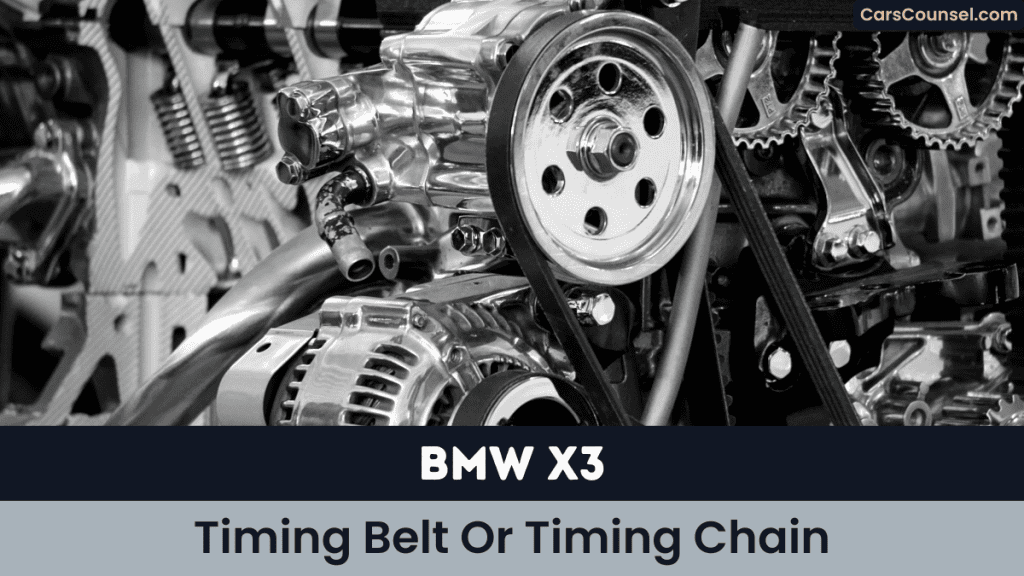
All U.S.-market BMW X3 models across all three generations use a timing chain. No U.S.-spec X3 engine has used a rubber timing belt at any production year.
Engine oil maintenance is the primary service variable affecting timing component longevity across all variants.
Quick Navigation
Does the BMW X3 Have a Timing Belt or Timing Chain?
All U.S.-market BMW X3 models from 2004 through 2024 use a timing chain. This applies to every engine variant across all three generations. No U.S.-spec X3 has ever used a timing belt.
2024 BMW X3 Timing Belt Or Timing Chain
| Engine Option | Timing System | Interference Engine | Replacement Interval | Maintenance Notes |
|---|---|---|---|---|
| 2.0L TwinPower Turbo 4-Cyl (B48B20), xDrive30i, 248 hp | Timing Chain | Not officially published | No scheduled interval | Chain-driven timing; oil maintenance is primary service factor |
| 3.0L TwinPower Turbo Inline-6 (B58B30), M40i, 382 hp | Timing Chain | Not officially published | No scheduled interval | Same chain-based timing architecture as xDrive30i |
| 3.0L TwinPower Turbo Inline-6 (S58B30), X3 M / M Competition | Timing Chain | Not officially published | No scheduled interval | High-output S58 uses same chain-based architecture as B58 family |
All three 2024 engine variants use timing chains without a manufacturer-published replacement interval. Consistent use of BMW-approved full-synthetic oil is the primary maintenance action for chain longevity across B48, B58, and S58 applications.
2023 BMW X3 Timing Belt Or Timing Chain
| Engine Option | Timing System | Interference Engine | Replacement Interval | Maintenance Notes |
|---|---|---|---|---|
| 2.0L TwinPower Turbo 4-Cyl (B48B20), xDrive30i, 248 hp | Timing Chain | Not officially published | No scheduled interval | Same timing system as previous model year |
| 3.0L TwinPower Turbo Inline-6 (B58B30), M40i, 382 hp | Timing Chain | Not officially published | No scheduled interval | Same timing system as previous model year |
| 3.0L TwinPower Turbo Inline-6 (S58B30), X3 M / M Competition | Timing Chain | Not officially published | No scheduled interval | Same timing system as previous model year |
All three engine options carry over from the 2022 model year without changes to the timing assembly. No replacement interval applies to any chain-equipped X3 variant under standard service conditions.
2022 BMW X3 Timing Belt Or Timing Chain
| Engine Option | Timing System | Interference Engine | Replacement Interval | Maintenance Notes |
|---|---|---|---|---|
| 2.0L TwinPower Turbo 4-Cyl (B48B20), xDrive30i, 248 hp | Timing Chain | Not officially published | No scheduled interval | G01 LCI refresh year; timing assembly unchanged |
| 3.0L TwinPower Turbo Inline-6 (B58B30), M40i, 382 hp | Timing Chain | Not officially published | No scheduled interval | M40i power increased to 382 hp with updated B58; chain configuration unchanged |
| 3.0L TwinPower Turbo Inline-6 (S58B30), X3 M / M Competition | Timing Chain | Not officially published | No scheduled interval | Same timing system as previous model year |
The 2022 model year introduced the G01 LCI refresh, with the M40i receiving an updated B58 engine producing 382 hp. Timing chain configuration remained unchanged across all three engine options.
2021 BMW X3 Timing Belt Or Timing Chain
| Engine Option | Timing System | Interference Engine | Replacement Interval | Maintenance Notes |
|---|---|---|---|---|
| 2.0L TwinPower Turbo 4-Cyl (B48B20), xDrive30i, 248 hp | Timing Chain | Not officially published | No scheduled interval | Same timing system as previous model year |
| 3.0L TwinPower Turbo Inline-6 (B58B30), M40i, 355 hp | Timing Chain | Not officially published | No scheduled interval | Same timing system as previous model year |
| 3.0L TwinPower Turbo Inline-6 (S58B30), X3 M / M Competition | Timing Chain | Not officially published | No scheduled interval | Same timing system as previous model year |
Timing components carry over unchanged across all three engine variants from the 2020 model year. Oil maintenance frequency is the primary variable affecting timing chain condition on B48, B58, and S58 applications.
2020 BMW X3 Timing Belt Or Timing Chain
| Engine Option | Timing System | Interference Engine | Replacement Interval | Maintenance Notes |
|---|---|---|---|---|
| 2.0L TwinPower Turbo 4-Cyl (B48B20), xDrive30i, 248 hp | Timing Chain | Not officially published | No scheduled interval | Same timing system as previous model year |
| 3.0L TwinPower Turbo Inline-6 (B58B30), M40i, 355 hp | Timing Chain | Not officially published | No scheduled interval | Same timing system as previous model year |
| 3.0L TwinPower Turbo Inline-6 (S58B30), X3 M / M Competition | Timing Chain | Not officially published | No scheduled interval | First U.S. model year for X3 M; S58 uses same chain architecture as B58 family |
The 2020 model year added the X3 M and X3 M Competition to the U.S. lineup. The S58B30 uses the same chain-based timing architecture as the B58 family. No manufacturer-published replacement interval applies to the S58 timing chain.
2019 BMW X3 Timing Belt Or Timing Chain
| Engine Option | Timing System | Interference Engine | Replacement Interval | Maintenance Notes |
|---|---|---|---|---|
| 2.0L TwinPower Turbo 4-Cyl (B48B20), xDrive30i, 248 hp | Timing Chain | Not officially published | No scheduled interval | Same timing system as previous model year |
| 3.0L TwinPower Turbo Inline-6 (B58B30), M40i, 355 hp | Timing Chain | Not officially published | No scheduled interval | Same timing system as previous model year |
Same timing systems as the 2018 model year across both engine options. The B48 and B58 timing chains are designed as lifetime components with no scheduled replacement interval under standard operating conditions.
2018 BMW X3 Timing Belt Or Timing Chain
| Engine Option | Timing System | Interference Engine | Replacement Interval | Maintenance Notes |
|---|---|---|---|---|
| 2.0L TwinPower Turbo 4-Cyl (B48B20), xDrive30i, 248 hp | Timing Chain | Not officially published | No scheduled interval | First model year of G01 generation in U.S. market; B48 replaced N20 from F25 |
| 3.0L TwinPower Turbo Inline-6 (B58B30), M40i, 355 hp | Timing Chain | Not officially published | No scheduled interval | B58 replaced N55 from prior generation; chain-based timing retained |
The 2018 model year launched the G01-generation X3 in the U.S. The B48 and B58 engines replaced the N20 and N55 from the F25 generation, with timing chain configurations carried over in both applications.
2017 BMW X3 Timing Belt Or Timing Chain
| Engine Option | Timing System | Interference Engine | Replacement Interval | Maintenance Notes |
|---|---|---|---|---|
| 2.0L TwinPower Turbo 4-Cyl (N20B20), xDrive28i, 240 hp | Timing Chain | Not officially published | No scheduled interval | Same timing system as previous model year; final year of F25 generation |
| 3.0L TwinPower Turbo Inline-6 (N55B30), xDrive35i, 300 hp | Timing Chain | Not officially published | No scheduled interval | Same timing system as previous model year; final year of N55 in U.S. X3 |
The 2017 model year was the final production year for the F25-generation X3 in the U.S. Both engine options continued with unchanged chain-driven timing assemblies, with the G01 generation succeeding for 2018.
2016 BMW X3 Timing Belt Or Timing Chain
| Engine Option | Timing System | Interference Engine | Replacement Interval | Maintenance Notes |
|---|---|---|---|---|
| 2.0L TwinPower Turbo 4-Cyl (N20B20), xDrive28i, 240 hp | Timing Chain | Not officially published | No scheduled interval | Same timing system as previous model year |
| 3.0L TwinPower Turbo Inline-6 (N55B30), xDrive35i, 300 hp | Timing Chain | Not officially published | No scheduled interval | Same timing system as previous model year |
No timing system changes occurred for either engine option in 2016. Both N20 and N55 timing chains are treated as lifetime components with no manufacturer-published replacement interval under standard conditions.
2015 BMW X3 Timing Belt Or Timing Chain
| Engine Option | Timing System | Interference Engine | Replacement Interval | Maintenance Notes |
|---|---|---|---|---|
| 2.0L TwinPower Turbo 4-Cyl (N20B20), xDrive28i, 240 hp | Timing Chain | Not officially published | No scheduled interval | Same timing system as previous model year |
| 3.0L TwinPower Turbo Inline-6 (N55B30), xDrive35i, 300 hp | Timing Chain | Not officially published | No scheduled interval | Same timing system as previous model year |
Timing chain components are unchanged from the 2014 model year for both engine options. Cold-start chain rattle on the N20B20 is a documented service concern to monitor on higher-mileage F25 examples.
2014 BMW X3 Timing Belt Or Timing Chain
| Engine Option | Timing System | Interference Engine | Replacement Interval | Maintenance Notes |
|---|---|---|---|---|
| 2.0L TwinPower Turbo 4-Cyl (N20B20), xDrive28i, 240 hp | Timing Chain | Not officially published | No scheduled interval | Same timing system as previous model year |
| 3.0L TwinPower Turbo Inline-6 (N55B30), xDrive35i, 300 hp | Timing Chain | Not officially published | No scheduled interval | Same timing system as previous model year |
Same timing systems as the 2013 model year for both engine options. The N20 has a documented service history related to timing chain tensioner wear that becomes more prevalent as mileage increases.
2013 BMW X3 Timing Belt Or Timing Chain
| Engine Option | Timing System | Interference Engine | Replacement Interval | Maintenance Notes |
|---|---|---|---|---|
| 2.0L TwinPower Turbo 4-Cyl (N20B20), xDrive28i, 240 hp | Timing Chain | Not officially published | No scheduled interval | Same timing system as previous model year |
| 3.0L TwinPower Turbo Inline-6 (N55B30), xDrive35i, 300 hp | Timing Chain | Not officially published | No scheduled interval | Same timing system as previous model year |
Timing assemblies carry over without change from the 2012 specification for both the N20 and N55 engines. Oil quality and change frequency remain the primary factors affecting chain and tensioner longevity on both engine families.
2012 BMW X3 Timing Belt Or Timing Chain
| Engine Option | Timing System | Interference Engine | Replacement Interval | Maintenance Notes |
|---|---|---|---|---|
| 2.0L TwinPower Turbo 4-Cyl (N20B20), xDrive28i, 240 hp | Timing Chain | Not officially published | No scheduled interval | Same timing system as previous model year |
| 3.0L TwinPower Turbo Inline-6 (N55B30), xDrive35i, 300 hp | Timing Chain | Not officially published | No scheduled interval | Same timing system as previous model year |
Same timing systems as the 2011 model year for both the N20 and N55. Consistent full-synthetic oil changes at BMW-specified intervals support long-term timing chain reliability across both F25 engine options.
2011 BMW X3 Timing Belt Or Timing Chain
| Engine Option | Timing System | Interference Engine | Replacement Interval | Maintenance Notes |
|---|---|---|---|---|
| 2.0L TwinPower Turbo 4-Cyl (N20B20), xDrive28i, 240 hp | Timing Chain | Not officially published | No scheduled interval | First model year of F25 generation in U.S.; N20 four-cylinder introduced |
| 3.0L TwinPower Turbo Inline-6 (N55B30), xDrive35i, 300 hp | Timing Chain | Not officially published | No scheduled interval | First model year of N55 in U.S. X3; single-turbo chain-driven system |
The 2011 model year launched the F25-generation X3 in the U.S., introducing the turbocharged N20 and N55 engines. Both use chain-driven timing systems with no manufacturer-scheduled replacement interval.
2010 BMW X3 Timing Belt Or Timing Chain
| Specification | Detail |
|---|---|
| Engine Option(s) | 3.0L Inline-6 (N52B30), 260 hp |
| Timing System | Timing Chain |
| Interference Engine | Not officially published |
| Replacement Interval | No scheduled replacement interval |
| Maintenance Notes | Final model year of E83 generation in U.S. market; same timing system as prior year |
The 2010 model year closed the E83 production run for the U.S. X3. The N52B30 timing chain continued without modification from prior years. No manufacturer-published replacement interval applies to this engine.
2009 BMW X3 Timing Belt Or Timing Chain
| Specification | Detail |
|---|---|
| Engine Option(s) | 3.0L Inline-6 (N52B30), 260 hp |
| Timing System | Timing Chain |
| Interference Engine | Not officially published |
| Replacement Interval | No scheduled replacement interval |
| Maintenance Notes | Same timing system as previous model year |
No timing system changes occurred for 2009. The N52B30 uses chain-driven Valvetronic variable valve lift alongside Double VANOS. Oil maintenance is the primary preventive service measure for timing chain longevity on this engine.
2008 BMW X3 Timing Belt Or Timing Chain
| Specification | Detail |
|---|---|
| Engine Option(s) | 3.0L Inline-6 (N52B30), 260 hp |
| Timing System | Timing Chain |
| Interference Engine | Not officially published |
| Replacement Interval | No scheduled replacement interval |
| Maintenance Notes | Same timing system as previous model year |
Timing hardware carries over unchanged from the 2007 specification. The N52B30 uses a chain-based Valvetronic system with no scheduled replacement interval. Standard oil maintenance practices apply to this engine family.
2007 BMW X3 Timing Belt Or Timing Chain
| Specification | Detail |
|---|---|
| Engine Option(s) | 3.0L Inline-6 (N52B30), 260 hp |
| Timing System | Timing Chain |
| Interference Engine | Not officially published |
| Replacement Interval | No scheduled replacement interval |
| Maintenance Notes | N52B30 replaced M54 engines for this year; Valvetronic and Double VANOS introduced |
The 2007 model year introduced the N52B30 to the U.S. X3, replacing the M54 family and adding Valvetronic variable valve lift technology. The N52 uses a chain-driven timing system throughout, with no published replacement schedule.
2006 BMW X3 Timing Belt Or Timing Chain
| Engine Option | Timing System | Interference Engine | Replacement Interval | Maintenance Notes |
|---|---|---|---|---|
| 2.5L Inline-6 (M54B25), X3 2.5i, 184 hp | Timing Chain | Not officially published | No scheduled interval | Final model year for 2.5i variant in U.S. market |
| 3.0L Inline-6 (M54B30), X3 3.0i, 225 hp | Timing Chain | Not officially published | No scheduled interval | Final model year for 3.0i variant in U.S. market; N52 replaces M54 for 2007 |
The 2006 model year was the last year for both the 2.5i and 3.0i variants in the U.S. Both M54-family engines use conventional roller timing chains with Double VANOS. No replacement interval applies under standard service conditions.
2005 BMW X3 Timing Belt Or Timing Chain
| Engine Option | Timing System | Interference Engine | Replacement Interval | Maintenance Notes |
|---|---|---|---|---|
| 2.5L Inline-6 (M54B25), X3 2.5i, 184 hp | Timing Chain | Not officially published | No scheduled interval | Same timing system as previous model year |
| 3.0L Inline-6 (M54B30), X3 3.0i, 225 hp | Timing Chain | Not officially published | No scheduled interval | Same timing system as previous model year |
Same timing systems as the 2004 model year for both M54B25 and M54B30 engine options. The M54 family uses Double VANOS variable valve timing on both intake and exhaust camshafts, driven entirely by the timing chain.
2004 BMW X3 Timing Belt Or Timing Chain
| Engine Option | Timing System | Interference Engine | Replacement Interval | Maintenance Notes |
|---|---|---|---|---|
| 2.5L Inline-6 (M54B25), X3 2.5i, 184 hp | Timing Chain | Not officially published | No scheduled interval | First U.S. model year; chain-driven Double VANOS timing from launch |
| 3.0L Inline-6 (M54B30), X3 3.0i, 225 hp | Timing Chain | Not officially published | No scheduled interval | First U.S. model year; M54B30 uses same chain-based Double VANOS system |
The 2004 model year was the first U.S. X3, launched with two M54-family engine options. Both used chain-driven timing systems from initial production. No timing belt was present in either engine configuration.
Timing Belt vs Timing Chain on the BMW X3
A timing belt is a reinforced rubber component that synchronizes crankshaft and camshaft rotation. It requires scheduled replacement at manufacturer-defined mileage intervals due to age- and material-related degradation. No U.S.-market BMW X3 has ever used a timing belt as a factory component.
A timing chain performs the same synchronization function using a metal link assembly lubricated by the engine oil circuit. It is engineered to last the engine’s full service life under normal operating conditions. All BMW X3 models from 2004 through 2024 use this system exclusively.
Timing belts require proactive replacement regardless of visible condition, typically between 60,000 and 100,000 miles depending on the application. Timing chains carry no scheduled replacement interval but depend on oil quality and change frequency for long-term performance. The maintenance approach and cost profile differ significantly between the two systems.
Timing belt replacement typically costs between $400 and $900 including labor. When timing chain replacement becomes necessary on a BMW X3, costs are considerably higher due to engine disassembly requirements. Both systems produce audible rattling or ticking from the front of the engine when internal wear becomes significant.
BMW X3 Timing System Maintenance
All U.S.-market BMW X3 engines use timing chains with no manufacturer-published replacement interval. BMW classifies these chains as lifetime components under standard operating and maintenance conditions. Replacement is warranted only when inspection findings or operational symptoms confirm degradation of timing components.
Cold-start rattling from the front of the engine that clears within seconds of startup is the primary symptom of timing chain tensioner or guide wear. This condition is most frequently documented on the N20B20-equipped F25 generation but can occur across all engine families at higher mileage.
Engine oil quality and change frequency are the most critical variables affecting timing chain service life across all X3 generations. BMW specifies full-synthetic engine oil for all X3 variants. Degraded or low-level oil reduces tensioner hydraulic performance and increases chain wear rates over time.
When chain replacement becomes necessary, the repair requires partial engine disassembly and is labor-intensive across all X3 engine families. Total cost including parts and labor typically ranges from $1,000 to $2,500 or more depending on engine variant, extent of component wear, and shop labor rates.
| Factor | Timing Belt | Timing Chain |
|---|---|---|
| Material | Reinforced rubber | Metal link assembly |
| Scheduled Replacement | Yes, mileage-based | No scheduled interval |
| Oil Dependency | Low | High |
| Common Failure Symptom | Often none before failure | Cold-start rattle |
| Applies to BMW X3 | No | Yes, all years (2004-2024) |
If you’re researching whether a BMW uses a timing belt or timing chain, be sure to explore our detailed guides on models like the BMW X5, BMW Z4, BMW Z3, and BMW 328i. Knowing your vehicle’s timing system is important for maintenance planning, repair cost awareness, and long-term engine reliability. Our expert resources explain timing belt vs timing chain setups by model, common replacement intervals, warning signs of wear, and what owners should know to avoid costly engine damage.
Frequently Asked Questions
Does the BMW X3 have a timing belt or chain? All U.S.-market BMW X3 models from 2004 through 2024 use a timing chain. No production year or engine variant has used a timing belt.
When should a BMW X3 timing belt be replaced? The BMW X3 does not use a timing belt. No belt replacement interval applies to any U.S.-market X3 engine variant across any model year.
Does the BMW X3 timing chain need maintenance? No scheduled replacement interval exists for any X3 timing chain. Consistent full-synthetic oil changes are the primary preventive measure for chain and tensioner longevity.
Is the BMW X3 an interference engine? BMW does not officially publish interference engine status for U.S. X3 engines in consumer-facing documentation. This designation is not listed in the owner’s manual or standard maintenance schedules.
How much does BMW X3 timing chain replacement cost? Timing chain replacement on a BMW X3 typically ranges from $1,000 to $2,500 or more, depending on engine variant, extent of component wear, and shop labor rates.
Which BMW X3 generation has the most timing chain concerns? The F25 generation N20B20 engine has a documented history of timing chain tensioner and guide wear at higher mileage. Consistent oil maintenance reduces this risk across all F25 variants.
Conclusion
All U.S.-market BMW X3 models from 2004 through 2024 use a timing chain. This applies across all three generations and all engine variants, from the M54 inline-6 in the original E83 to the B48, B58, and S58 engines in the current G01 lineup.
Owners should prioritize consistent oil maintenance as the primary action for preserving timing chain condition across all generations. The F25 N20B20 engine warrants additional attention for cold-start rattle symptoms as mileage accumulates on this platform.
Always verify timing system details using the owner’s manual or manufacturer service information before scheduling repairs.