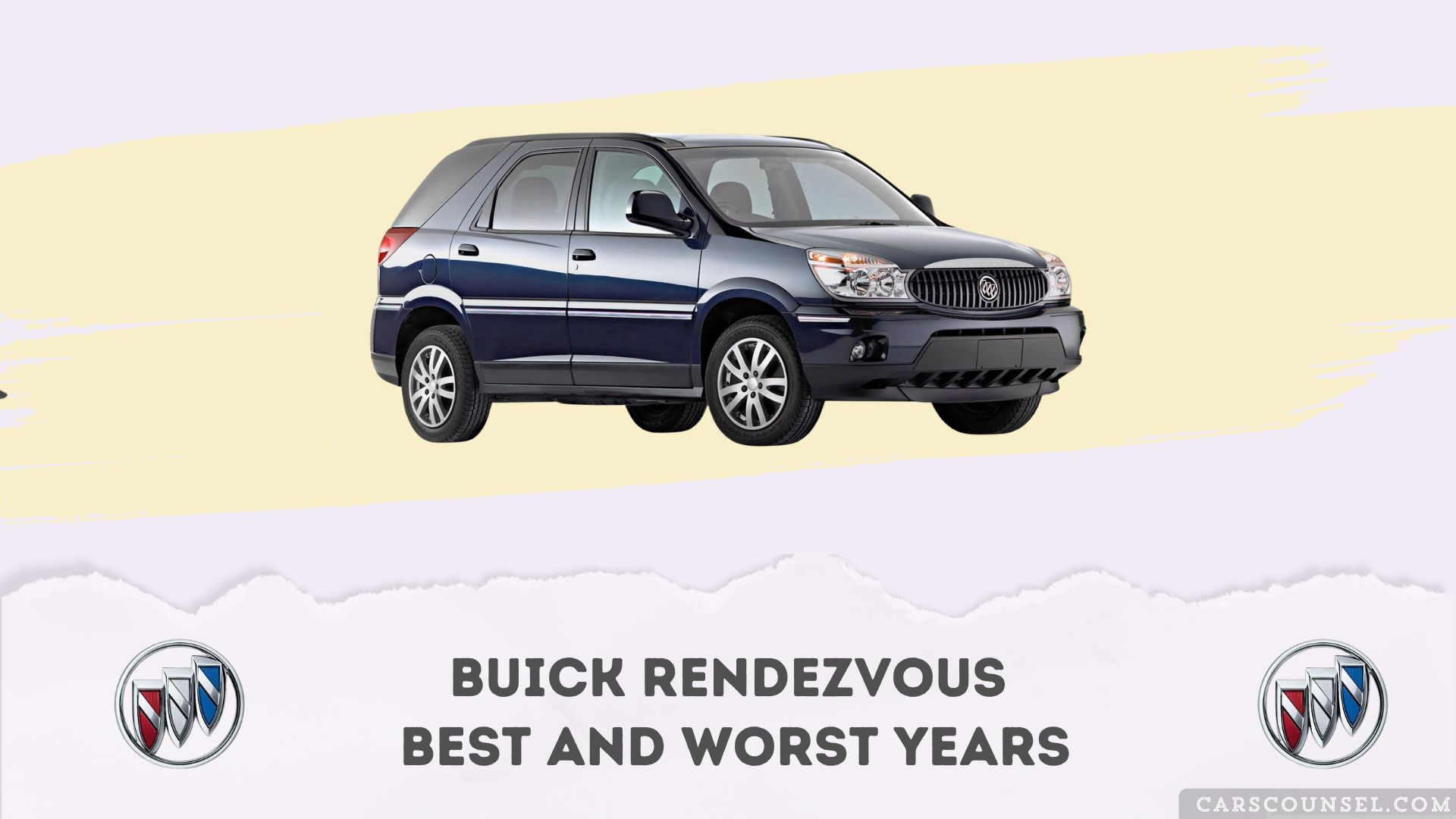
The 2006 and 2007 Buick Rendezvous model years are the best choices for used buyers. These final production years feature the most refined versions of the crossover and consistently record the lowest frequency of major powertrain complaints.
Rankings are comparative, meaning no used Rendezvous is entirely flawless. Routine maintenance, overall condition, and rust protection remain critical factors for any older GM vehicle.
Meaningful differences exist between configurations, particularly the 3.4L and 3.5L pushrod V6 engines versus the 3.6L DOHC V6. Understanding these powertrain distinctions is essential before making a purchase.
Quick Navigation
Best and Worst Buick Rendezvous Years at a Glance
| Model Year | Verdict | Main Reason | Buyer Guidance |
|---|---|---|---|
| 2002 | Avoid | High rate of engine and transmission failures | Look for newer models instead |
| 2003 | Avoid | Persistent intake gasket and shifting issues | Prioritize 2006 or 2007 models |
| 2004 | Avoid | Mixed powertrain reliability and high complaints | Verify complete engine service history |
| 2005 | Approach Carefully | Fewer complaints than early years but residual risks | Confirm intake gasket replacement |
| 2006 | Best Choice | Refined final-generation build with fewer defects | Check ABS and transmission health |
| 2007 | Best Choice | Lowest complaint volume and most mature platform | Inspect maintenance records closely |
Key Takeaways
- The 2006 and 2007 model years are the strongest choices for a used Rendezvous.
- Buyers should generally avoid the 2002 through 2004 model years due to powertrain vulnerabilities.
- The 3.4L and 3.5L V6 engines are notorious for intake manifold gasket failures that mix coolant and oil.
- The 3.6L V6 avoids the gasket issue but requires strict oil change intervals to prevent timing chain stretch.
- Transmission pressure control solenoid failures are common across most years and require prompt attention.
- ABS and traction control warning lights frequently indicate a failed wheel hub assembly sensor.
- Always verify the VIN for open recalls and arrange an independent pre-purchase inspection.
How We Evaluated the Buick Rendezvous Model Years
Our analysis considers official NHTSA recalls, manufacturer service campaigns, consumer complaint patterns, and powertrain evolution across the single generation. We evaluate the severity, recurrence, and repair complexity of reported issues.
Consumer complaints are not confirmed failure rates, and a recall does not automatically make a vehicle unreliable. Older vehicles naturally accumulate more reports, while recent models have less long-term exposure data. “Best” indicates comparatively stronger ownership experiences, not a flawless vehicle.
Best Buick Rendezvous Years
2006 – 2007: Best Choice
The 2006 and 2007 model years represent the final iteration of the Rendezvous. By this point, GM had addressed many early-production U-body platform quirks, resulting in a more mature and reliable vehicle.
These years standardize the 3.5L V6, which benefits from updated gasket materials compared to the earlier 3.4L. The optional 3.6L V6 is also available for buyers seeking more power. Complaint volumes for 2006 and 2007 are significantly lower than the early years.
Buyers should still inspect the transmission shifting behavior and test the ABS system, as electrical and sensor issues can still occur in high-mileage examples.
Best Year by Buyer Type
Best Overall: 2007 Buick Rendezvous
As the final year of production, the 2007 model benefits from a decade of platform refinements. It records the lowest complaint totals and offers the most predictable ownership experience among all model years.
Best Budget Option: 2006 Buick Rendezvous
The 2006 model shares most of the 2007’s improvements but often carries a slightly lower market price. It remains a solid choice if a thorough maintenance history is documented.
Years to Approach Carefully
2005: Approach Carefully
The 2005 model year sits between the problematic early releases and the refined final years. Complaint volumes drop compared to 2002–2004, but the 3.5L engine remains susceptible to intake manifold gasket degradation if the updated parts were never installed.
Buyers considering a 2005 Rendezvous must verify whether the lower intake gaskets have been replaced with updated Fel-Pro or OEM equivalents. If the repair history is unknown, budget for the gasket replacement and inspect the coolant for oil contamination.
Worst Buick Rendezvous Years
2002 – 2004: Avoid
The first three model years of the Rendezvous are plagued by higher frequencies of severe engine and transmission complaints. The 3.4L V6 engine in the 2002 and 2003 models is particularly vulnerable to lower intake manifold gasket failures.
When these gaskets fail, coolant and engine oil can mix, leading to catastrophic engine damage if not caught immediately. The 2004 model year introduces new engine options but still suffers from early-production electrical issues and harsh transmission shifting.
Because the repair costs for engine and transmission failures often exceed the current market value of these older vehicles, buyers are better served by seeking a 2006 or 2007 example.
Buick Rendezvous Reliability by Generation
The Buick Rendezvous was produced for a single generation spanning the 2002 through 2007 model years. It rides on the GM U-body platform, sharing its underlying architecture with the Pontiac Aztek and several GM minivans.
While the exterior and interior received minor refreshes, the major reliability shifts occurred under the hood. The transition from the 3.4L to the 3.5L V6 improved displacement, though both pushrod engines share the same intake gasket design flaws.
The introduction of the 3.6L DOHC V6 provided a more modern alternative, but it introduced timing chain stretch concerns if oil changes were neglected. Understanding which engine is equipped in a specific trim is vital for predicting maintenance needs.
Common Buick Rendezvous Problems
Engine Problems
The most notorious issue affecting the 3.4L and 3.5L V6 engines is lower intake manifold gasket failure. The original composite gaskets degrade over time, allowing coolant to leak externally or mix with the engine oil internally.
Symptoms include low coolant levels, a milky substance on the oil dipstick, and overheating. If coolant enters the oil passages, it can destroy the engine bearings. Replacing the gaskets with updated, reinforced versions is a mandatory preventative repair.
The 3.6L V6 avoids the gasket issue but is known for timing chain stretch. This is usually caused by infrequent oil changes or the use of incorrect oil viscosity, leading to misfires and check engine lights.
Transmission Problems
Most Rendezvous models are equipped with the GM 4T65-E four-speed automatic transmission. A frequent failure point is the transmission pressure control solenoid.
When this solenoid fails, owners report harsh shifting, slipping between gears, or a sudden loss of drive. While the solenoid itself is relatively inexpensive, accessing it requires dropping the transmission pan and, in some cases, partial removal of the transmission.
ABS and Traction Control Issues
The wheel speed sensors are integrated directly into the front and rear wheel hub assemblies. Moisture intrusion and wiring degradation frequently cause these sensors to fail.
A failed sensor will trigger the ABS and “Service Traction System” warning lights on the dashboard. Fixing this requires replacing the entire wheel hub assembly, which is a moderately expensive but straightforward repair.
Repair-Cost Overview
| Problem | Commonly Affected Years | Approximate Repair Range | Important Notes |
|---|---|---|---|
| Intake Manifold Gasket | 2002 – 2005 | $750 – $1,000 | Must use updated gasket design |
| Transmission Solenoid | 2002 – 2007 | $400 – $700 | Requires transmission fluid service |
| Wheel Hub Assembly (ABS) | 2002 – 2007 | $300 – $500 per wheel | Replaces integrated speed sensor |
Repair costs vary significantly by region, labor rates, parts choice, and whether the work is performed at a dealership or an independent shop.
What to Check Before Buying a Used Buick Rendezvous
- Verify the VIN for any open NHTSA recalls and ensure they were completed.
- Check the engine oil and coolant for signs of mixing, which indicates intake gasket failure.
- Review service records to confirm the intake manifold gaskets were replaced with updated parts.
- Inspect the transmission fluid for burnt smells and test drive for harsh or slipping shifts.
- Scan the OBD-II port for hidden ABS or traction control codes.
- Test all power windows and interior electronics, as switch failures are common.
- Inspect the rear wheel arches and subframe for structural rust.
- Arrange an independent pre-purchase inspection to verify the condition of the wheel hubs and suspension.
Related Buying Guides
- Pontiac Aztek best and worst years: The Rendezvous shares its U-body platform with this controversial but mechanically similar GM crossover.
- Buick Enclave years to avoid: Buyers needing more modern three-row passenger space often look to the larger Enclave as a family alternative.
- Buick Encore years to avoid: For those who prefer a smaller, more fuel-efficient footprint, the subcompact Encore offers a different Buick ownership experience.
Frequently Asked Questions
What is the best year to buy a Buick Rendezvous?
The 2007 model year is the best choice. As the final year of production, it benefits from the most factory refinements and records the lowest volume of owner complaints regarding major powertrain failures.
What is the worst year for the Buick Rendezvous?
The 2002 model year is widely considered the worst. It suffers from the highest concentration of severe engine and transmission complaints, particularly regarding the 3.4L V6 intake manifold gasket failures.
Do Buick Rendezvous models have transmission problems?
Yes, the 4T65-E automatic transmission is prone to pressure control solenoid failures. This can cause harsh shifting, slipping, or erratic gear changes, requiring internal transmission service to repair.
Why is my ABS and Traction Control light on?
These warning lights usually indicate a failed wheel speed sensor. Because the sensor is built into the wheel hub assembly, fixing the issue requires replacing the entire hub on the affected corner.
How long can a Buick Rendezvous last?
A well-maintained Rendezvous can reach high mileage, but longevity depends heavily on addressing the intake gasket and transmission issues early. Rust and neglected maintenance will drastically shorten the vehicle’s lifespan.
Is the Buick Rendezvous a reliable SUV?
The Rendezvous has a mixed reliability record. The 2006 and 2007 models are comparatively favorable, while earlier years require careful inspection and immediate preventative maintenance to remain dependable.
Which Buick Rendezvous Year Should You Buy?
Target the 2006 and 2007 model years for the most reliable ownership experience. These final production years offer the best balance of mature engineering and lower complaint volumes.
Avoid the 2002 through 2004 models due to widespread engine and transmission vulnerabilities. Regardless of the year, verify the intake gasket service history and always complete a thorough pre-purchase inspection.

