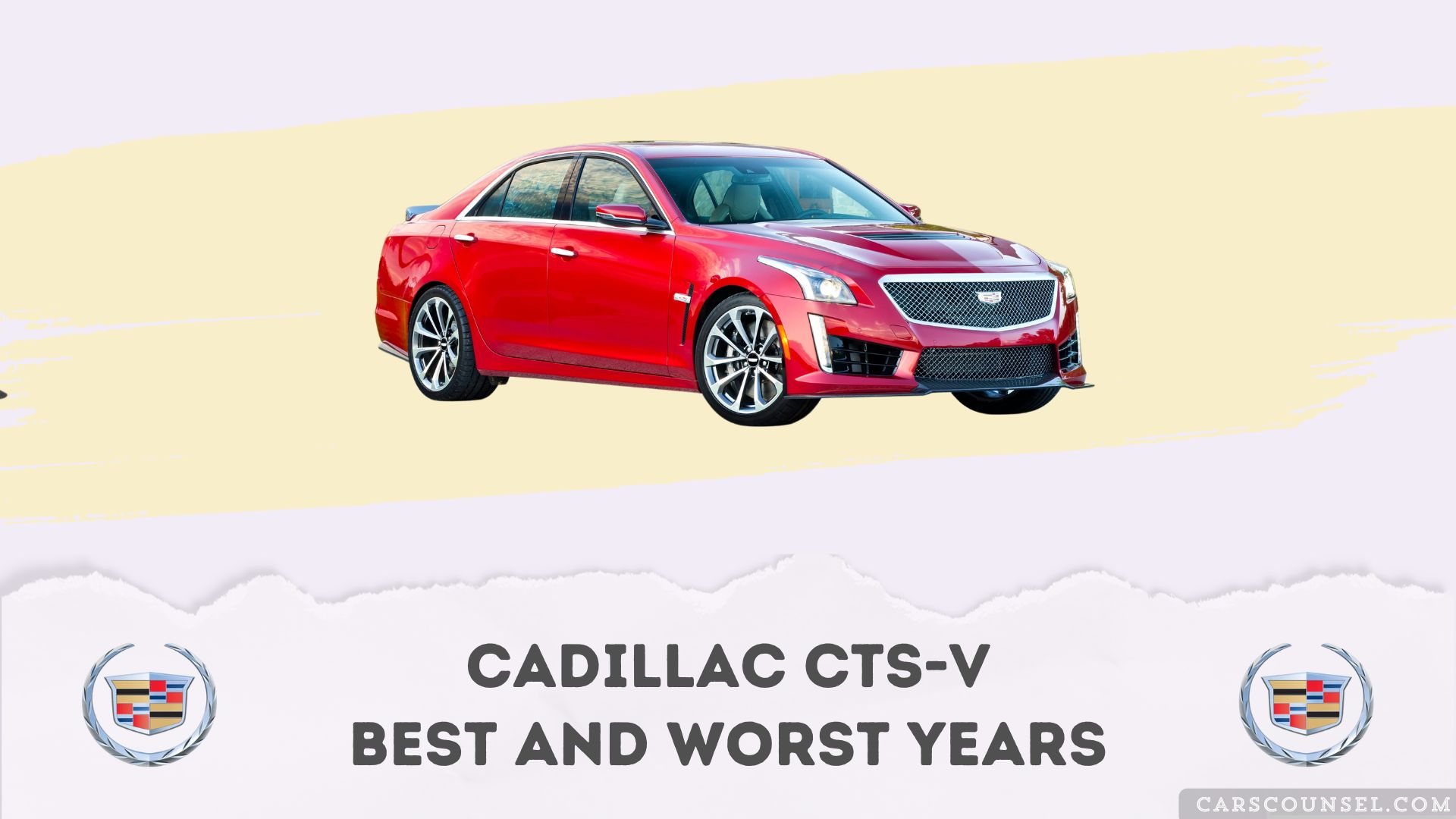
The best Cadillac CTS-V years are 2012-2015 and 2018-2019, offering updated supercharger components and refined transmissions. Buyers should approach the 2006-2007 models carefully due to engine oil consumption issues.
Rankings are comparative. No high-performance vehicle is flawless, and long-term reliability heavily depends on strict maintenance, previous ownership, and current condition.
The CTS-V exclusively uses V8 engines. Buyers must verify they are looking at a true V-Series model, as standard CTS sedans use different engines with distinct reliability patterns.
Quick Navigation
Best and Worst Cadillac CTS-V Years at a Glance
| Model Year | Verdict | Main Reason | Buyer Guidance |
|---|---|---|---|
| 2004-2005 | Best Enthusiast Choice | Iconic LS6 V8 | Inspect differential and clutch |
| 2006-2007 | Approach Carefully | LS2 V8 oil consumption | Check for blue smoke and oil records |
| 2009-2011 | Good With Inspection | Early LSA supercharger wear | Listen for isolator rattle |
| 2012-2015 | Best Choice | Refined LSA V8 | Budget for MagneRide shocks |
| 2016-2017 | Good With Inspection | 8L90 transmission shudder | Verify fluid flush or TC replacement |
| 2018-2019 | Best Late-Generation Choice | Final production updates | Check for carbon buildup |
Key Takeaways
- The CTS-V is strictly a V8 performance vehicle; it never left the factory with a V6.
- The 2012-2015 and 2018-2019 model years offer the most refined ownership experiences.
- Early second-generation models require inspection for supercharger bearing wear.
- Third-generation models are known for specific 8-speed transmission shudder issues.
- Always verify the VIN to ensure the vehicle is a genuine V-Series.
- Magnetic Ride Control shocks are a wear item on all generations and are expensive to replace.
How We Evaluated the Cadillac CTS-V Model Years
We analyzed NHTSA records, manufacturer service campaigns, and enthusiast community data to separate genuine CTS-V issues from standard CTS problems.
Complaints are not failure rates, and a recall does not automatically make a year unreliable.
Because the CTS-V is a low-volume performance car, long-term data relies heavily on specialized repair records and technical service bulletins.
Best Cadillac CTS-V Years
2012-2015 (Best Choice)
These years represent the peak of the second generation. The 6.2L supercharged LSA V8 received internal updates to address early supercharger wear.
MagneRide shock absorbers remain a known expensive wear item across all Gen 2 models, so budget accordingly.
2018-2019 (Best Late-Generation Choice)
These are the final production years of the CTS-V. The 640-horsepower LT4 V8 is robust, and most 8L90 transmission shudder issues were addressed via factory updates.
They represent the most modern and track-capable iterations of the nameplate.
2004-2005 (Best Enthusiast Choice)
These models feature the iconic 5.7L LS6 V8 and a six-speed manual transmission. They are highly sought after by collectors.
However, they require careful inspection of the rear differential, wheel bearings, and clutch condition due to their age.
Best Year by Buyer Type
- Best Overall: 2014. This year offers the best balance of second-generation refinement, updated supercharger components, and comprehensive luxury features.
- Best Enthusiast Choice: 2004-2005. The raw, naturally aspirated LS6 V8 and manual transmission provide a pure driving experience that modern cars cannot replicate.
- Best Modern Alternative: 2019. The final model year delivers 640 horsepower, carbon fiber aerodynamics, and the most sorted 8-speed automatic transmission.
Years to Approach Carefully
2009-2011 (Good With Inspection)
Early second-generation models use the 6.2L LSA V8. These engines are prone to supercharger isolator rattle and nose cone bearing wear.
Listen carefully for a distinct rattle at idle. If present, the supercharger snout may require rebuilding or replacement.
2016-2017 (Good With Inspection)
These third-generation models introduced the 8L90 8-speed automatic transmission. Early versions are prone to torque converter shudder, often described as a “rumble strip” sensation.
Verify if the specialized fluid flush (TSB 18-NA-355) or a torque converter replacement has already been performed.
Worst Cadillac CTS-V Years
2006-2007 (Approach Carefully)
These first-generation models switched to the 6.0L LS2 V8. This engine is known for piston ring issues that lead to excessive oil consumption.
Blue smoke on acceleration and frequent oil top-offs are common symptoms. An engine teardown or piston ring replacement is often required.
Cadillac CTS-V Reliability by Generation
First Generation (2004-2007)
Built on the Sigma platform, these cars feature robust LS V8 engines. However, aging rubber components, wheel bearings, and rear differential bushings require attention.
Second Generation (2009-2015)
This generation introduced the supercharged LSA V8 and Magnetic Ride Control. While the powertrain is potent, the supercharger bearings and MagneRide shocks are known wear items.
Third Generation (2016-2019)
The third generation moved to the Alpha platform, sharing related architecture with the smaller Cadillac ATS. It features the LT4 V8 and an 8-speed automatic, though early transmission tuning caused shudder issues.
Common Cadillac CTS-V Problems
Supercharger Isolator and Bearing Wear
Affecting 2009-2015 models, the LSA supercharger can develop a rattle at idle due to isolator spring wear or nose cone bearing failure.
If ignored, bearing contamination can damage the supercharger internals, requiring an expensive rebuild or replacement.
Transmission Shudder
The 2016-2017 models with the 8L90 transmission often experience a shudder during light acceleration between 20 and 45 mph.
This is typically caused by moisture contamination in the transmission fluid. A specialized fluid flush often resolves the issue, though severe cases require a new torque converter.
Magnetic Ride Control Leaks
Affecting second and third-generation models, the MagneRide shock absorbers are prone to leaking fluid as they age.
OEM replacement shocks are highly expensive, leading some owners to install aftermarket coilover suspensions, which alters the factory ride quality.
Oil Consumption
The 2006-2007 models with the 6.0L LS2 V8 suffer from defective piston rings that allow oil to enter the combustion chamber.
This leads to fouled spark plugs, catalytic converter damage, and the need for a costly engine rebuild.
Rear Differential Wear
First-generation models use a limited-slip differential that is prone to clutch pack wear and fluid leaks.
Listen for whining noises during cornering and inspect the pinion seal for leaks during a pre-purchase inspection.
Repair-Cost Overview
| Problem | Commonly Affected Years | Approximate Repair Range | Important Notes |
|---|---|---|---|
| MagneRide Shock Replacement | 2009-2019 | $1,200 – $2,500+ per corner | OEM parts are expensive; aftermarket alternatives exist. |
| Supercharger Isolator/Bearing | 2009-2015 | $800 – $1,500 | Requires specialized tools to service the snout. |
| 8L90 Torque Converter | 2016-2017 | $2,500 – $4,000 | Labor-intensive removal; fluid flush is the first step. |
| LS2 Engine Rebuild | 2006-2007 | $4,000 – $7,000 | Required to fix severe oil consumption issues. |
Repair costs vary significantly by region, labor rate, parts choice, vehicle configuration, damage severity, and whether you use a dealer or independent performance shop.
What to Check Before Buying a Used Cadillac CTS-V
- Verify the VIN to ensure the vehicle is a genuine V-Series and not a base model with added badges.
- Listen for supercharger rattle at idle on second-generation models.
- Test drive for transmission shudder between 20-45 mph on third-generation models.
- Inspect MagneRide shocks for fluid leaks or uneven ride height.
- Check rear differential fluid condition and listen for whining on first-generation models.
- Review oil consumption records and check for blue smoke on 2006-2007 models.
- Arrange an independent pre-purchase inspection by a shop familiar with GM LS and LT V8 engines.
Related Buying Guides
- Cadillac CT5 best and worst years: The CT5-V and CT5-V Blackwing serve as the modern spiritual successors to the CTS-V.
- Cadillac CTS years to avoid: Learn about the standard CTS sedans, which use different V6 engines and have distinct reliability patterns.
Frequently Asked Questions
Did the Cadillac CTS-V ever come with a V6 engine?
No. The CTS-V was exclusively equipped with V8 engines. V6 models are either the standard CTS or the twin-turbo CTS V-Sport.
What causes the 8L90 transmission shudder in the 2016-2017 CTS-V?
Moisture contamination and friction issues in the torque converter cause a “rumble strip” sensation. A specialized fluid flush often resolves it.
Are MagneRide shocks expensive to replace on a CTS-V?
Yes. OEM Magnetic Ride Control shocks are costly, often exceeding $1,000 per corner, and they are a known wear item on high-performance Cadillacs.
Why is the 2006-2007 CTS-V rated lower than the 2004-2005 model?
The 2006-2007 models use the 6.0L LS2 V8, which is prone to piston ring issues and excessive oil consumption, unlike the robust 5.7L LS6.
Is the Cadillac CTS-V a reliable daily driver?
It can be, but it requires strict maintenance. It is a high-performance vehicle, and deferred maintenance will quickly lead to expensive repairs.
How do I verify if a CTS is a true V-Series model?
Check the VIN. The 8th digit should indicate the V8 engine code. Also, verify the presence of factory Brembo brakes and specific V-Series badging.
Which Cadillac CTS-V Year Should You Buy?
The 2012-2015 and 2018-2019 model years offer the most refined ownership experiences, featuring updated supercharger components and sorted transmissions.
Avoid the 2006-2007 models due to severe oil consumption issues, and carefully inspect early third-generation cars for transmission shudder.
Always verify the VIN to ensure you are buying a genuine V-Series, and never skip an independent inspection by a performance specialist.

