The Fiat 500 is a subcompact front-wheel-drive hatchback sold in the United States from the 2012 through 2019 model years.
It was assembled in Toluca, Mexico, and offered in hatchback and convertible body styles across multiple trim levels including Pop, Sport, Lounge, Turbo, and Abarth.
The U.S.-market 500 used a single engine family throughout its entire production run: the 1.4-liter MultiAir inline four-cylinder, available in naturally aspirated and turbocharged configurations.
Identifying the timing system type is essential for maintenance planning, particularly because belt failure on this engine carries serious consequences.
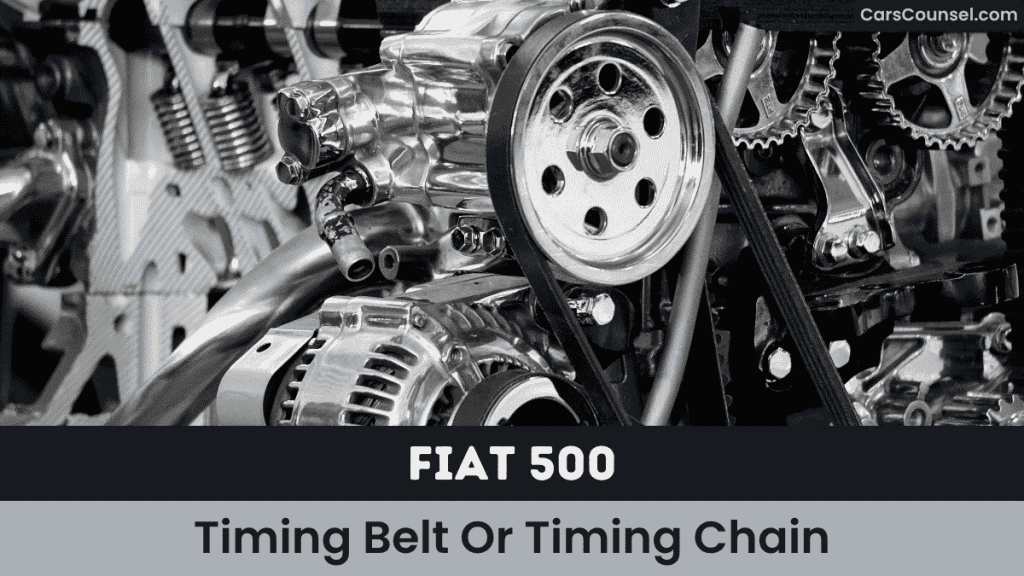
All U.S.-market Fiat 500 gasoline engines use a timing belt, not a timing chain. The belt replacement interval per the North American owner’s manual is 150,000 miles (247,000 km).
This is a high-mileage interval compared to many other timing belt engines, which makes correct identification and adherence to the schedule especially important.
Quick Navigation
Does the Fiat 500 Have a Timing Belt or Timing Chain?
All U.S.-market Fiat 500 gasoline engines use a timing belt. The 1.4L MultiAir engine, in both naturally aspirated and turbocharged forms, is belt-driven.
The belt replacement interval per the North American owner’s manual is 150,000 miles (247,000 km). All configurations are interference engines.
2019 Fiat 500 Timing Belt Or Timing Chain
| Specification | Detail |
|---|---|
| Engine Option(s) | 1.4L MultiAir Turbo I4 (135 hp) / 1.4L MultiAir Turbo I4 Abarth (160 hp) |
| Timing System | Timing Belt |
| Interference Engine | Yes |
| Replacement Interval | 150,000 miles (247,000 km) |
| Maintenance Notes | Final U.S. model year. All trims carry the 1.4L turbo. Belt drives the camshaft; replace tensioner and water pump at the same service. |
The 2019 model year was the last for the Fiat 500 in the U.S. market. All trims, including the Abarth, use the turbocharged 1.4L MultiAir with a timing belt. The engine is interference-type; belt failure risks valve damage.
2018 Fiat 500 Timing Belt Or Timing Chain
| Specification | Detail |
|---|---|
| Engine Option(s) | 1.4L MultiAir Turbo I4 (135 hp) / 1.4L MultiAir Turbo I4 Abarth (160 hp) |
| Timing System | Timing Belt |
| Interference Engine | Yes |
| Replacement Interval | 150,000 miles (247,000 km) |
| Maintenance Notes | Starting in 2018, the turbocharged 1.4L became standard on all trims, replacing the prior naturally aspirated base engine. |
For 2018, Fiat eliminated the naturally aspirated 1.4L and made the turbocharged version standard across all trims. All 2018 Fiat 500 engines use the same timing belt and share the 150,000-mile replacement interval.
2017 Fiat 500 Timing Belt Or Timing Chain
| Specification | Detail |
|---|---|
| Engine Option(s) | 1.4L MultiAir I4 N/A (101 hp) / 1.4L MultiAir Turbo I4 (135 hp) / 1.4L MultiAir Turbo I4 Abarth (160 hp) |
| Timing System | Timing Belt (all variants) |
| Interference Engine | Yes |
| Replacement Interval | 150,000 miles (247,000 km) |
| Maintenance Notes | Three power outputs, one engine family. All use the same belt-driven MultiAir valvetrain and share the same replacement interval. |
All three power outputs in the 2017 lineup use the 1.4L MultiAir engine family with a timing belt. No timing chain variant was offered in the U.S. Replacement interval and interference status are the same across all configurations.
2016 Fiat 500 Timing Belt Or Timing Chain
| Specification | Detail |
|---|---|
| Engine Option(s) | 1.4L MultiAir I4 N/A (101 hp) / 1.4L MultiAir Turbo I4 (135 hp) / 1.4L MultiAir Turbo I4 Abarth (160 hp) |
| Timing System | Timing Belt (all variants) |
| Interference Engine | Yes |
| Replacement Interval | 150,000 miles (247,000 km) |
| Maintenance Notes | Same timing system as 2017. Verify engine output by VIN or option code if purchasing used. |
Same timing system as the 2017 model year. All U.S.-market 2016 Fiat 500 engines use a timing belt. Because this is an interference engine, a broken belt typically results in bent valves and significant engine repair costs.
2015 Fiat 500 Timing Belt Or Timing Chain
| Specification | Detail |
|---|---|
| Engine Option(s) | 1.4L MultiAir I4 N/A (101 hp) / 1.4L MultiAir Turbo I4 (135 hp) / 1.4L MultiAir Turbo I4 Abarth (160 hp) |
| Timing System | Timing Belt (all variants) |
| Interference Engine | Yes |
| Replacement Interval | 150,000 miles (247,000 km) |
| Maintenance Notes | Same timing system as 2016. Replace the belt, tensioner, and idler pulley as a set at the specified interval. |
Same engine lineup and timing system as the 2016 model year. The 150,000-mile belt interval is unusually long; many technicians recommend inspection before that mileage on high-age vehicles.
2014 Fiat 500 Timing Belt Or Timing Chain
| Specification | Detail |
|---|---|
| Engine Option(s) | 1.4L MultiAir I4 N/A (101 hp) / 1.4L MultiAir Turbo I4 (135 hp) / 1.4L MultiAir Turbo I4 Abarth (160 hp) |
| Timing System | Timing Belt (all variants) |
| Interference Engine | Yes |
| Replacement Interval | 150,000 miles (247,000 km) |
| Maintenance Notes | Same timing system as 2015. Timing belt also interacts with the MultiAir hydraulic valve system; correct oil maintenance supports belt longevity. |
Same timing system as the 2015 model year. The 1.4L MultiAir’s belt-driven valvetrain is directly linked to the hydraulic actuator system. Consistent oil maintenance helps protect the timing components from premature wear.
2013 Fiat 500 Timing Belt Or Timing Chain
| Specification | Detail |
|---|---|
| Engine Option(s) | 1.4L MultiAir I4 N/A (101 hp) / 1.4L MultiAir Turbo I4 (135 hp Turbo trim) / 1.4L MultiAir Turbo I4 Abarth (160 hp) |
| Timing System | Timing Belt (all variants) |
| Interference Engine | Yes |
| Replacement Interval | 150,000 miles (247,000 km) |
| Maintenance Notes | The 500 Turbo trim debuted in 2013 with 135 hp. All U.S.-market 2013 engines share the same belt-driven MultiAir architecture. |
The 2013 model year introduced the 500 Turbo trim at 135 hp, positioned between the base 101-hp engine and the Abarth. All three use the same 1.4L MultiAir engine family with a timing belt and the same 150,000-mile replacement schedule.
2012 Fiat 500 Timing Belt Or Timing Chain
| Specification | Detail |
|---|---|
| Engine Option(s) | 1.4L MultiAir I4 N/A (101 hp) / 1.4L MultiAir Turbo I4 Abarth (160 hp) |
| Timing System | Timing Belt (all variants) |
| Interference Engine | Yes |
| Replacement Interval | 150,000 miles (247,000 km) |
| Maintenance Notes | First U.S. model year. Valve system listed as “belt-driven, MultiAir” in official Fiat press documentation. Belt interval confirmed in North American owner’s manual at 152,000 miles. |
The 2012 model year marked the return of Fiat to the U.S. market. Official Fiat specifications confirmed the 1.4L MultiAir uses a belt-driven valvetrain. The North American owner’s manual specifies a 150,000-mile (247,000 km) replacement interval.
Timing Belt vs Timing Chain on the Fiat 500
A timing belt is a reinforced rubber component that connects the crankshaft sprocket to the camshaft sprocket, controlling valve timing. The 1.4L MultiAir uses its belt to drive the camshaft, which then actuates the MultiAir hydraulic valve control system.
A timing chain serves the same function using a metal roller chain running on metal sprockets inside the engine. Timing chains are lubricated by engine oil and are generally designed for engine-lifetime operation. The U.S.-market Fiat 500 does not use a timing chain; all gasoline versions use a belt.
The primary maintenance difference is scheduled replacement. Timing belts degrade with heat, age, and mileage and must be replaced before failure. The 1.4L belt carries an unusually long 150,000-mile interval, but age-related rubber deterioration means calendar time should also factor into replacement decisions.
Timing belt failure on the 1.4L MultiAir results in valve-to-piston contact, bent valves, and typically requires major engine repair. Warning symptoms can include misfires, rough running, or engine shutdown, though belts can also fail without prior warning. Do not wait for symptoms on an interference engine.
Fiat 500 Timing System Maintenance
The North American owner’s manual specifies a timing belt replacement at 150,000 miles (247,000 km). Because the 1.4L MultiAir is an interference engine, the belt must be replaced at or before this interval. Replacing the tensioner, idler pulley, and water pump at the same time is standard practice.
Cold-start rattles or ticking on the 1.4L MultiAir are more commonly related to the hydraulic valve actuators or oil pressure than to the timing belt itself. Belt-related issues typically present as engine shutdown, misfires, or loss of camshaft position sensor signal. Have the belt inspected if any of these occur near or beyond 100,000 miles.
Engine oil quality directly affects the MultiAir hydraulic system, which operates from oil pressure. Degraded oil can impair valve actuation and also accelerates wear on the belt tensioner system. Use the oil grade and change interval specified in the owner’s manual to protect both the hydraulic components and the timing belt assembly.
If a vehicle has passed 150,000 miles without belt replacement, or if the service history of a used vehicle is unknown, replace the timing belt before driving the vehicle further. There is no external symptom check that confirms the belt’s remaining service life. Proactive replacement is less expensive than engine repair after belt failure.
| Timing Belt | Timing Chain |
|---|---|
| Required at 150,000 miles (247,000 km) | Not applicable; no chain-equipped U.S. Fiat 500 |
| Interference engine; failure causes valve damage | N/A |
| Replace tensioner, idler, and water pump as a set | N/A |
| Age and heat degrade belt regardless of mileage | N/A |
| All U.S.-market gasoline Fiat 500 models (2012-2019) | No U.S.-market Fiat 500 uses a timing chain |
Frequently Asked Questions
Does the Fiat 500 have a timing belt or timing chain? All U.S.-market Fiat 500 gasoline engines (2012-2019) use a timing belt. The 1.4L MultiAir engine in all power outputs is belt-driven. No U.S.-market 500 uses a timing chain.
When should the Fiat 500 timing belt be replaced? The North American owner’s manual specifies replacement at 150,000 miles (247,000 km). Many technicians recommend earlier inspection given the engine’s interference design and the potential for age-related belt degradation.
Is the Fiat 500 a timing belt interference engine? Yes. All U.S.-market Fiat 500 engines are confirmed interference engines. Belt failure allows pistons to contact open valves, resulting in bent valves and significant engine damage.
Does the Fiat 500 Abarth have the same timing belt as the standard 500? Yes. The Abarth uses the same 1.4L MultiAir engine family as all other U.S. trims. The timing belt, replacement interval, and interference status are identical across all power variants.
How much does Fiat 500 timing belt replacement cost? Estimated replacement costs range from approximately $400 to $700 including labor. Cost varies by labor rate and whether the water pump, tensioner, and idler are replaced at the same time, which is recommended.
Does the 500e (electric) Fiat 500 have a timing belt? No. The 500e uses an electric motor with no internal combustion engine, no camshaft, and no timing belt or chain. Timing system maintenance does not apply to the 500e.
Conclusion
Every U.S.-market Fiat 500 gasoline model from 2012 through 2019 uses the 1.4L MultiAir engine with a timing belt. The timing system did not change across trims or power outputs during any production year. The belt interval is 150,000 miles per the North American owner’s manual, and the engine is an interference design across all configurations.
Because belt failure on this engine causes internal damage, adherence to the replacement schedule is critical. Age-related deterioration should also be factored in for vehicles that have reached or exceeded ten years of service. Always verify timing system details using the owner’s manual or manufacturer service information before scheduling repairs.