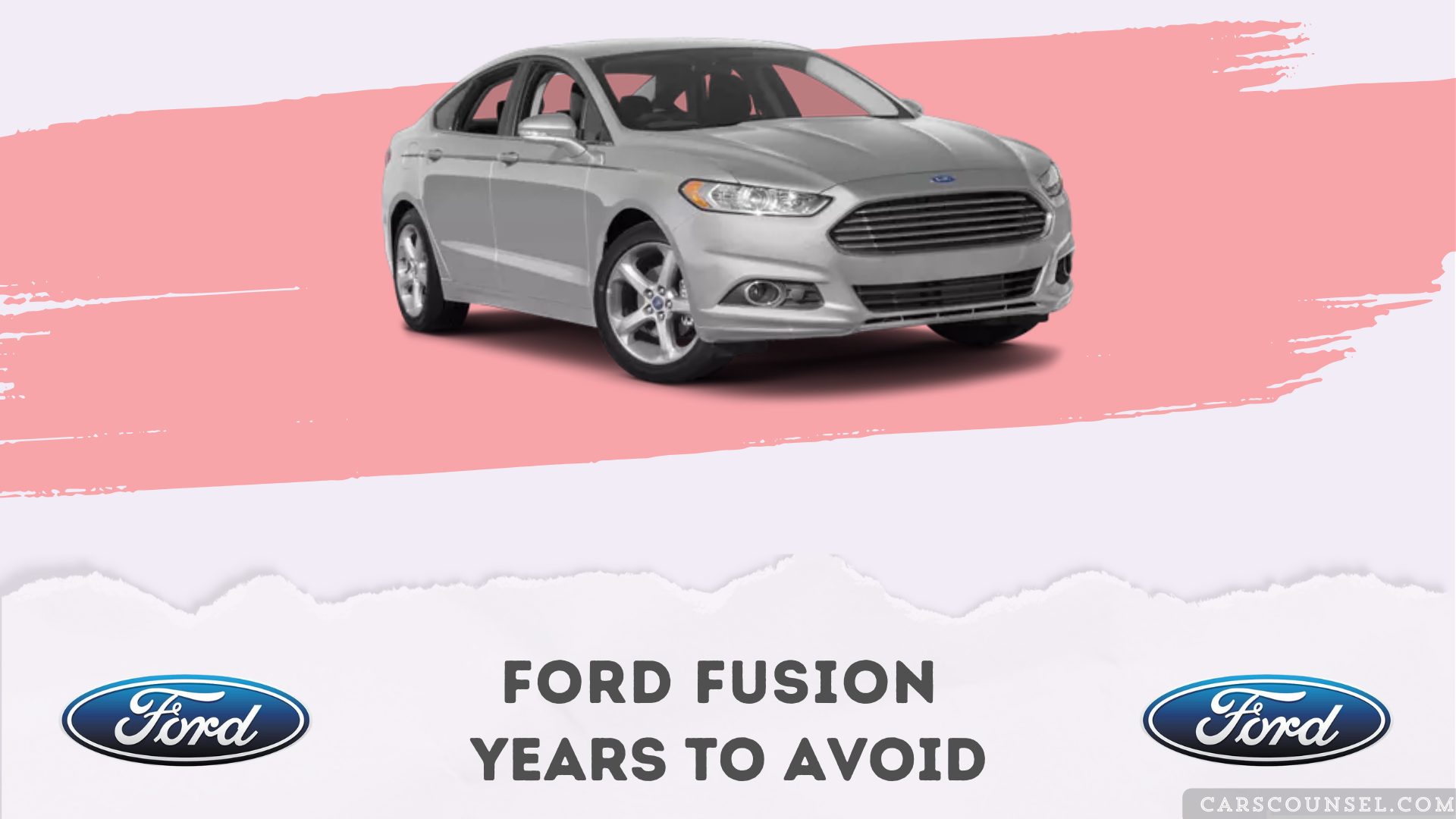
The best Ford Fusion years are 2017 through 2020 with the 2.5L engine or Hybrid, alongside the 2007 to 2009 models. Buyers should strictly avoid the 2013 and 2014 model years due to severe engine and electrical defects.
These rankings are comparative. No used vehicle is flawless, and long-term reliability heavily depends on strict maintenance records, overall condition, and verifying that all open safety recalls have been completed.
Powertrain choice matters significantly. The naturally aspirated 2.5L four-cylinder and Hybrid setups are vastly more reliable than the early EcoBoost turbocharged engines, which suffer from documented coolant intrusion and fire risks.
Quick Navigation
Best and Worst Ford Fusion Years at a Glance
| Model Year | Verdict | Main Reason | Buyer Guidance |
|---|---|---|---|
| 2017–2020 | Best Late-Generation Choice | Mature platform, excellent 2.5L and Hybrid options | Prioritize 2.5L or Hybrid; check 1.5L recall status |
| 2015–2016 | Good Choice | Improved electronics, SYNC 3 introduction | Avoid early 1.5L EcoBoost configurations |
| 2013–2014 | Avoid | 1.6L EcoBoost fire risk, severe transmission shudder | Skip these redesign years entirely |
| 2010–2012 | Mixed | Reliable 2.5L engine, but EPAS steering failures | Verify steering recall completion before purchase |
| 2007–2009 | Best Older Choice | Sorted first-generation mechanics | Inspect for age-related suspension and rust issues |
| 2006 | Approach Carefully | First-year production teething issues | Require comprehensive pre-purchase inspection |
Key Takeaways
- The 2013 and 2014 model years are the worst due to 1.6L EcoBoost fire recalls and transmission shudder.
- The 2.5L naturally aspirated engine and Hybrid powertrains offer the strongest reliability across most generations.
- Early 1.5L and 1.6L EcoBoost engines carry severe coolant intrusion and fire risks.
- Models from 2010 to 2012 suffer from expensive Electric Power Assist Steering (EPAS) failures.
- The 2017 through 2020 models are excellent, provided the 1.5L coolant intrusion recall is addressed.
- Always verify open recalls using the VIN before finalizing any purchase.
How We Evaluated the Ford Fusion Model Years
Our analysis relies on official safety records, manufacturer recalls, and long-term ownership data. We evaluate powertrain differences, generation changes, and repair complexity to identify reliable configurations.
Consumer complaints are not confirmed failure rates. A recall does not automatically make a vehicle unreliable, but recurring severe defects heavily influence our verdicts. Recent models have less long-term exposure.
Best Ford Fusion Years
2017–2020 (Best Late-Generation Choice)
The final production years offer a mature platform with excellent reliability, particularly when equipped with the naturally aspirated 2.5L four-cylinder or the Hybrid powertrain. Ford resolved most early electronic gremlins by this point.
Buyers should still verify the status of the 1.5L EcoBoost coolant intrusion recall. Choosing the 2.5L engine or Hybrid completely bypasses this turbocharged engine vulnerability.
2007–2009 (Best Older Choice)
These years represent the sorted first generation. The available V6 engines and conventional automatic transmissions provide dependable performance without the complex turbocharged or hybrid systems found in later models.
Age is the primary concern here. A thorough inspection for rust, suspension wear, and age-related fluid leaks is mandatory before purchasing any first-generation example.
2015–2016 (Good Choice)
The 2016 mid-cycle refresh introduced the vastly superior SYNC 3 infotainment system, replacing the problematic MyFord Touch interface. Build quality improved significantly over the disastrous 2013 redesign.
While better than earlier second-generation models, the 1.5L EcoBoost engine still carries coolant intrusion risks. The 2.0L EcoBoost or 2.5L four-cylinder remain the safer configuration choices.
Best Year by Buyer Type
Best Overall: 2019 Hybrid or 2.5L
The 2019 model year provides modern safety features, updated styling, and proven naturally aspirated or hybrid powertrains that avoid the severe turbocharged engine recalls.
Best Budget Option: 2008 V6
For buyers on a strict budget, a well-maintained 2008 V6 model offers spacious comfort and conventional mechanicals, provided a pre-purchase inspection confirms the chassis is rust-free.
Best Commuter: 2020 Hybrid
The final production year Hybrid delivers exceptional fuel economy and outstanding reliability, making it the ultimate choice for high-mileage daily driving and stop-and-go traffic.
Years to Approach Carefully
2010–2012 (Mixed)
These years introduced the highly reliable 2.5L four-cylinder engine. However, they are plagued by Electric Power Assist Steering (EPAS) failures, which can cause a sudden loss of steering assist.
Ford issued extended coverage programs for the steering torque sensor, but many vehicles still require expensive rack replacements. Verify the steering recall status before buying.
2006 (Approach Carefully)
As the inaugural model year, the 2006 Fusion experienced typical first-year production teething issues. Electrical gremlins and early transmission wear are more common than in the subsequent 2007 through 2009 models.
Worst Ford Fusion Years
2013–2014 (Avoid)
The second-generation redesign was disastrous. The 1.6L EcoBoost engine carries a severe fire risk due to coolant leaks, prompting major safety recalls. Early models also suffer from rampant transmission shudder.
Additionally, the MyFord Touch infotainment system is notoriously unresponsive and prone to complete failure. These compounding mechanical and electrical defects make the 2013 and 2014 model years strictly avoid.
Ford Fusion Reliability by Generation
First Generation (2006–2012)
Built on the CD3 platform, the first generation shares related architecture with the Ford Edge. The 2007 through 2012 models are generally robust, especially with the 2.5L four-cylinder.
The primary vulnerability across the 2010 to 2012 refresh is the EPAS steering system. Hybrid models introduced in 2010 proved exceptionally reliable and remain highly sought after today.
Second Generation (2013–2020)
The CD4 platform brought aggressive styling and turbocharged EcoBoost engines. Unfortunately, the early 1.6L and 1.5L EcoBoost engines suffer from severe coolant intrusion, leading to hydrolock and engine failure.
The 2016 refresh vastly improved the interior electronics. For this generation, the naturally aspirated 2.5L engine and the Hybrid variants are the only configurations we confidently recommend for long-term ownership.
Common Ford Fusion Problems
EcoBoost Coolant Intrusion and Fire Risk
The 1.6L EcoBoost (2013–2014) has a severe fire risk from coolant leaks hitting hot engine components. The 1.5L EcoBoost (2013–2019) suffers from coolant leaking into the cylinders, causing catastrophic engine failure.
Electric Power Assist Steering (EPAS) Failure
Models from 2010 to 2012 frequently experience EPAS torque sensor failures. This causes a sudden loss of power steering assist, making the vehicle incredibly difficult to maneuver at low speeds.
Automatic Transmission Shudder
The 6F35 automatic transmission, particularly in the 2013 and 2014 models, is known for harsh shifting, shuddering under acceleration, and premature valve body wear. Fluid changes rarely resolve severe mechanical shudder.
MyFord Touch and SYNC Electrical Failures
The 2013 to 2015 models use the MyFord Touch interface, which is plagued by freezing screens, unresponsive inputs, and total system blackouts. Ford eventually replaced this with the much more stable SYNC 3 system.
Repair-Cost Overview
| Problem | Commonly Affected Years | Approximate Repair Range | Important Notes |
|---|---|---|---|
| EPAS Steering Rack Replacement | 2010–2012 | $1,200 – $1,800 | Check for open recall coverage first |
| EcoBoost Engine Replacement | 2013–2019 (1.5L/1.6L) | $4,000 – $7,000 | Coolant intrusion often destroys the short block |
| Transmission Valve Body | 2013–2014 | $800 – $1,500 | Shudder may require full rebuild |
Repair costs vary significantly by region, labor rates, parts choice, and vehicle configuration. Independent shops often provide lower estimates than dealerships, but official recall work must be completed at an authorized Ford dealer.
What to Check Before Buying a Used Ford Fusion
- Verify the VIN for any open safety recalls, especially regarding the 1.5L and 1.6L EcoBoost engines.
- Confirm the EPAS steering recall status on 2010 through 2012 models.
- Test the transmission for shuddering during light acceleration and smooth shifting at highway speeds.
- Inspect the coolant reservoir for low levels or a milky appearance, indicating internal engine leaks.
- Test all SYNC infotainment functions, including Bluetooth pairing, navigation, and climate controls.
- Check for uneven tire wear, which can indicate worn suspension components or alignment issues.
- Arrange an independent pre-purchase inspection to evaluate the undercarriage for structural rust.
Related Buying Guides
- Ford Escape best and worst years: The Escape shares many EcoBoost powertrains and steering components with the Fusion, making its reliability patterns highly relevant for cross-shopping buyers.
- Ford Edge best and worst years: Buyers needing more cargo space than the Fusion offers often look to the Edge, which shares the underlying CD3 and CD4 platform architectures.
- Ford Focus best and worst years: While smaller, the Focus provides a useful comparison for buyers evaluating Ford’s compact and midsize automatic transmission reliability during the same era.
Frequently Asked Questions
What is the most reliable Ford Fusion engine?
The naturally aspirated 2.5L four-cylinder and the Hybrid powertrains are the most reliable. They avoid the severe coolant intrusion and fire risks associated with the early 1.5L and 1.6L EcoBoost turbocharged engines.
Why should I avoid the 2013 Ford Fusion?
The 2013 model year was a disastrous redesign. It suffers from severe 1.6L EcoBoost fire recalls, rampant transmission shudder, and the incredibly problematic MyFord Touch infotainment system.
Do all Ford Fusions have transmission problems?
No. The severe transmission shudder is primarily concentrated in the 2013 and 2014 model years. Earlier first-generation models and later 2017 through 2020 examples feature much more stable automatic transmissions.
Is the Ford Fusion Hybrid reliable?
Yes, the Fusion Hybrid is exceptionally reliable across both generations. The eCVT transmission and Atkinson-cycle engines avoid the traditional automatic transmission and turbocharged engine vulnerabilities found in the gasoline models.
What causes the steering failure in older Fusions?
The 2010 to 2012 models use an Electric Power Assist Steering system with a prone-to-fail torque sensor. When it fails, the steering becomes incredibly heavy, prompting extended warranty coverage from Ford.
When did Ford discontinue the Fusion?
Ford discontinued the Fusion in the United States after the 2020 model year to focus on SUVs and trucks. The 2017 through 2020 models remain excellent, mature choices for used sedan buyers.
Which Ford Fusion Year Should You Buy?
For the best blend of modern features and proven reliability, target the 2017 through 2020 model years equipped with the 2.5L four-cylinder or Hybrid powertrain. These configurations avoid the major turbocharged engine defects.
Strictly avoid the 2013 and 2014 model years due to severe fire risks and transmission issues. If considering a 2010 to 2012 model, verify the steering recall status and insist on a thorough pre-purchase inspection.
Always check the VIN for open recalls and review maintenance records. A well-maintained Fusion with the correct powertrain can provide excellent, comfortable service for years to come.

