The Hyundai Venue is a front-wheel-drive subcompact crossover SUV sold in the U.S. market from the 2020 model year onward.
It is built on the Hyundai-Kia K2 platform and occupies the entry-level position in Hyundai’s SUV lineup.
The Venue has been offered with a single engine configuration across all U.S. model years.
Identifying the timing system type remains relevant for long-term maintenance planning and for verifying compatibility when sourcing engine components.
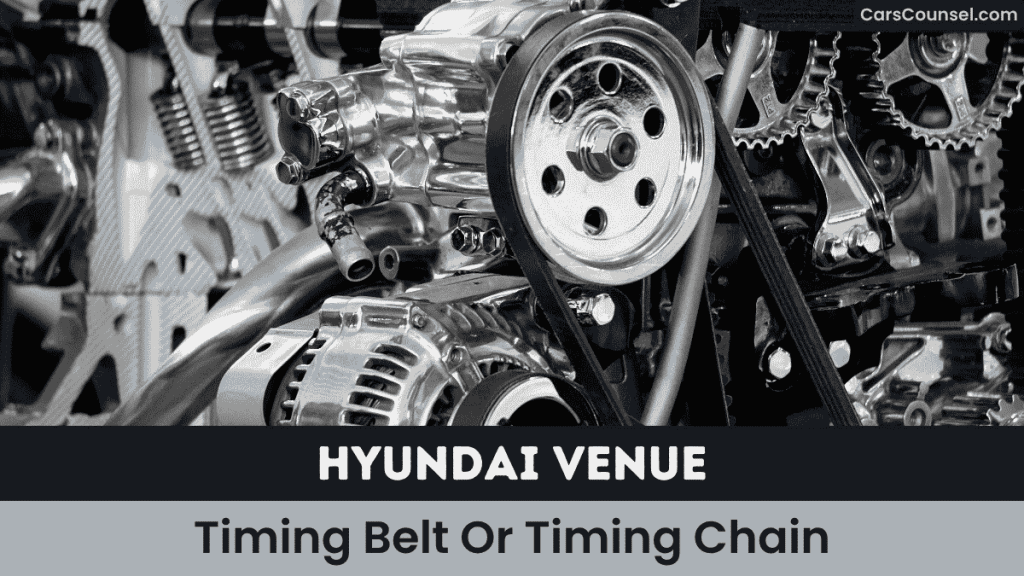
Timing system identification also matters when purchasing a used Venue. Knowing whether the engine uses a chain or a belt affects expected service costs and long-term engine reliability planning.
Quick Navigation
Does the Hyundai Venue Have a Timing Belt or Timing Chain?
Every U.S.-market Hyundai Venue, from 2020 through 2026, uses a timing chain. The single 1.6L four-cylinder engine offered across all model years is an interference engine. No timing belt service applies to any Venue configuration.
2026 Hyundai Venue Timing Belt Or Timing Chain
| Specification | Detail |
|---|---|
| Engine Option | 1.6L 4-cylinder (Smartstream G4FM DPI DOHC) |
| Timing System | Timing Chain |
| Interference Engine | Yes |
| Replacement Interval | Lifetime (no scheduled replacement) |
| Maintenance Notes | Same engine as 2025; Limited trim discontinued for 2026, SE and SEL only |
The 2026 Venue carries over the same 1.6L Smartstream engine from the prior model year with no changes to the timing system.
The lineup was simplified to SE and SEL trims. No timing belt service applies to any 2026 Venue configuration.
2025 Hyundai Venue Timing Belt Or Timing Chain
| Specification | Detail |
|---|---|
| Engine Option | 1.6L 4-cylinder (Smartstream G4FM DPI DOHC) |
| Timing System | Timing Chain |
| Interference Engine | Yes |
| Replacement Interval | Lifetime (no scheduled replacement) |
| Maintenance Notes | 121 hp at 6,300 rpm; 113 lb-ft at 4,500 rpm; paired with IVT/CVT |
Same timing system as the previous model year. Available in SE, SEL, and Limited trims, all powered by the same 1.6L engine.
Routine oil changes at the manufacturer-specified intervals are the primary timing-system maintenance requirement.
2024 Hyundai Venue Timing Belt Or Timing Chain
| Specification | Detail |
|---|---|
| Engine Option | 1.6L 4-cylinder (Smartstream G4FM DPI DOHC) |
| Timing System | Timing Chain |
| Interference Engine | Yes |
| Replacement Interval | Lifetime (no scheduled replacement) |
| Maintenance Notes | Dual rear USB-C ports added for SEL and Limited trims; engine unchanged |
The 2024 model year received minor feature additions but no changes to the powertrain or timing system.
The 1.6L chain-driven engine carries over unchanged from 2023. Timing chain longevity depends on consistent oil maintenance.
2023 Hyundai Venue Timing Belt Or Timing Chain
| Specification | Detail |
|---|---|
| Engine Option | 1.6L 4-cylinder (Smartstream G4FM DPI DOHC) |
| Timing System | Timing Chain |
| Interference Engine | Yes |
| Replacement Interval | Lifetime (no scheduled replacement) |
| Maintenance Notes | More standard safety features added for 2023; wireless charging standard on Limited trim |
Same timing system as previous model year. Though other markets received a mid-cycle refresh for 2023, the North American Venue retained its first-generation platform and engine without change to the timing system configuration.
2022 Hyundai Venue Timing Belt Or Timing Chain
| Specification | Detail |
|---|---|
| Engine Option | 1.6L 4-cylinder (Smartstream G4FM DPI DOHC) |
| Timing System | Timing Chain |
| Interference Engine | Yes |
| Replacement Interval | Lifetime (no scheduled replacement) |
| Maintenance Notes | Engine immobilizer added as standard for 2022; power sunroof became standard on SEL |
The 2022 Venue received a standard-equipment update but no powertrain changes. The timing chain in the 1.6L Smartstream engine is oil-lubricated and operates inside the engine block with no external access required for routine service.
2021 Hyundai Venue Timing Belt Or Timing Chain
| Specification | Detail |
|---|---|
| Engine Option | 1.6L 4-cylinder (Smartstream G4FM DPI DOHC) |
| Timing System | Timing Chain |
| Interference Engine | Yes |
| Replacement Interval | Lifetime (no scheduled replacement) |
| Maintenance Notes | 15-inch alloy wheels became standard for 2021; engine and timing system unchanged from 2020 |
Same timing system as the launch model year. The Smartstream 1.6L uses Dual Port Injection (DPI), pairing port and direct fuel injectors. The timing chain is rated for the engine’s service life under normal operating conditions.
2020 Hyundai Venue Timing Belt Or Timing Chain
| Specification | Detail |
|---|---|
| Engine Option | 1.6L 4-cylinder (Smartstream G4FM DPI DOHC) |
| Timing System | Timing Chain |
| Interference Engine | Yes |
| Replacement Interval | Lifetime (no scheduled replacement) |
| Maintenance Notes | First U.S. model year; Gamma Gen 2 family engine with CVVT; IVT/CVT transmission standard |
The 2020 Venue is the launch year for the U.S. market. Hyundai fitted the Venue with the Smartstream 1.6L engine from the start, which uses a timing chain instead of a belt. No scheduled timing belt replacement interval applies.
Timing Belt vs Timing Chain on the Hyundai Venue
A timing belt is an external rubber-reinforced toothed drive component that connects the crankshaft to the camshaft. It requires replacement at scheduled intervals, typically between 60,000 and 100,000 miles, because the rubber degrades over time regardless of visible condition.
A timing chain performs the same camshaft timing function using metal links that run on sprockets inside the engine. The chain is continuously lubricated by engine oil and does not have a manufacturer-published replacement interval under normal operating conditions.
The Hyundai Venue uses a timing chain on its 1.6L Smartstream engine for all U.S. model years. Timing chain maintenance differs from belt maintenance: there is no replacement schedule, but the chain requires consistent oil quality and proper change intervals to avoid premature wear of the tensioner and chain guides.
A worn timing chain typically produces a rattling or slapping noise during cold starts that decreases once oil pressure builds. A failing tensioner may not adequately take up chain slack, causing noise and, in advanced cases, timing deviation. These symptoms warrant inspection before continued operation.
Hyundai Venue Timing System Maintenance
The Venue’s 1.6L Smartstream timing chain carries no published replacement interval. It is designed to last the service life of the engine under normal conditions. Owners should not budget for scheduled timing chain replacement the way timing belt owners must.
Cold-start rattling or slapping noise coming from the engine front is the primary audible indicator of chain or tensioner wear. On the Smartstream G4FM, this noise is more likely to occur when oil changes have been deferred or when the incorrect oil viscosity has been used.
Engine oil condition directly affects timing chain longevity. The Venue’s 1.6L engine uses 5W-20 or 0W-20 full synthetic oil, depending on the model year. Adhering to Hyundai’s published oil change interval protects the chain tensioner, guides, and sprocket surfaces from accelerated wear.
Inspection of the timing chain system is warranted if the vehicle has exceeded 150,000 miles, if there is persistent startup noise that does not clear quickly, or if the vehicle has a history of missed oil changes. A qualified technician can assess chain stretch and tensioner function without full engine disassembly.
| Timing Belt | Timing Chain |
|---|---|
| Rubber component; external | Metal links; internal, oil-lubricated |
| Scheduled replacement required | No scheduled replacement interval |
| Failure risk if interval exceeded | Wear accelerated by neglected oil changes |
| Not used on any Venue engine | Used on all U.S. Venue model years (2020–2026) |
If you’re researching whether a Hyundai uses a timing belt or timing chain, be sure to explore our detailed guides on models like the Hyundai Veloster, Hyundai Tiburon, Hyundai Santa Fe, and Hyundai Sonata. Knowing your vehicle’s timing system is important for maintenance planning, repair cost awareness, and long-term engine reliability. Our expert resources explain timing belt vs timing chain setups by model, common replacement intervals, warning signs of wear, and what owners should know to avoid costly engine damage.
Frequently Asked Questions
Does the Hyundai Venue have a timing belt or timing chain? Every U.S.-market Hyundai Venue uses a timing chain. The single 1.6L Smartstream four-cylinder engine, used across all model years from 2020 to 2026, is chain-driven with no scheduled replacement interval.
Does the timing chain on a Hyundai Venue need to be replaced? No replacement interval is published for the Venue’s timing chain. Consistent oil changes using the specified viscosity are the primary maintenance requirement for chain longevity.
Is the Hyundai Venue an interference engine? Yes. The 1.6L Smartstream engine in all U.S.-market Venue models is an interference engine. A severely stretched or broken chain can cause valve-to-piston contact and significant internal damage.
What engine does the Hyundai Venue use? All U.S.-market Venue models use the 1.6L Smartstream four-cylinder (G4FM), producing 121 horsepower and 113 lb-ft of torque. It is paired with Hyundai’s Intelligent Variable Transmission (IVT/CVT).
How long does the timing chain last on a Hyundai Venue? Under normal maintenance, the chain is rated to last the engine’s service life. Premature wear is typically associated with extended oil change intervals or use of incorrect oil viscosity.
What are signs of a worn timing chain on a Hyundai Venue? Rattling or slapping from the front of the engine during cold starts is the most common indicator. Persistent noise after the engine reaches operating temperature warrants professional inspection.
Conclusion
The Hyundai Venue uses a timing chain across every U.S. model year, from its 2020 launch through the 2026 model year. A single engine, the 1.6L Smartstream four-cylinder, has been the sole powertrain offered in the U.S. throughout the vehicle’s production run. No timing belt service has ever applied to any U.S.-specification Venue.
The engine is an interference design, making chain and tensioner condition relevant to long-term engine health. Always verify timing system details using the owner’s manual or manufacturer service information before scheduling repairs.