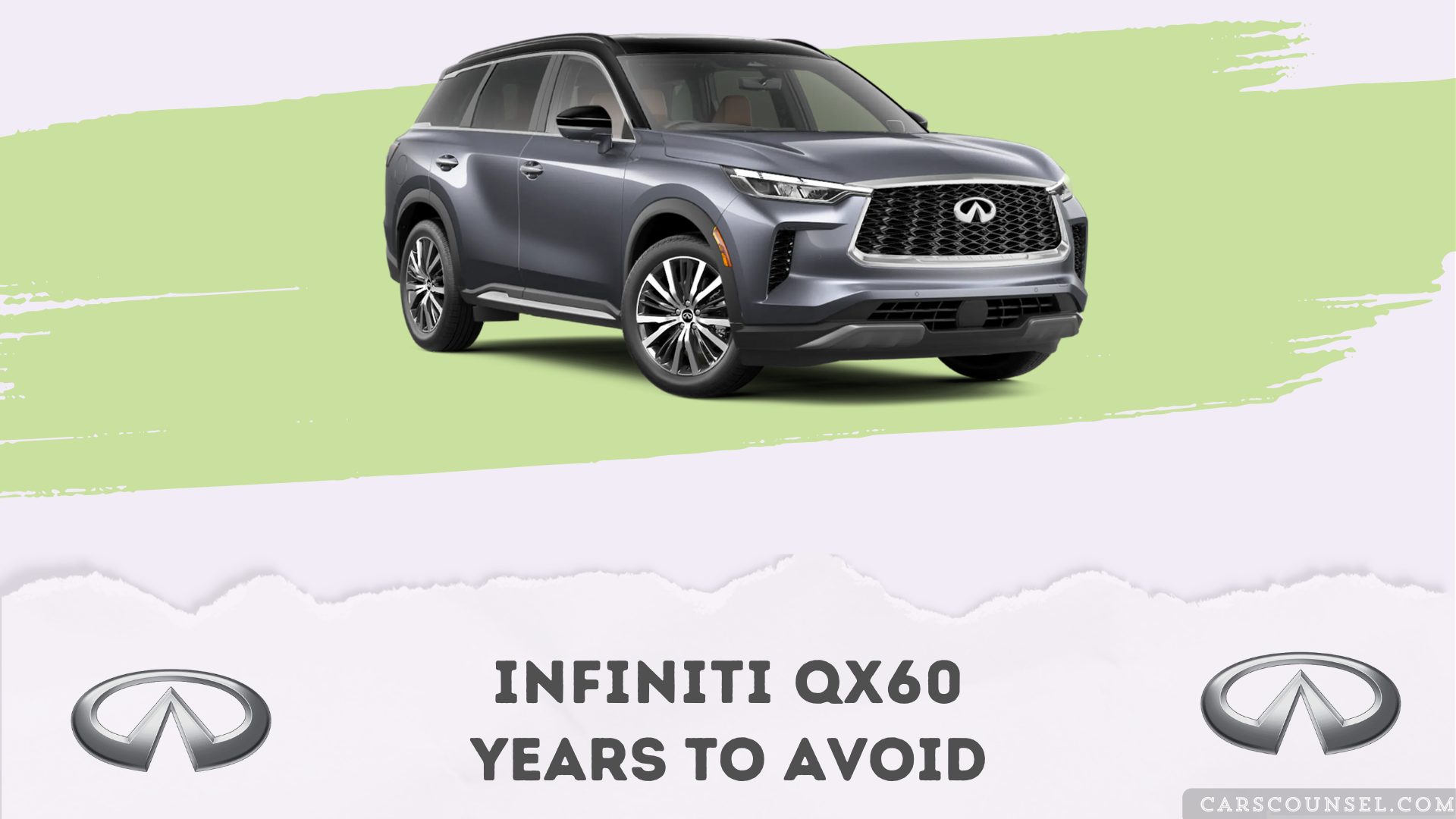
The best Infiniti QX60 years are 2018 through 2020, offering a mature first-generation design with improved transmission tuning. Buyers should avoid the 2014 model year due to early CVT transmission issues and multiple safety recalls.
These rankings are comparative. No used luxury SUV is flawless, and long-term reliability heavily depends on previous maintenance, accident history, and whether all open recalls were addressed by a dealer.
Meaningful differences exist between the first and second generations. The early first-generation models use a continuously variable transmission, while the redesigned second-generation models switched to a traditional nine-speed automatic and a turbocharged engine.
Quick Navigation
Best and Worst Infiniti QX60 Years at a Glance
| Model Year | Verdict | Main Reason | Buyer Guidance |
|---|---|---|---|
| 2014 | Avoid | Early CVT issues, safety recalls | Skip this first-year carryover |
| 2015 | Approach Carefully | ABS actuator recall, CVT shudder | Verify recall completion and CVT health |
| 2016 | Good Choice | Facelift year, improved CVT tuning | Inspect maintenance records |
| 2017 (Gas) | Good Choice | Mature V6 powertrain | Avoid the Hybrid configuration |
| 2017 (Hybrid) | Avoid | Complex electrical and battery faults | Stick to the conventional V6 |
| 2018-2020 | Best Choice | Mature platform, fewer complaints | Top pick for first-generation buyers |
| 2022 | Approach Carefully | First-year redesign, early recalls | Check for fuel pump and software updates |
| 2023 | Good Choice | Improved second-generation reliability | Verify warranty status |
| 2024-2025 | Too New to Judge | Limited long-term ownership data | Rely on certified pre-owned warranties |
Key Takeaways
- The 2018 through 2020 model years are the strongest choices for a used first-generation QX60.
- Avoid the 2014 model year due to transmission shudder and safety concerns.
- The 2017 QX60 Hybrid configuration suffers from complex electrical and battery issues.
- Second-generation models use a new turbocharged engine and nine-speed automatic transmission.
- Always verify if the critical ABS actuator recall was performed on any first-generation model.
- Low complaint totals on recent models do not guarantee long-term reliability.
- Arrange an independent pre-purchase inspection before finalizing any purchase.
How We Evaluated the Infiniti QX60 Model Years
Our analysis considers official safety recalls, manufacturer service campaigns, and consumer complaint patterns. We evaluate powertrain differences, generation changes, and repair complexity.
Complaints are not confirmed failure rates. A recall does not automatically make a model year unreliable if the remedy is available. Recent models have limited long-term exposure, and “best” means comparatively stronger, not flawless.
Best Infiniti QX60 Years
2018 through 2020 (Best Choice)
These late first-generation years represent the most refined version of the original platform. Infiniti addressed early transmission complaints, resulting in a smoother driving experience.
Owner satisfaction is generally high, and major mechanical failures are less common than in earlier years. Buyers should still verify that all scheduled maintenance was performed.
2016 (Good Choice)
The 2016 model year introduced a mid-cycle refresh with updated styling and interior improvements. More importantly, the continuously variable transmission received software updates to reduce shudder.
While better than the 2014 and 2015 models, it still requires a careful inspection of the transmission fluid and service history.
2023 (Good Choice)
The second-generation redesign launched for 2022, making 2023 a safer bet as early production bugs were addressed. It features a turbocharged four-cylinder engine and a nine-speed automatic transmission.
Long-term durability remains unproven, so purchasing a certified pre-owned example with an extended warranty is highly recommended.
Best Year by Buyer Type
- Best Overall: 2019 (Mature first-generation, strong reliability)
- Best Budget Option: 2016 (Refreshed styling, improved transmission, lower price)
- Best Modern Alternative: 2023 (Newer safety tech, traditional automatic transmission)
Years to Approach Carefully
2015 (Approach Carefully)
The 2015 model year is affected by the widespread ABS actuator recall. Brake fluid can leak onto the circuit board, potentially causing a loss of braking power or an electrical fire.
Only consider a 2015 model if you can confirm the dealer has already installed the updated relay and inspected the actuator.
2017 Hybrid (Avoid)
While the standard V6 model is fine, the 2017 QX60 Hybrid is plagued by complex electrical faults and hybrid battery issues. Infiniti discontinued the hybrid shortly after due to poor reliability.
Stick to the conventional 3.5-liter V6 engine to avoid expensive high-voltage system repairs.
2022 (Approach Carefully)
As the first year of a complete redesign, the 2022 model experienced several early recalls, including issues with the fuel pump and backup camera software.
Ensure all technical service bulletins and recall remedies have been applied before purchasing.
Worst Infiniti QX60 Years
2014 (Avoid)
The 2014 QX60 is essentially a renamed 2013 JX35, carrying over early production issues. Owners frequently report severe CVT transmission shudder, hesitation, and premature failure.
Additionally, this year is subject to multiple major safety recalls, including the ABS actuator and Takata airbag campaigns. The repair costs and safety risks make it a poor investment.
Infiniti QX60 Reliability by Generation
First Generation (2014-2020)
The first generation uses a 3.5-liter V6 paired with a continuously variable transmission. Early years struggled with transmission durability and brake actuator defects.
Later years are much more dependable. This generation shares its underlying architecture with the Nissan Pathfinder, meaning parts are widely available and mechanics are familiar with the platform.
Second Generation (2022-Present)
Infiniti completely redesigned the SUV, dropping the V6 and CVT in favor of a 2.0-liter variable-compression turbocharged engine and a nine-speed automatic transmission.
While the driving dynamics improved, early models faced teething issues. Long-term reliability of the new turbocharged engine is still being evaluated.
Common Infiniti QX60 Problems
Transmission Shudder
Early first-generation models are known for CVT shudder during acceleration. This is often caused by degraded transmission fluid or internal belt wear.
Later models received improved programming and cooling. Always check for smooth acceleration during a test drive and review fluid change records.
ABS Actuator Defect
A massive manufacturer recall affects many first-generation models. The ABS actuator relay can fail, allowing brake fluid to leak onto the circuit board.
This can cause the ABS warning light to illuminate, lead to a loss of braking assist, or create a fire risk. Verify the VIN for recall completion.
Hybrid System Failures
The hybrid variants use a complex supercharged four-cylinder and electric motor setup. Owners report hybrid battery faults and clutch actuator failures.
These repairs are highly specialized and expensive. The conventional V6 models do not share these high-voltage vulnerabilities.
What to Check Before Buying a Used Infiniti QX60
- Verify the VIN for open safety recalls, especially the ABS actuator campaign.
- Review service records for regular CVT fluid changes on first-generation models.
- Test drive the vehicle to check for transmission shudder or hesitation.
- Scan for diagnostic codes, focusing on hybrid system faults if applicable.
- Inspect the panoramic sunroof seals for leaks or wind noise.
- Confirm that all software updates for the infotainment and transmission are installed.
- Arrange an independent pre-purchase inspection to check suspension and drivetrain health.
Related Buying Guides
- Lexus RX 350 best and worst years (A direct luxury midsize competitor with a different reliability profile)
- Infiniti QX80 best and worst years (A larger, body-on-frame alternative from the same brand)
Frequently Asked Questions
Is the Infiniti QX60 a reliable SUV?
Later first-generation models are generally reliable. Early models and the hybrid variants suffer from expensive transmission and electrical issues that lower their dependability.
What is the biggest problem with the QX60?
The most critical issue is the ABS actuator defect, which can cause brake failure or fires. Early CVT transmission shudder is also a major concern.
Did Infiniti fix the CVT problems?
Infiniti improved the CVT programming and cooling for the 2016 facelift. While not entirely immune to wear, the later first-generation models experience far fewer catastrophic transmission failures.
Should I buy a QX60 Hybrid?
No. The hybrid system is overly complex and prone to expensive battery and clutch failures. Infiniti discontinued it after 2017 due to these persistent reliability issues.
Are second-generation models better?
The 2022 redesign introduced a better transmission and modern tech. However, 2022 models had early recalls, making 2023 or later a safer choice for long-term ownership.
How long do Infiniti QX60s last?
Well-maintained V6 models can reach high mileage. Longevity depends heavily on strict adherence to fluid change intervals, rust prevention, and addressing recall remedies promptly.
Which Infiniti QX60 Year Should You Buy?
Target the 2018 through 2020 model years for the most dependable first-generation experience. Avoid the 2014 model year and all hybrid configurations due to severe powertrain and safety concerns.
Always verify that the ABS actuator recall was completed. Regardless of the year, secure an independent inspection and prioritize vehicles with complete maintenance records.

