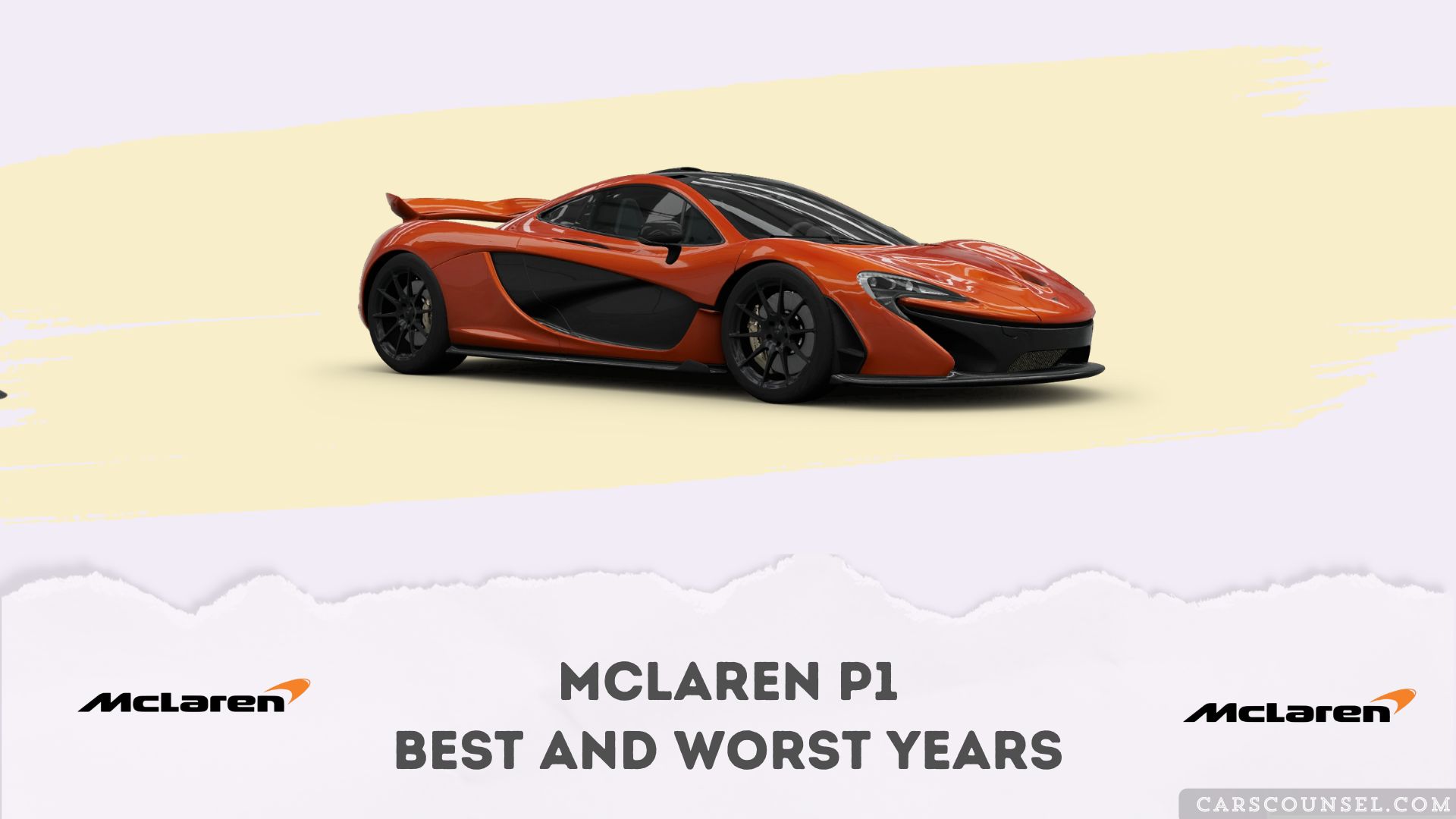
The McLaren P1 was only produced for the 2014 and 2015 model years, meaning there are no traditional best or worst years to choose from. Both years are mechanically identical and represent a landmark hybrid hypercar.
However, every P1 requires a strict pre-purchase inspection focusing on the hybrid battery system. Neglected examples can face six-figure repair bills, making maintenance records more important than the model year.
Because production was strictly limited to 375 road-going units, buyer focus must shift to individual vehicle history. Proper storage and continuous battery maintenance are the true markers of a desirable example.
Quick Navigation
Best and Worst McLaren P1 Years at a Glance
| Model Year | Verdict | Main Reason | Buyer Guidance |
|---|---|---|---|
| 2014 | Good With Inspection | Identical to 2015; limited production run. | Verify hybrid battery health and continuous trickle-charging history. |
| 2015 | Good With Inspection | Final production year; identical mechanics. | Confirm active aero actuator function and full McLaren service history. |
Key Takeaways
- The McLaren P1 was only built for the 2014 and 2015 model years.
- Total production was strictly limited to 375 road-going examples.
- The most critical ownership risk is hybrid battery degradation from improper storage.
- A replacement P1 hybrid battery can cost upwards of $150,000.
- The track-only P1 GTR was produced separately in 2015 and 2016.
- Always verify the VIN and review complete McLaren dealer service records before buying.
How We Evaluated the McLaren P1 Model Years
Our analysis of this ultra-low-volume hypercar focuses on manufacturer specifications, hybrid system longevity, and owner maintenance patterns.
Traditional complaint databases are largely irrelevant for a limited run of 375 hand-built cars. Instead, we evaluate the financial risks associated with complex hybrid components and active aerodynamics.
Recent model years do not apply here, as production ended in 2015. A good choice depends entirely on documented care rather than factory build dates.
Best McLaren P1 Years
2014 and 2015 McLaren P1
Because the entire 375-car run was completed between late 2013 and December 2015, there are no mechanical differences between the 2014 and 2015 model years.
Both years feature the 3.8-liter twin-turbo V8 and electric motor producing a combined 903 horsepower. The choice between them comes down to specification, color, and maintenance history.
Examples with a documented history of being kept on a factory battery maintainer represent the strongest purchases. These cars avoid the severe financial penalties of hybrid system neglect.
Best Year by Buyer Type
Best Enthusiast Choice: 2014-2015 McLaren P1
As the only available model years, both 2014 and 2015 represent the ultimate enthusiast choice. They offer groundbreaking hybrid hypercar performance that defined an automotive era.
Years to Approach Carefully
Good With Inspection (All Years)
While the P1 does not have inherently bad years, any example lacking a documented history of proper storage is a massive financial risk.
The high-voltage battery system is highly sensitive to prolonged hibernation. If a previous owner failed to keep the car plugged in, the battery cells can degrade rapidly.
Buyers must approach every P1 carefully until a McLaren specialist verifies the hybrid battery health. Skipping this step can lead to catastrophic repair bills.
Worst McLaren P1 Years
Since production ended in 2015, there are no worst model years to avoid. The manufacturing run was too short and consistent to produce a bad vintage.
However, the worst example you can buy is one that has been stored improperly without a trickle charger. These neglected cars are essentially financial liabilities.
Avoid any P1 that cannot provide complete service records proving the hybrid system was maintained. The cost of reviving a dead hypercar battery is simply too high.
McLaren P1 Reliability by Generation
First Generation (2014-2015)
The McLaren P1 exists as a single, highly focused generation. It was designed as the flagship of McLaren’s Ultimate Series, bridging the gap between road cars and race cars.
McLaren also produced the track-only P1 GTR between 2015 and 2016. Many of these were later converted to road-legal P1 LM specifications by third-party engineering firms.
Looking forward, McLaren has officially confirmed the P1’s successor. The newly unveiled McLaren W1 will carry the brand’s hybrid hypercar legacy into the future.
Common McLaren P1 Problems
Hybrid Battery Degradation
The most severe issue facing the P1 is high-voltage battery degradation. The complex hybrid system requires constant conditioning, even when the car is parked.
If the vehicle is left unplugged for extended periods, the battery cells can fail. This renders the electric motor useless and triggers severe diagnostic faults.
Replacing this bespoke battery pack is extraordinarily expensive. Owners must ensure the car is always connected to a dedicated maintainer when not in use.
Active Aerodynamics and Electrical Gremlins
The P1 utilizes an active rear wing and complex front aero elements to generate downforce. The actuators controlling these components operate under extreme thermal and mechanical stress.
Occasional electrical gremlins can affect the deployment mechanisms or the digital instrument cluster. These issues usually require specialized diagnostic software to resolve.
While not as financially devastating as a battery failure, electrical faults can ground the car until a McLaren dealer can source the correct replacement components.
Repair-Cost Overview
| Problem | Commonly Affected Years | Approximate Repair Range | Important Notes |
|---|---|---|---|
| Hybrid Battery Replacement | 2014-2015 | $150,000 – $160,000 | Requires specialized McLaren dealer equipment and extended lead times. |
Repair costs for ultra-low-volume hypercars vary significantly by region, parts availability, and dealer labor rates. Always obtain a formal quote from an authorized McLaren service center.
What to Check Before Buying a Used McLaren P1
- Verify the VIN and confirm the car’s original build specification.
- Check hybrid battery health using official McLaren diagnostic software.
- Confirm the car was continuously stored on a factory battery maintainer.
- Inspect the carbon fiber MonoCage for structural cracks or previous repair history.
- Test the active rear wing actuator for smooth and complete deployment.
- Review all McLaren dealer service records and clutch engagement data.
Related Buying Guides
- McLaren 720S best and worst years: Explore McLaren’s highly capable V8 supercar that offers immense performance with more everyday usability than the P1.
- McLaren Artura best and worst years: Learn about McLaren’s modern V6 hybrid supercar and the early production challenges to watch for.
- McLaren GT best and worst years: Discover McLaren’s grand tourer, designed for buyers who prioritize long-distance comfort over track-focused aerodynamics.
- McLaren 750S best and worst years: Review the updated successor to the 720S, featuring refined aerodynamics and increased power output.
Frequently Asked Questions
How many McLaren P1s were made?
McLaren strictly limited production to 375 road-going examples. This extreme scarcity makes the P1 one of the most highly sought-after modern hypercars by collectors worldwide.
What is the most common McLaren P1 problem?
The most significant problem is hybrid battery degradation caused by improper storage. If the car is not kept on a maintainer, the high-voltage system can fail completely.
How much does a McLaren P1 battery replacement cost?
A replacement high-voltage hybrid battery can cost upwards of $150,000. This massive expense makes verifying the battery’s health the most critical step in the buying process.
Is the McLaren P1 street legal?
The standard 375 road cars are fully street legal. However, the track-only P1 GTR variant was not originally road-legal, though some were later converted by third parties.
What is the successor to the McLaren P1?
McLaren has officially confirmed the W1 as the P1’s successor. The W1 continues the brand’s Ultimate Series lineage with next-generation hybrid performance and aerodynamics.
Does the McLaren P1 have a manual transmission?
No, the P1 uses a specialized seven-speed dual-clutch automatic transmission. This gearbox is designed to handle the immense combined torque of the V8 engine and electric motor.
Choosing the Right McLaren P1 Model Year
Because the McLaren P1 was only produced for the 2014 and 2015 model years, your decision relies entirely on the individual car’s condition rather than its vintage.
Prioritize examples with flawless maintenance records and proof of continuous battery maintenance. A well-documented car will always be superior to a neglected example, regardless of its build date.
Always arrange an independent inspection by a certified McLaren specialist. Verifying the hybrid system and carbon fiber chassis is the only way to safely secure this automotive legend.