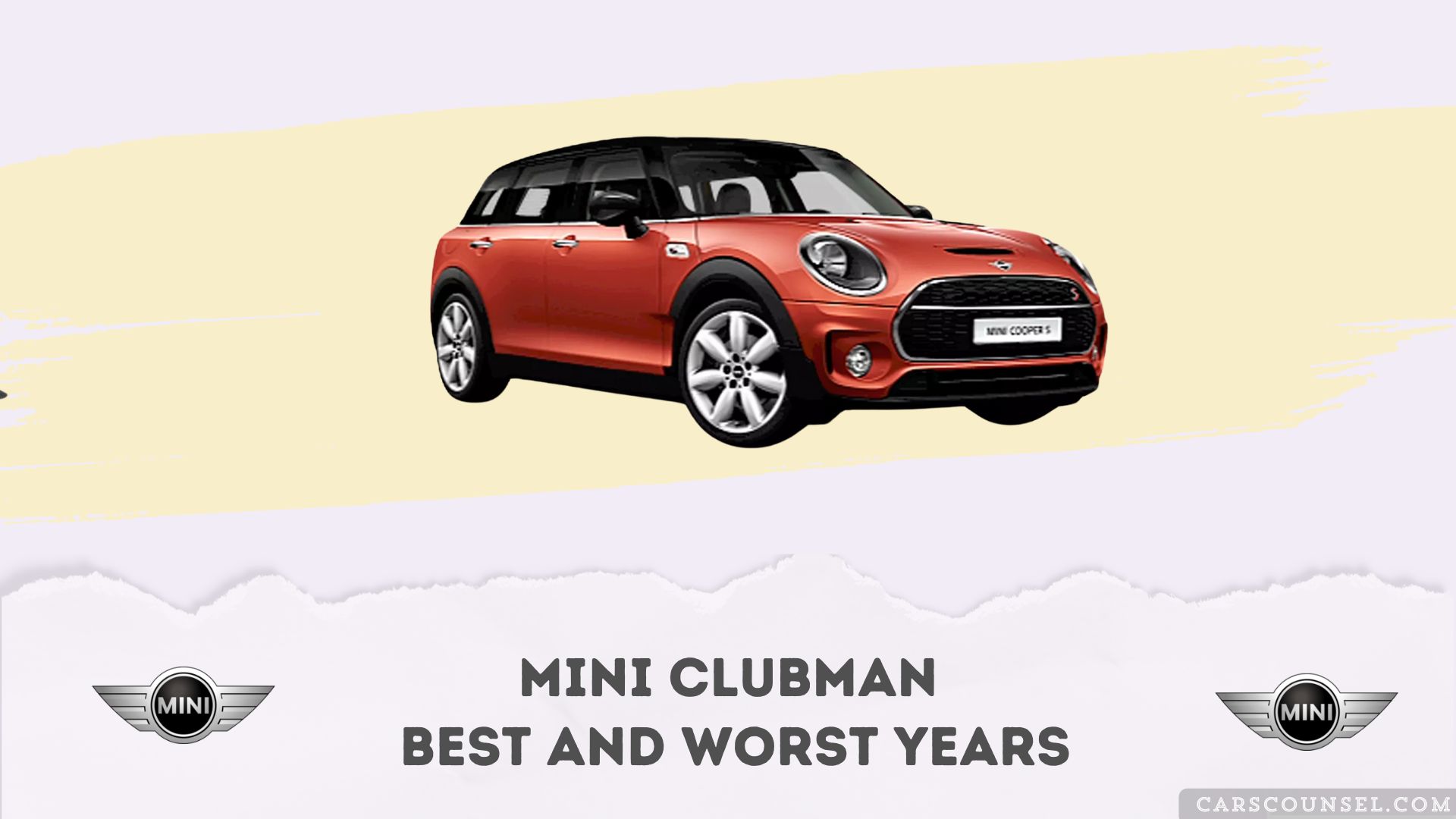
The best MINI Cooper Clubman years are 2018 through 2021, which offer mature reliability. Buyers should avoid the 2008 through 2010 model years due to severe engine defects and fire risks.
Rankings are comparative, and no used vehicle is flawless. Maintenance history, overall condition, and recall completion remain critical factors for any model year you consider.
Reliability differs heavily by generation. The first generation suffers from timing chain and fire risks, while the second generation uses vastly improved turbocharged engines.
Quick Navigation
Best and Worst MINI Cooper Clubman Years at a Glance
| Model Year | Verdict | Main Reason | Buyer Guidance |
|---|---|---|---|
| 2022-2024 | Best Late-Generation Choice | Refined F54 platform, Final Edition | Verify warranty status |
| 2018-2021 | Best Choice | Mature B48/B38 engines, fewer complaints | Check service records |
| 2016-2017 | Good With Inspection | First-year F54 bugs, airbag recall | Confirm recall completion |
| 2011-2014 | Approach Carefully | N18 engine timing chain issues | Inspect timing chain |
| 2008-2010 | Avoid | N14 engine failures, water pump fire risk | Seek newer alternatives |
Key Takeaways
- The 2018-2021 MINI models are the strongest choices for used buyers.
- Avoid 2008-2010 model years due to severe engine and electrical fire risks.
- The 2015 model year was skipped in the United States market.
- Second-generation F54 models use vastly improved BMW B-series engines.
- Always verify that the auxiliary water pump recall was performed on first-generation models.
- Recent models like the 2024 Final Edition have limited long-term ownership data.
How We Evaluated the MINI Cooper Clubman Model Years
Our analysis reviews official recalls, NHTSA investigations, and manufacturer service campaigns. We also track consumer complaint patterns and long-term ownership surveys.
Complaints are not confirmed failure rates. A recall does not automatically make a vehicle unreliable, and recent models naturally have less long-term data.
Best MINI Cooper Clubman Years
2018-2021 (Best Choice)
These years represent the mature phase of the second-generation F54 platform. The turbocharged B38 and B48 engines proved significantly more durable than earlier designs.
Consumer surveys and complaint data show a noticeable drop in major powertrain issues. Buyers get modern infotainment and improved ride quality without first-year redesign risks.
2022-2024 (Best Late-Generation Choice)
The final production years, including the 2024 Final Edition, benefit from continuous factory refinements. Mechanical components are well-sorted, and build quality is generally excellent.
Long-term ownership data remains limited for these newer models. However, their established powertrains and mature platform make them comparatively strong choices for used buyers.
Best Year by Buyer Type
Best Overall: 2019-2020
These model years sit in the sweet spot of the F54 generation. They offer excellent reliability, modern safety features, and strong enthusiast appeal.
Best Budget Option: 2011-2014
First-generation models are more affordable but require strict maintenance. The N18 engine is an improvement over earlier years, though buyers must budget for potential timing chain repairs.
Years to Approach Carefully
2016-2017 (Good With Inspection)
These are the first model years of the redesigned F54 generation. While the new engines are robust, early production models experienced some minor electrical and software gremlins.
Additionally, certain vehicles built between August 2015 and July 2016 were recalled for side curtain airbag issues. Buyers must verify that this recall was completed.
2011-2014 (Approach Carefully)
These later first-generation models received the updated N18 engine, which reduced some severe failures seen in earlier years. However, timing chain wear and oil consumption remain concerns.
These years are also subject to the critical auxiliary water pump recall. Only consider these models if you can verify complete service and recall histories.
Worst MINI Cooper Clubman Years
2008-2010 (Avoid)
The earliest US-market Clubman models are plagued by the notoriously unreliable N14 and N12 engines. Owners frequently report catastrophic timing chain failures and excessive oil consumption.
High-pressure fuel pump failures are also common on Cooper S trims. Furthermore, these years are subject to a severe auxiliary water pump recall that poses an engine fire risk.
MINI Cooper Clubman Reliability by Generation
First Generation (R55: 2008-2014)
The original Clubman brought iconic styling to the US market but suffered from significant powertrain vulnerabilities. The Prince-family engines used during this era are known for carbon buildup and timing chain tensioner failures.
While the 2011 update introduced the improved N18 engine, the fundamental architecture remained prone to expensive oil leaks and cooling system faults. Buyers must exercise extreme caution.
Second Generation (F54: 2016-2024)
Skipping the 2015 model year in the US, the redesigned F54 Clubman adopted BMW’s modular B-series engines. This switch dramatically improved long-term engine reliability and drivability.
The F54 platform also introduced the ALL4 all-wheel-drive system and a more practical four-door layout. Overall ownership costs and complaint volumes dropped significantly compared to the R55.
If you need more ground clearance and cargo space, the related MINI Countryman shares the underlying UKL2 architecture and powertrains.
Common MINI Cooper Clubman Problems
Timing Chain and Engine Failures
First-generation models equipped with the N14 and N12 engines are highly susceptible to timing chain stretch and tensioner failure. This can lead to catastrophic engine damage if ignored.
The updated N18 engine improved durability but still requires strict adherence to oil change intervals. The second-generation B-series engines largely resolved these severe mechanical vulnerabilities.
Auxiliary Water Pump Fire Risk
Many 2008-2014 models were recalled due to an electrical short in the auxiliary water pump wiring. This defect can cause the pump to overheat and ignite an engine bay fire.
Buyers must verify that the recall repair was performed. If the vehicle lacks documented proof of this specific service, it poses a severe safety hazard.
Oil Filter Housing Leaks
Second-generation models using the B48 engine may develop leaks at the oil filter housing gasket. Over time, the plastic housing can warp or crack, allowing oil and coolant to mix.
Addressing this leak promptly is essential to prevent severe engine damage. Upgrading to an improved aftermarket or updated OEM housing is a common preventative measure.
Repair-Cost Overview
Maintenance and repair costs for the Clubman are generally higher than average non-luxury compact cars. First-generation models can incur massive bills for timing chain or high-pressure fuel pump replacements.
Second-generation models are more reliable, but dealership labor rates and specialized BMW-group parts keep routine maintenance relatively expensive. Always budget for premium synthetic oil and specialized diagnostics.
Actual repair costs vary widely by region, labor rates, parts choice, and whether you use an independent European specialist or a franchised dealership.
What to Check Before Buying a Used MINI Cooper Clubman
- Verify the VIN for open recalls, especially the auxiliary water pump and airbag campaigns.
- Inspect the engine bay for signs of oil leaks around the valve cover and oil filter housing.
- Listen for a rattling sound on cold starts, which indicates timing chain wear on first-generation models.
- Review service records to ensure frequent oil changes were performed using the correct specification.
- Test the transmission for smooth shifting and verify the all-wheel-drive system engages properly on ALL4 models.
- Arrange an independent pre-purchase inspection with a technician experienced in European vehicles.
Related Buying Guides
- MINI Convertible best and worst years: For buyers who prefer open-air driving over wagon practicality.
- MINI Cooper years to avoid: A broader look at the standard Hardtop models and their specific reliability patterns.
Frequently Asked Questions
What is the best year to buy a MINI Clubman?
The 2018 through 2021 model years are the best choices. They feature the reliable second-generation platform and avoid the first-year redesign bugs of the 2016 models.
What years of MINI Clubman should I avoid?
Avoid the 2008 through 2010 model years. These early vehicles suffer from severe timing chain defects and carry a significant risk of electrical engine fires.
Did MINI make a 2015 Clubman?
No, the Clubman skipped the 2015 model year in the United States. The first generation ended in 2014, and the redesigned second generation launched for 2016.
Is the MINI Clubman expensive to maintain?
Yes, maintenance costs are higher than average compacts. While second-generation models are more reliable, specialized parts and European engineering require a larger annual maintenance budget.
Are second-generation Clubman engines reliable?
The B38 and B48 engines used in the 2016-2024 models are significantly more reliable than earlier designs. They offer strong performance without the catastrophic timing chain failures.
What is the Final Edition Clubman?
The 2024 Final Edition marks the end of Clubman production. It features unique cosmetic accents but shares the proven mechanical underpinnings of the 2022 and 2023 models.
Choosing the Right MINI Clubman Model Year
The second-generation F54 models from 2018 to 2024 offer the best blend of quirky styling, practicality, and modern reliability. The BMW-sourced turbocharged engines are a massive improvement.
First-generation models remain risky due to expensive timing chain repairs and fire recall concerns. Always verify recall completion and secure an independent inspection before purchasing any used example.

