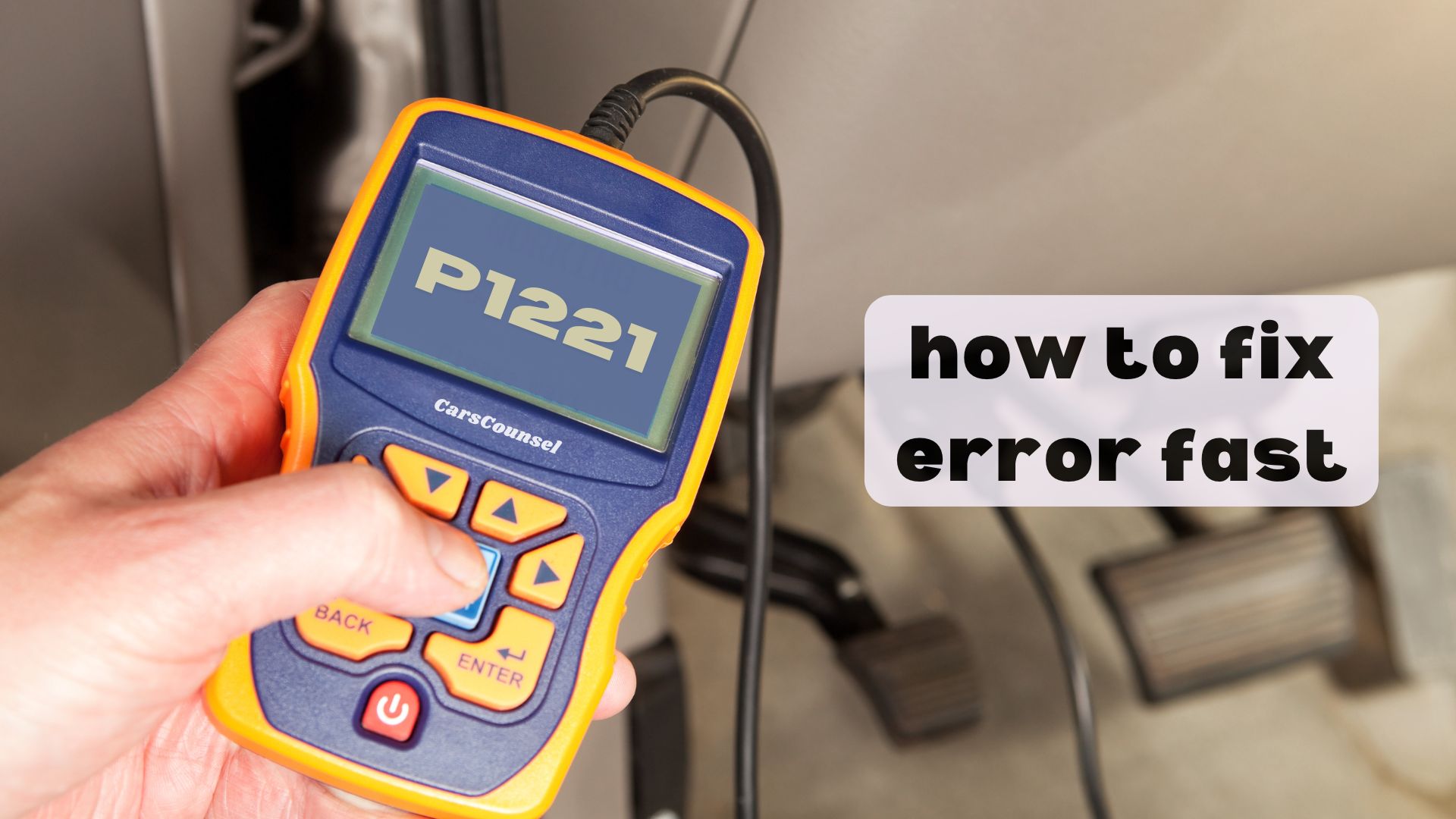
P1221 is a manufacturer-specific diagnostic trouble code. Because it is not standardized, its exact definition depends entirely on the vehicle make and application.
You must verify the exact factory definition for your vehicle before starting repairs. The code indicates a detected condition, but testing is required to identify the root cause.
Quick Navigation
Key Takeaways
- P1221 is a manufacturer-specific code with different meanings for GM, Ford, Toyota, and other applications.
- On many GM applications, it indicates a throttle position sensor correlation fault between two internal sensor signals.
- On certain Ford applications, it points to a traction control system malfunction or communication issue.
- Accurate diagnosis requires verifying your exact vehicle application before testing specific throttle or traction components.
- The code identifies a detected discrepancy, but testing is required to confirm whether a sensor, circuit, or module failed.
P1221 Code Description and Implications
GM and Chevrolet applications: P1221 typically indicates a Throttle Position (TP) Sensor 1-2 correlation fault. The powertrain control module detects that the two internal throttle position sensor signals do not agree as expected.
Ford applications: The code often identifies a Traction Control System malfunction. The control module detects a communication or circuit issue within the traction control system.
Toyota applications: On certain diesel platforms, P1221 indicates a Venturi Control Circuit malfunction. On other applications, it may also relate to traction control system faults.
BMW applications: The code can signify an Accelerator Pedal Position Sensor 2 range or performance problem, indicating a signal discrepancy from the pedal assembly.
Because definitions vary drastically, treating P1221 as a universal fault code will lead to incorrect diagnostics. Always consult the service information for your exact make and model.
Common Causes of the P1221 Code
GM throttle correlation faults: A failing throttle body assembly is a known cause, as the sensors are often integrated. Damaged wiring, corroded connectors, or poor grounds in the throttle circuit can also cause signal discrepancies.
Ford traction control faults: Damaged wiring between the ABS module and the powertrain control module can trigger this code. Faulty wheel speed sensors or a failing traction control switch may also be responsible.
Toyota and BMW applications: For Toyota diesel venturi faults, a sticking venturi valve or damaged actuator wiring are possible causes. For BMW pedal sensor faults, a failing pedal position sensor assembly is a likely cause.
Symptoms Associated With P1221
Symptoms depend entirely on which system the code monitors on your specific vehicle. The Check Engine Light will usually illuminate, but other warning lamps may also appear.
GM applications: The vehicle will likely enter Reduced Engine Power mode. You may experience severe hesitation, poor acceleration, or an inability to exceed low speeds.
Ford applications: The Traction Control and ABS warning lights may illuminate. The vehicle may disable stability control features, though normal driving might remain unaffected.
Toyota and BMW applications: A Toyota diesel may limit engine RPMs or enter limp mode. A BMW may exhibit erratic throttle response or trigger a drivetrain malfunction warning.
Diagnosing the P1221 Trouble Code
Diagnosis must begin by confirming the exact factory definition for your vehicle. Using the wrong diagnostic path will waste time and lead to unnecessary part replacements.
For GM throttle correlation faults: Use a scan tool to monitor both throttle position sensor signals while slowly depressing the accelerator. If the signals do not correlate smoothly, inspect the throttle body connector and wiring.
For Ford traction faults: Check for accompanying ABS or network codes. Inspect the wiring harness between the ABS module and the PCM for chafing or corrosion. Verify wheel speed sensor operation.
For Toyota and BMW faults: Inspect the venturi actuator linkage for binding on Toyota diesels. On BMW applications, monitor the pedal position sensor live data to verify if the secondary signal drops out erratically.
Repairing the P1221 Issue
Repairs must follow confirmed diagnostic testing. Never replace components based solely on the presence of the code.
GM applications: If the wiring and connectors test correctly, the throttle body assembly usually requires replacement. The new assembly must be calibrated using a scan tool to perform the idle relearn procedure.
Ford applications: Repair any damaged wiring in the traction control circuit. If a specific wheel speed sensor or traction control switch fails testing, replace the confirmed faulty component.
Toyota and BMW applications: Replace the venturi control valve or actuator if it fails mechanical testing. For BMW pedal sensor faults, replace the complete accelerator pedal position sensor assembly.
Cost Considerations for P1221 Repairs
Repair costs vary significantly based on the underlying cause and the vehicle application. Wiring repairs are generally less expensive than replacing major electronic assemblies.
Replacing an integrated throttle body or an accelerator pedal assembly involves moderate parts and labor costs. Diagnosing complex traction control network faults can require extensive diagnostic time, increasing the total expense.
Prevention Strategies for Future Occurrences
Preventative measures depend on the specific failure mechanism associated with your vehicle. Some electronic failures cannot be reliably prevented.
GM and BMW applications: Keep the throttle body clean to prevent carbon buildup from binding the throttle plate. Avoid placing heavy objects on the driver’s floor mat that could interfere with the pedal assembly.
All applications: Protect engine bay wiring harnesses from excessive heat and moving components. Address battery and alternator issues promptly, as voltage spikes can damage sensitive control modules and sensors.
Troubleshooting Tips and Best Practices
Do not assume P1221 is universally a throttle position sensor issue. Always check for accompanying diagnostic trouble codes, as they provide vital context for the repair.
On GM vehicles, a P1221 code may appear alongside P1516 or other throttle actuator codes. Always clear the codes after repairs and perform the required idle relearn or calibration procedure.
More OBD-II Codes
| P1214 | P1213 | P1212 | P1211 |
| P1210 | P1209 | P1222 | P1223 |
| P1224 | P1225 | P1226 | P1227 |
| P0121 | P2101 | P1173 | P1325 |
| P1859 | P1513 | P1512 | P1511 |
| P1331 | P1866 | P1865 | P1864 |
Frequently Asked Questions
Is P1221 a generic OBD-II code?
No. P1221 is a manufacturer-specific code. Its exact definition depends entirely on the vehicle make, such as GM, Ford, Toyota, or BMW.
Can a dirty throttle body cause a P1221 code?
On GM applications, heavy carbon buildup can bind the throttle plate. This mechanical binding can cause the two internal sensor signals to disagree, triggering the correlation fault.
Will P1221 put my car in limp mode?
On many GM and Toyota applications, a throttle or venturi correlation fault will trigger Reduced Engine Power or limp mode to protect the engine from unintended acceleration.
Is it safe to drive with a P1221 code?
If the vehicle enters Reduced Engine Power mode, driving is unsafe and difficult. If it only disables traction control, normal driving may be possible, but professional diagnosis is recommended.
Do I need to recalibrate the throttle body after replacing it?
Yes. On most modern electronic throttle applications, a scan tool is required to perform an idle relearn or calibration procedure after installing a new throttle body assembly.
What Should You Do About the P1221 Code?
Confirm the exact factory definition for your specific vehicle make and model. Follow the applicable manufacturer diagnostic procedure to test the relevant system and components. Do not replace parts without confirmed testing.

