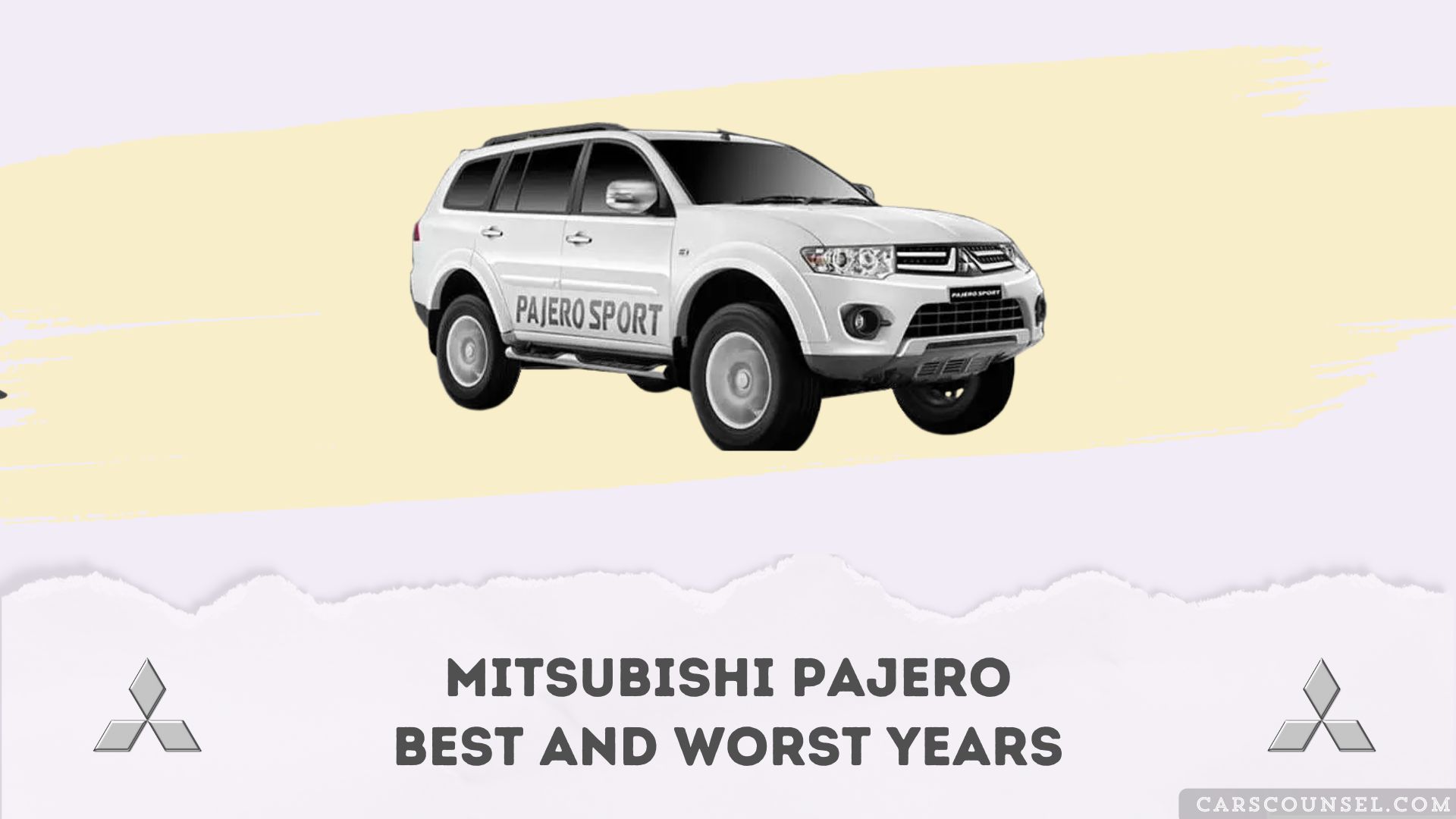
The best Mitsubishi Pajero years are 2007 through 2021 for global buyers, featuring a mature platform and reliable diesel engines. United States buyers should target the 2000 through 2006 Montero models, which offer robust V6 power and solid off-road capability.
These rankings are comparative, and no aging body-on-frame SUV is entirely flawless. Strict maintenance history, rust prevention, and timing belt services heavily influence long-term reliability and ownership costs for these rugged vehicles.
Significant differences exist between early underpowered engines and later V6 configurations. Additionally, the Pajero was discontinued in the US after 2006, meaning American buyers must rely on older Montero examples or import global models.
Quick Navigation
Best and Worst Mitsubishi Pajero Years at a Glance
| Model Year Range | Verdict | Main Reason | Buyer Guidance |
|---|---|---|---|
| 1982-1991 | Approach Carefully | Severe rust risk, underpowered engines | Inspect frame strictly |
| 1992-1999 | Good With Inspection | Better V6 options, aging electricals | Verify timing belt history |
| 2000-2006 (US Montero) | Good Choice | Robust V6, mature off-road tech | Top US pick for off-roaders |
| 2007-2021 (Global) | Best Choice | Highly reliable 3.2L diesel, refined | Best global market choice |
Key Takeaways
- The 2007-2021 global models represent the best choices, featuring a highly reliable 3.2-liter diesel and mature off-road systems.
- US buyers should target 2000-2006 Montero models, which offer a robust 3.8-liter V6 and excellent trail capability.
- Approach 1982-1991 examples carefully due to severe structural rust risks and underpowered early engines.
- The petrol V6 engines are interference designs, making strict timing belt replacement intervals mandatory to prevent engine destruction.
- Always verify the vehicle identification number for open recalls and insist on a pre-purchase inspection focusing on frame rust.
How We Evaluated the Mitsubishi Pajero Model Years
Our analysis reviews official recalls, manufacturer service campaigns, technical service bulletins, and long-term ownership data. We weigh the severity of mechanical failures against repair costs and daily usability.
Complaints are not failure rates, and a recall does not automatically make a year unreliable. Recent models have less ownership history, so best means comparatively stronger, not flawless.
Best Mitsubishi Pajero Years
2007-2021 (Fourth Generation – Global Market)
The fourth-generation Pajero perfected the formula with a highly reliable 3.2-liter DI-D diesel and a refined 3.8-liter V6. The independent front suspension improved on-road manners without sacrificing trail capability.
These final production years offer the most secure ownership experience for international buyers, though they were not sold in the United States.
2000-2006 (Third Generation – US Montero)
The third generation introduced a unibody construction with a built-in ladder frame, providing excellent rigidity. The US-market Montero featured a strong 3.5-liter and later 3.8-liter V6.
Buyers must verify that the timing belt and water pump have been replaced, as these are interference engines.
Best Year by Buyer Type
Best Global Choice
The 2007-2021 models provide the most secure ownership experience for international buyers seeking a reliable, daily-drivable off-roader with modern diesel efficiency.
Best US Budget Option
The 2000-2006 Montero models offer the best balance of off-road capability and V6 reliability for American buyers willing to maintain an older vehicle.
Years to Approach Carefully
1992-1999 (Second Generation)
This generation introduced much-needed V6 power and improved comfort. However, aging wiring harnesses, automatic transmission cooling issues, and severe rust now dictate reliability more than inherent design flaws.
Inspect the frame and body mounts carefully. If the vehicle has been heavily modified for off-roading, bypass it unless the work was done professionally.
1982-1991 (First Generation)
The inaugural models suffer from underpowered engines and severe structural corrosion. While mechanically simple, finding a rust-free example today is exceptionally difficult.
Buyers must demand a thorough undercarriage inspection. Any significant frame rust should be an immediate dealbreaker.
Worst Mitsubishi Pajero Years
There are no model years that universally warrant an absolute avoid verdict, provided the specific maintenance needs are met. However, the 1982-1991 examples carry the highest concentration of age-related structural failures.
Buyers seeking a trouble-free daily driver should bypass heavily modified early examples in favor of the updated 2000 and newer vehicles.
Mitsubishi Pajero Reliability by Generation
First Generation (1982-1991)
The original Pajero established the brand’s off-road credentials. While mechanically stout, severe rust and aging electrical harnesses now threaten long-term survivability.
Second Generation (1992-1999)
This era brought V6 power and improved comfort. However, early automatic transmissions were prone to overheating under heavy loads, and rust remains a primary enemy.
Third Generation (2000-2006)
Sold as the Montero in the US, this generation introduced a unibody frame. The 3.8-liter V6 is robust, but strict timing belt maintenance is mandatory. This was the final US year.
Fourth Generation (2007-2021)
Available only in global markets, the final generation refined the independent front suspension and introduced the excellent 3.2-liter diesel. It remains a highly capable and reliable off-roader.
Note that the Pajero Sport is a completely different vehicle based on a pickup truck platform and is not covered in this Pajero analysis.
Common Mitsubishi Pajero Problems
Timing Belt Failure (Petrol V6)
Affecting all V6 petrol engines across all generations, the timing belt must be replaced at strict intervals. Failure results in catastrophic valve and piston damage, requiring a complete engine rebuild.
Diesel Intake Manifold Clogging
Found on the 3.2-liter DI-D diesel engines, the EGR system causes soot and oil vapor to build up in the intake manifold. This restricts airflow and requires periodic manual cleaning.
Structural Rust
Affecting the 1982-1999 models primarily, the frame, body mounts, and rear wheel arches are highly susceptible to severe corrosion. This compromises vehicle safety and structural integrity.
Automatic Transmission Overheating
Found on older models used for heavy towing, the automatic transmission fluid can overheat without an auxiliary cooler. This leads to premature clutch pack wear and transmission failure.
What to Check Before Buying a Used Mitsubishi Pajero
- Verify the VIN for open recalls and check for severe salvage history.
- Inspect the frame, body mounts, and rocker panels for severe structural rust.
- Confirm the timing belt and water pump have been replaced on all V6 petrol models.
- Check the diesel intake manifold for severe soot buildup on 3.2-liter models.
- Test the four-wheel-drive system, including the low-range transfer case and rear differential lock.
- Arrange a pre-purchase inspection with a qualified specialist.
Related Buying Guides
- Mitsubishi Outlander best and worst years – Compact crossover alternative for buyers needing modern safety features, unibody comfort, and current US market availability instead of a rugged body-on-frame SUV.
- Mitsubishi Eclipse best and worst years – Discontinued coupe alternative for enthusiasts prioritizing sporty styling and tuning potential over off-road capability and passenger space.
Frequently Asked Questions
Which Mitsubishi Pajero year is most reliable?
The 2007-2021 global models offer the strongest reliability records. They benefit from a mature platform, refined suspension, and a highly dependable 3.2-liter diesel engine.
Is the Mitsubishi Pajero available in the United States?
No. The Pajero was sold as the Montero in the US and was discontinued after the 2006 model year. American buyers must look at 2000-2006 Montero examples.
Does the Mitsubishi Pajero have engine problems?
The petrol V6 engines are interference designs, meaning a broken timing belt will destroy the engine. The 3.2-liter diesel requires periodic intake manifold cleaning to prevent soot buildup.
Is the Pajero expensive to maintain?
Maintenance costs are moderate for stock examples. However, neglected timing belts, transmission rebuilds, and rust repair can be financially devastating on older models.
Are there any common rust issues?
Yes. The 1982-1999 generations are highly susceptible to severe frame and body mount corrosion. Strict rust inspections are mandatory for any older Pajero or Montero.
Is the Pajero a good daily driver?
Yes, especially the 2007-2021 diesel models. They offer a comfortable ride and good fuel economy. However, older V6 models are thirsty and feel dated on the highway.
Choosing the Right Mitsubishi Pajero Model Year
Choosing the right Mitsubishi Pajero requires paying close attention to your local market availability and engine configuration. The 2007-2021 models provide the most secure ownership experience for international buyers.
US buyers must carefully evaluate 2000-2006 Montero examples to ensure the timing belt has been serviced. Ensuring the frame is free of structural rust is mandatory for all older examples.
Before purchasing, verify the VIN for open recalls and hire a specialist for a thorough inspection. Knowing which models stand out ensures driving satisfaction rather than severe financial consequences.

