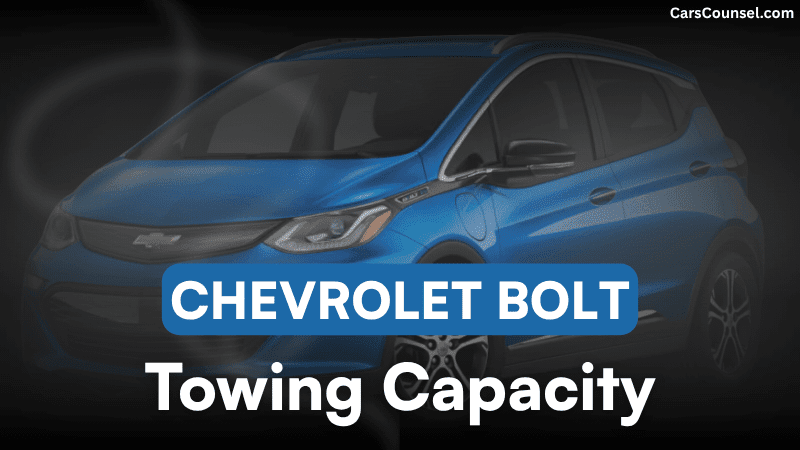
The Chevrolet Bolt is a battery electric subcompact vehicle produced under General Motors’ Chevrolet brand. It has been sold in two primary body styles: the Bolt EV hatchback (2017-2023) and the Bolt EUV crossover (2022-2023), with a next-generation model returning for the 2027 model year.
Chevrolet does not publish an official factory tow rating for the Bolt in the U.S. or Canadian markets.
Across all model years from 2017 through 2023, towing is listed as “not recommended” in the owner’s manual, and no factory tow package was offered.
This guide documents the official manufacturer position, available aftermarket hitch ratings, payload limits, and critical safety considerations for Bolt owners by model year.
Operating any vehicle beyond manufacturer-rated limits can compromise braking performance, drivetrain integrity, and structural components.
Following the limits documented in the owner’s manual and any third-party hitch certification is essential for safe operation.
Quick Navigation
2027 Chevrolet Bolt Towing Capacity
The 2027 Chevrolet Bolt is a redesigned next-generation model returning after a production hiatus from 2024 through 2026. It uses a new LFP (lithium iron phosphate) battery and a 210-horsepower front-mounted electric motor. Chevrolet again does not publish an official factory tow rating for this model.
| Specification | Detail |
|---|---|
| Motor / Powertrain | Single electric motor, 210 hp, front-wheel drive |
| Battery | LFP (lithium iron phosphate) |
| Official Factory Tow Rating | Not rated – towing not recommended (Chevrolet) |
| Aftermarket Hitch Rating (EcoHitch est.) | 3,000 lbs (1,361 kg) GTW / 450 lbs (204 kg) TW |
| Maximum Payload Capacity | TBD – consult door jamb placard |
| Gross Combined Weight Rating (GCWR) | Not published by manufacturer |
| Tongue Weight Limit (aftermarket) | 450 lbs (204 kg) estimated |
| Hitch Class (aftermarket) | Class III – 2-inch receiver |
| Factory Tow Package | No |
| Fifth-Wheel / Gooseneck Capacity | N/A |
The 2027 Chevrolet Bolt carries no official Chevrolet tow rating, and Chevy’s own website confirms towing is not supported. Aftermarket hitch manufacturers such as EcoHitch and CURT have produced Class III receiver hitches for the 2027 platform with estimated ratings of up to 3,000 lbs (1,361 kg) GTW and 450 lbs (204 kg) tongue weight, though these are third-party estimates and not manufacturer-certified towing specifications. Owners must verify payload availability using the door jamb placard before any towing activity.
2023 Chevrolet Bolt EV / EUV Towing Capacity
The 2023 model year was the final production year for the first-generation Bolt lineup, offered in both the EV hatchback and EUV crossover variants. Both variants share the 65 kWh lithium-ion battery and front-wheel-drive electric motor producing 200 horsepower. Neither variant carries a factory tow rating from Chevrolet.
| Specification | Detail |
|---|---|
| Motor / Powertrain | Single electric motor, 200 hp, front-wheel drive |
| Battery | 65 kWh lithium-ion |
| Official Factory Tow Rating | Not rated – towing not recommended (Chevrolet) |
| Aftermarket Hitch Rating (Draw-Tite / EcoHitch) | Up to 2,000 lbs (907 kg) GTW / 300 lbs (136 kg) TW |
| Maximum Payload Capacity | Approx. 900 lbs (408 kg) combined passengers and cargo |
| GVWR | Approx. 4,500 lbs (2,041 kg) |
| Curb Weight | Approx. 3,600 lbs (1,633 kg) EV; 3,679 lbs (1,669 kg) EUV |
| Tongue Weight Limit (aftermarket) | 300 lbs (136 kg) |
| Hitch Class (aftermarket) | Class III – 2-inch receiver |
| Factory Tow Package | No |
| Fifth-Wheel / Gooseneck Capacity | N/A |
The 2023 Chevrolet Bolt EV and EUV are not certified for trailer towing under manufacturer guidelines, and no factory hitch package was offered. Aftermarket hitches from Draw-Tite and EcoHitch are rated up to 2,000 lbs (907 kg) GTW and 300 lbs (136 kg) tongue weight for this platform. Practical towing loads for owners using third-party hitches are typically kept between 500 and 1,500 lbs (227-680 kg) to preserve braking margins and battery range.
2022 Chevrolet Bolt EV / EUV Towing Capacity
The 2022 model year introduced the Bolt EUV as a new, slightly larger crossover variant alongside the refreshed Bolt EV hatchback. Both models share the same 65 kWh battery, 200 hp front-wheel-drive powertrain, and the same absence of factory tow rating.
| Specification | Detail |
|---|---|
| Motor / Powertrain | Single electric motor, 200 hp, front-wheel drive |
| Battery | 65 kWh lithium-ion |
| Official Factory Tow Rating | Not rated – towing not recommended (Chevrolet) |
| Aftermarket Hitch Rating (Draw-Tite – EUV) | Up to 2,000 lbs (907 kg) GTW / 300 lbs (136 kg) TW |
| Maximum Payload Capacity | Approx. 900 lbs (408 kg) combined |
| GVWR | Approx. 4,500 lbs (2,041 kg) |
| Curb Weight | 3,589 lbs (1,628 kg) EV; 3,679 lbs (1,669 kg) EUV |
| Tongue Weight Limit (aftermarket) | 300 lbs (136 kg) |
| Hitch Class (aftermarket) | Class III – 2-inch receiver |
| Factory Tow Package | No |
| Fifth-Wheel / Gooseneck Capacity | N/A |
The 2022 Bolt EUV is one of the more common platforms for aftermarket hitch installation, with Draw-Tite offering a Class III receiver rated to 2,000 lbs (907 kg) GTW and 300 lbs (136 kg) tongue weight specifically verified for the 2022-2023 EUV. The Bolt EV for 2022 shares the same powertrain and structural configuration as the EUV, with curb weights documented at 3,589 lbs (1,628 kg) and 3,679 lbs (1,669 kg) respectively. No weight-distributing hitch compatibility is supported, as these platforms are not rated for heavy towing.
2021 Chevrolet Bolt EV Towing Capacity
The 2021 Bolt EV was a transitional year that introduced interior and infotainment updates while retaining the same powertrain. Chevrolet maintained the “towing not recommended” position for this model year.
| Specification | Detail |
|---|---|
| Motor / Powertrain | Single electric motor, 200 hp, front-wheel drive |
| Battery | 65 kWh lithium-ion |
| Official Factory Tow Rating | Not rated – towing not recommended (Chevrolet) |
| Aftermarket Hitch Rating | Up to 2,000 lbs (907 kg) GTW / 200-300 lbs (91-136 kg) TW |
| Maximum Payload Capacity | Approx. 950 lbs (431 kg) combined |
| GVWR | Approx. 4,513 lbs (2,047 kg) |
| Curb Weight | Approx. 3,563 lbs (1,616 kg) |
| Tongue Weight Limit (aftermarket) | 200-300 lbs (91-136 kg) |
| Hitch Class (aftermarket) | Class III – 2-inch receiver |
| Factory Tow Package | No |
| Fifth-Wheel / Gooseneck Capacity | N/A |
The 2021 Chevrolet Bolt EV shares its powertrain and vehicle architecture with the 2017-2020 generation, including a GVWR of approximately 4,513 lbs (2,047 kg) and a curb weight around 3,563 lbs (1,616 kg). Payload capacity of approximately 950 lbs (431 kg) covers all passengers and cargo combined, limiting the practical tongue weight that can be added without exceeding the GVWR. Chevrolet’s official stance for this model year remains that trailer towing is not recommended.
2020 Chevrolet Bolt EV Towing Capacity
The 2020 Bolt EV received minor updates and continued with the same core electric drivetrain configuration introduced in 2017. The manufacturer towing position remained unchanged from prior years.
| Specification | Detail |
|---|---|
| Motor / Powertrain | Single electric motor, 200 hp, front-wheel drive |
| Battery | 60 kWh lithium-ion |
| Official Factory Tow Rating | Not rated – towing not recommended (Chevrolet) |
| Aftermarket Hitch Rating | Up to 2,000 lbs (907 kg) GTW / 200 lbs (91 kg) TW |
| Maximum Payload Capacity | Approx. 950 lbs (431 kg) combined |
| GVWR | Approx. 4,513 lbs (2,047 kg) |
| Curb Weight | Approx. 3,580 lbs (1,620 kg) |
| Tongue Weight Limit (aftermarket) | 200 lbs (91 kg) |
| Hitch Class (aftermarket) | Class III – 2-inch receiver |
| Factory Tow Package | No |
| Fifth-Wheel / Gooseneck Capacity | N/A |
The 2020 Chevrolet Bolt EV retains the same general platform as the 2017-2019 models, with a curb weight of approximately 3,580 lbs (1,620 kg). The EcoHitch aftermarket trailer hitch is compatible with this model year and carries a 2,000 lbs (907 kg) GTW and 300 lbs (136 kg) tongue weight rating. Staying within payload limits is critical, as tongue weight directly adds to the vehicle’s gross weight and reduces available passenger and cargo capacity.
2019 Chevrolet Bolt EV Towing Capacity
The 2019 Bolt EV was a carryover model year with no significant powertrain changes. The official manufacturer tow rating remained absent.
| Specification | Detail |
|---|---|
| Motor / Powertrain | Single electric motor, 200 hp, front-wheel drive |
| Battery | 60 kWh lithium-ion |
| Official Factory Tow Rating | Not rated – towing not recommended (Chevrolet) |
| Aftermarket Hitch Rating | Up to 2,000 lbs (907 kg) GTW / 300 lbs (136 kg) TW |
| Maximum Payload Capacity | Approx. 950 lbs (431 kg) combined |
| GVWR | Approx. 4,513 lbs (2,047 kg) |
| Curb Weight | Approx. 3,580 lbs (1,620 kg) |
| Tongue Weight Limit (aftermarket) | 300 lbs (136 kg) |
| Hitch Class (aftermarket) | Class III – 2-inch receiver |
| Factory Tow Package | No |
| Fifth-Wheel / Gooseneck Capacity | N/A |
The 2019 Chevrolet Bolt EV has no official tow rating from Chevrolet, with the owner’s manual listing trailer towing as not recommended for normal consumer use. Third-party hitch systems designed for the first-generation Bolt platform provide an aftermarket reference of up to 2,000 lbs (907 kg) GTW, though these are hitch manufacturer ratings and not vehicle certifications. Owners must account for tongue weight within the available payload envelope, as the total GVWR limits all combined loads.
2018 Chevrolet Bolt EV Towing Capacity
The 2018 Bolt EV was a direct carryover from the launch year with no major drivetrain or structural changes. Chevrolet maintained the same “not recommended” towing stance.
| Specification | Detail |
|---|---|
| Motor / Powertrain | Single electric motor, 200 hp, front-wheel drive |
| Battery | 60 kWh lithium-ion |
| Official Factory Tow Rating | Not rated – towing not recommended (Chevrolet) |
| Aftermarket Hitch Rating | Up to 2,000 lbs (907 kg) GTW / 300 lbs (136 kg) TW |
| Maximum Payload Capacity | Approx. 950 lbs (431 kg) combined |
| GVWR | Approx. 4,513 lbs (2,047 kg) |
| Curb Weight | Approx. 3,580 lbs (1,620 kg) |
| Tongue Weight Limit (aftermarket) | 300 lbs (136 kg) |
| Hitch Class (aftermarket) | Class III – 2-inch receiver |
| Factory Tow Package | No |
| Fifth-Wheel / Gooseneck Capacity | N/A |
The 2018 Chevrolet Bolt EV shares the same BEV2 platform with identical powertrain and weight specifications as the 2017 model year. Aftermarket hitch compatibility exists through the EcoHitch product line, which covers 2017-2024 Bolt EV models with a uniform 2,000 lbs (907 kg) GTW and 300 lbs (136 kg) tongue weight rating. No factory tow package, trailer brake controller provision, or integrated hitch was available on this model year.
2017 Chevrolet Bolt EV Towing Capacity
The 2017 Chevrolet Bolt EV was the launch year for the nameplate, entering production as a five-passenger subcompact electric hatchback. No factory tow rating was assigned at launch or for any subsequent production year of the first-generation model.
| Specification | Detail |
|---|---|
| Motor / Powertrain | Single electric motor, 200 hp, front-wheel drive |
| Battery | 60 kWh lithium-ion |
| Official Factory Tow Rating | Not rated – towing not recommended (Chevrolet) |
| Aftermarket Hitch Rating | Up to 2,000 lbs (907 kg) GTW / 300 lbs (136 kg) TW |
| Maximum Payload Capacity | Approx. 950 lbs (431 kg) combined |
| GVWR | Approx. 4,513 lbs (2,047 kg) |
| Curb Weight | Approx. 3,580 lbs (1,620 kg) |
| Tongue Weight Limit (aftermarket) | 300 lbs (136 kg) |
| Hitch Class (aftermarket) | Class III – 2-inch receiver |
| Factory Tow Package | No |
| Fifth-Wheel / Gooseneck Capacity | N/A |
The 2017 Chevrolet Bolt EV has no official towing capacity from Chevrolet, and the owner’s manual does not include a trailer tow weight rating. Aftermarket hitch manufacturer EcoHitch covers the 2017 Bolt EV in its product line, listing a 2,000 lbs (907 kg) towing weight and 300 lbs (136 kg) tongue weight limit as third-party specifications tested to SAE J684 towing safety standards. Community use cases on the first-generation platform typically involve small utility trailers, motorcycle transport trailers, and cargo platforms well under 1,000 lbs (454 kg).
Towing Equipment and Setup Considerations
Because Chevrolet does not certify the Bolt for towing, none of the typical factory tow package components are available from the manufacturer. Owners who choose to tow with an aftermarket hitch should understand the equipment requirements and limitations specific to this platform.
Aftermarket Hitch Selection
Hitches compatible with the Bolt EV and EUV are available from manufacturers including EcoHitch (Torklift), Draw-Tite, and CURT. These products install using existing factory mounting points and require no drilling. Hitch ratings from these manufacturers range from 2,000 lbs (907 kg) to 3,000 lbs (1,361 kg) GTW depending on model year and specific product, but these are hitch component ratings and not vehicle tow certifications.
Payload and GVWR Constraints
Tongue weight is counted against the vehicle’s payload capacity. For first-generation Bolt models, total payload is approximately 900-950 lbs (408-431 kg) for all passengers and cargo combined. Adding tongue weight directly reduces available passenger and cargo capacity. The vehicle’s GVWR must not be exceeded regardless of what the aftermarket hitch is rated to handle.
Trailer Brake Requirements
No integrated trailer brake controller connection is available from Chevrolet for the Bolt. For any trailer that exceeds brake requirements under applicable state or provincial law, an independent aftermarket brake controller would need to be installed. Most jurisdictions require trailer brakes for trailers over 1,500 lbs (680 kg) of gross trailer weight.
Normal vs. Heavy Towing Setup Reference
| Factor | Light Towing (under 1,000 lbs) | Heavier Towing (1,000-2,000 lbs) |
|---|---|---|
| Hitch Required | Class III aftermarket | Class III aftermarket (higher-rated variant) |
| Trailer Brakes | Generally not required | Verify by jurisdiction |
| Range Impact | 20-35% estimated reduction | 35-50% estimated reduction |
| Charging Stop Planning | Moderate increase | Significant increase needed |
| Tongue Weight Margin | Easily within payload | Must calculate against remaining payload |
| Weight Distribution Hitch | Not compatible / not needed | Not compatible with Bolt platform |
If you’re researching Chevrolet towing capacity, be sure to explore our detailed guides on models like the Chevrolet Cruze, Chevrolet Colorado Z71, Chevrolet Blazer, and Chevrolet Avalanche. Knowing your vehicle’s towing limits is essential for safe and efficient hauling. Our expert resources break down towing capacity by model, explain key factors like engine power and braked vs unbraked limits, and help you choose the right setup so you can tow with confidence and avoid unnecessary strain on your vehicle.
Frequently Asked Questions
What is the maximum towing capacity of a Chevrolet Bolt?
Chevrolet does not publish an official tow rating for any Bolt EV or Bolt EUV model year sold in the United States or Canada. Aftermarket hitch manufacturers rate their Class III receiver hitches for first-generation models at up to 2,000 lbs (907 kg) GTW and 300 lbs (136 kg) tongue weight, though these are component ratings and not manufacturer-certified towing capacities.
How much can a Chevrolet Bolt tow with an aftermarket hitch?
Third-party hitch products from EcoHitch and Draw-Tite are rated for up to 2,000 lbs (907 kg) gross trailer weight and 300 lbs (136 kg) tongue weight for 2017-2023 models. The 2027 Bolt EcoHitch carries an estimated 3,000 lbs (1,361 kg) GTW and 450 lbs (204 kg) tongue weight. These ratings are from hitch manufacturers and must be evaluated against the vehicle’s available payload capacity before any towing.
Does the Chevrolet Bolt have a factory tow package?
No. Chevrolet has never offered a factory tow package for any Bolt EV or Bolt EUV model year. The owner’s manual explicitly states that trailer towing is not recommended for normal consumer use. Any towing performed on the Bolt platform uses entirely aftermarket components installed by the owner.
What trailer weight is safe for a Chevrolet Bolt?
With an aftermarket hitch installed, cautious owners typically limit total trailer weight to between 500 and 1,500 lbs (227-680 kg) to maintain adequate braking margins and preserve battery range. Tongue weight must be kept within 10-15% of trailer weight and must not push total vehicle weight above the GVWR listed on the door jamb placard.
Does FWD (front-wheel drive) affect Bolt towing performance?
The Chevrolet Bolt uses front-wheel drive across all model years, which is a limiting factor for towing stability compared to rear-wheel drive or all-wheel drive platforms. Tongue weight pressing down on the rear of the vehicle while the drive axle is at the front creates a potential for trailer sway at higher speeds. Keeping trailer loads light and well below any hitch rating helps mitigate this risk.
Do I need a weight-distributing hitch for a Chevrolet Bolt?
No. Weight-distributing hitches are not compatible with the Bolt platform. Draw-Tite’s Class III hitch for the 2022-2023 Bolt EUV is explicitly rated as not suitable for use with weight distribution systems. The lightweight trailer loads appropriate for this platform do not require weight distribution equipment.
Conclusion
The Chevrolet Bolt EV and Bolt EUV, produced from 2017 through 2023, carry no official factory tow rating from Chevrolet across any model year. The 2027 next-generation Bolt continues this pattern, with Chevrolet confirming no quoted towing figures for the vehicle. For owners who proceed with aftermarket hitch installations, third-party hitch ratings of up to 2,000 lbs (907 kg) for first-generation models and an estimated 3,000 lbs (1,361 kg) for the 2027 model represent the outer limits available, not manufacturer-certified towing specifications.
Payload capacity, GVWR, tongue weight, and braking performance all impose practical constraints that are more restrictive than the hitch hardware rating alone. The Bolt’s front-wheel-drive configuration, compact size, and absence of factory tow provisions mean that towing, when performed, requires careful load planning, aftermarket equipment selection, and route planning to account for reduced driving range.
Always verify specifications using the owner’s manual and door jamb payload placard before towing any load.