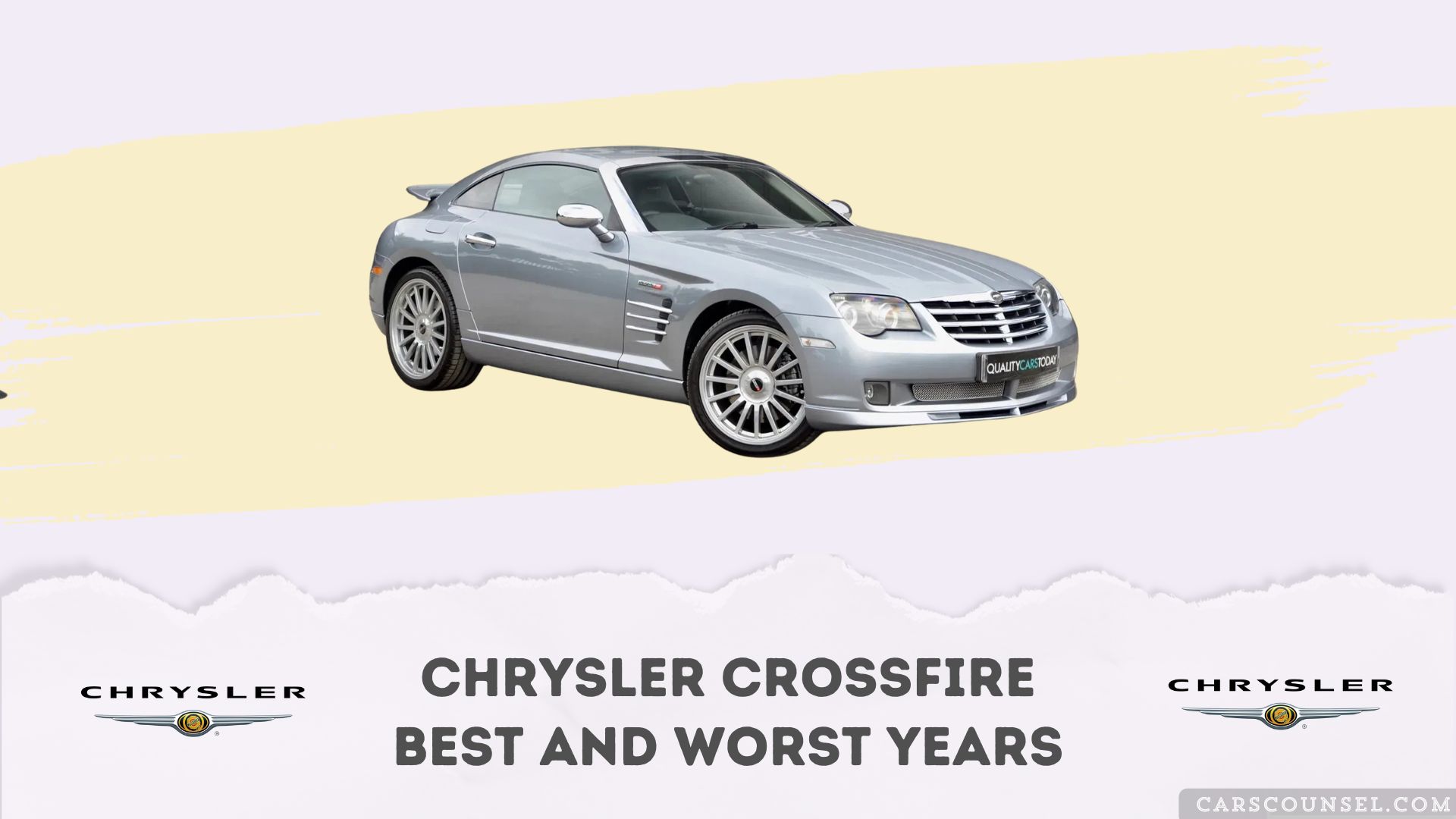
The best Chrysler Crossfire years are 2007 and 2008, offering the most refined reliability and ironed-out electronics. Buyers should approach the 2004 model year carefully due to first-year electrical gremlins and relay control module failures.
Rankings are comparative, and no used sports car is flawless. Proper maintenance, rust prevention, and a thorough pre-purchase inspection remain essential for any Crossfire.
Meaningful differences exist between the standard V6 and the supercharged SRT-6, as well as between the coupe and roadster body styles.
Quick Navigation
Best and Worst Chrysler Crossfire Years at a Glance
| Model Year | Verdict | Main Reason | Buyer Guidance |
|---|---|---|---|
| 2004 | Approach Carefully | First-year electrical and RCM issues | Verify RCM replacement and electrical health |
| 2005-2006 | Good Choice | Improved reliability, SRT-6 availability | Check supercharger service on SRT-6 models |
| 2007-2008 | Best Choice | Most refined, fewer electronic faults | Prioritize low-mileage, well-documented examples |
Key Takeaways
- 2007 and 2008 are the strongest choices for overall reliability.
- 2004 models require careful inspection of the Relay Control Module.
- The SRT-6 offers enthusiast performance but demands strict maintenance.
- Takata airbag recalls affect all years; verify VIN completion.
- Manual and automatic transmissions are robust if properly serviced.
- Always check central locking and window regulator operation.
How We Evaluated the Chrysler Crossfire Model Years
Our analysis considers official recalls, manufacturer service campaigns, and consumer complaint patterns. We weigh powertrain differences, generation changes, and repair complexity.
Complaints are not confirmed defects or failure rates. A recall does not automatically make a year unreliable, and recent years have less ownership history.
Best means comparatively stronger, not flawless. We prioritize exact-model evidence over shared-platform assumptions to guide used buyers.
Best Chrysler Crossfire Years
2007-2008: Best Choice
The final production years represent the most refined versions of the Crossfire. Chrysler and Karmann resolved many early electrical gremlins by this point.
These models benefit from mature assembly processes and updated software. The standard 3.2L V6 remains a robust Mercedes-derived powertrain.
Buyers should still prioritize low-mileage examples with documented service history. Rust prevention and garage storage heavily influence long-term condition.
2005-2006: Good Choice
These middle years show improved reliability over the launch model. They are particularly notable for offering the high-performance SRT-6 variant.
The standard V6 models are solid daily drivers or weekend cars. The five-speed automatic and six-speed manual transmissions are generally durable.
Ensure the previous owner followed strict maintenance intervals. Mercedes-derived components require precise fluid specifications and timely service.
Best Year by Buyer Type
- Best Overall: 2008 (Most refined, lowest complaint volume)
- Best Enthusiast Choice: 2005 SRT-6 (Supercharged AMG performance)
- Best Budget Option: 2006 (Depreciated, but mechanically sorted)
Years to Approach Carefully
2004: Approach Carefully
The inaugural model year suffers from typical first-year production issues. The Relay Control Module (RCM) is a known failure point.
A failing RCM can cause stalling, no-start conditions, and erratic gauge behavior. Replacing it requires specialized knowledge and can be costly.
Early models also experience more frequent central locking and window regulator failures. Only consider a 2004 if the RCM has been updated.
Common Chrysler Crossfire Problems
Electrical and RCM Failures
The Relay Control Module manages critical engine and body functions. Moisture intrusion or internal solder failure can leave the car stranded.
Symptoms include random stalling, dead batteries, and warning light clusters. Verify if the RCM has been replaced or repaired by a specialist.
Window Regulator and Central Locking
Door lock actuators and window regulators are prone to wear. The plastic clips and internal gears can degrade over time.
Owners report windows dropping unexpectedly or doors refusing to unlock via the key fob. Replacement parts are available but require door panel removal.
Airbag Inflator Recalls
Crossfires are included in the massive Takata airbag recall. The passenger-side inflator can rupture during deployment, sending metal shrapnel into the cabin.
This is a critical safety hazard. Buyers must run the VIN through the NHTSA database to ensure the recall repair was completed.
Repair-Cost Overview
| Problem | Commonly Affected Years | Approximate Repair Range | Important Notes |
|---|---|---|---|
| RCM Replacement | 2004-2006 | $400 – $800 | Requires specialized diagnostic tools |
| Window Regulator | 2004-2008 | $250 – $450 | Labor intensive door panel removal |
| Ignition Switch | 2004-2005 | $200 – $350 | Can cause no-start conditions |
Repair costs vary significantly by region, labor rate, and parts choice. Dealer rates for Mercedes-derived components are typically higher than independent European specialists.
What to Check Before Buying a Used Chrysler Crossfire
- Verify the VIN for open Takata airbag recalls.
- Test the central locking system and all power windows.
- Inspect the Relay Control Module for signs of water damage.
- Check for uneven tire wear indicating alignment issues.
- Test the convertible top operation on Roadster models.
- Review service records for Mercedes-specific fluid changes.
- Scan for hidden diagnostic trouble codes.
- Arrange an independent inspection by a European car specialist.
Related Buying Guides
- Chrysler 300 best and worst years – A practical sedan alternative with available V8 power.
- Chrysler Pacifica best and worst years – For buyers needing family space instead of a two-seat coupe.
- Chrysler 200 best and worst years – A more modern, budget-friendly daily driver option.
- Chrysler PT Cruiser years to avoid – Another retro-styled Chrysler with unique reliability patterns.
Frequently Asked Questions
What is the best Chrysler Crossfire year?
The 2008 model year is the best choice. It benefits from late-production refinements and generally shows the lowest volume of consumer complaints.
Is the Chrysler Crossfire reliable?
The Crossfire is moderately reliable when properly maintained. Its Mercedes-derived powertrain is robust, but early electrical components require careful inspection.
Are Crossfire parts expensive?
Maintenance costs are higher than average domestic cars. Many mechanical and electronic components are shared with the Mercedes-Benz SLK320, requiring premium parts.
What is the SRT-6 Crossfire?
The SRT-6 is a high-performance variant produced for 2005 and 2006. It features a supercharged 3.2L V6 and AMG-tuned suspension.
Does the Crossfire have a timing belt?
No, the 3.2L V6 engine uses a timing chain. It is generally designed to last the life of the engine if oil changes are maintained.
Is the Crossfire a Mercedes?
It is a joint venture. The Crossfire uses the chassis, engine, and transmission from the Mercedes-Benz R170 SLK320, but features unique Chrysler styling.
Which Chrysler Crossfire Year Should You Buy?
Target the 2007 and 2008 model years for the most dependable ownership experience. These late-production cars offer the best balance of style and sorted electronics.
Avoid rushing into a 2004 model unless the Relay Control Module has been professionally addressed. Always verify Takata recall completion before purchasing.
Prioritize examples with extensive service records. An independent pre-purchase inspection by a European specialist is highly recommended to uncover hidden faults.

