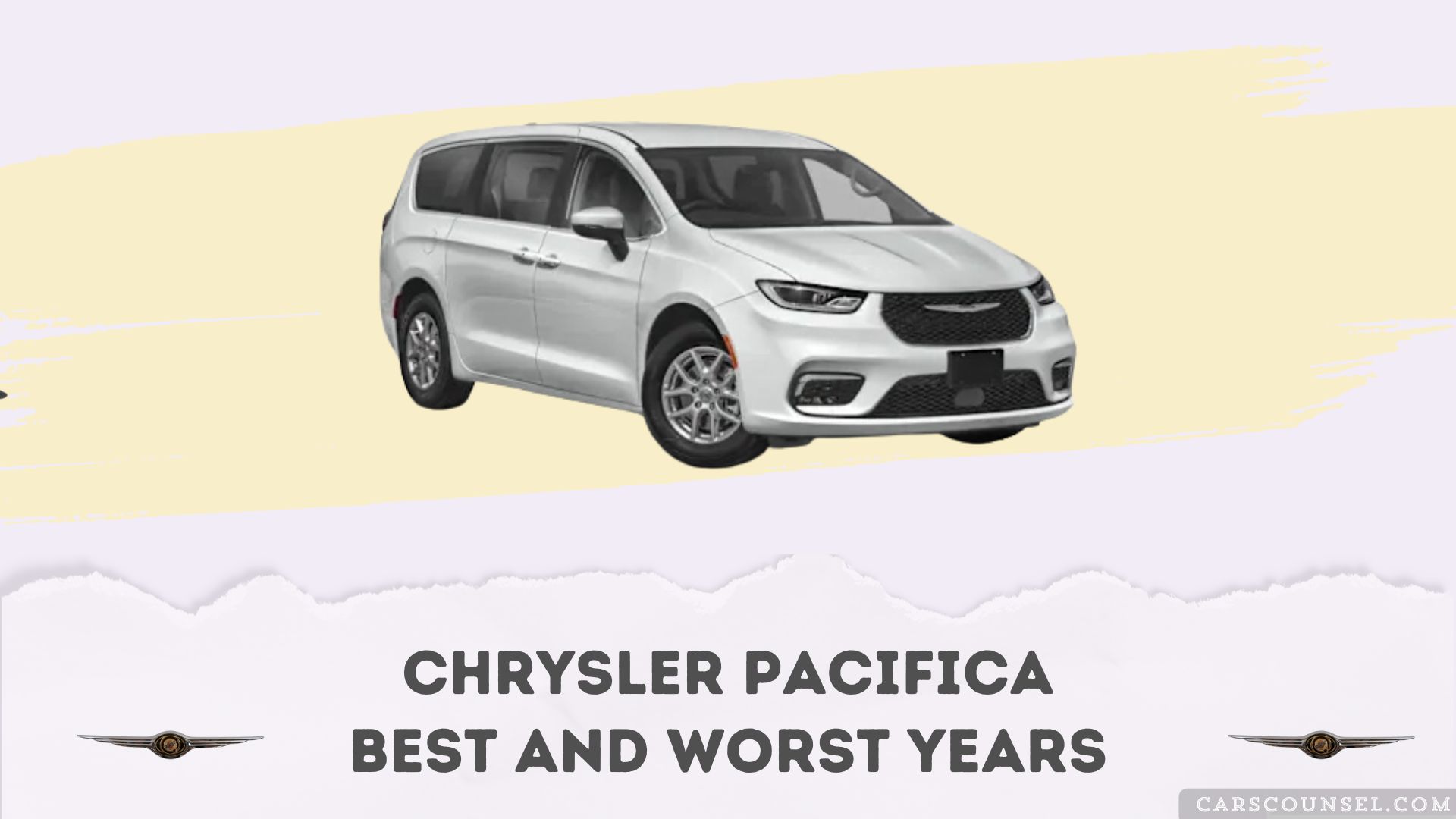
The best Chrysler Pacifica model years are 2019 through 2023. These minivan model years benefit from mature powertrain tuning and resolved first-year electrical bugs.
We recommend avoiding the 2017 model year entirely due to severe transmission and electrical complaints. Buyers should also approach early first-generation crossovers (2004-2006) with extreme caution due to structural rust.
No used minivan is flawless. Your final choice must depend on verified service history, current recall status, and a thorough pre-purchase inspection. Configuration choices, such as the plug-in hybrid versus the standard V6, also significantly impact long-term ownership costs.
Quick Navigation
Best and Worst Chrysler Pacifica Years at a Glance
| Model Year | Verdict | Main Reason | Buyer Guidance |
|---|---|---|---|
| 2021-2023 | Best Late-Generation Choice | Refreshed styling, AWD availability, mature platform | Prioritize for modern families |
| 2019-2020 | Good Choice | Improved transmission software, fewer electrical issues | Verify sliding door operation |
| 2018 | Approach Carefully | Lingering first-generation bugs, PHEV fire recall risk | Check recall completion carefully |
| 2017 | Avoid | Massive complaint volume, shifting and stalling issues | Skip this first-year redesign |
| 2007-2008 | Approach Carefully | Best of the early crossovers, but age and rust remain | Inspect subframe thoroughly |
| 2004-2006 | Avoid | Severe engine cradle rot, aging electrical systems | Too risky for most buyers |
| 2024-2025 | Too New to Judge | Insufficient long-term reliability data | Rely on warranty coverage |
Key Takeaways
- The 2021 through 2023 model years offer the best balance of modern features and resolved mechanical bugs.
- Avoid the 2017 debut year of the modern minivan due to widespread transmission and electrical failures.
- The 3.6L Pentastar V6 engine requires close inspection of the plastic oil filter housing for cracks and leaks.
- First-generation crossovers (2004-2008) are highly susceptible to structural subframe rust.
- Always verify open recalls, especially regarding the 12-volt battery and hybrid fire risks on early PHEV models.
- A pre-purchase inspection is mandatory to check power sliding door motors and transmission shift quality.
How We Evaluated the Chrysler Pacifica Model Years
Our analysis relies on official NHTSA safety records, manufacturer recall campaigns, and aggregated owner complaint data. We weigh the severity and repair complexity of reported defects against total production volume.
Complaint totals reflect owner frustrations, not guaranteed failure rates. A high number of reports does not automatically mean every vehicle will fail. Similarly, a recent recall does not inherently ruin a model year if the dealer remedy is effective and freely available.
We also account for long-term exposure. Recent models naturally have fewer complaints simply because they have spent less time on the road. Finally, we separate distinct configurations, as the plug-in hybrid system carries unique risks compared to the standard gasoline V6.
Best Chrysler Pacifica Years
2021 Through 2023
These model years represent the best late-generation choices for used buyers. Chrysler introduced a significant exterior refresh and added available all-wheel drive during this period.
The 3.6L V6 and nine-speed automatic transmission had received multiple software updates by this point, resulting in much smoother shift quality. Most early electrical gremlins were ironed out at the factory.
2019 and 2020
These years are solid good choices for budget-conscious families. By 2019, Chrysler had issued several technical service bulletins to address the harsh shifting of the early nine-speed transmission.
Owner complaints dropped significantly compared to the launch years. While you should still test the infotainment system and sliding doors, the core powertrain is generally dependable if properly maintained.
Best Year by Buyer Type
- Best Overall: 2022 (Mature platform, modern safety tech, AWD availability)
- Best Budget Option: 2019 (Lower depreciation, major early bugs resolved)
- Best Family Alternative: Honda Odyssey or Toyota Sienna (For buyers seeking traditional V6 or hybrid reliability without the nine-speed transmission quirks)
- Best Fleet / Value Option: Chrysler Voyager (A lower-trim, fleet-oriented sibling that shares the Pacifica’s core architecture but often costs less)
Years to Approach Carefully
2018
The 2018 model year shows improvement over the disastrous launch year, but it still carries lingering risks. Complaint volumes remain higher than average for the segment.
Buyers must be especially careful with Pacifica Hybrid models from this era. Certain 2017 and 2018 plug-in hybrids were recalled due to a potential battery fire risk. Verify that the high-voltage battery software update or hardware repair was completed by a dealer.
2007 and 2008
These are the final years of the first-generation Pacifica crossover. They are mechanically superior to the 2004 through 2006 models, offering an available 4.0L V6 engine.
However, they are now quite old. Structural rust remains a primary concern, and parts for the unique crossover platform can be difficult to source. Only consider these if the subframe is pristine.
Worst Chrysler Pacifica Years
2017
The 2017 Pacifica was a massive undertaking, replacing the long-running Town & Country minivan with an entirely new platform. Unfortunately, first-year redesign bugs plagued this launch.
Owners reported thousands of issues, primarily focusing on the nine-speed transmission hunting for gears or failing entirely. Electrical gremlins, stalling while driving, and premature brake wear are also common. We strongly advise avoiding this model year.
2004 Through 2006
The original Pacifica crossover is largely obsolete for today’s used car buyers. The most severe issue is engine cradle rot, where the front subframe corrodes to the point of structural failure.
Combined with aging wiring harnesses and obsolete transmission control modules, these early crossovers are financial liabilities. The cost of replacing a rusted subframe usually exceeds the vehicle’s total market value.
Chrysler Pacifica Reliability by Generation
First Generation (2004-2008)
Originally marketed as a luxury sports-touring crossover, this generation shares little with the modern minivan. It rode on a modified Chrysler sedan platform.
While comfortable, these vehicles are notorious for severe rust issues in the snowbelt states. The 3.5L V6 is adequate, but the 4.0L V6 introduced later is preferred. Finding a rust-free survivor is exceptionally difficult today.
Second Generation (2017-Present)
This generation marked Chrysler’s return to the minivan segment, directly competing with established rivals. It introduced the 3.6L Pentastar V6 paired with a ZF-sourced nine-speed automatic transmission.
The plug-in hybrid variant was also introduced, offering excellent electric-only range. While the early years struggled with software integration, the platform has matured into a highly capable and comfortable family hauler.
Common Chrysler Pacifica Problems
Transmission Shifting and Software
The early iterations of the nine-speed automatic transmission were notorious for hard shifts, hesitation, and unexpected clunking. This frustrated many owners of the 2017 and 2018 models.
Chrysler released multiple software updates to recalibrate the shift points. When test-driving an older model, ensure the transmission shifts smoothly and that the dealer has applied all available updates.
Pentastar V6 Oil Cooler Housing Leaks
The 3.6L Pentastar V6 uses a plastic oil filter housing and oil cooler assembly that sits in the engine valley. Over time, heat cycles cause this plastic to warp and crack.
Oil leaks into the engine valley, which can lead to severe engine damage if unnoticed. Many owners opt for upgraded aluminum aftermarket housings to permanently resolve this design flaw, a vulnerability also seen in the Jeep Grand Cherokee.
Power Sliding Door Failures
The power sliding doors rely on complex motors, latches, and pinch sensors. Owners frequently report doors that refuse to close, reverse unexpectedly, or fail to latch securely.
Diagnosing the exact failure point requires specialized scan tools. Always test every door repeatedly during your test drive, including the operation of the key fob and overhead buttons.
Electrical Gremlins and ESS Battery Drain
The Engine Start/Stop (ESS) system relies on an auxiliary 12-volt battery. When this smaller battery degrades, it causes widespread electrical chaos, including the dreaded “Shift to P to Start” message.
Many owners choose to disable the ESS system or upgrade the battery to prevent these frustrating dashboard warnings and intermittent stalling events.
Repair-Cost Overview
| Problem | Commonly Affected Years | Approximate Repair Range | Important Notes |
|---|---|---|---|
| Oil Filter Housing/Cooler | 2017-Present | $800 – $1,500 | Aluminum aftermarket housings are recommended |
| Transmission Valve Body | 2017-2019 | $1,000 – $1,800 | Try software updates before replacing hardware |
| Sliding Door Motor/Latch | 2017-Present | $600 – $1,200 | Requires calibration with a dealer scan tool |
| Subframe Replacement | 2004-2008 | $1,500 – $3,000+ | Often exceeds the value of the crossover |
Repair costs vary significantly by region, labor rates, parts choice, and vehicle configuration. Dealership repairs will generally cost more than independent specialists.
What to Check Before Buying a Used Chrysler Pacifica
- Verify the VIN for open recalls, especially concerning the high-voltage battery on Hybrid models.
- Review service records to confirm regular oil changes and transmission fluid services.
- Inspect the engine valley for signs of oil pooling from the plastic filter housing.
- Test all power sliding doors and the power liftgate for smooth operation and secure latching.
- Check the auxiliary 12-volt battery health if the vehicle has the Engine Start/Stop system.
- Look underneath first-generation crossovers for severe flaking or structural rust on the engine cradle.
- Perform a cold-start test to listen for timing chain rattle on high-mileage V6 engines.
- Arrange an independent pre-purchase inspection to scan for hidden body control module codes.
Related Buying Guides
- Chrysler Town & Country best and worst years (The direct predecessor to the modern Pacifica minivan)
- Chrysler Voyager best and worst years (A value-oriented, fleet-focused sibling of the Pacifica)
- Honda Odyssey years to avoid (A primary competitor known for its traditional V6 and smooth transmission)
- Toyota Sienna years to avoid (A rival minivan that transitioned to a standard hybrid powertrain)
- Kia Carnival best and worst years (A modern alternative with SUV-inspired styling and strong warranty coverage)
- Jeep Grand Cherokee years to avoid (Shares the 3.6L Pentastar V6 and similar oil cooler vulnerabilities)
Frequently Asked Questions
What is the most reliable Chrysler Pacifica year?
The 2021 through 2023 model years are currently the most reliable choices. They benefit from a mature platform, refined transmission software, and the addition of available all-wheel drive.
Why should I avoid the 2017 Chrysler Pacifica?
The 2017 model year was the first of the modern minivan generation. It suffers from high complaint volumes regarding harsh transmission shifting, electrical gremlins, and premature brake wear.
Do Chrysler Pacificas have transmission problems?
Early models (2017-2018) experienced rough shifting and hesitation with the nine-speed automatic. Chrysler issued software updates that largely resolved these issues in later model years.
What is the Pentastar oil cooler issue?
The plastic oil filter housing on the 3.6L V6 engine can crack and leak oil into the engine valley. Many owners replace it with an upgraded aluminum housing to prevent severe engine damage.
Are Chrysler Pacifica Hybrids reliable?
Pacifica Hybrids offer excellent efficiency but carry unique risks. Early 2017 and 2018 plug-in models were recalled for high-voltage battery fire risks, making recall verification absolutely critical.
How long do Chrysler Pacificas last?
A well-maintained Pacifica can reach high mileage, but longevity depends heavily on addressing the oil cooler housing and keeping up with transmission fluid services. Individual outcomes vary based on maintenance and rust exposure.
Which Chrysler Pacifica Year Should You Buy?
For most used buyers, the 2021 through 2023 Chrysler Pacifica models represent the smartest investment. These years offer modern safety technology, refined powertrain behavior, and available all-wheel drive.
If you are on a stricter budget, the 2019 and 2020 model years provide excellent value, provided the transmission software is up to date. Always avoid the 2017 debut year and the rust-prone early crossovers.
Regardless of the year you choose, a thorough pre-purchase inspection is mandatory. Verify all recall repairs, check the engine valley for oil leaks, and ensure every power door latches securely before signing the paperwork.

