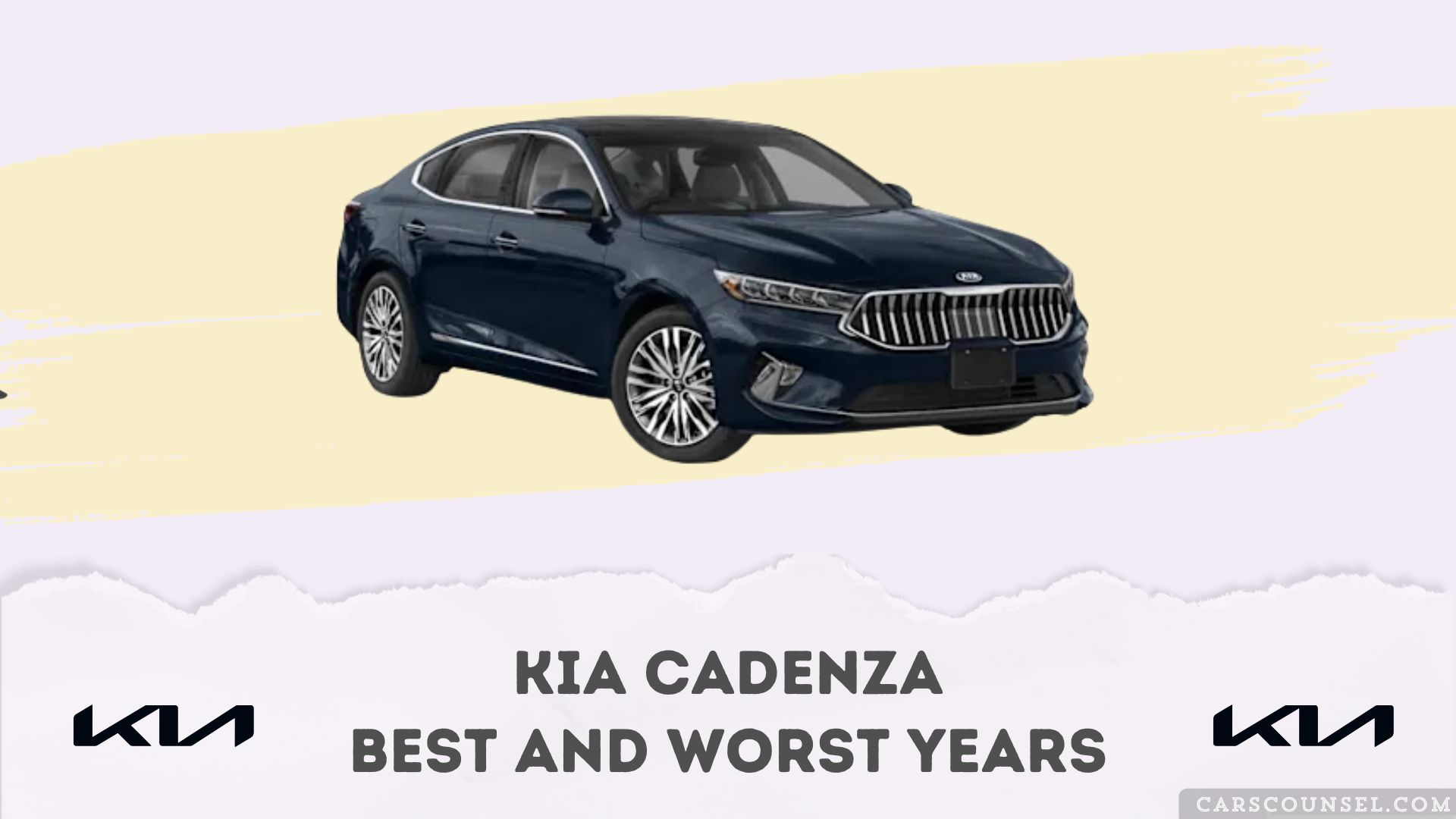
The best Kia Cadenza years are 2018, 2019, and 2020. These models benefit from a mature second-generation platform, the reliable 3.3L Lambda V6 engine, and very few owner complaints.
Buyers should avoid the 2014 and 2015 model years. These early first-generation examples suffer from higher complaint volumes and multiple electrical recalls.
Rankings are comparative, and no used luxury sedan is flawless. Maintenance history matters more than mileage. Configuration differences are minimal, as all US models use the same V6 and automatic transmission.
Quick Navigation
Best and Worst Kia Cadenza Years at a Glance
| Model Year | Verdict | Main Reason | Buyer Guidance |
|---|---|---|---|
| 2020 | Best Late-Generation Choice | Final US year, minimal complaints | Check for open HECU recalls |
| 2018–2019 | Best Choice | Mature platform, excellent reliability | Inspect maintenance records |
| 2017 | Approach Carefully | First-year redesign bugs, HECU recall | Verify recall completion |
| 2016 | Best Older Choice | Final first-generation year | Expect older infotainment tech |
| 2014–2015 | Avoid | High complaints, brake/electrical recalls | Look at newer alternatives |
Key Takeaways
- The 2018 and 2019 model years offer the best blend of luxury and proven reliability.
- Avoid the 2014 and 2015 model years due to electrical gremlins and brake vacuum recalls.
- All US models use the 3.3L Lambda V6, avoiding the problematic Theta II four-cylinder engines.
- The 2017 model year requires careful inspection due to first-year redesign bugs and safety recalls.
- Kia discontinued the Cadenza in the US after the 2020 model year, making parts slightly less abundant than mainstream models.
- Always verify the VIN for open recalls, particularly regarding the HECU electrical circuit.
How We Evaluated the Kia Cadenza Model Years
Our analysis reviews official NHTSA recalls, manufacturer service campaigns, and consumer complaint databases. We evaluate powertrain reliability, generation changes, and repair complexity.
Complaints are not failure rates, and a recall does not automatically make a vehicle unreliable. Recent years have less ownership history, so we prioritize long-term evidence. Best means comparatively stronger, not flawless.
Best Kia Cadenza Years
2018–2019
These years represent the sweet spot of the second generation. Kia resolved most first-year redesign bugs, resulting in excellent reliability scores. The 3.3L Lambda V6 is robust, and the eight-speed automatic gearbox shifts smoothly.
2020
As the final model year in the United States, the 2020 Cadenza benefits from maximum factory refinement. It features updated styling, lane departure warning, and adaptive cruise control. Long-term exposure is limited, but early data is highly favorable.
2016
The final year of the first generation offers a comfortable ride and proven mechanicals. It avoids the early electrical issues of the 2014 launch. Buyers get a spacious luxury sedan at a budget-friendly price point.
Best Year by Buyer Type
Best Overall: 2019 Kia Cadenza. It balances modern safety tech, mature reliability, and strong resale value.
Best Budget Option: 2016 Kia Cadenza. It provides first-generation luxury with most early bugs resolved.
Best Modern Alternative: Buyers wanting a newer warranty should look at the Kia K5 or a certified pre-owned Telluride.
Years to Approach Carefully
2017
The 2017 model year introduced the second-generation redesign. While the new interior and styling are impressive, first-year models experienced infotainment glitches and electrical faults.
Additionally, certain 2017 models are included in a fire-risk recall related to the Hydraulic Electronic Control Unit (HECU). Buyers must verify that the recall remedy was performed before purchasing.
Worst Kia Cadenza Years
2014–2015
The US launch years are the most troublesome. The 2014 model year has the highest volume of NHTSA complaints, focusing on electrical system faults and accessory failures.
Both years are subject to recalls for brake vacuum hose kinking and HECU electrical circuit issues. These problems can lead to reduced braking assist or potential fire risks. We recommend skipping these years in favor of newer models.
Kia Cadenza Reliability by Generation
First Generation (2014–2016)
This generation introduced the Cadenza to the US market. It uses a 3.3L V6 and a six-speed automatic transmission. Early years struggled with electrical gremlins, but the 2016 model year is much more stable.
Second Generation (2017–2020)
A complete redesign brought an eight-speed automatic transmission, sharper styling, and improved structural rigidity. The Lambda V6 engine remained, avoiding the severe engine failure recalls that plagued Kia’s four-cylinder Theta II engines.
Common Kia Cadenza Problems
Electrical and HECU Issues
Some models suffer from faults in the Hydraulic Electronic Control Unit (HECU). This can trigger ABS warning lights or, in rare cases, pose a fire risk. Kia issued recalls to replace the faulty relays.
Infotainment Glitches
Owners of the 2017 and 2018 models occasionally report frozen touchscreens or backup camera failures. These are usually resolved with software updates or module replacements at the dealership.
Speaker and Audio Failures
A recurring complaint across several years involves the premium audio system losing sound. This often requires replacing the external amplifier or checking wiring harness connections.
What to Check Before Buying a Used Kia Cadenza
- Verify the VIN for open recalls, especially the HECU fire-risk campaign.
- Confirm the brake vacuum hose was inspected or replaced on 2014–2015 models.
- Test the infotainment screen, backup camera, and premium audio system for full functionality.
- Check service records for regular oil changes to protect the Lambda V6 engine.
- Inspect the sunroof for rattles or drainage blockages that could cause water leaks.
- Arrange an independent pre-purchase inspection to check suspension bushings and engine mounts.
Related Buying Guides
- Kia Telluride best and worst years: The midsize SUV that ultimately replaced the Cadenza in Kia’s US showroom strategy.
- Kia Optima years to avoid: A smaller, more fuel-efficient sedan option for buyers who do not need full-size luxury dimensions.
- Kia Rio years to avoid: A subcompact alternative for buyers prioritizing maximum fuel economy over luxury features.
- Kia Sedona years to avoid: A practical minivan alternative for families needing maximum passenger space and cargo volume.
- Kia Stinger GT best and worst years: A performance-focused alternative that shares the robust Lambda V6 architecture.
Frequently Asked Questions
What year did Kia stop making the Cadenza?
Kia discontinued the Cadenza in the United States after the 2020 model year. The shift in consumer preference toward SUVs like the Telluride led to its cancellation.
Does the Kia Cadenza have engine problems?
The US Cadenza uses the 3.3L Lambda V6 engine, which is generally reliable. It avoids the severe connecting rod bearing issues that plagued Kia’s four-cylinder Theta II engines.
Is the Kia Cadenza expensive to maintain?
Maintenance costs are reasonable for a luxury sedan. Routine services are affordable, and the V6 engine does not require the complex repairs associated with European luxury rivals.
Are there any fire risk recalls for the Cadenza?
Yes, certain 2017–2019 models were recalled due to a potential short circuit in the HECU module. Buyers must verify the recall remedy was completed by a dealer.
How long can a Kia Cadenza last?
Well-maintained examples can reach high mileage. Longevity depends on strict adherence to oil change intervals, rust prevention, and addressing electrical recalls promptly.
What is the difference between the Cadenza and the K900?
The Cadenza is a front-wheel-drive luxury sedan. The K900 is a larger, rear-wheel-drive flagship sedan with a more powerful engine and a significantly higher price tag.
Choosing the Right Kia Cadenza Model Year
The 2018 and 2019 Kia Cadenza models are the smartest choices for used buyers. They offer a refined luxury experience with excellent reliability and minimal complaints.
Avoid the 2014 and 2015 launch years due to electrical and braking recalls. Always verify the VIN for open safety campaigns before finalizing your purchase.
For broader research, consult our resources on years to avoid across all brands.

