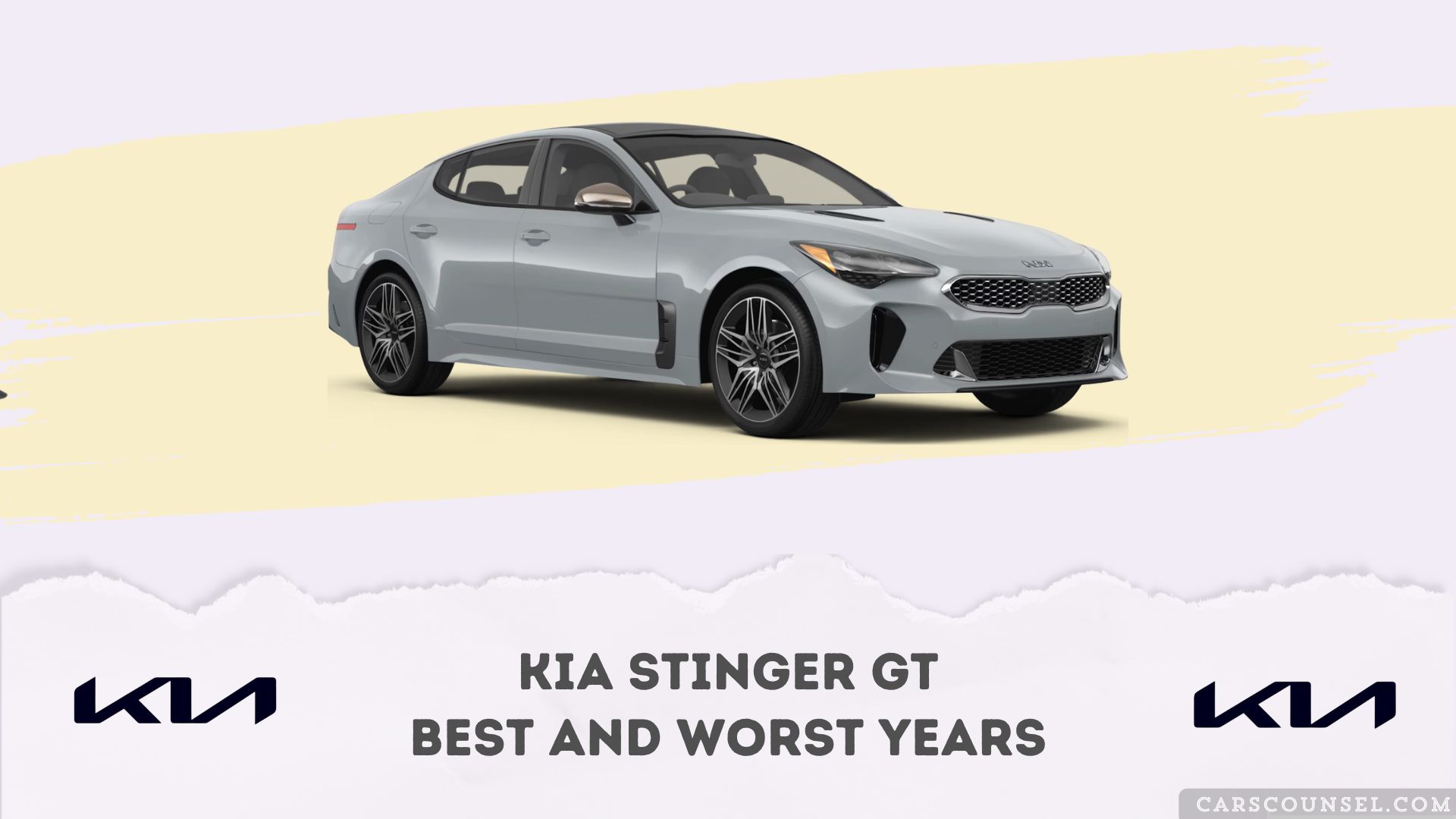
The best Kia Stinger model years are 2021 through 2023, benefiting from the discontinuation of the problematic base engine and a comprehensive mid-cycle refresh. Buyers should approach the 2018 and 2019 model years carefully due to first-year electrical recalls and base engine vulnerabilities.
Rankings for performance sedans remain comparative. No turbocharged sports sedan is flawless, and individual maintenance history matters far more than the factory build year for long-term survivability.
Meaningful differences exist across the powertrains. The early 2.0L turbocharged four-cylinder carries more mechanical risk than the robust 3.3L twin-turbo V6 and the later 2.5L turbocharged four-cylinder.
Quick Navigation
Best and Worst Kia Stinger Years at a Glance
| Model Year Range | Verdict | Main Reason | Buyer Guidance |
|---|---|---|---|
| 2018 | Approach Carefully | First-year wiring harness recalls and 2.0T engine risks. | Verify recall completion and avoid the 2.0T engine. |
| 2019 | Good With Inspection | Fewer first-year bugs, but retains 2.0T and ABS recalls. | Demand strict service records and verify ABS module repair. |
| 2020 | Good Choice | Dropped the 2.0T in the US, leaving only the robust 3.3T V6. | Confirm ABS HECU recall completion and fuel pump campaigns. |
| 2021 | Best Choice | Introduced the reliable 2.5T engine and avoided Theta II risks. | Inspect turbocharger health and verify infotainment updates. |
| 2022-2023 | Best Late-Generation Choice | Mid-cycle refresh, sorted production, and final Tribute Editions. | Demand comprehensive maintenance records for the twin-turbo V6. |
Key Takeaways
- The 2021-2023 models are the strongest choices, featuring the robust 2.5T and 3.3T powertrains.
- Buyers researching years to avoid should be wary of the 2018-2019 models equipped with the 2.0L Theta II engine.
- The 3.3L twin-turbo V6 is widely considered the most reliable and desirable engine configuration.
- A massive ABS module (HECU) fire-risk recall affects 2018-2022 models and must be verified.
- The 2018 model year features an additional front wiring harness recall that poses a severe fire hazard.
- Always verify open NHTSA recalls and arrange an independent pre-purchase inspection.
How We Evaluated the Kia Stinger Model Years
Our analysis considers official NHTSA recalls, manufacturer service campaigns, and long-term ownership patterns for Kia performance vehicles. We evaluate powertrain differences, generation updates, and repair complexity.
Consumer complaints are not confirmed failure rates. A recall does not automatically make a vehicle unreliable, but it requires immediate attention. Recent models have minimal ownership history. Best means comparatively stronger, not flawless.
Best Kia Stinger Years
2022-2023: Best Late-Generation Choice
The 2022 model year introduced a comprehensive mid-cycle refresh with updated exterior styling, a revised interior, and enhanced infotainment technology. These final production years benefit from sorted assembly line processes and the discontinuation of early problematic components.
The 2023 Tribute Edition serves as the send-off for the nameplate, offering exclusive cosmetic features. While these represent the pinnacle of the Stinger’s development, the complex twin-turbo V6 still demands strict, documented maintenance to prevent premature wear.
2021: Best Choice
The 2021 model year marks a critical turning point for the Stinger lineup. Kia replaced the controversial 2.0L Theta II engine with a much more robust 2.5L turbocharged four-cylinder, significantly reducing the risk of catastrophic engine failure for base-model buyers.
These models avoid the worst engine vulnerabilities while retaining the aggressive styling and dynamic chassis tuning that enthusiasts desire. Buyers must still verify that all open ABS and fuel system recalls have been properly addressed by a dealer.
Best Kia Stinger Year by Buyer Type
Best Enthusiast Choice: 3.3L Twin-Turbo V6 (All Years)
The 3.3L Lambda II twin-turbo V6 is the definitive Stinger experience. It avoids the bearing wear issues that plague the early 2.0L four-cylinder and delivers effortless torque, making it the most reliable and engaging configuration for driving enthusiasts.
Years to Approach Carefully
2020: Good Choice
The 2020 model year is a solid option because Kia completely dropped the problematic 2.0L engine from the United States market. Every 2020 Stinger is equipped with the reliable 3.3L twin-turbo V6, eliminating the primary mechanical concern of earlier years.
However, these models remain subject to the massive ABS module fire-risk recall and a secondary fuel pump campaign. Buyers must verify the VIN to ensure all safety campaigns were completed before the vehicle was resold.
2019: Good With Inspection
The 2019 model year ironed out many of the first-year assembly gremlins that plagued the launch models. However, it still offers the 2.0L Theta II engine, which carries a well-documented history of oil consumption and premature bearing wear across the lineup.
If you must purchase a 2019 model, strictly prioritize the 3.3L V6 configuration. Additionally, verify that the dealer has installed the updated fuse and software patch for the HECU ABS module fire recall.
2018: Approach Carefully
The inaugural 2018 model year suffers from the highest concentration of recalls and early-production quality issues. Beyond the standard ABS module fire risk, the 2018 Stinger was subject to a critical recall regarding the front wiring harness in the engine compartment.
This harness could chafe and short-circuit, posing a severe fire hazard even when the vehicle is parked. Combined with the availability of the risky 2.0L Theta II engine, the 2018 model year demands extreme vigilance and a thorough specialist inspection.
Kia Stinger Reliability by Generation
First Generation (2018-2023)
The Stinger spans a single generation built on the CK platform. The Kia Stinger shares its underlying rear-wheel-drive architecture and powertrains with the Genesis G70, though the two feature distinct exterior styling and interior luxury appointments.
The 2022 mid-cycle refresh brought vital software updates, improved aerodynamics, and the discontinuation of early problematic electrical components. The transition from the Theta II to the Smartstream 2.5T engine in 2021 marks the most critical dividing line for long-term reliability.
Common Kia Stinger Problems
Electrical Problems and Fire Risks
The most severe issue affecting 2018-2022 models is a defect in the Hydraulic Electronic Control Unit (HECU) for the anti-lock brakes. Internal corrosion can cause a short circuit, leading to an engine compartment fire even when the vehicle is turned off.
Additionally, 2018 models feature a specific recall for a damaged front wiring harness that can short-circuit. Buyers must verify the VIN to ensure the dealer has installed the mandatory relay kit and software updates to mitigate these severe fire hazards.
Engine Problems (2.0L Theta II)
The 2.0L turbocharged four-cylinder engine used in 2018 and 2019 models belongs to the Theta II family, which is notorious across the Kia lineup for premature rod bearing wear, excessive oil consumption, and catastrophic engine seizure.
While not every 2.0L Stinger will fail, the statistical risk is significantly higher than the V6 models. Buyers are strongly advised to avoid this specific engine configuration or demand extensive documentation proving the engine block was replaced under warranty.
What to Check Before Buying a Used Kia Stinger
- Verify the VIN for open NHTSA recalls, specifically the HECU ABS module and wiring harness fire campaigns.
- Confirm whether the vehicle is equipped with the 2.0L Theta II engine and avoid it if possible.
- Review service records to ensure strict adherence to the severe-duty maintenance schedule for the twin-turbo V6.
- Inspect the turbocharger oil feed lines and coolant reservoirs for signs of leaks or degradation.
- Test the infotainment system and digital instrument cluster for rebooting glitches or screen delamination.
- Arrange an independent pre-purchase inspection with a certified Kia or European performance car specialist.
Related Buying Guides
- Kia Optima years to avoid: A practical midsize sedan alternative for buyers who want daily-driving comfort and fuel efficiency without the high maintenance costs of a twin-turbo sports sedan.
- Kia Telluride best and worst years: A family-focused alternative for buyers who need maximum passenger space and towing capability that the low-slung Stinger cannot provide.
Frequently Asked Questions
Which Kia Stinger year is the most desirable?
The 2022 and 2023 model years are the most desirable. They feature the comprehensive mid-cycle refresh, sorted electrical systems, and the reliable 2.5T and 3.3T powertrains, representing the pinnacle of the nameplate’s development.
Is the Kia Stinger 3.3T reliable?
Yes, the 3.3L Lambda II twin-turbo V6 is widely considered the most reliable engine in the Stinger lineup. It avoids the bearing wear issues of the early 2.0L four-cylinder and offers exceptional durability when properly maintained.
What is the most common Kia Stinger problem?
The most severe problem is the HECU ABS module fire risk affecting 2018-2022 models. Internal corrosion can cause a short circuit and engine compartment fire, requiring a mandatory dealer recall repair to install a fuse and software patch.
Will the Kia Stinger hold its value?
Yes, the Kia Stinger is a discontinued modern classic. Well-maintained, low-mileage examples, particularly the GT2 and 2023 Tribute Edition models, are highly sought after by enthusiasts and have shown strong value retention.
Does the Stinger share parts with the Genesis G70?
Yes, the Stinger shares its underlying rear-wheel-drive architecture, engines, and transmissions with the Genesis G70. However, they feature entirely distinct exterior body panels, interior luxury materials, and suspension tuning characteristics.
Should I buy a used Kia Stinger?
You should only buy a Stinger if you can find a 2021 or newer model, or a 3.3L V6 example with verified recall completion. Individual maintenance history and the avoidance of the 2.0L Theta II engine are critical for long-term ownership.
Choosing the Right Kia Stinger Model Year
The 2021 through 2023 model years offer the ultimate Stinger experience, delivering sorted production quality and the robust 2.5T and 3.3T powertrains. Buyers should approach the 2018-2019 models with extreme caution, strictly avoiding the 2.0L Theta II engine.
Because these are complex turbocharged performance vehicles, individual maintenance history and recall completion dictate the car’s true value. Never finalize a purchase without verifying the VIN for open fire-risk campaigns and arranging an independent specialist inspection.