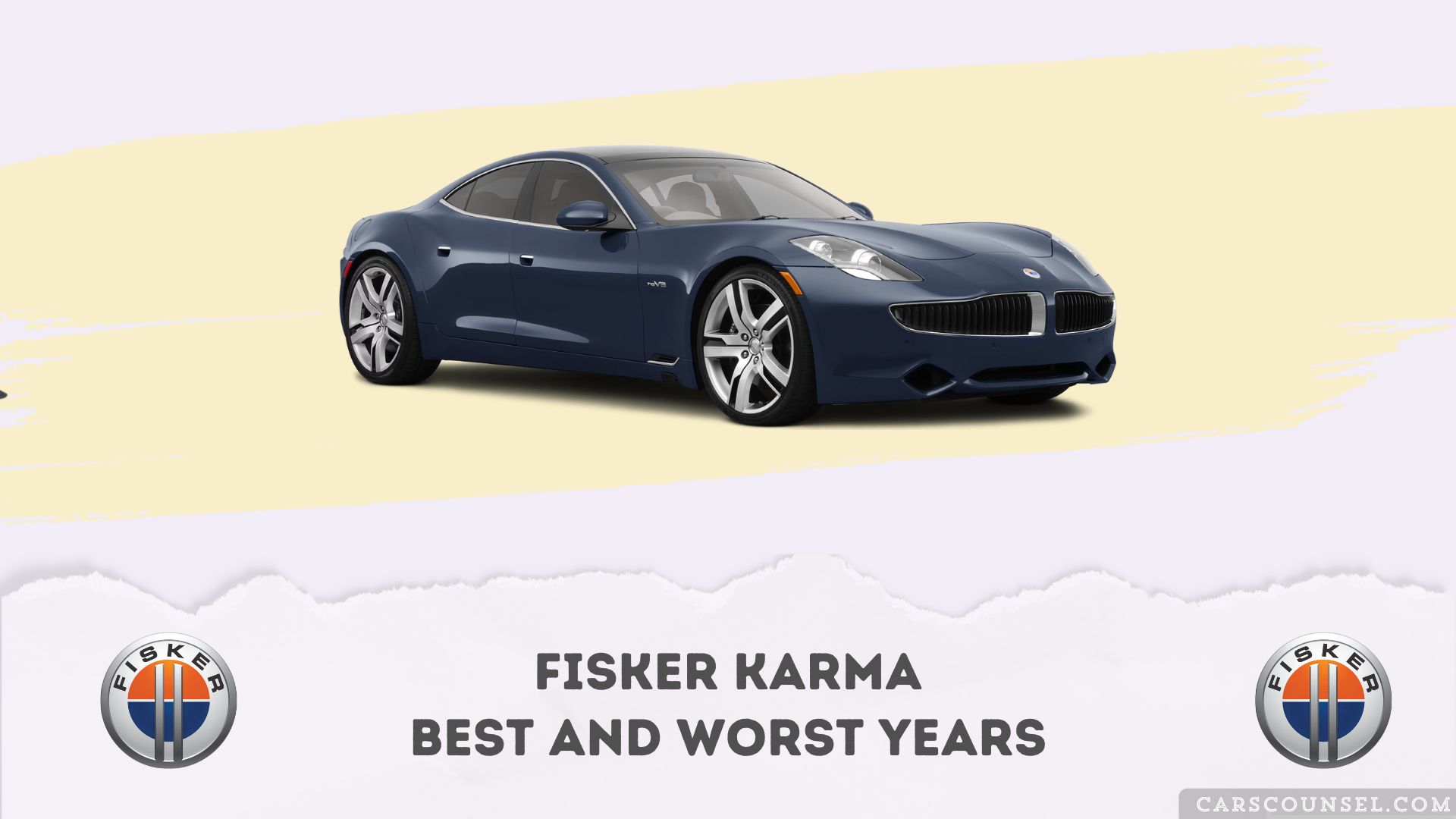
The best Fisker Karma year is the 2012 model, which represents the main production run of this discontinued plug-in hybrid sedan. Buyers should strictly avoid the early 2011 models due to a severe coolant leak fire risk and early production flaws.
Rankings for this rare vehicle are strictly comparative. Because Fisker Automotive went bankrupt in 2013, individual condition, retrofitted battery health, and meticulous maintenance matter far more than the model year.
Meaningful differences exist between the early 2011 builds and the 2012 models. The series-hybrid powertrain relies on a complex 2.0L turbocharged range-extender and an A123 Systems battery pack that requires expert evaluation.
Quick Navigation
Best and Worst Fisker Karma Years at a Glance
| Model Year | Verdict | Main Reason | Buyer Guidance |
|---|---|---|---|
| 2011 | Avoid | Early production coolant leak fire risk. | Verify if the vehicle is part of the 239-unit recall; generally avoid. |
| 2012 | Approach Carefully | Main production; complex hybrid system and parts scarcity. | Confirm battery health, cooling fan recall completion, and specialist support. |
Key Takeaways
- The 2012 model year is the only viable option for collectors, representing the main production run.
- Early 2011 models should be avoided due to a severe coolant leak that posed a battery fire risk.
- The A123 Systems battery pack is highly complex, and replacement parts are extremely scarce.
- Multiple NHTSA recalls addressed fire risks related to the cooling fan and high-voltage battery.
- Always verify the VIN to ensure all open safety recalls and software updates were completed.
- Arrange an independent inspection by a technician certified in high-voltage series hybrids.
How We Evaluated the Fisker Karma Model Years
Our analysis considers official NHTSA recalls, the bankruptcy of Fisker Automotive and A123 Systems, and verified owner reports. We evaluate the unique series-hybrid powertrain, extreme parts scarcity, and the severe impact of high-voltage battery degradation.
Complaints
The best Fisker Karma year is the 2012 model, which represents the main production run of this discontinued plug-in hybrid sedan. Buyers should strictly avoid the early 2011 models due to a severe coolant leak fire risk and early production flaws.
Rankings for this rare vehicle are strictly comparative. Because Fisker Automotive went bankrupt in 2013, individual condition, retrofitted battery health, and meticulous maintenance matter far more than the model year.
Meaningful differences exist between the early 2011 builds and the 2012 models. The series-hybrid powertrain relies on a complex 2.0L turbocharged range-extender and an A123 Systems battery pack that requires expert evaluation.
Best and Worst Fisker Karma Years at a Glance
| Model Year | Verdict | Main Reason | Buyer Guidance |
|---|---|---|---|
| 2011 | Avoid | Early production coolant leak fire risk. | Verify if the vehicle is part of the 239-unit recall; generally avoid. |
| 2012 | Approach Carefully | Main production; complex hybrid system and parts scarcity. | Confirm battery health, cooling fan recall completion, and specialist support. |
Key Takeaways
- The 2012 model year is the only viable option for collectors, representing the main production run.
- Early 2011 models should be avoided due to a severe coolant leak that posed a battery fire risk.
- The A123 Systems battery pack is highly complex, and replacement parts are extremely scarce.
- Multiple NHTSA recalls addressed fire risks related to the cooling fan and high-voltage battery.
- Always verify the VIN to ensure all open safety recalls and software updates were completed.
- Arrange an independent inspection by a technician certified in high-voltage series hybrids.
How We Evaluated the Fisker Karma Model Years
Our analysis considers official NHTSA recalls, the bankruptcy of Fisker Automotive and A123 Systems, and verified owner reports. We evaluate the unique series-hybrid powertrain, extreme parts scarcity, and the severe impact of high-voltage battery degradation.
Complaints and traditional reliability metrics do not apply to a discontinued, low-volume startup vehicle. Ownership history, specialist support, and retrofitted components dictate the experience.
Best Fisker Karma Years
2012 Fisker Karma
The 2012 model year represents the primary production run of the Fisker Karma. While still a highly complex ownership proposition, these examples benefit from the manufacturing updates applied after the initial 2011 launch.
Buyers must approach these cars carefully, as the bankruptcy of battery supplier A123 Systems means that high-voltage battery replacements are incredibly difficult to source and expensive to install.
Best Year by Buyer Type
Best Enthusiast Choice: 2012 Fisker Karma
For automotive historians and EV enthusiasts, the 2012 Karma offers a striking design and a pioneering plug-in hybrid layout. It is strictly a collector’s item that requires a dedicated specialist for maintenance.
Years to Approach Carefully
Approach Carefully: 2012 Fisker Karma
While the 2012 model is the most viable option, it remains a massive mechanical risk. The 2.0-liter turbocharged range-extender and the high-voltage electrical system require constant, specialized attention.
Buyers must verify that the NHTSA recall for the low-temperature cooling fan was properly completed by a qualified facility to prevent high-voltage short circuits.
Worst Fisker Karma Years
Avoid: 2011 Fisker Karma
The earliest Fisker Karma units represent the highest risk. The first 239 vehicles were subject to a critical NHTSA recall due to a severe coolant leak that could enter the high-voltage battery compartment, creating a severe fire hazard.
Combined with extreme early-production teething issues and the subsequent bankruptcy of the manufacturer, these initial examples should be strictly avoided by all but the most dedicated restoration experts.
Fisker Karma Reliability by Generation
First Generation (2011-2012)
The Fisker Karma was produced exclusively between July 2011 and late 2012. It utilizes a series-hybrid powertrain where a 2.0-liter turbocharged engine acts solely as a generator to feed two rear-mounted electric motors that deliver instant torque.
The EPA rated its combined city/highway fuel economy at 52 MPGe in all-electric mode. Following Fisker Automotive’s 2013 bankruptcy, the remaining assets were acquired by Karma Automotive, which later released the redesigned Revero.
Common Fisker Karma Problems
High-Voltage Battery and Fire Risks
The Karma’s A123 Systems battery pack is prone to degradation and cell failures. Multiple NHTSA recalls addressed fire risks stemming from coolant leaks and faulty cooling fans that could cause high-voltage shorts.
Electrical and Software Glitches
As a pioneering plug-in hybrid, the Karma suffers from severe software bugs and 12-volt electrical gremlins. The complex integration between the range-extender, battery management system, and cabin electronics frequently leads to sudden power loss.
Parts Scarcity and Support
Because Fisker Automotive ceased operations in 2013, sourcing replacement body panels, proprietary electrical components, and high-voltage parts is incredibly difficult. Owners often rely on a small network of independent EV specialists.
What to Check Before Buying a Used Fisker Karma
- Verify the VIN to confirm all NHTSA fire-risk recalls were completed.
- Inspect the high-voltage battery health and cell balancing records.
- Confirm the operational status of the 2.0L turbocharged range-extender.
- Test the regenerative braking system and high-voltage cooling fans.
- Check for software updates and aftermarket battery management system retrofits.
- Arrange an independent inspection by a certified high-voltage EV technician.
Related Buying Guides
- Chevrolet Bolt best and worst years: A practical, mass-market EV alternative for buyers who want electric propulsion without the extreme financial risks of a discontinued startup vehicle.
- Toyota Prius best and worst years: A highly reliable hybrid alternative for buyers who prioritize exceptional fuel economy and low maintenance costs over exotic luxury styling.
- Tesla Model S best and worst years: A modern luxury EV alternative that offers superior range, performance, and an established Supercharger network for daily driving and road trips.
Frequently Asked Questions
Is the Fisker Karma reliable?
No, it is a discontinued startup vehicle with severe parts scarcity and a history of high-voltage battery fires. It requires expert maintenance and is not a practical daily driver.
What engine is in the Fisker Karma?
It uses a 2.0-liter turbocharged four-cylinder engine that acts solely as a generator to charge the battery and power the rear electric motors. It does not mechanically drive the wheels.
Why did Fisker Automotive go bankrupt?
The company faced severe financial difficulties, exacerbated by the bankruptcy of its battery supplier A123 Systems, multiple costly vehicle recalls, and a frozen Department of Energy loan.
Are Fisker Karma parts hard to find?
Yes, replacement parts for the original Karma are exceptionally rare. Owners rely on a small network of independent specialists, custom fabricators, and salvage yards to keep these vehicles running.
What is the difference between the Karma and the Revero?
The Revero is a redesigned and updated version produced by Karma Automotive after it acquired Fisker’s remaining assets following the original company’s 2013 bankruptcy.
Can I daily drive a Fisker Karma?
It is not recommended for daily driving due to the risk of sudden high-voltage failures, extreme repair costs, limited all-electric range, and the severe lack of dealership support.
Choosing the Right Fisker Karma Model Year
The 2012 Fisker Karma is the only viable choice for collectors, but it remains a highly specialized enthusiast vehicle rather than a practical car. The early 2011 models should be strictly avoided due to severe fire-risk recalls.
Buyers must accept the massive financial burden of maintaining a discontinued startup’s complex series-hybrid powertrain. Verifying recall completion and securing a dedicated high-voltage specialist is absolutely essential before purchase.
Always check the VIN and arrange an independent inspection. Evaluating the battery health and electrical systems is critical before purchasing this rare piece of automotive history.