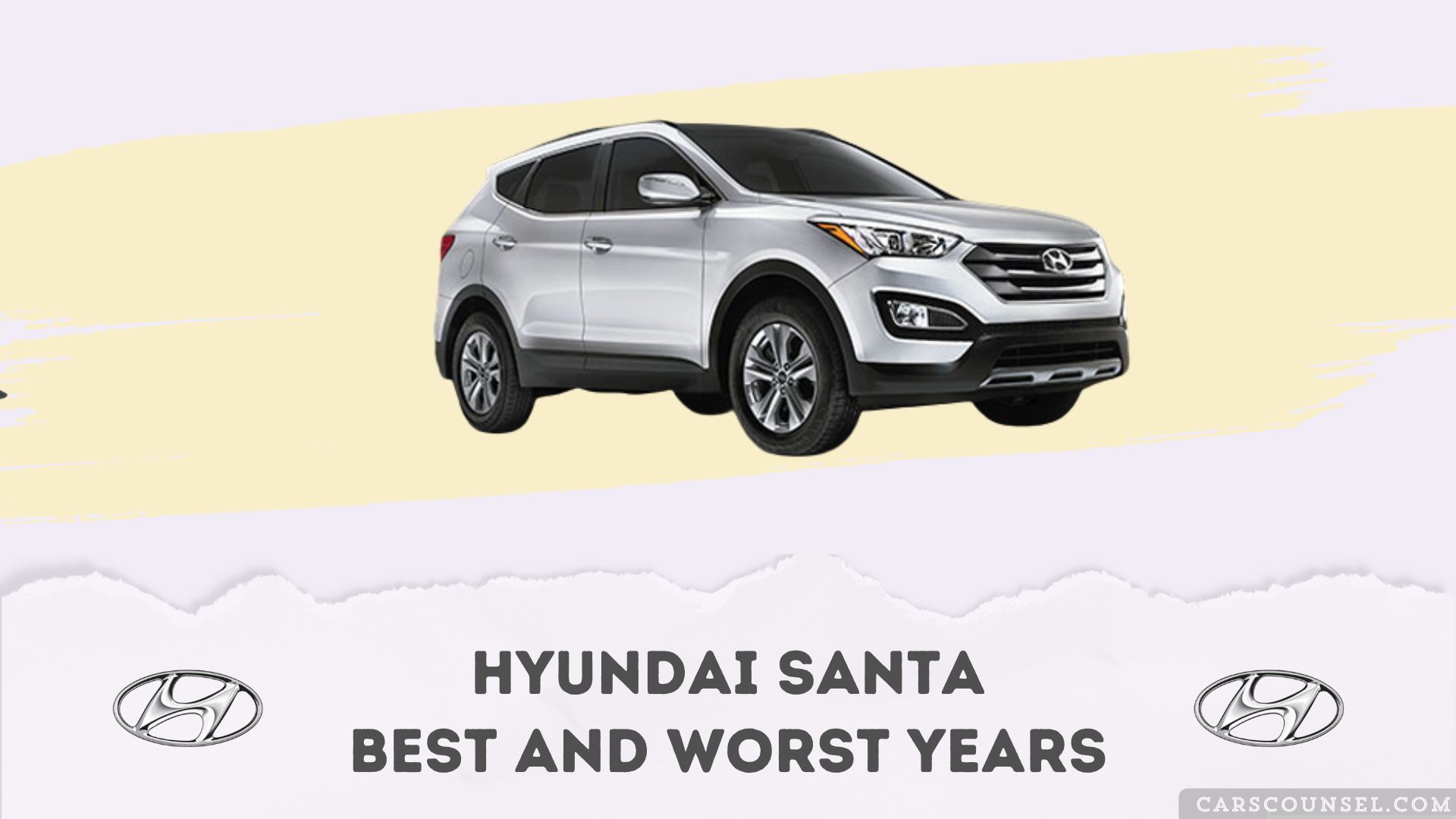
The best Hyundai Santa Fe years are 2015 through 2018, specifically models equipped with the 3.3L V6 engine. Buyers should avoid the 2013 and 2014 Santa Fe Sport models with 2.4L or 2.0T four-cylinder engines due to severe failure risks.
These rankings help buyers navigate the best and worst years. No used vehicle is flawless, and long-term reliability heavily depends on strict maintenance, accident history, and whether all open safety recalls have been properly addressed.
Reliability varies drastically by configuration. The larger V6 models are generally dependable, while the four-cylinder Sport variants suffer from widespread engine defects. Always verify the exact powertrain before purchasing this SUV.
Quick Navigation
Best and Worst Hyundai Santa Fe Years at a Glance
| Model Year Range | Verdict | Main Reason | Buyer Guidance |
|---|---|---|---|
| 2001-2006 | Best Older Choice | Durable V6 engines | Require thorough age-related inspections. |
| 2007-2009 | Good Choice | Solid V6 options | Check for electrical gremlins and rust. |
| 2010-2012 | Approach Carefully | Early 2.4L engine issues | Prefer the 3.5L V6 if available. |
| 2013-2014 | Mixed | Severe 4-cylinder defects | Avoid the Sport 2.4L/2.0T; the 3.3L V6 is safer. |
| 2015-2018 | Best Choice | Mature platform, reliable V6 | Target the 3.3L V6 for maximum dependability. |
| 2019-2024 | Best Late-Generation Choice | Modern safety, better engines | The 2.5L and 3.5L V6 are excellent options. |
| 2025 | Too New to Judge | All-new generation | Long-term reliability data is currently unavailable. |
Key Takeaways
- The 2015-2018 models with the 3.3L V6 are the strongest used choices.
- Avoid the 2013-2014 Santa Fe Sport with 2.4L or 2.0T engines.
- Four-cylinder models carry significant engine seizure and fire recall risks.
- Always verify that ABS module and engine software recalls are completed.
- Newer 2019-2024 models offer great safety but verify maintenance records.
- Recent redesigns lack extensive long-term ownership data.
How We Evaluated the Hyundai Santa Fe Model Years
We evaluate used vehicles by analyzing NHTSA recalls, manufacturer service campaigns, and verified owner complaints. We also separate configurations, as a V6 engine often has a completely different reliability profile than a four-cylinder.
Complaints are not confirmed failure rates, and a recall does not automatically make a vehicle unreliable if the remedy is effective. Recent model years naturally have fewer complaints due to limited road exposure.
Best Hyundai Santa Fe Years
2015-2018 (3.3L V6 Models)
The third-generation Santa Fe equipped with the 3.3L Lambda II V6 is widely considered the most dependable configuration. It avoids the catastrophic four-cylinder engine issues and offers strong towing capability.
These years benefit from late-generation refinements, meaning most early production bugs were resolved. Buyers should still verify that all ABS module recalls have been performed.
2019-2024 (2.5L and 3.5L V6 Models)
The fourth generation introduced the Smartstream 2.5L naturally aspirated engine and a 3.5L V6. Both powertrains have proven significantly more reliable than the previous four-cylinder options.
These models feature excellent safety technology, including adaptive cruise control, and comfortable rides. While long-term data is still accumulating for the newest examples, ownership satisfaction remains high.
Best Year by Buyer Type
Best Overall Value
The 2017 and 2018 models with the 3.3L V6 offer the best balance of modern features, proven reliability, and reasonable used market pricing.
Best Budget Option
The 2007-2009 models with the V6 engine provide affordable transportation. However, buyers must budget for age-related suspension and electrical repairs.
Years to Approach Carefully
2013-2018 Santa Fe Sport (2.4L and 2.0T)
The short-wheelbase Santa Fe Sport equipped with the 2.4L GDI or 2.0T Theta II engines requires extreme caution. These engines are notorious for premature rod bearing wear and sudden seizure.
Hyundai has issued multiple recalls and warranty extensions for these engines. If the knock sensor software update and previous inspections were neglected, the engine is a massive financial liability.
2010-2012 (2.4L Models)
The introduction of the Theta II four-cylinder engine brought early manufacturing defects. While not every vehicle failed, the risk of oil consumption and bearing wear is higher than average.
Worst Hyundai Santa Fe Years
2013-2014 (Four-Cylinder Sport Models)
The 2013 and 2014 Santa Fe Sport models represent the peak of the Theta II engine crisis. Machining errors during manufacturing led to widespread engine seizures and severe fire risks.
NHTSA investigations and massive recalls plague these specific years. Unless you have definitive proof that the engine was replaced or fully remedied under warranty, these are the worst years to buy.
Hyundai Santa Fe Reliability by Generation
First Generation (2001-2006)
Hyundai’s entry into the midsize SUV segment was surprisingly rugged. The V6 engines are durable, but finding a well-maintained example today is challenging due to age and rust.
Second Generation (2007-2012)
This generation shifted to a car-based unibody platform. The 3.3L and 3.5L V6 engines are solid, but the introduction of the 2.4L four-cylinder in 2010 marked the beginning of major engine reliability issues.
Third Generation (2013-2018)
Hyundai split this generation into the smaller Santa Fe Sport and the larger three-row Santa Fe. The Sport’s four-cylinder engines are a major liability, while the larger V6 models remain excellent choices.
Fourth Generation (2019-2024)
Hyundai consolidated the lineup and introduced much better powertrains. The 2.5L and 3.5L V6 engines restored the nameplate’s reputation. The hybrid variants introduced later are also promising.
Fifth Generation (2025-Present)
The radically redesigned boxy fifth generation is heavily focused on hybrid powertrains. It is simply too new to evaluate for long-term durability.
Common Hyundai Santa Fe Problems
Theta II Engine Failure
Affecting primarily 2010-2018 models with 2.4L and 2.0T engines, machining debris can block oil passages. This leads to rod bearing wear, engine knocking, and complete seizure while driving.
ABS Module Fire Risk
Many 2013-2018 models, and some newer examples, suffer from electrical shorts in the Anti-Lock Brake System module. This can cause engine bay fires even when the vehicle is parked and turned off.
Oil Consumption
Four-cylinder models from the third generation are prone to excessive oil consumption. If owners failed to check the dipstick regularly, the resulting oil starvation often destroyed the engine.
Repair-Cost Overview
| Problem | Affected Years | Approximate Range | Notes |
|---|---|---|---|
| Theta II Engine Replacement | 2010-2018 (4-cyl) | $4,500 – $7,500 | May be covered if recalls were completed. |
| ABS Module Replacement | 2013-2018 | $800 – $1,300 | Usually covered by official fire risk recalls. |
| Transmission Fluid Service | All Automatics | $200 – $350 | Crucial for long-term transmission health. |
Repair costs vary significantly by region, labor rates, and whether you use an independent mechanic or a dealership. Always verify if an open recall covers the repair before paying out of pocket.
What to Check Before Buying a Used Hyundai Santa Fe
- Run the VIN to check for open engine and ABS fire recalls.
- Verify the knock sensor software update was performed on 4-cylinder models.
- Listen for engine knocking or ticking during a cold start.
- Check the service history for frequent oil changes.
- Inspect the undercarriage for severe rust on older models.
- Test the transmission for smooth shifting and hesitation.
- Arrange an independent pre-purchase inspection.
Related Buying Guides
- Hyundai Palisade best and worst years: The larger, more premium three-row alternative.
- Kia Sorento years to avoid: The Santa Fe’s corporate cousin with similar platform dynamics.
- Toyota Highlander years to avoid: The segment benchmark for long-term V6 reliability.
Frequently Asked Questions
What is the most reliable Hyundai Santa Fe year?
The 2017 and 2018 models equipped with the 3.3L V6 engine are the most reliable. They avoid the four-cylinder engine defects and benefit from late-generation manufacturing refinements.
Why are 2013-2014 Santa Fe models considered problematic?
The 2013-2014 Santa Fe Sport models with 2.4L and 2.0T engines suffer from severe Theta II manufacturing defects, leading to engine seizures and multiple fire risk recalls.
Does the Hyundai Santa Fe have transmission problems?
Most Hyundai automatic transmissions are durable if the fluid is maintained. However, engine failures in four-cylinder models are often misdiagnosed by owners as transmission slipping or hesitation.
Are there any fire recalls for the Santa Fe?
Yes. Multiple model years are affected by ABS module electrical shorts and engine bay fuel pipe recalls. Always verify recall completion using the vehicle’s VIN before purchasing.
How long can a Hyundai Santa Fe last?
Well-maintained V6 examples can easily reach high mileage. Longevity depends entirely on strict adherence to maintenance schedules, rust prevention, and verifying that all engine software updates were applied.
Is the new 2025 Santa Fe reliable?
The 2025 model features an all-new boxy design and hybrid powertrains. It is currently too new to judge for long-term reliability or widespread defect patterns.
Choosing the Right Hyundai Santa Fe Model Year
The Hyundai Santa Fe offers excellent utility, but buyers must navigate a minefield of four-cylinder engine defects. The 2015-2018 models with the 3.3L V6 remain the safest used investments.
If you prefer modern technology, the 2019-2024 models with the 2.5L or 3.5L V6 engines are excellent choices. Always avoid the 2013-2014 four-cylinder Sport models unless the engine was replaced under warranty.
Regardless of the year you choose, run the VIN to confirm all fire and engine recalls are closed. Finally, always pay for an independent pre-purchase inspection to verify the vehicle’s true condition.

