The Nissan Versa is a subcompact sedan and hatchback produced from the 2006 model year through the 2025 model year. It launched as a front-wheel-drive economy car with a focus on fuel efficiency and low cost of ownership.
Three distinct generations span the production run: the first generation (2006-2011) with a 1.8-liter engine, the second generation (2012-2019) with a 1.6-liter engine, and the third generation (2020-2025) with an updated 1.6-liter engine.
This guide provides year-by-year towing specifications for the Nissan Versa, including maximum trailer weight, payload limits, and hitch requirements.
Nissan does not rate the Versa for towing from the factory.
The manufacturer’s owner manuals for multiple model years explicitly state: “Do not tow a trailer with your vehicle.”
Any towing figures referenced in this guide are unofficial estimates based on aftermarket hitch ratings, community consensus, and third-party testing.
Operating outside manufacturer-rated limits may void warranty coverage, cause premature drivetrain wear, and compromise braking performance.
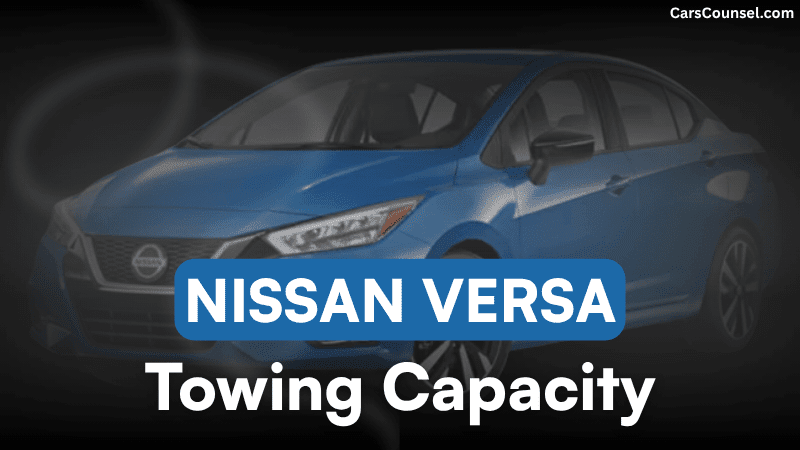
Understanding towing limits matters for protecting the engine, continuously variable transmission (CVT), and braking systems.
Exceeding safe load thresholds introduces risk of transmission overheating, brake fade, and chassis stress that the Versa platform was not engineered to manage.
Quick Navigation
2025 Nissan Versa Towing Capacity
| Specification | Detail |
|---|---|
| Engine Options | 1.6L DOHC 16-valve I4 (122 hp, 114 lb-ft) |
| Drivetrain | FWD |
| Maximum Towing Capacity | Not rated by manufacturer (0 lbs / 0 kg official); 1,000 lbs / 453 kg unofficial |
| Conventional Towing Capacity | N/A |
| Fifth-Wheel / Gooseneck Capacity | N/A |
| Maximum Payload Capacity | 924-972 lbs (419-441 kg) depending on trim |
| Gross Combined Weight Rating (GCWR) | Not published by manufacturer |
| Tongue Weight Limit | Not rated by manufacturer; 100 lbs / 45 kg estimated |
| Hitch Class | Class I (aftermarket only) |
| Factory Tow Package | No |
The 2025 Nissan Versa is the final model year for the nameplate. Nissan has not assigned an official towing capacity to this vehicle.
Aftermarket hitch manufacturers list a Class I receiver compatible with the Versa chassis, rated for up to 2,000 lbs gross trailer weight at the hitch itself. Practical towing estimates from third-party sources place the unofficial limit at 1,000 lbs. The CVT-equipped S trim carries a maximum payload of 972 lbs, while the manual transmission S trim holds 924 lbs. Any trailer load subtracts directly from available payload.
2024 Nissan Versa Towing Capacity
| Specification | Detail |
|---|---|
| Engine Options | 1.6L DOHC 16-valve I4 (122 hp, 114 lb-ft) |
| Drivetrain | FWD |
| Maximum Towing Capacity | Not rated by manufacturer (0 lbs / 0 kg official); 1,000 lbs / 453 kg unofficial |
| Conventional Towing Capacity | N/A |
| Fifth-Wheel / Gooseneck Capacity | N/A |
| Maximum Payload Capacity | 862-955 lbs (391-433 kg) depending on trim |
| Gross Combined Weight Rating (GCWR) | Not published by manufacturer |
| Tongue Weight Limit | Not rated by manufacturer; 100 lbs / 45 kg estimated |
| Hitch Class | Class I (aftermarket only) |
| Factory Tow Package | No |
The 2024 Nissan Versa carries forward the third-generation platform with no mechanical changes affecting towing capability. Nissan does not offer a tow package and does not publish a GCWR for this model year. The 1.6-liter engine produces 122 horsepower and 114 lb-ft of torque, sent through a 5-speed manual or Xtronic CVT to the front wheels. Payload capacity varies by trim: 862 lbs for the S manual, 955 lbs for the SV CVT. Unofficial towing guidance remains at 1,000 lbs with the understanding that all trailer weight counts against the vehicle’s payload rating.
2023 Nissan Versa Towing Capacity
| Specification | Detail |
|---|---|
| Engine Options | 1.6L DOHC 16-valve I4 (122 hp, 114 lb-ft) |
| Drivetrain | FWD |
| Maximum Towing Capacity | Not rated by manufacturer (0 lbs / 0 kg official); 1,000 lbs / 453 kg unofficial |
| Conventional Towing Capacity | N/A |
| Fifth-Wheel / Gooseneck Capacity | N/A |
| Maximum Payload Capacity | 862-1,025 lbs (391-465 kg) depending on trim |
| Gross Combined Weight Rating (GCWR) | Not published by manufacturer |
| Tongue Weight Limit | Not rated by manufacturer; 100 lbs / 45 kg estimated |
| Hitch Class | Class I (aftermarket only) |
| Factory Tow Package | No |
The 2023 Nissan Versa received a mid-cycle facelift with updated styling but no powertrain revisions. The 1.6-liter engine and FWD layout remain unchanged. Official manufacturer documentation lists trailer weight as “N/A” for all hitch configurations. The GVWR sits at approximately 3,461 lbs for the base S trim and up to 3,605 lbs for higher trims, which constrains how much combined passenger, cargo, and trailer weight the vehicle can legally carry. Owner manuals for this model year define GCWR but do not publish a specific numerical limit for the Versa platform.
2022 Nissan Versa Towing Capacity
| Specification | Detail |
|---|---|
| Engine Options | 1.6L DOHC 16-valve I4 (122 hp, 114 lb-ft) |
| Drivetrain | FWD |
| Maximum Towing Capacity | Not rated by manufacturer (0 lbs / 0 kg official); 1,000 lbs / 453 kg unofficial |
| Conventional Towing Capacity | N/A |
| Fifth-Wheel / Gooseneck Capacity | N/A |
| Maximum Payload Capacity | 849-1,025 lbs (385-465 kg) depending on trim |
| Gross Combined Weight Rating (GCWR) | Not published by manufacturer |
| Tongue Weight Limit | Not rated by manufacturer; 100 lbs / 45 kg estimated |
| Hitch Class | Class I (aftermarket only) |
| Factory Tow Package | No |
The 2022 Nissan Versa continues the third-generation architecture introduced for 2020. No factory towing provisions exist. Payload capacity on the 2022 Versa reaches 849 lbs across most trims. Community reports and aftermarket hitch providers reference 1,000 lbs as a practical maximum for lightweight utility towing such as an empty small trailer or a kayak carrier. The rear suspension uses a torsion beam design not intended for sustained tongue-weight loads.
2021 Nissan Versa Towing Capacity
| Specification | Detail |
|---|---|
| Engine Options | 1.6L DOHC 16-valve I4 (122 hp, 114 lb-ft) |
| Drivetrain | FWD |
| Maximum Towing Capacity | Not rated by manufacturer (0 lbs / 0 kg official); 1,000 lbs / 453 kg unofficial |
| Conventional Towing Capacity | N/A |
| Fifth-Wheel / Gooseneck Capacity | N/A |
| Maximum Payload Capacity | 849-1,025 lbs (385-465 kg) depending on trim |
| Gross Combined Weight Rating (GCWR) | Not published by manufacturer |
| Tongue Weight Limit | Not rated by manufacturer; 100 lbs / 45 kg estimated |
| Hitch Class | Class I (aftermarket only) |
| Factory Tow Package | No |
The 2021 model year carries the same specifications as 2020 with no towing-related updates. Nissan’s official position remains that the Versa is not designed or recommended for trailer towing. All trims share the 1.6-liter engine and front-wheel drive. Owner manuals for this generation include loading and weight distribution guidance but do not assign a trailer weight rating.
2020 Nissan Versa Towing Capacity
| Specification | Detail |
|---|---|
| Engine Options | 1.6L DOHC 16-valve I4 (122 hp, 114 lb-ft) |
| Drivetrain | FWD |
| Maximum Towing Capacity | Not rated by manufacturer (0 lbs / 0 kg official); 1,000 lbs / 453 kg unofficial |
| Conventional Towing Capacity | N/A |
| Fifth-Wheel / Gooseneck Capacity | N/A |
| Maximum Payload Capacity | 955 lbs (433 kg) |
| Gross Combined Weight Rating (GCWR) | Not published by manufacturer |
| Tongue Weight Limit | Not rated by manufacturer; 100 lbs / 45 kg estimated |
| Hitch Class | Class I (aftermarket only) |
| Factory Tow Package | No |
The 2020 Nissan Versa marks the beginning of the third generation, built on a new platform with revised suspension and a redesigned body. Despite the structural updates, Nissan did not add towing capability. The 1.6-liter engine gained output compared to the previous generation, now producing 122 horsepower. GVWR sits at 3,461-3,605 lbs, giving the vehicle a limited weight budget for occupants, cargo, and any trailer tongue load. Aftermarket Class I hitches remain the only option for mounting a trailer ball.
2019 Nissan Versa Towing Capacity
| Specification | Detail |
|---|---|
| Engine Options | 1.6L DOHC 16-valve I4 (109 hp, 107 lb-ft) |
| Drivetrain | FWD |
| Maximum Towing Capacity | Not rated by manufacturer (0 lbs / 0 kg official); 1,000 lbs / 453 kg unofficial |
| Conventional Towing Capacity | N/A |
| Fifth-Wheel / Gooseneck Capacity | N/A |
| Maximum Payload Capacity | 994 lbs (451 kg) |
| Gross Combined Weight Rating (GCWR) | Not published by manufacturer |
| Tongue Weight Limit | Not rated by manufacturer; 100 lbs / 45 kg estimated |
| Hitch Class | Class I (aftermarket only) |
| Factory Tow Package | No |
The 2019 Nissan Versa sedan is part of the second generation, powered by a 1.6-liter engine producing 109 horsepower. The Versa Note hatchback variant continued through this model year with the same powertrain. Neither body style carries a factory tow rating. The CVT and 5-speed manual transmissions lack supplemental cooling circuits designed for towing loads. Payload for the sedan reaches 994 lbs, which must accommodate all passengers and cargo before any trailer tongue weight is added.
2018 Nissan Versa Towing Capacity
| Specification | Detail |
|---|---|
| Engine Options | 1.6L DOHC 16-valve I4 (109 hp, 107 lb-ft) |
| Drivetrain | FWD |
| Maximum Towing Capacity | Not rated by manufacturer (0 lbs / 0 kg official); 1,000 lbs / 453 kg unofficial |
| Conventional Towing Capacity | N/A |
| Fifth-Wheel / Gooseneck Capacity | N/A |
| Maximum Payload Capacity | 860-994 lbs (390-451 kg) depending on body style |
| Gross Combined Weight Rating (GCWR) | Not published by manufacturer |
| Tongue Weight Limit | Not rated by manufacturer; 100 lbs / 45 kg estimated |
| Hitch Class | Class I (aftermarket only) |
| Factory Tow Package | No |
The 2018 Nissan Versa owner’s manual contains explicit language: “Do not tow a trailer with your vehicle.” This direct prohibition appears in the technical and consumer information section. The Versa Note hatchback offered up to 860 lbs of payload, while the sedan reached 994 lbs. A Class I aftermarket hitch can be installed, but Nissan warns that doing so may void warranty coverage for related drivetrain components.
2017 Nissan Versa Towing Capacity
| Specification | Detail |
|---|---|
| Engine Options | 1.6L DOHC 16-valve I4 (109 hp, 107 lb-ft) |
| Drivetrain | FWD |
| Maximum Towing Capacity | Not rated by manufacturer (0 lbs / 0 kg official); 1,000 lbs / 453 kg unofficial |
| Conventional Towing Capacity | N/A |
| Fifth-Wheel / Gooseneck Capacity | N/A |
| Maximum Payload Capacity | 860-1,025 lbs (390-465 kg) depending on body style |
| Gross Combined Weight Rating (GCWR) | Not published by manufacturer |
| Tongue Weight Limit | Not rated by manufacturer; 100 lbs / 45 kg estimated |
| Hitch Class | Class I (aftermarket only) |
| Factory Tow Package | No |
No mechanical changes between 2016 and 2017 affect the Versa’s towing capability. The 1.6-liter engine and front-wheel-drive layout remain constant. Payload capacity ranges from 860 lbs for the Note hatchback to 1,025 lbs for certain sedan trims. Towing any trailer places additional strain on the engine, CVT belt, and undersized front brake rotors, none of which were designed with trailer loads in mind.
2016 Nissan Versa Towing Capacity
| Specification | Detail |
|---|---|
| Engine Options | 1.6L DOHC 16-valve I4 (109 hp, 107 lb-ft) |
| Drivetrain | FWD |
| Maximum Towing Capacity | Not rated by manufacturer (0 lbs / 0 kg official); 1,000 lbs / 453 kg unofficial |
| Conventional Towing Capacity | N/A |
| Fifth-Wheel / Gooseneck Capacity | N/A |
| Maximum Payload Capacity | 860-1,025 lbs (390-465 kg) depending on body style |
| Gross Combined Weight Rating (GCWR) | Not published by manufacturer |
| Tongue Weight Limit | Not rated by manufacturer; 100 lbs / 45 kg estimated |
| Hitch Class | Class I (aftermarket only) |
| Factory Tow Package | No |
The 2016 model year continues the second-generation Versa platform. Nissan’s official documentation does not assign trailer weight ratings to any Versa configuration. Aftermarket hitch solutions provide a Class I receiver with a 200-lb tongue weight rating at the hitch, but this does not override the vehicle’s lack of manufacturer approval. The GVWR for the 2016 Versa sedan sits at approximately 3,388 lbs, limiting the total combined weight of the vehicle, its occupants, and any attached trailer.
2015 Nissan Versa Towing Capacity
| Specification | Detail |
|---|---|
| Engine Options | 1.6L DOHC 16-valve I4 (109 hp, 107 lb-ft) |
| Drivetrain | FWD |
| Maximum Towing Capacity | Not rated by manufacturer (0 lbs / 0 kg official); 1,000 lbs / 453 kg unofficial |
| Conventional Towing Capacity | N/A |
| Fifth-Wheel / Gooseneck Capacity | N/A |
| Maximum Payload Capacity | 1,025 lbs (465 kg) |
| Gross Combined Weight Rating (GCWR) | Not published by manufacturer |
| Tongue Weight Limit | Not rated by manufacturer; 100 lbs / 45 kg estimated |
| Hitch Class | Class I (aftermarket only) |
| Factory Tow Package | No |
The 2015 Nissan Versa sedan was available in S, S Plus, SV, and SL trims, all powered by the 1.6-liter engine with 109 horsepower. Curb weight ranges around 2,363 lbs, with GVWR at 3,388 lbs. The roughly 1,025-lb payload gap between curb weight and GVWR must cover passengers, cargo, and any trailer tongue weight. Aftermarket towing guidance suggests a 1,000-lb trailer limit for altitudes up to 3,280 feet, with a 10 percent reduction for every additional 3,280 feet of elevation due to reduced engine output in thinner air.
2014 Nissan Versa Towing Capacity
| Specification | Detail |
|---|---|
| Engine Options | 1.6L DOHC 16-valve I4 (109 hp, 107 lb-ft) |
| Drivetrain | FWD |
| Maximum Towing Capacity | Not rated by manufacturer (0 lbs / 0 kg official); 1,000 lbs / 453 kg unofficial |
| Conventional Towing Capacity | N/A |
| Fifth-Wheel / Gooseneck Capacity | N/A |
| Maximum Payload Capacity | 1,025 lbs (465 kg) |
| Gross Combined Weight Rating (GCWR) | Not published by manufacturer |
| Tongue Weight Limit | Not rated by manufacturer; 100 lbs / 45 kg estimated |
| Hitch Class | Class I (aftermarket only) |
| Factory Tow Package | No |
The 2014 Nissan Versa sedan and Note hatchback share the same 1.6-liter powertrain. The owner’s manual for this model year defines GCWR terminology but does not provide a specific numerical GCWR for the Versa. This absence of a published combined weight rating signals that Nissan did not engineer or validate the platform for trailer towing. Aftermarket hitch installations require drilling into the rear frame rails, as the Versa lacks factory mounting points.
2013 Nissan Versa Towing Capacity
| Specification | Detail |
|---|---|
| Engine Options | 1.6L DOHC 16-valve I4 (109 hp, 107 lb-ft) |
| Drivetrain | FWD |
| Maximum Towing Capacity | Not rated by manufacturer (0 lbs / 0 kg official); 1,000 lbs / 453 kg unofficial |
| Conventional Towing Capacity | N/A |
| Fifth-Wheel / Gooseneck Capacity | N/A |
| Maximum Payload Capacity | 1,025 lbs (465 kg) |
| Gross Combined Weight Rating (GCWR) | Not published by manufacturer |
| Tongue Weight Limit | Not rated by manufacturer; 100 lbs / 45 kg estimated |
| Hitch Class | Class I (aftermarket only) |
| Factory Tow Package | No |
The 2013 Nissan Versa represents the second year of the second-generation sedan, while the first-generation hatchback continued alongside it through 2012. Nissan does not list trailer towing specifications for any 2013 Versa variant. The vehicle’s front disc and rear drum brake setup provides adequate stopping power for the vehicle’s own weight, but lacks the thermal capacity to manage repeated braking with a trailer in tow.
2012 Nissan Versa Towing Capacity
| Specification | Detail |
|---|---|
| Engine Options | 1.6L DOHC 16-valve I4 (109 hp, 107 lb-ft) / 1.8L DOHC 16-valve I4 (122 hp, 127 lb-ft) |
| Drivetrain | FWD |
| Maximum Towing Capacity | Not rated by manufacturer (0 lbs / 0 kg official); 1,000 lbs / 453 kg unofficial |
| Conventional Towing Capacity | N/A |
| Fifth-Wheel / Gooseneck Capacity | N/A |
| Maximum Payload Capacity | 1,039 lbs (471 kg) |
| Gross Combined Weight Rating (GCWR) | Not published by manufacturer |
| Tongue Weight Limit | Not rated by manufacturer; 100 lbs / 45 kg estimated |
| Hitch Class | Class I (aftermarket only) |
| Factory Tow Package | No |
The 2012 model year is a split year for the Versa lineup. The sedan transitioned to the second-generation design with a 1.6-liter engine producing 109 horsepower. The hatchback continued on the first-generation platform with a 1.8-liter engine producing 122 horsepower and 127 lb-ft of torque. The hatchback’s higher torque figure provides marginally better pulling capability, but Nissan still does not rate either variant for towing. Payload on the 2012 sedan reaches 1,039 lbs across trims, though the 1.6 S manual transmission version carries a curb weight of just 2,350 lbs.
2011 Nissan Versa Towing Capacity
| Specification | Detail |
|---|---|
| Engine Options | 1.8L DOHC 16-valve I4 (122 hp, 127 lb-ft) |
| Drivetrain | FWD |
| Maximum Towing Capacity | Not rated by manufacturer (0 lbs / 0 kg official); 1,000 lbs / 453 kg unofficial |
| Conventional Towing Capacity | N/A |
| Fifth-Wheel / Gooseneck Capacity | N/A |
| Maximum Payload Capacity | Approximately 1,050 lbs (476 kg) |
| Gross Combined Weight Rating (GCWR) | Not published by manufacturer |
| Tongue Weight Limit | Not rated by manufacturer; 100 lbs / 45 kg estimated |
| Hitch Class | Class I (aftermarket only) |
| Factory Tow Package | No |
The 2011 Nissan Versa is part of the first generation, available as a sedan and hatchback. Both body styles use a 1.8-liter engine generating 122 horsepower and 127 lb-ft of torque. The 6-speed manual and CVT transmissions in this generation lack auxiliary coolers. Towing guidance from Nissan’s official towing guide for this model year covers the Titan, Armada, Pathfinder, Frontier, and Xterra but excludes the Versa entirely. This omission confirms the vehicle’s non-towing design intent.
2010 Nissan Versa Towing Capacity
| Specification | Detail |
|---|---|
| Engine Options | 1.8L DOHC 16-valve I4 (122 hp, 127 lb-ft) |
| Drivetrain | FWD |
| Maximum Towing Capacity | Not rated by manufacturer (0 lbs / 0 kg official); 1,000 lbs / 453 kg unofficial |
| Conventional Towing Capacity | N/A |
| Fifth-Wheel / Gooseneck Capacity | N/A |
| Maximum Payload Capacity | Approximately 1,100 lbs (499 kg) |
| Gross Combined Weight Rating (GCWR) | Not published by manufacturer |
| Tongue Weight Limit | Not rated by manufacturer; 100 lbs / 45 kg estimated |
| Hitch Class | Class I (aftermarket only) |
| Factory Tow Package | No |
The 2010 Nissan Versa carries the same 1.8-liter engine as the rest of the first generation. Curb weight for the hatchback starts around 2,700 lbs, while the sedan is slightly lighter. GVWR across trims ranges from approximately 3,461 to 3,605 lbs. The difference between curb weight and GVWR defines the available payload headroom, which must cover all additional weight including tongue load from any attached trailer.
2009 Nissan Versa Towing Capacity
| Specification | Detail |
|---|---|
| Engine Options | 1.8L DOHC 16-valve I4 (122 hp, 127 lb-ft) |
| Drivetrain | FWD |
| Maximum Towing Capacity | Not rated by manufacturer (0 lbs / 0 kg official); 1,000 lbs / 453 kg unofficial |
| Conventional Towing Capacity | N/A |
| Fifth-Wheel / Gooseneck Capacity | N/A |
| Maximum Payload Capacity | Approximately 1,100 lbs (499 kg) |
| Gross Combined Weight Rating (GCWR) | Not published by manufacturer |
| Tongue Weight Limit | Not rated by manufacturer; 100 lbs / 45 kg estimated |
| Hitch Class | Class I (aftermarket only) |
| Factory Tow Package | No |
The 2009 model year introduces no changes relevant to towing. The Versa’s unibody chassis lacks the reinforced frame rails found on vehicles designed for trailer loads. Aftermarket hitch mounting requires drilling into the spare tire well area and rear subframe. Installers should verify that hitch attachment points do not compromise the structural integrity of the rear crumple zones.
2008 Nissan Versa Towing Capacity
| Specification | Detail |
|---|---|
| Engine Options | 1.8L DOHC 16-valve I4 (122 hp, 127 lb-ft) |
| Drivetrain | FWD |
| Maximum Towing Capacity | Not rated by manufacturer (0 lbs / 0 kg official); 1,000 lbs / 453 kg unofficial |
| Conventional Towing Capacity | N/A |
| Fifth-Wheel / Gooseneck Capacity | N/A |
| Maximum Payload Capacity | Approximately 1,100 lbs (499 kg) |
| Gross Combined Weight Rating (GCWR) | Not published by manufacturer |
| Tongue Weight Limit | Not rated by manufacturer; 100 lbs / 45 kg estimated |
| Hitch Class | Class I (aftermarket only) |
| Factory Tow Package | No |
The 2008 Nissan Versa owner’s manual discusses weight measurement and loading but does not assign a trailer weight rating. Enthusiast forums from this era report that 1,000 lbs is manageable for short-distance utility towing with the CVT transmission, which offers lower gearing in its lowest range compared to the conventional automatic. However, sustained towing with the CVT introduces risk of belt slippage and accelerated wear due to heat buildup that the factory cooling system cannot dissipate.
2007 Nissan Versa Towing Capacity
| Specification | Detail |
|---|---|
| Engine Options | 1.8L DOHC 16-valve I4 (122 hp, 127 lb-ft) |
| Drivetrain | FWD |
| Maximum Towing Capacity | Not rated by manufacturer (0 lbs / 0 kg official); 1,000 lbs / 453 kg unofficial |
| Conventional Towing Capacity | N/A |
| Fifth-Wheel / Gooseneck Capacity | N/A |
| Maximum Payload Capacity | Approximately 1,100 lbs (499 kg) |
| Gross Combined Weight Rating (GCWR) | Not published by manufacturer |
| Tongue Weight Limit | Not rated by manufacturer; 100 lbs / 45 kg estimated |
| Hitch Class | Class I (aftermarket only) |
| Factory Tow Package | No |
The 2007 Nissan Versa debuted for the US market as a 2007 model, though some markets received it earlier. The platform was designed as an urban commuter car with maximizing interior volume as its engineering priority. The rear torsion beam suspension, while space-efficient, lacks the load-carrying geometry of an independent multi-link setup. This suspension design limits the chassis’s ability to manage tongue weight without excessive rear squat.
2006 Nissan Versa Towing Capacity
| Specification | Detail |
|---|---|
| Engine Options | 1.8L DOHC 16-valve I4 (122 hp, 127 lb-ft) |
| Drivetrain | FWD |
| Maximum Towing Capacity | Not rated by manufacturer (0 lbs / 0 kg official); 1,000 lbs / 453 kg unofficial |
| Conventional Towing Capacity | N/A |
| Fifth-Wheel / Gooseneck Capacity | N/A |
| Maximum Payload Capacity | Approximately 1,100 lbs (499 kg) |
| Gross Combined Weight Rating (GCWR) | Not published by manufacturer |
| Tongue Weight Limit | Not rated by manufacturer; 100 lbs / 45 kg estimated |
| Hitch Class | Class I (aftermarket only) |
| Factory Tow Package | No |
The 2006 Nissan Versa launched the nameplate in North America. As the inaugural model year, it established the pattern that all subsequent Versas would follow: no factory tow rating, no tow package option, and no published GCWR. The 1.8-liter engine, shared with the Nissan Sentra of the same era, delivered adequate power for the vehicle’s own mass but was not validated for sustained high-load operation. Any towing with a 2006 Versa falls outside the vehicle’s design parameters.
Towing Equipment and Setup for the Nissan Versa
Aftermarket Hitch Installation
Nissan does not manufacture a tow hitch for the Versa. Aftermarket Class I hitches are available from third-party suppliers such as CURT, Draw-Tite, and Reese. These hitches mount to the rear frame rails and typically require drilling. A Class I hitch is rated for a maximum gross trailer weight of 2,000 lbs and a maximum tongue weight of 200 lbs at the hitch itself. These hitch ratings exceed what the Versa chassis can practically handle, so the vehicle’s own limitations govern the actual safe trailer weight.
Hitch Class Considerations
The only hitch class compatible with the Nissan Versa is Class I, which uses a 1-1/4-inch receiver tube. Adapters exist to accept 2-inch accessories, but using an adapter does not increase the hitch’s weight rating. The small receiver size limits ball mount options to lightweight duty.
Trailer Wiring Harness
Installing a trailer wiring harness requires splicing into the Versa’s taillight circuits or using a plug-and-play T-connector where available. A powered converter may be necessary to protect the vehicle’s sensitive electronics from trailer lighting current draw. Always verify compatibility with the specific model year before purchasing a wiring kit.
Trailer Brake Considerations
The Nissan Versa does not support an integrated trailer brake controller. For trailers equipped with electric brakes, an aftermarket proportional brake controller must be installed. However, given the Versa’s lack of manufacturer towing approval, trailer brakes do not increase the safe towing limit beyond the unofficial 1,000-lb threshold.
Weight Distribution
A weight-distributing hitch is not applicable to Class I receivers and is not recommended for the Nissan Versa. The unibody construction lacks the structural reinforcement points required to transfer load to the front axle through spring bars. Attempting to use weight-distribution equipment may damage the vehicle’s frame.
Transmission Cooling
The Nissan Versa does not come equipped with a dedicated transmission cooler. The CVT and manual transmissions rely on the factory radiator-integrated heat exchanger for temperature regulation. Under towing loads, transmission fluid temperatures can rise rapidly. Installing an auxiliary transmission cooler is advisable for any towing application, though it does not change the vehicle’s unofficial tow rating.
Tire Load Ratings
The factory tire load rating on the Nissan Versa must not be exceeded. Typical OEM tires carry a load index between 87 and 89, corresponding to approximately 1,201 to 1,279 lbs per tire at maximum inflation. Adding trailer tongue weight increases rear axle load. Verify that the combined axle load does not exceed the Gross Axle Weight Rating (GAWR) posted on the driver’s door jamb label.
Trailer Sway Control
The Nissan Versa lacks electronic trailer sway control. The short wheelbase of 102.4 to 103.1 inches makes the Versa more susceptible to trailer-induced sway than longer vehicles. Towing a trailer with a single-axle Versa requires careful attention to proper trailer loading, with 60 percent of the trailer weight positioned forward of the trailer axle.
Normal Towing vs. Heavy Towing Setup
| Component | Light Duty (Under 500 lbs) | Maximum Unofficial (Up to 1,000 lbs) |
|---|---|---|
| Hitch | Class I, 1-1/4-inch receiver | Class I, 1-1/4-inch receiver |
| Ball Mount | Fixed, 1-7/8 or 2-inch ball | Fixed, 2-inch ball |
| Wiring | 4-pin flat connector | 4-pin flat connector |
| Trailer Brakes | Not required | Recommended but not supported by vehicle |
| Transmission Cooler | Not required | Strongly recommended for CVT models |
| Weight Distribution | Not applicable | Not applicable |
| Sway Control | Not required | Friction sway control (aftermarket) recommended |
| Tire Pressure | Factory specification | Increase rear tire pressure to maximum rated on sidewall |
If you’re researching Nissan towing capacity, be sure to explore our detailed guides on models like the Nissan Xterra, Nissan Leaf, Nissan Kicks, and Nissan Altima. Knowing your vehicle’s towing limits is essential for safe and efficient hauling. Our expert resources break down towing capacity by model, explain key factors like engine power and braked vs unbraked limits, and help you choose the right setup so you can tow with confidence and avoid unnecessary strain on your vehicle.
Frequently Asked Questions
What is the maximum towing capacity of a Nissan Versa?
The Nissan Versa has no official maximum towing capacity. Nissan does not rate the Versa for trailer towing in any model year. The manufacturer’s owner manuals for multiple years state explicitly that the vehicle should not be used to tow a trailer. Unofficial estimates from aftermarket sources place the practical limit at 1,000 lbs, though towing at this level may void the vehicle warranty and risks drivetrain damage.
How much can a Nissan Versa tow with a tow package?
A tow package does not exist for the Nissan Versa. Nissan has never offered a factory tow package for any Versa model year or trim level. Aftermarket Class I hitches are available, but installing one does not confer a manufacturer-recognized towing capacity.
Does the Nissan Versa have a trailer hitch option from the factory?
No. The Nissan Versa is not equipped with a factory trailer hitch. All hitch installations are aftermarket and require drilling into the rear frame structure. The vehicle’s bumper is not rated for bumper-mounted trailer balls.
What trailer weight is safe for a Nissan Versa?
Based on aftermarket guidance and community consensus, lightweight trailers under 500 lbs pose lower risk for short-distance, low-speed towing. Empty kayak trailers, bicycle carriers, and small cargo platforms fall into this category. Trailers exceeding 500 lbs increase stress on the CVT, brakes, and suspension. Loaded trailers beyond 1,000 lbs exceed all practical safety margins.
Can a Nissan Versa tow a U-Haul trailer?
U-Haul trailer weights typically exceed the Nissan Versa’s practical limits. Even U-Haul’s smallest enclosed trailer weighs approximately 800 lbs empty. A loaded small utility trailer can reach 2,500 lbs or more. Nissan’s official stance against towing means U-Haul may refuse to rent a trailer for use with a Versa due to liability concerns.
Why does the Nissan Versa have no official towing capacity?
The Nissan Versa was designed as an economical subcompact commuter car. The engineering priorities focused on interior volume, fuel efficiency, and low manufacturing cost. The unibody chassis, rear torsion beam suspension, undersized braking system, and CVT transmission were not designed or validated for the sustained thermal and mechanical loads of trailer towing. Nissan’s decision to rate towing capacity at zero reflects the platform’s design constraints.
Does the 1.8-liter Versa tow better than the 1.6-liter?
The first-generation Versa (2006-2011) with the 1.8-liter engine produces more torque (127 lb-ft versus 107-114 lb-ft in the 1.6-liter), which provides marginally better pulling power from a standstill. However, neither engine was validated for towing, and the higher torque figure does not change the vehicle’s lack of factory approval or its structural limitations.
Conclusion
The Nissan Versa towing capacity across all model years from 2006 through 2025 is officially zero. Nissan does not assign trailer weight ratings, publish GCWR figures, or offer tow packages for this vehicle. Aftermarket sources and owner communities reference an unofficial limit of 1,000 lbs for lightweight, short-distance towing, but this figure lacks manufacturer endorsement.
Engine choice does not alter the towing equation. The 1.8-liter first-generation engine provides more torque than the later 1.6-liter units, yet neither platform generation was engineered with towing validation. Payload capacity, ranging from roughly 850 lbs to 1,100 lbs across years and trims, further constrains how much combined occupant and trailer weight a Versa can legally carry. Adding a trailer subtracts directly from available payload headroom.
Any decision to tow with a Nissan Versa falls outside the manufacturer’s design envelope and warranty coverage. Aftermarket Class I hitch installation and auxiliary transmission cooling can reduce some risks but cannot replicate factory engineering validation.
Always verify specifications using the owner’s manual for your specific model year. Refer to the vehicle certification label on the driver’s door jamb for GVWR, GAWR, and payload limits before loading or towing.