You can usually reset Toyota’s Auto Start‑Stop by turning the engine off and restarting it, since the system reactivates on every key cycle; if the Stop/Start warning stays on, check the battery, terminals and related sensors because faults often prevent restart and need diagnostics. Dealers can run factory-level checks and resets with their tools and will inspect battery health and sensor signals to restore proper function.
Quick Navigation
Key Takeaways
- Check battery charge, as weak batteries disable Auto Start-Stop on Toyotas.
- Verify hood latch is fully engaged to restore system function.
- Use OBD2 scanner to read codes and reset faults.
- Visit Toyota dealer for diagnostic resets using factory tools.
- Perform software updates at dealer to fix recurring issues.
What Is Toyota Auto Start-Stop System
Toyota’s Auto Start-Stop system automatically shuts off your engine when you stop at red lights or in traffic, then restarts it as you release the brake or press the accelerator.
You’ll use start stop technology that monitors brake input, vehicle sensors, and battery/engine conditions to restart reliably. It’s aimed at hybrid efficiency by cutting idle time and emissions, often saving significant fuel in heavy traffic.
You can disable it with a manual button left of the steering wheel, but the feature resets each engine start. Some drivers find it intrusive despite its fuel- and emissions-saving purpose.
How Toyota Auto Start-Stop Works
Your Toyota Auto Start-Stop system shuts down the engine when you stop at lights or in traffic, triggered by zero vehicle speed, sufficient battery charge, ideal engine temperature, and closed hood with seat belts fastened.
It automatically restarts the engine when you release the brake or press the accelerator, ensuring seamless acceleration while sensors confirm safe conditions like proper electrical connections.
These triggers prioritize fuel savings and safety in stop-and-go driving.
Engine Shutdown Triggers
One clear way the auto start‑stop decides to shut the engine is by continuously checking a set of operating conditions and only cutting fuel when all safety and performance criteria are met.
You’ll notice it activates when you’re stationary at red lights or stop signs, thanks to sensor calibration monitoring vehicle speed, engine temperature, and battery charge for ideal engine performance.
It restarts seamlessly as you release the brake or press the accelerator. However, it won’t engage if battery charge is low, temperatures are extreme, or electrical loads are heavy.
Safety overrides disable it if your seatbelt’s unfastened or doors open.
Automatic Restart Conditions
When you release the brake pedal or press the accelerator, Toyota’s Auto Start-Stop system instantly restarts the engine using precise sensors that monitor speed, brake pressure, and driver intent.
You’ll experience automatic restart scenarios driven by an engine conditions analysis that checks battery charge, engine temperature, traction, and safety inputs.
- Restart triggers: brake release or accelerator input.
- Sensor checks: speed, brake pressure, battery and engine temp.
- Disabled when loads high: A/C, heated seats, heavy electrical use.
- Safety prevents restart: unfastened seat belt, hood open, steep incline.
- Delayed in stop‑and‑go to guarantee smooth operation.
Manual Method to Disable Auto Start-Stop
Press the Auto Start-Stop on/off button (usually left of the steering wheel) once to keep the engine running continuously for that drive cycle; the system will revert to its default each time you restart the vehicle, so you’ll need to press the button again after each ignition cycle.
Use this manual method when you want uninterrupted HVAC or smoother stopping without auto shutoff.
Use this manual method for uninterrupted HVAC or smoother, auto-shutoff‑free stops.
Note user feedback and user experiences report the button is simple and reliable but repetitive to use each trip.
Hybrids typically won’t allow permanent disablement due to design constraints.
Light braking can also prevent activation as an alternative habit.
Why Auto Start-Stop Reactivates After Restart
Your Toyota’s auto start-stop reactivates automatically after every engine restart because it doesn’t retain your manual deactivation setting.
This design guarantees the system engages by default to maximize fuel efficiency and meet emissions standards whenever you start the vehicle.
You’ll need to press the disable button again each time since sensors prioritize activation under typical stop-and-go conditions.
Reactivates on Restart
- You must press the disable button every restart, as it doesn’t retain your setting.
- Sensors detect idling at stoplights, shutting off then restarting the engine seamlessly.
- It prioritizes environmental benefits, engaging as a standard feature on most models.
- Manual deactivation suits AC-heavy or towing scenarios, but resets on restart.
- Toyota engineers it for consistent fuel savings, overriding temporary disables.
Memory Not Retained
| Factor | Impact on Memory | User Tip |
|---|---|---|
| Design Default | Resets to “on” always | Disable per trip |
| Safety/Emissions | Prioritizes compliance | Check indicators |
| Low Battery | Auto-disables temporarily | Charge fully |
| User Feedback | Demands permanent fixes | Investigate coding apps |
| Forum Experiences | Widespread frustration | Join discussions |
Common User Complaints About Auto Start-Stop
Although Auto Start‑Stop aims to cut fuel use, many drivers find it intrusive because it re-enables automatically after every engine restart, forcing you to press the disable button each trip and turning a one‑time preference into a recurring annoyance.
You’ll see recurring themes in user experiences and consumer feedback: concern about engine wear from frequent cycling, frustration that light braking can prevent engagement, habit changes to avoid activation, and a desire for permanent disable options.
- Automatic reactivation after restart
- Worries about increased engine wear
- Light braking defeats engagement
- Habit modification as workaround
- Demand for permanent disablement
Fuel Efficiency Benefits of Auto Start-Stop
You’ll see quantified fuel savings from Toyota’s auto start‑stop especially in stop‑and‑go city traffic, often translating to measurable MPG gains over time.
The system also reduces CO2 and tailpipe emissions by cutting idling fuel use, helping your vehicle meet tighter urban emissions goals.
Together these effects improve traffic efficiency and operating cost, since less fuel wasted idling means lower fuel bills and smoother flow in congested driving.
Fuel Savings Quantified
- Shuts off engine at stops, saving fuel on frequent halts.
- Boosts efficiency over 8% in heavy traffic versus non-equipped vehicles.
- Cuts emissions, aiding sustainability during stop-and-go.
- Reduces costs long-term by minimizing idling waste.
- Maximizes savings at lights and signs, per studies.
Emissions Reduction Achieved
Toyota’s auto start-stop system cuts your vehicle’s emissions by shutting off the engine during idle stops, building on its 8%+ fuel efficiency gains in traffic.
You’ll lower tailpipe pollutants and greenhouse gases because the engine isn’t burning fuel while stopped, improving your vehicle’s environmental impact and helping meet stricter emissions regulations at fleet and municipal scales.
In urban driving you’ll reduce local exhaust during idling, supporting cleaner air goals.
Hybrid models amplify these gains by combining regenerative systems with frequent engine-off periods, optimizing fuel use and cutting carbon output more effectively than conventional drivetrains.
Traffic Efficiency Gains
When traffic forces repeated stops, the auto start-stop system cuts engine idling and can boost your real-world fuel economy by roughly 8% or more in heavy stop‑and‑go conditions.
You’ll see traffic congestion benefits as the system reduces wasted fuel and tailpipe emissions during idle-heavy urban driving, supporting urban planning goals for cleaner streets.
It operates automatically, needs no extra driver action, and uses sensors to assess when restarting’s most efficient.
- Cuts idling time in stop‑and‑go traffic.
- Lowers fuel use and emissions in urban areas.
- Engages automatically for driver convenience.
- Uses sensors to guarantee reliability.
- Helps meet traffic congestion and urban planning targets.
Reasons Auto Start-Stop Fails to Activate
Your Toyota’s auto start-stop system deactivates under specific conditions to prioritize safety and performance.
You’ll notice it won’t engage if your battery charge is low, as it prevents stalling. If the engine’s too cold or hot, it stays off until temperatures stabilize.
Unbuckled seatbelts, open doors, or heavy loads like AC inhibit activation for safety.
Faulty sensors (battery, brake, hood) or software glitches also disable it—check system maintenance for start stop benefits like efficiency.
Regular battery tests and diagnostics guarantee reliable operation.
Battery Issues Affecting Start-Stop Function
You’ll notice start-stop deactivation from:
- Low engine temperature, preventing reliable restarts.
- High engine temperature, risking overheating.
- Unfastened seat belts or open doors, for safety.
- Heavy loads like AC or heated seats, conserving power.
- Faulty sensors needing sensor calibration or software fixes.
Test capacity regularly; replace with OEM-spec batteries to restore function.
Troubleshooting Start-Stop Malfunctions
First, check your battery charge—test it or have it load-tested, as a weak 12-volt battery often disables the start-stop system to avoid stalling.
Next, verify the hood latch is fully engaged, since an open or faulty sensor here tricks the system into thinking the hood’s ajar and prevents operation.
Finally, use an OBD2 module to scan for codes and perform a reset, clearing temporary faults in sensors or software.
Battery Charge Check
A weak or undercharged 12‑volt battery is the most common reason a Toyota’s auto start/stop will disable itself, so check battery state of charge and health before chasing sensors or software faults.
You should prioritize battery maintenance and testing frequency to keep the system active. Address dashboard battery warnings immediately, verify cable clamps for corrosion or looseness, and fit the correct battery type if replacement’s needed.
Suitable batteries include AGM or improved flooded types designed for frequent restarts.
- Test battery regularly per manufacturer recommended testing frequency.
- Use AGM/improved flooded batteries.
- Confirm new battery matches start‑stop specs.
- Fix loose/corroded clamps.
- Service immediately if warning lights appear.
Hood-Latch Disabling
Disconnecting the hood‑latch electrical connector can silently disable Toyota’s auto start/stop, so if the system keeps reactivating when you don’t want it to, check the hood‑latch wiring as a potential culprit.
Disconnecting that connector has been reported to prevent start‑stop activation without dash warnings on some models, though results vary by year and model.
You can gain consistent control over start‑stop without repeated manual deactivation, but be aware of modification risks: altering factory wiring may affect warranty, safety systems, or trigger alerts on other models.
Verify compatibility for your Toyota and accept potential liability before proceeding.
OBD2 Module Reset
- Confirm adapter and app compatibility
- Read and clear stored fault codes
- Verify battery profile settings
- Scan sensors and electrical circuits
- Repeat reset after fixes
Using OBD2 Adapters for Customization
OBD2 adapters like the Carista tool let you customize your Toyota’s settings, including permanently disabling auto start/stop. Plug the adapter into your OBD2 port, then use companion software to access and modify electronic features—you won’t need to reactivate manually after restarts.
Enjoy OBD2 customization benefits like tailored lights, turn signals, and window controls for a personalized drive.
Check OBD2 compatibility issues for your model on the app’s site to verify support. Research instructions thoroughly, as changes may void warranties or risk systems—proceed cautiously.
Hood Latch Disconnection Method
- Locate the hood latch sensor near the front grille; unplug its connector by releasing clips.
- Verify no warning lights activate—works on models like 2020 RAV4 without hood-open alerts.
- It’s a simple, no-tools mod favored for reliability over OBD2 adapters.
- Check user experiences on forums; success varies by year and model.
- Proceed cautiously—mods carry liability if issues arise; consult pros first.
Autostop Eliminator Installation Guide
When you install the Autostop Eliminator, you’ll plug its inline harness between the vehicle’s auto start/stop switch (or module harness) and the factory connector so the device can intercept and send the “disable” command at every startup. You’ll typically access the harness behind the dash or near the OBD2/data link connector for installation tips, and you can plug into the module without cutting wires for device compatibility with many Toyotas, including Tacoma. Once connected, the unit prevents auto start/stop automatically. Test each startup to confirm the feature stays disabled and tuck and secure the harness.
| Step | Location | Tip |
|---|---|---|
| 1 | Dash behind switch | Remove trim gently |
| 2 | Module/OBD2 area | Unplug factory connector |
| 3 | Inline harness | Connect device ends |
| 4 | Finalize | Tuck and zip-tie harness |
Plug-and-Play Devices for Permanent Disable
Plug-and-play devices permanently disable Toyota’s auto start/stop feature, so you avoid pressing the manual button after every restart. You plug an OBD2 or OEM-style module into the vehicle, then the device intercepts or programs the start-stop command to keep the engine running every ignition cycle (plug and play benefits).
Plug-and-play OBD2/OEM modules permanently disable Toyota’s auto start/stop, keeping the engine running every ignition without repeated button presses
- Simple installation: usually OBD2 or inline connector.
- Persistent disable: remembers setting across restarts.
- Model checks: confirm device compatibility before purchase.
- Popular options: Carista and dedicated start/stop eliminators.
- User reports: reliable, fewer interruptions while driving.
Risks and Considerations of Modifications
Because modifying Toyota’s auto start/stop involves altering safety, emissions, and electrical systems, you should understand the potential legal, warranty, and safety trade-offs before you act. Modifying the hood latch connector or using inline devices creates modification implications like liability risks if issues arise. Circuit changes trigger warranty concerns, voiding coverage and complicating dealership repairs. Not all tweaks suit every Toyota model, risking malfunctions. Disabling start/stop compromises designed efficiency and emissions controls, potentially raising safety hazards. OBD2 adapters demand caution—wrong settings spawn error codes needing pro diagnostics. Weigh these carefully.
Dealer Options for Start-Stop Management
After weighing modification risks, your next practical step is to consult your Toyota dealer for managed, warranty-safe options for Start‑Stop control.
Dealers provide dealer support to diagnose and reset Start‑Stop faults using factory tools, and they’ll verify battery and sensor health to restore normal operation. They can update control software and apply calibrated resets when needed.
They can replace faulty components like battery sensors under warranty to prevent recurring disablement. Discuss feature settings and personalization with service staff; they’ll explain temporary disable methods, permanent options, and implications for warranty and software updates.
- Diagnostic checks and resets
- Software updates and recalibrations
- Faulty component replacement
- Guidance on feature settings
- Test drives to confirm behavior
Frequently Asked Questions
How Do I Reset My Start-Stop System?
Disconnect your Toyota’s battery for a few minutes to reset the start-stop system, then reconnect it. Verify it’s fully charged for start stop benefits like fuel savings. Use OBD2 for system troubleshooting if issues persist.
Why Is My Toyota Auto Start-Stop Not Working?
Your Toyota’s Auto Start‑Stop likely isn’t working due to battery issues (low charge, weak or wrong type) or system malfunctions (faulty sensors, software faults, safety overrides, heavy accessory load or manual disable).
How to Permanently Turn off Start-Stop on Toyota?
Like a scalpel cutting code, you can permanently disable the start stop system by vehicle customization: install a dedicated eliminator, unplug the switch/hood sensor, or use an OBD2 coder like Carista—risks and hybrid limits apply.
What Does the a With a Circle Around It Mean in a Toyota?
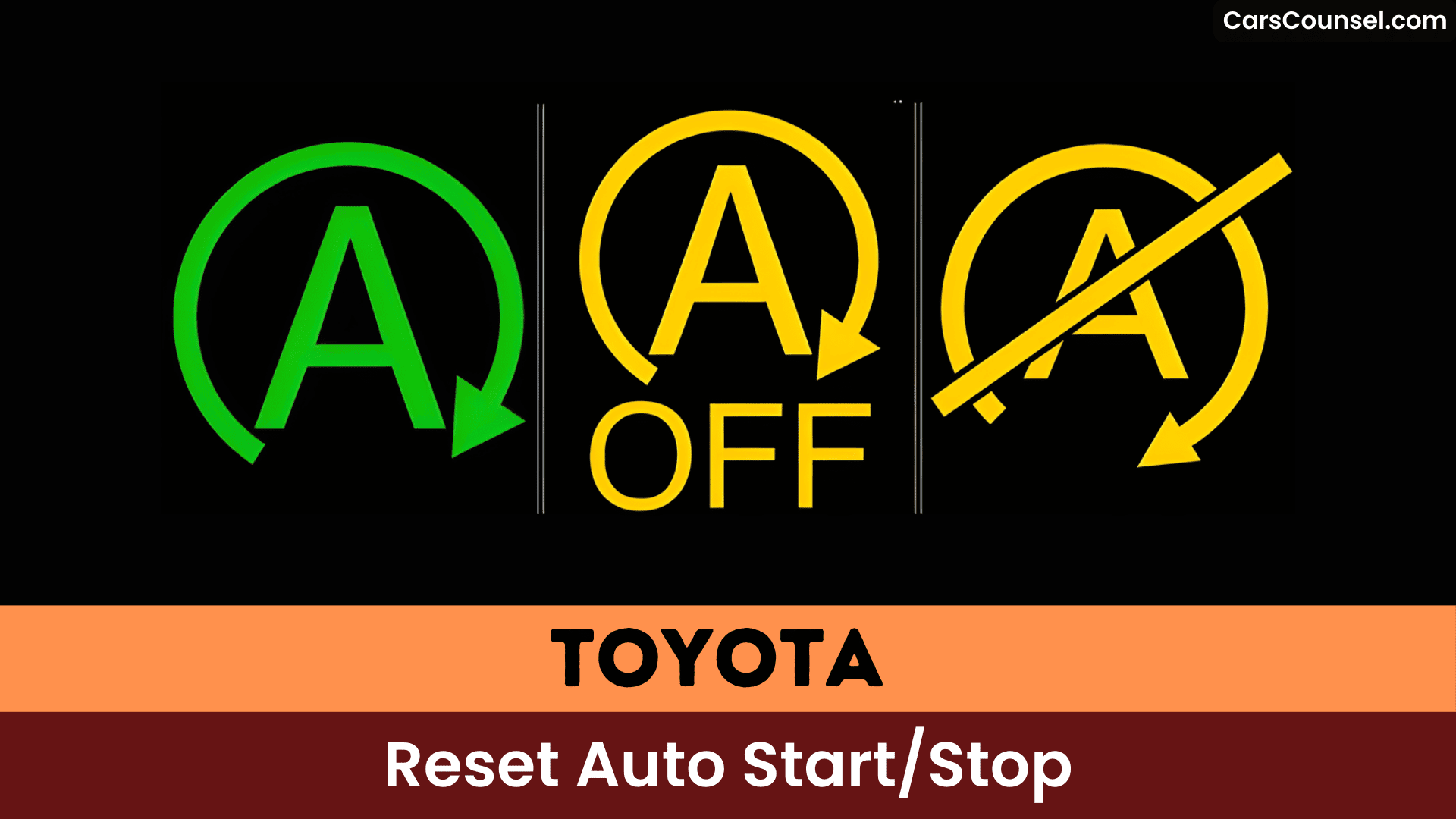
The “a” with a circle is a dashboard indicator showing Toyota’s Auto Start/Stop system is active and part of your vehicle features; it lights when ready, blinks during engine restart, and won’t operate if conditions disable it.
Conclusion
You master your Toyota’s Auto Start-Stop system by pressing the dashboard button, easing off the brake gently, or lifting your foot slightly at stops. You avoid reactivation by understanding its default restart on every ignition. You maintain peak performance through battery checks and dealer diagnostics. You drive efficiently, saving fuel while controlling this tech seamlessly.