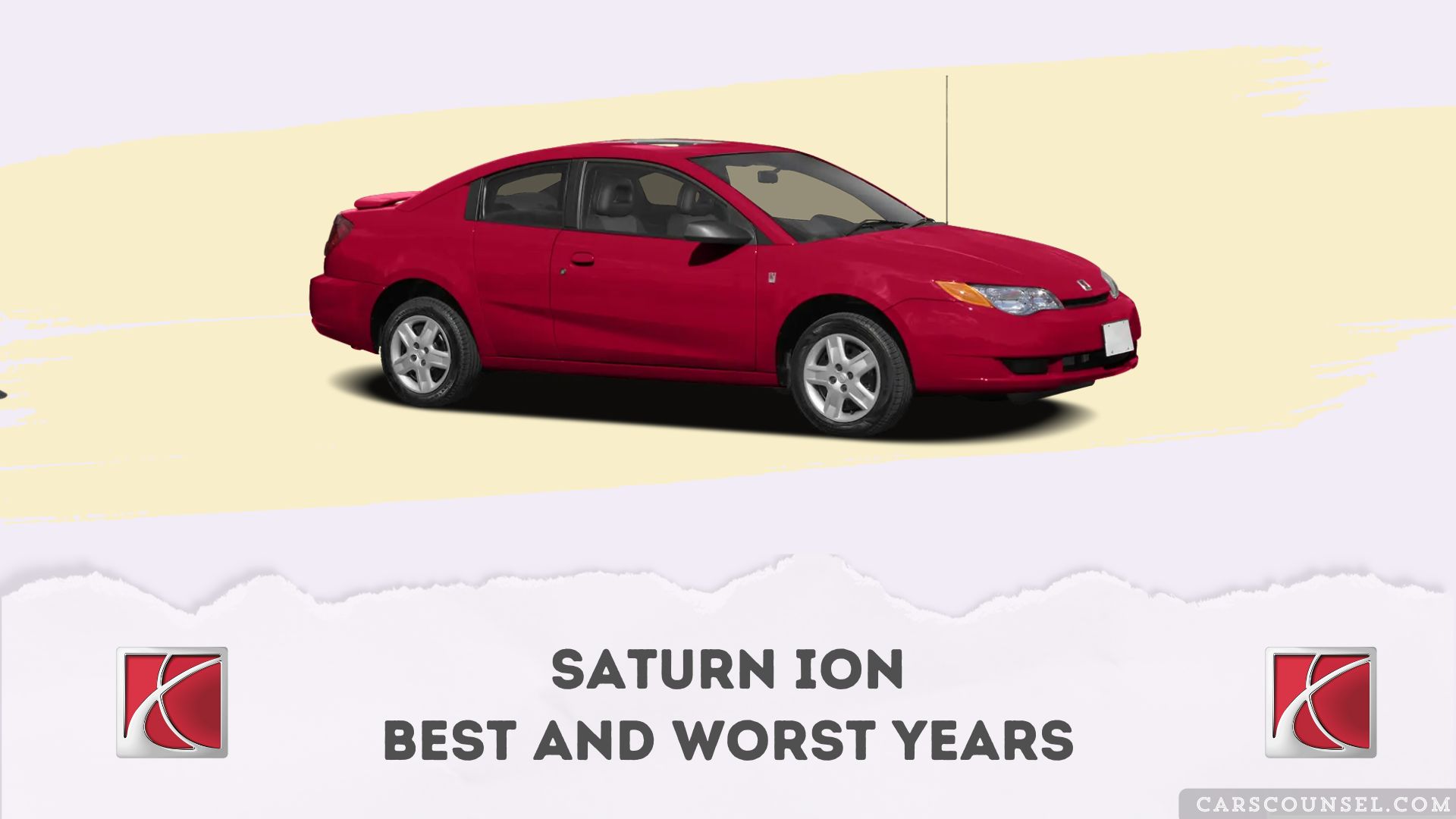
The best Saturn Ion years are the 2006 and 2007 models, which benefit from a mature platform and the removal of the problematic CVT. Buyers should avoid the 2003 model year due to severe first-year design flaws and high complaint volumes.
These rankings are comparative, and no used compact car from this era is flawless. Long-term reliability depends heavily on strict maintenance, rust prevention, and verifying the completion of critical safety recalls.
Meaningful differences exist between the early and late production years. The discontinuation of the continuously variable transmission and the introduction of updated Ecotec engines significantly improved the ownership experience for later models.
Quick Navigation
Best and Worst Saturn Ion Years at a Glance
| Model Year or Range | Verdict | Main Reason | Buyer Guidance |
|---|---|---|---|
| 2007 | Best Late-Generation Choice | Final year with sorted Ecotec engines | Verify EPS recall completion |
| 2006 | Good Choice | Conventional automatic replaced CVT | Inspect steering column |
| 2005 | Mixed | New engines but early timing chain risks | Check service records |
| 2004 | Approach Carefully | Ignition switch recalls and EPS faults | Test all electronics |
| 2003 | Avoid | First-year flaws and CVT failures | Skip this year entirely |
Key Takeaways
- The 2006–2007 models offer the most reliable ownership experience with conventional automatic transmissions.
- Avoid the 2003 model year due to severe first-year design flaws and high failure rates.
- The electric power steering (EPS) system is prone to failure across all years and requires recall verification.
- Early 2.2L Ecotec engines may suffer from timing chain tensioner wear if oil changes were neglected.
- Always verify the VIN for open recalls, especially for the ignition switch and steering motor.
How We Evaluated the Saturn Ion Model Years
Our analysis examines official safety recalls, government investigations, and consumer complaint patterns across the single generation. We also weigh powertrain changes, transmission reliability, and the impact of age on these discontinued compact cars.
Consumer complaints are not confirmed defects or failure rates. A recall does not automatically make a vehicle unreliable, and classic car reliability depends heavily on previous owner care and storage conditions.
Best Saturn Ion Years
2007: Best Late-Generation Choice
The final production year benefits from a fully matured Delta platform. The problematic continuously variable transmission was eliminated in prior years, leaving a robust four-speed automatic or reliable manual options.
Buyers must still verify that the electric power steering recall was performed. The 2.2L and 2.4L Ecotec engines are generally durable if the timing chain and spark plugs were serviced on time.
2006: Good Choice
This year continues the improved powertrain lineup without the early Ecotec teething issues. The interior received minor updates, and the conventional automatic transmission proved much more durable than the earlier CVT.
Inspect the steering column for clunks or intermittent power assist loss. Ensure the oxygen sensors and catalytic converter are functioning properly to avoid emissions test failures.
Best Year by Buyer Type
The 2007 model is the Best Overall choice for daily commuting, offering the most refined iteration of the platform. Budget buyers seeking a basic commuter might find a well-maintained 2006 to be a solid alternative.
Years to Approach Carefully
2005: Mixed
This year introduced the new Ecotec engine family and phased out the CVT. However, early 2.2L engines were still prone to timing chain tensioner failures, which can cause severe engine damage if ignored.
Purchase only if you have comprehensive records proving frequent oil changes and proper cooling system maintenance.
2004: Approach Carefully
While it received interior upgrades over the launch year, the 2004 model is still plagued by the fragile CVT in Quad Coupe trims. It is also heavily affected by the critical ignition switch recall.
Thoroughly test all electronic accessories and verify the ignition recall was completed before purchasing.
Worst Saturn Ion Years
2003: Avoid
The launch year is notorious for first-year redesign flaws, including widespread electrical gremlins and premature powertrain failures. The CVT equipped on Quad Coupes is particularly fragile and expensive to replace.
Combined with early steering column defects and high complaint volumes, the 2003 model year presents too many financial risks for used buyers.
Saturn Ion Reliability by Generation
First Generation (2003–2007)
Built on the GM Delta platform, the Saturn Ion was the brand’s compact offering. It shares related architecture and electric power steering components with the Chevy Cobalt, meaning both models suffer from similar steering motor failures.
The transition from the problematic CVT to a conventional four-speed automatic in 2005 dramatically improved long-term drivetrain reliability.
Common Saturn Ion Problems
Steering and Suspension Problems
The electric power steering (EPS) motor is the most common failure point across all years. When it fails, the steering becomes extremely heavy, and a warning light illuminates on the dash.
GM issued a safety recall to replace the EPS motor on affected vehicles. Buyers must verify this repair was completed by a dealer.
Electrical Problems
Faulty ignition switches can cause the engine to shut off unexpectedly while driving, disabling the power steering and airbags. This critical safety defect was addressed by a major manufacturer recall.
Other electrical quirks include flickering dashboard lights and malfunctioning power windows, which are common in early 2000s General Motors compact vehicles.
Engine Problems
The early 2.2L Ecotec four-cylinder engine is known for timing chain stretch and tensioner failure. This usually stems from extended oil change intervals or the use of incorrect oil viscosity.
Listen for a distinct rattling noise on cold starts, which indicates a worn timing chain requiring immediate and expensive replacement.
What to Check Before Buying a Used Saturn Ion
Verify the VIN to ensure the electric power steering and ignition switch recalls are completed. Test the steering at low speeds to ensure the EPS motor provides consistent assist without clunking.
Inspect the engine bay for oil leaks around the valve cover and timing chain cover. Listen for timing chain rattle on a cold start and test the automatic transmission for smooth shifts.
Related Buying Guides
- Saturn Sky best and worst years: A stylish roadster alternative for buyers wanting open-air driving and a more engaging sports car experience.
- Saturn Vue years to avoid: A practical compact SUV alternative for families needing more passenger space and cargo versatility.
- Chevy Cobalt years to avoid: A platform sibling that shares the GM Delta architecture and similar Ecotec powertrains.
Frequently Asked Questions
What is the most reliable Saturn Ion engine?
The 2.4L Ecotec four-cylinder introduced in later years is generally the most robust. It avoids the severe timing chain tensioner issues that plagued the early 2.2L engines when maintenance was neglected.
Why is the 2003 Saturn Ion considered unreliable?
The 2003 launch year suffers from severe first-year design flaws and electrical gremlins. The continuously variable transmission found in Quad Coupe trims is particularly fragile and prone to premature, expensive failure.
Do Saturn Ions have power steering problems?
Yes, the electric power steering (EPS) motor is a major failure point across all model years. GM issued a safety recall to replace the faulty motor, so verifying recall completion is essential.
Is the Saturn Ion a good daily driver?
A well-maintained 2006 or 2007 model with a conventional automatic transmission can serve as a budget daily driver. However, parts scarcity and age-related electrical issues make it less ideal than modern alternatives.
What should I look for when buying a used Saturn Ion?
Prioritize recall completion for the steering motor and ignition switch. Verify the timing chain is quiet on cold starts, and ensure the transmission shifts smoothly without hesitation or slipping.
Are Saturn Ion parts hard to find?
Mechanical parts for the Ecotec engines and GM transmissions are generally available. However, Ion-specific body panels, interior trim, and unique Quad Coupe components are becoming increasingly scarce and expensive.
Which Saturn Ion Year Should You Buy?
Target the 2006 and 2007 models for the most reliable ownership experience, as they feature the conventional automatic transmission and sorted Ecotec engines. The 2005 model is acceptable if maintenance records are pristine.
Avoid the 2003 launch year entirely due to severe first-year flaws and fragile transmissions. Always verify the VIN for open safety recalls and arrange an independent pre-purchase inspection.

