The Toyota C-HR is a subcompact crossover produced for the North American market from the 2018 through 2022 model years.
It is offered exclusively in front-wheel-drive configuration in the United States, powered by a 2.0-liter four-cylinder engine paired with a continuously variable transmission. Towing specifications vary by market and model year.
This guide covers towing capacity data for the Toyota C-HR by model year, including manufacturer-rated trailer weight limits, payload capacity, and hitch requirements.
Understanding the towing limitations of a vehicle before hitching any trailer helps protect the drivetrain, braking system, and suspension components from overload damage.
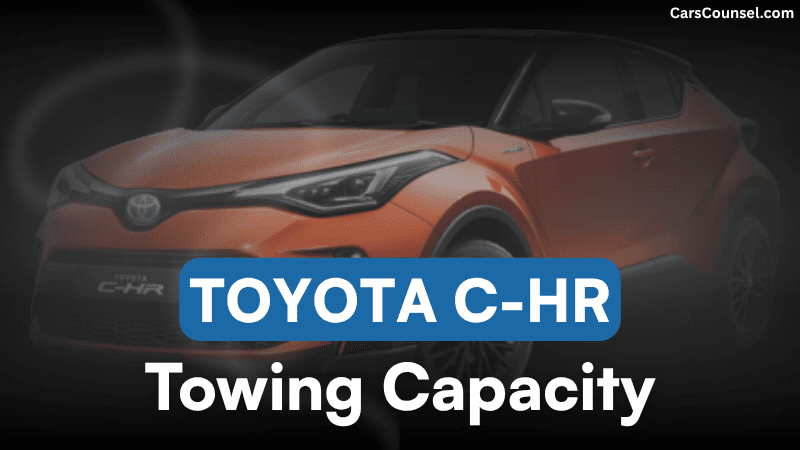
A critical note applies to this vehicle: Toyota does not publish a manufacturer towing capacity rating for the C-HR in the United States and Canadian markets.
The C-HR is not equipped with a factory tow package in North America, and Toyota does not recommend towing with this vehicle in those markets.
Owners in international markets, including Australia and select European countries, may reference locally issued towing specifications from Toyota, which differ from the North American specifications covered here.
Quick Navigation
2022 Toyota C-HR Towing Capacity
| Specification | Detail |
|---|---|
| Engine Options | 2.0L Inline-4 (2ZR-FAE), 144 hp |
| Drivetrain | FWD |
| Maximum Towing Capacity | Not Rated (North America) |
| Conventional Towing Capacity | Not Rated (North America) |
| Fifth-Wheel / Gooseneck Capacity | N/A |
| Maximum Payload Capacity | 850 lbs (386 kg) |
| Gross Combined Weight Rating (GCWR) | Not Published |
| Tongue Weight Limit | Not Rated |
| Hitch Class | Not Applicable |
| Factory Tow Package | No |
The 2022 Toyota C-HR carries no manufacturer towing capacity rating for the North American market, as Toyota does not authorize or equip this model for trailer towing in the United States or Canada.
The payload capacity of 850 lbs reflects the maximum combined weight of passengers and cargo the vehicle can carry within its gross vehicle weight rating.
Attempting to tow with this vehicle without a manufacturer towing rating voids relevant warranties and creates safety and liability risks.
2021 Toyota C-HR Towing Capacity
| Specification | Detail |
|---|---|
| Engine Options | 2.0L Inline-4 (2ZR-FAE), 144 hp |
| Drivetrain | FWD |
| Maximum Towing Capacity | Not Rated (North America) |
| Conventional Towing Capacity | Not Rated (North America) |
| Fifth-Wheel / Gooseneck Capacity | N/A |
| Maximum Payload Capacity | 850 lbs (386 kg) |
| Gross Combined Weight Rating (GCWR) | Not Published |
| Tongue Weight Limit | Not Rated |
| Hitch Class | Not Applicable |
| Factory Tow Package | No |
The 2021 Toyota C-HR shares the same no-tow designation as the rest of the North American model run. The 2.0-liter engine configuration and FWD platform in this model year were not engineered or validated for trailer towing loads by Toyota. Owners needing towing capability in this segment should consult Toyota’s RAV4 or Venza models, which carry published towing specifications.
2020 Toyota C-HR Towing Capacity
| Specification | Detail |
|---|---|
| Engine Options | 2.0L Inline-4 (2ZR-FAE), 144 hp |
| Drivetrain | FWD |
| Maximum Towing Capacity | Not Rated (North America) |
| Conventional Towing Capacity | Not Rated (North America) |
| Fifth-Wheel / Gooseneck Capacity | N/A |
| Maximum Payload Capacity | 850 lbs (386 kg) |
| Gross Combined Weight Rating (GCWR) | Not Published |
| Tongue Weight Limit | Not Rated |
| Hitch Class | Not Applicable |
| Factory Tow Package | No |
The 2020 Toyota C-HR received exterior styling updates but no changes to the powertrain or chassis specifications relevant to towing capacity. The vehicle remains unrated for towing in North America. No aftermarket hitch installation changes the manufacturer towing rating, as the absence of a towing specification reflects a platform-level engineering decision by Toyota for this market.
2019 Toyota C-HR Towing Capacity
| Specification | Detail |
|---|---|
| Engine Options | 2.0L Inline-4 (2ZR-FAE), 144 hp |
| Drivetrain | FWD |
| Maximum Towing Capacity | Not Rated (North America) |
| Conventional Towing Capacity | Not Rated (North America) |
| Fifth-Wheel / Gooseneck Capacity | N/A |
| Maximum Payload Capacity | 850 lbs (386 kg) |
| Gross Combined Weight Rating (GCWR) | Not Published |
| Tongue Weight Limit | Not Rated |
| Hitch Class | Not Applicable |
| Factory Tow Package | No |
The 2019 Toyota C-HR continues the no-tow specification established in the first model year. Payload capacity remains 850 lbs, which covers the maximum combined load of occupants and in-vehicle cargo. Installing a third-party receiver hitch on the C-HR does not establish a legal or manufacturer-sanctioned trailer weight limit for this model.
2018 Toyota C-HR Towing Capacity
| Specification | Detail |
|---|---|
| Engine Options | 2.0L Inline-4 (2ZR-FAE), 144 hp |
| Drivetrain | FWD |
| Maximum Towing Capacity | Not Rated (North America) |
| Conventional Towing Capacity | Not Rated (North America) |
| Fifth-Wheel / Gooseneck Capacity | N/A |
| Maximum Payload Capacity | 850 lbs (386 kg) |
| Gross Combined Weight Rating (GCWR) | Not Published |
| Tongue Weight Limit | Not Rated |
| Hitch Class | Not Applicable |
| Factory Tow Package | No |
The 2018 Toyota C-HR was the first model year of the C-HR in the North American market, and it launched without any towing capacity rating or factory tow package. The front-wheel-drive powertrain and CVT transmission were not configured or tested for trailer towing loads in this market. The 2018 model year established the no-tow classification that persisted through the entire North American production run.
Toyota C-HR Towing Limitations Explained
The Toyota C-HR is classified as a non-towing vehicle in the North American market. This classification is not a matter of engine power or hitch availability. It reflects a deliberate design and validation decision by Toyota based on the vehicle’s transmission cooling capacity, suspension geometry, brake system sizing, and structural hitch attachment points.
Why Toyota Does Not Rate the C-HR for Towing
Toyota publishes a towing capacity for a vehicle only after conducting towing validation testing specific to that market. The C-HR in North America was not submitted for this testing. As a result, no manufacturer towing capacity exists for any C-HR model year in the United States or Canada.
The absence of a towing rating means there is no approved maximum trailer weight, no tongue weight limit, no GCWR, and no endorsed hitch class for this vehicle in the North American market.
International Market Towing Specifications
In select international markets, Toyota has published limited towing specifications for the C-HR. In Australia, for example, the C-HR with a 1.2-liter turbocharged engine has been rated for a braked trailer capacity of up to 1,000 lbs (450 kg) and an unbraked trailer capacity of 992 lbs (450 kg). These specifications apply only to those markets and those engine configurations. They do not apply to the North American 2.0L variant.
Owners purchasing or operating a C-HR outside North America should consult the owner’s manual issued for that specific market and engine configuration.
Aftermarket Hitch Installations
Aftermarket hitch manufacturers may offer receiver hitch kits designed to fit the C-HR chassis. The availability of a physical hitch attachment does not establish a towing rating. Toyota’s published guidance for North American C-HR models does not include any towing limit, and using an aftermarket hitch to tow a trailer on this vehicle carries significant risks including:
Brake system overload. Cooling system thermal stress. Transmission damage from unregulated load. Structural stress on non-reinforced attachment points.
Any towing conducted on an unrated vehicle is undertaken entirely at the owner’s risk and outside the scope of manufacturer warranty coverage.
Towing Equipment and Setup Tips
This section applies primarily to C-HR owners in markets where a towing capacity has been published by Toyota, or to general reference for owners considering an alternative tow-rated vehicle. For North American C-HR owners, the guidance below does not apply to this vehicle.
Tow Package
A factory tow package is the minimum prerequisite for reaching a vehicle’s published maximum towing capacity. It typically includes a transmission oil cooler, trailer wiring harness, and receiver hitch rated to the appropriate hitch class. The Toyota C-HR does not offer a factory tow package in North America.
Trailer Brake Controller
Trailers exceeding 1,500 lbs gross weight generally require electric trailer brakes controlled by a proportional brake controller installed in the tow vehicle. A brake controller coordinates trailer braking with the deceleration rate of the tow vehicle, reducing stopping distances and trailer sway risk.
Weight-Distributing Hitch
Trailers with a gross weight above 5,000 lbs or tongue weight above 500 lbs require a weight-distributing hitch to maintain proper axle load balance across both the tow vehicle and the trailer. This equipment type is not relevant to the C-HR given its no-tow designation and low-capacity international ratings.
Transmission Cooler
Sustained towing increases automatic transmission operating temperatures. Vehicles equipped for towing typically include an auxiliary transmission oil cooler as part of the factory tow package. The CVT transmission in the C-HR does not include provisions for a supplemental cooler in North American models.
Proper Tire Load Ratings
Tire load ratings must accommodate the full gross vehicle weight when towing, including passengers, cargo, and the portion of trailer tongue weight transferred to the rear axle. Consult the tire sidewall for the maximum load index value and compare it against the calculated rear axle load before towing.
Trailer Sway Control
Trailer sway occurs when lateral oscillation of the trailer exceeds the corrective response of the tow vehicle’s stability system. It is most commonly triggered by improper tongue weight distribution, excessive speed, or crosswind loads. A friction-type sway control bar or electronic trailer sway mitigation device reduces onset risk on tow-rated vehicles.
Normal Towing vs Heavy Towing Setup
| Component | Normal Towing (Under 3,500 lbs) | Heavy Towing (3,500 to 7,000 lbs) |
|---|---|---|
| Hitch Type | Standard ball mount | Weight-distributing hitch |
| Brake Controller | Optional below 1,500 lbs trailer weight | Required |
| Transmission Cooler | Factory cooler with tow package | Auxiliary cooler recommended |
| Sway Control | Optional | Recommended |
| Tire Pressure | Standard inflation | Adjusted to maximum sidewall rating |
| Mirror Configuration | Standard | Extended tow mirrors recommended |
If you’re researching Toyota towing capacity, be sure to explore our detailed guides on models like the Toyota Venza, Toyota Sienna, Toyota FJ Cruiser, and Toyota Crown Signia. Knowing your vehicle’s towing limits is essential for safe and efficient hauling. Our expert resources break down towing capacity by model, explain key factors like engine power and braked vs unbraked limits, and help you choose the right setup so you can tow with confidence and avoid unnecessary strain on your vehicle.
Frequently Asked Questions
What is the towing capacity of a Toyota C-HR?
The Toyota C-HR has no manufacturer-published towing capacity in the North American market. Toyota does not rate this vehicle for trailer towing in the United States or Canada, and no factory tow package is available. In limited international markets, certain engine configurations carry a restricted towing rating issued by Toyota for those regions only.
Can a Toyota C-HR tow a trailer?
Toyota does not authorize or recommend towing with the C-HR in North America, as the vehicle carries no towing capacity rating for this market. Owners who install an aftermarket hitch and attempt to tow do so without a manufacturer-sanctioned weight limit, which presents safety risks and may void warranty coverage. Those requiring towing capability should consider a Toyota model with a published towing rating.
Does the Toyota C-HR have a tow package available?
No. The Toyota C-HR does not offer a factory tow package in the North American market. A tow package, which typically includes a transmission cooler, trailer wiring harness, and rated receiver hitch, was never offered as standard or optional equipment on any C-HR model year sold in the United States or Canada.
What is the payload capacity of a Toyota C-HR?
The Toyota C-HR carries a maximum payload capacity of 850 lbs (386 kg) across all North American model years from 2018 to 2022. Payload refers to the combined weight of all passengers and cargo carried within the vehicle. Exceeding the payload capacity overloads the suspension, tires, and braking system regardless of whether a trailer is attached.
Which Toyota SUV should I choose if I need towing capacity?
Owners requiring towing capacity in Toyota’s crossover lineup should consider the Toyota RAV4, which is rated at up to 3,500 lbs with the available tow package, or the Toyota Venza, rated at up to 1,500 lbs. The Toyota 4Runner provides significantly higher towing capacity of up to 5,000 lbs with the V6 or up to 7,300 lbs with the V8 engine in earlier model years. All towing ratings are model-specific and configuration-dependent.
Is it safe to tow with a Toyota C-HR using an aftermarket hitch?
Toyota does not recommend towing with the C-HR in North America, and no manufacturer-approved trailer weight limit exists for this vehicle in this market. Installing an aftermarket hitch provides a physical connection point but does not establish a structurally or thermally validated towing specification. The risks include transmission overheating, brake overload, structural damage to the hitch attachment point, and reduced vehicle control.
Conclusion
The Toyota C-HR covers the 2018 through 2022 model years in the North American market and carries no manufacturer towing capacity rating in the United States or Canada across any of those years. Toyota did not submit this vehicle for towing validation testing in this market, and no factory tow package was made available.
The C-HR’s engine configuration, CVT transmission, FWD drivetrain, and brake system sizing reflect a vehicle engineered for passenger transportation rather than trailer towing. This limitation is consistent across all five North American model years and is not altered by engine tuning, trim level, or aftermarket hitch installation.
In limited international markets, restricted towing ratings may exist for specific C-HR engine variants, and owners in those regions should reference the locally issued owner’s manual for applicable specifications.
Always verify towing specifications using the owner’s manual applicable to your market before attaching any trailer or towing equipment to a vehicle.