The Volkswagen ID. Buzz is a battery electric multi-passenger van built on the MEB platform.
It was introduced to the US market for the 2024 model year in long-wheelbase three-row configuration.
The ID. Buzz is offered in rear-wheel drive single-motor and all-wheel drive dual-motor configurations, with drivetrain selection determining the published towing capacity.
This guide covers Volkswagen ID. Buzz towing specifications by model year for the US market, including maximum trailer weight, tongue weight limits, payload capacity, and hitch class.
Staying within manufacturer-rated towing limits in an electric vehicle is essential for protecting the battery management system, electric motors, and braking components from thermal overload and mechanical stress.
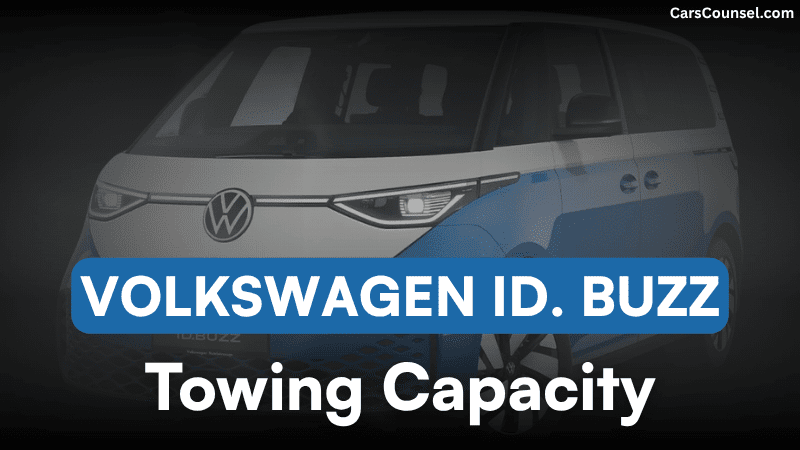
As an electric vehicle, the ID. Buzz experiences significant driving range reduction when towing. Battery range decreases in proportion to trailer weight, speed, and road grade. Route planning with available DC fast charging stations is a practical necessity when towing with this vehicle.
Quick Navigation
2025 Volkswagen ID. Buzz Towing Capacity
| Specification | Detail |
|---|---|
| Engine Options | Dual Permanent Magnet Synchronous Motors (AWD); Single Rear Motor (RWD) |
| Drivetrain | AWD (dual motor) / RWD (single motor) |
| Maximum Towing Capacity | 2,200 lbs (998 kg) — AWD; Not rated — RWD |
| Conventional Towing Capacity | 2,200 lbs (998 kg) — AWD only |
| Fifth-Wheel / Gooseneck Capacity | N/A |
| Maximum Payload Capacity | Approx. 1,058 lbs (480 kg) — verify on door jamb sticker |
| Gross Combined Weight Rating (GCWR) | Refer to owner’s manual |
| Tongue Weight Limit | 220 lbs (100 kg) |
| Hitch Class | Class I (1-1/4-inch receiver) |
| Factory Tow Package | Optional (AWD models only) |
The 2025 Volkswagen ID. Buzz AWD supports a maximum towing capacity of 2,200 lbs when equipped with the factory tow package. RWD single-motor variants do not carry a towing capacity rating from Volkswagen for the US market. Payload capacity on the ID. Buzz must account for all seated occupants across all three rows, cargo, and tongue weight simultaneously, making payload management a key operational consideration when towing.
2024 Volkswagen ID. Buzz Towing Capacity
| Specification | Detail |
|---|---|
| Engine Options | Dual Permanent Magnet Synchronous Motors (AWD); Single Rear Motor (RWD) |
| Drivetrain | AWD (dual motor) / RWD (single motor) |
| Maximum Towing Capacity | 2,200 lbs (998 kg) — AWD; Not rated — RWD |
| Conventional Towing Capacity | 2,200 lbs (998 kg) — AWD only |
| Fifth-Wheel / Gooseneck Capacity | N/A |
| Maximum Payload Capacity | Approx. 1,058 lbs (480 kg) — verify on door jamb sticker |
| Gross Combined Weight Rating (GCWR) | Refer to owner’s manual |
| Tongue Weight Limit | 220 lbs (100 kg) |
| Hitch Class | Class I (1-1/4-inch receiver) |
| Factory Tow Package | Optional (AWD models only) |
The 2024 Volkswagen ID. Buzz was the launch year for the US market and established the 2,200-lb maximum towing capacity for AWD configurations. The vehicle’s three-row seating capacity means that a full passenger load can quickly consume a large portion of the payload budget before any trailer tongue weight is added. Operators planning to tow should calculate remaining payload after accounting for all occupants and cargo before connecting a trailer.
Towing Equipment and Setup Tips
The Volkswagen ID. Buzz is an electric van with a rear-motor or dual-motor configuration. Towing equipment requirements follow standard passenger vehicle guidelines, with electric powertrain-specific operational considerations that differ from internal combustion platforms.
Tow Package
The factory tow package for the ID. Buzz AWD includes the Class I receiver hitch assembly and trailer wiring harness. The tow package is available only on AWD dual-motor models; RWD variants do not have a factory tow package option. The vehicle’s published maximum towing capacity of 2,200 lbs is contingent on factory tow package installation and cannot be achieved without it.
Trailer Brake Controller
For trailers approaching the 2,200-lb maximum towing capacity, a trailer brake controller reduces stopping distance and decreases load on the ID. Buzz’s regenerative and friction braking systems. Volkswagen does not include a factory-integrated electronic brake controller in this vehicle. An aftermarket proportional brake controller is advisable for trailers above 1,500 lbs gross weight and may be legally required in some jurisdictions.
Weight-Distributing Hitch
The ID. Buzz uses a Class I hitch with a 1-1/4-inch receiver. Weight-distributing hitch systems are designed for Class III and larger receivers and are not compatible with this platform. Correct tongue weight, kept between 10 and 15 percent of gross trailer weight and within the 220-lb limit, is the method for maintaining proper axle load distribution on this vehicle.
Battery Thermal Management and Range Planning
The ID. Buzz does not use a conventional transmission, making transmission cooling equipment non-applicable. Battery thermal load during sustained towing is the primary drivetrain concern. High motor output over extended distances generates heat in the battery pack and motors, which can trigger reduced power output modes. Planning charging stops at intervals shorter than unladen driving range is required for any towing trip.
Proper Tire Load Ratings
Tire load ratings must support the combined weight of the vehicle, all occupants, cargo, and trailer tongue weight. With up to seven passengers, the ID. Buzz can carry significant human load before trailer tongue weight is added. Confirming that total loaded vehicle weight does not exceed tire load ratings, using the pressures specified on the door jamb placard, is necessary before towing.
Trailer Sway Control
The ID. Buzz includes electronic stability control, which applies selective braking to reduce trailer sway. Sway risk increases when tongue weight falls below 10 percent of gross trailer weight or when the trailer carries excessive rear load. A 220-lb tongue weight limit means that sway management through physical load distribution is critical, as the margin for error is narrower than on higher-capacity tow vehicles.
Normal Towing vs. Heavy Towing Setup
| Configuration Factor | Light Load (Under 1,000 lbs) | Heavy Load (1,500 to 2,200 lbs) |
|---|---|---|
| Trailer Brake Controller | Not required | Recommended or legally required |
| Weight-Distributing Hitch | Not compatible / Not required | Not compatible with Class I receiver |
| Battery Range Planning | Moderate reduction expected | Plan for 40 to 60 percent range reduction |
| Tire Inflation | Standard pressure | Verify against door jamb load chart |
| Tow Package | Required | Required |
| Passenger Load | All rows available | Reduce passenger count to preserve payload margin |
If you’re researching Volkswagen towing capacity, be sure to explore our detailed guides on models like the Volkswagen Touareg, Volkswagen Taos, Volkswagen ID.4, and Volkswagen Atlas. Knowing your vehicle’s towing limits is essential for safe and efficient hauling. Our expert resources break down towing capacity by model, explain key factors like engine power and braked vs unbraked limits, and help you choose the right setup so you can tow with confidence and avoid unnecessary strain on your vehicle.
Frequently Asked Questions
What is the maximum towing capacity of a Volkswagen ID. Buzz?
The Volkswagen ID. Buzz has a maximum towing capacity of 2,200 lbs (998 kg) on AWD dual-motor models equipped with the factory tow package. RWD single-motor variants do not carry an approved towing rating in the US market. This specification applies to both the 2024 and 2025 US model years.
How much can a Volkswagen ID. Buzz tow with a tow package?
With the factory tow package installed on an AWD model, the Volkswagen ID. Buzz can tow up to 2,200 lbs (998 kg). The tow package includes the Class I receiver hitch and trailer wiring harness. The tow package is a required component for achieving the published maximum trailer weight rating and is not available on RWD models.
Does AWD affect Volkswagen ID. Buzz towing capacity?
Drivetrain selection directly determines whether the ID. Buzz can tow. AWD dual-motor models carry the 2,200-lb maximum towing capacity rating. RWD single-motor models have no manufacturer-approved towing capacity for the US market and should not be used to tow trailers.
What trailer weight is safe for a Volkswagen ID. Buzz?
For AWD models, any trailer at or below 2,200 lbs gross weight is within the manufacturer-specified towing limit. Operating below 80 percent of the maximum towing capacity, approximately 1,750 lbs, reduces drivetrain thermal stress and improves braking response. Tongue weight must not exceed 220 lbs regardless of trailer type, and payload must be calculated to include all occupants, cargo, and tongue weight simultaneously.
How does towing affect Volkswagen ID. Buzz battery range?
Towing reduces the ID. Buzz’s driving range by an estimated 40 to 60 percent depending on trailer weight, speed, road grade, and ambient temperature. Highway towing near the 2,200-lb maximum will reduce range considerably below the EPA-rated unladen figure. All towing trips require route planning with charging stops calculated against the reduced towing range, not the standard driving range.
What is the tongue weight limit on a Volkswagen ID. Buzz?
The Volkswagen ID. Buzz has a tongue weight limit of 220 lbs (100 kg) on AWD models. Tongue weight should represent 10 to 15 percent of the total gross trailer weight to maintain vehicle stability. Exceeding the 220-lb tongue weight limit overloads the rear axle and hitch receiver and is outside manufacturer specifications.
Conclusion
The Volkswagen ID. Buzz offers a maximum towing capacity of 2,200 lbs (998 kg) on AWD dual-motor models across US production years 2024 and 2025. RWD single-motor variants carry no approved towing rating in the US market. Powertrain configuration is therefore the determining factor when selecting an ID. Buzz for towing use.
The Class I hitch receiver, 220-lb tongue weight limit, and multi-row passenger capacity create a tight operating envelope for simultaneous towing and full occupancy. Battery range reduction under tow load and payload constraints are the two most significant practical limitations for this vehicle in towing applications. Trailers suitable for the ID. Buzz include small utility trailers, lightweight cargo trailers, and compact recreational trailers within the 2,200-lb gross weight.
Always verify towing specifications in the owner’s manual and on the door jamb placard before towing, and plan charging stops based on reduced towing range rather than the EPA unladen rating.

