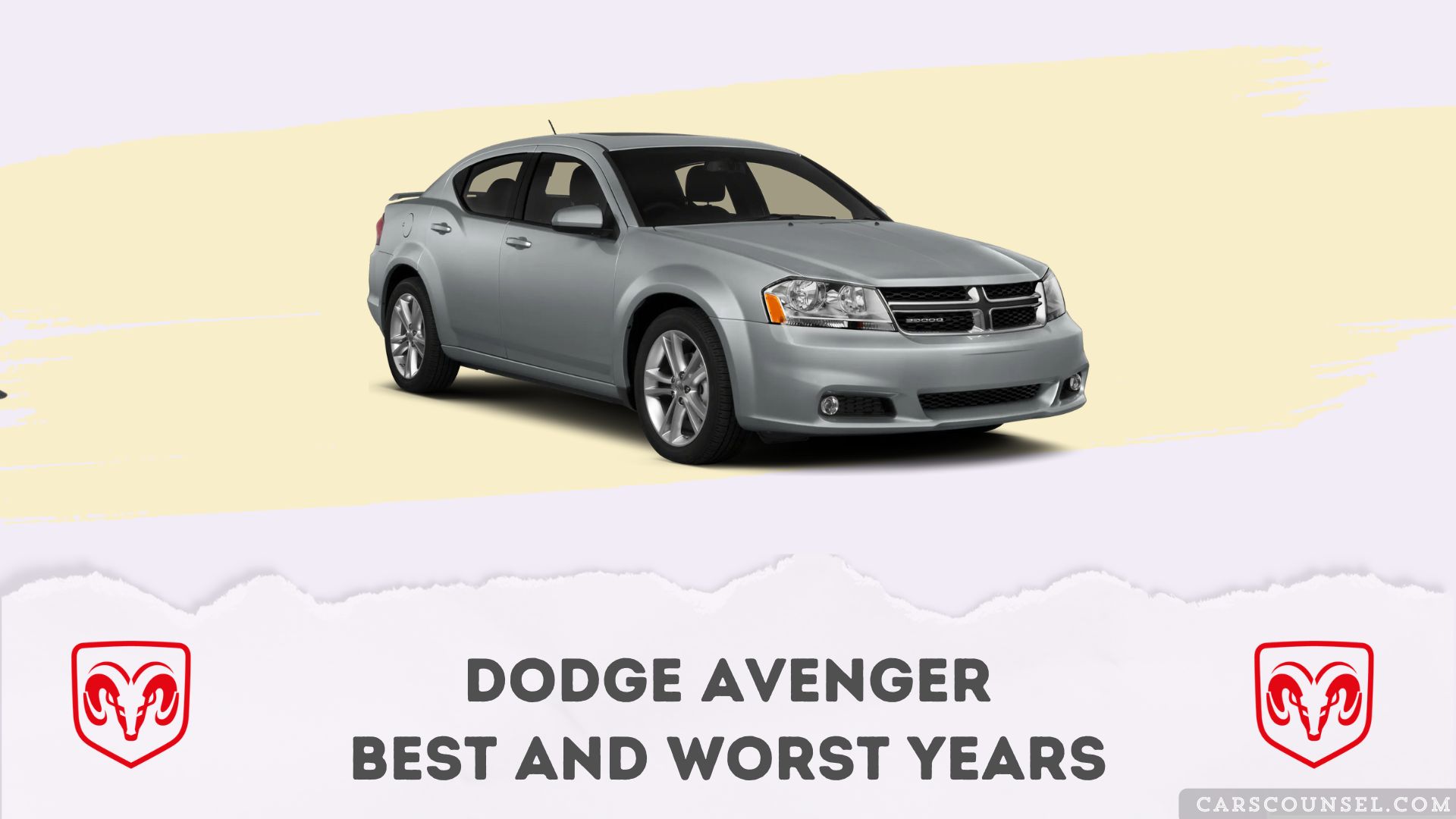
The best Dodge Avenger years are the 2012 through 2014 models, which feature a reliable V6 engine and updated interior. Buyers should strictly avoid the 2008 model year due to widespread transmission and electrical complaints. First-generation coupes from 1998 to 2000 remain solid older choices.
These rankings are comparative, meaning no used Avenger is entirely flawless. Long-term reliability heavily depends on previous maintenance, rust prevention, and whether all open manufacturer recalls were properly addressed by prior owners.
Reliability varies significantly between the first-generation coupe and the second-generation sedan. The 2011 introduction of the 3.6-liter Pentastar V6 engine dramatically improved the sedan’s performance and long-term durability compared to earlier V6 options.
Quick Navigation
Best and Worst Dodge Avenger Years at a Glance
| Model Year Range | Verdict | Main Reason | Buyer Guidance |
|---|---|---|---|
| 2012–2014 | Best Choice | Refined 3.6L V6, updated interior, lowest complaint rates | Top pick for daily driving |
| 2011 | Good Choice | First year of major refresh and new V6 engine | Verify early-production build quality |
| 2009–2010 | Mixed | Older powertrains, lingering electrical gremlins | Requires thorough pre-purchase inspection |
| 2008 | Avoid | First-year redesign plagued by transmission and steering issues | Look at newer models instead |
| 1998–2000 | Best Older Choice | Mature first-generation coupe with reliable Mitsubishi-based underpinnings | Check for age-related rust and wear |
| 1995–1997 | Approach Carefully | Early first-generation models with higher age-related risks | Enthusiast inspection required |
Key Takeaways
- The 2012 through 2014 Dodge Avenger sedans are the most reliable options, featuring the dependable 3.6-liter Pentastar V6.
- Strictly avoid the 2008 model year, which suffers from excessive transmission, steering, and electrical complaints.
- The 2011 model year is a good choice but requires careful inspection as the first year of a major powertrain refresh.
- First-generation Avenger coupes from 1998 to 2000 offer decent reliability for their age, though parts availability is declining.
- Always verify the vehicle identification number (VIN) to ensure all open safety recalls, particularly for airbags and fuel systems, have been completed.
How We Evaluated the Dodge Avenger Model Years
Our analysis compares official safety recalls, manufacturer service campaigns, and consumer complaint patterns across both generations of the Avenger. We weigh the severity and repair complexity of reported issues against the vehicle’s overall production volume.
Consumer complaints indicate owner frustration but do not automatically represent confirmed mechanical failure rates. A single recall does not render a model year unreliable, provided the remedy is available and completed. Recent model years naturally show fewer complaints due to limited road exposure.
Best Dodge Avenger Years
2012–2014: Best Choice
The final three years of the Avenger sedan represent the most refined versions of the nameplate. By 2012, Dodge had fully sorted the 3.6-liter Pentastar V6 and the six-speed automatic transmission introduced during the 2011 refresh.
These models benefit from a significantly upgraded interior, improved suspension tuning, and the lowest volume of consumer complaints in the sedan’s history. They offer a comfortable, reasonably reliable daily commuter experience.
2011: Good Choice
The 2011 model year marks a major turning point for the Avenger sedan. Dodge replaced the troublesome older engines with the 3.6-liter Pentastar V6 and completely overhauled the cheap-feeling dashboard and interior materials.
While the new powertrain is excellent, first-year redesigns can occasionally suffer from early-production assembly quirks. Buyers should verify that all software updates and initial service bulletins were addressed.
1998–2000: Best Older Choice
The first-generation Avenger was a compact coupe built on a Mitsubishi-derived platform. The 1998 through 2000 model years benefit from a mid-cycle refresh that improved styling and resolved early mechanical teething issues.
While age is a significant factor, these coupes are generally regarded as dependable classics. Finding pristine, low-mileage examples is challenging, and rust inspection is mandatory.
Best Dodge Avenger Year by Buyer Type
Best Overall: 2013 or 2014
For daily commuters seeking a budget-friendly sedan, the 2013 and 2014 models provide the best balance of modern safety features, reliable V6 performance, and updated interior comfort.
Best Budget Alternative: Honda Accord or Toyota Camry
Buyers prioritizing absolute long-term reliability over the Dodge badge should consider a contemporary Honda Accord or Toyota Camry. These midsize sedans generally offer superior longevity and lower ownership costs.
Years to Approach Carefully
2009–2010: Mixed
The 2009 and 2010 sedans show fewer catastrophic complaints than the 2008 model, but they still rely on the older 2.4-liter four-cylinder, 2.7-liter V6, or 3.5-liter V6 engines. These powertrains are less refined and more prone to minor sensor failures.
Buyers considering these years must budget for potential alternator replacements and thoroughly test the transmission for harsh shifting.
1995–1997: Approach Carefully
Early first-generation coupes are now classic vehicles. While mechanically simple, their age guarantees wear-and-tear issues, brittle plastics, and potential wiring degradation. These are best suited for enthusiast buyers willing to perform regular maintenance.
Worst Dodge Avenger Years
2008: Avoid
The 2008 model year was the first year of the second-generation sedan redesign, and it is plagued by a high volume of severe complaints. Owners frequently report premature transmission failures, faulty electronic throttle control modules, and steering angle sensor malfunctions.
Additionally, the 2008 models suffer from interior build quality issues and electrical gremlins that are expensive to diagnose. The financial risk of purchasing an uncorrected 2008 model far outweighs its low used-market price.
Dodge Avenger Reliability by Generation
First Generation (1995–2000)
Built as a compact coupe, the first-generation Avenger shared its underlying architecture with the Mitsubishi Eclipse and Eagle Talon. Reliability is heavily dependent on current condition rather than factory defect rates. Later years (1998–2000) are preferred for their improved build quality.
Second Generation (2008–2014)
The second generation shifted to a four-door sedan built on the Chrysler JS platform, making it a direct mechanical sibling to the Chrysler Sebring. Early models (2008–2010) struggled with powertrain and electrical reliability.
The 2011 mid-cycle refresh transformed the vehicle, introducing the highly reliable 3.6-liter Pentastar V6. This generation was eventually replaced by the Chrysler 200, which carried the platform forward with further refinements.
Common Dodge Avenger Problems
Transmission and Shift Interlock Issues
Models from 2008 to 2010 frequently experience issues with the automatic transmission shifting harshly or failing to engage. A related and highly frustrating issue involves the brake-shift interlock mechanism, which can fail and leave the vehicle permanently stuck in park.
Electrical and Alternator Failures
Across the second generation, premature alternator failure is a common complaint. When the alternator fails, it can cause the battery to drain, leading to sudden stalling while driving and the illumination of multiple dashboard warning lights.
Fuel System and Stalling
Some owners report engine stalling related to fuel pump relay failures or faulty crankshaft position sensors. While less prevalent than the transmission issues, sudden stalling at highway speeds presents a clear safety hazard that requires immediate diagnostic attention.
What to Check Before Buying a Used Dodge Avenger
- Run the vehicle identification number (VIN) to verify all open safety recalls, particularly those concerning the occupant restraint controller and fuel pump relay, have been completed.
- Test the brake-shift interlock by ensuring the vehicle smoothly shifts out of park when the brake pedal is depressed.
- Inspect the alternator output and battery health, as electrical system strain is common in second-generation models.
- Check for harsh shifts, hesitation, or slipping during a prolonged test drive of the automatic transmission.
- Examine the undercarriage and wheel wells for structural rust, especially on first-generation coupes and older sedans from snowy climates.
- Verify that the electronic throttle control responds smoothly without dead spots or sudden surges.
- Arrange for an independent pre-purchase inspection to scan for hidden diagnostic trouble codes.
Related Buying Guides
- Dodge Challenger best and worst years: Explore the reliability of Dodge’s modern muscle car if you want V8 performance instead of commuter sedan practicality.
- Subaru Legacy years to avoid: A reliable all-wheel-drive alternative to the Avenger for buyers who need extra traction in inclement weather.
Frequently Asked Questions
What is the most reliable Dodge Avenger year?
The 2013 and 2014 model years are the most reliable. They feature the refined 3.6-liter Pentastar V6 engine, an updated interior, and the lowest volume of consumer complaints in the sedan’s production run.
Why should I avoid the 2008 Dodge Avenger?
The 2008 model year was the first year of a major redesign and suffers from excessive transmission failures, electrical gremlins, and steering sensor malfunctions. The repair costs frequently exceed the vehicle’s current market value.
Does the Dodge Avenger have a good engine?
The 3.6-liter Pentastar V6, introduced for the 2011 model year, is a highly regarded and durable engine. Earlier models equipped with the 2.7-liter V6 are generally considered underpowered and more prone to maintenance issues.
Is the Dodge Avenger expensive to maintain?
Maintenance costs are slightly above the compact and midsize sedan average. While routine services are affordable, unexpected electrical diagnostics and transmission repairs can increase annual ownership expenses significantly.
What replaced the Dodge Avenger?
Dodge discontinued the Avenger after the 2014 model year. The Chrysler 200 effectively replaced it in the corporate lineup, utilizing an evolved version of the same underlying platform architecture.
Are first-generation Avengers good daily drivers?
The 1998 through 2000 coupes can be dependable, but their age makes them better suited as weekend classics. Finding replacement interior trim and specific electronic modules is becoming increasingly difficult.
Which Dodge Avenger Year Should You Buy?
For a dependable daily commuter, target the 2012 through 2014 Dodge Avenger sedans equipped with the 3.6-liter V6. These final production years offer the best combination of modern features and sorted mechanical reliability.
Strictly avoid the 2008 model year due to its high rate of severe powertrain and electrical failures. Regardless of the year you choose, always verify the VIN for open recalls and secure an independent pre-purchase inspection.

