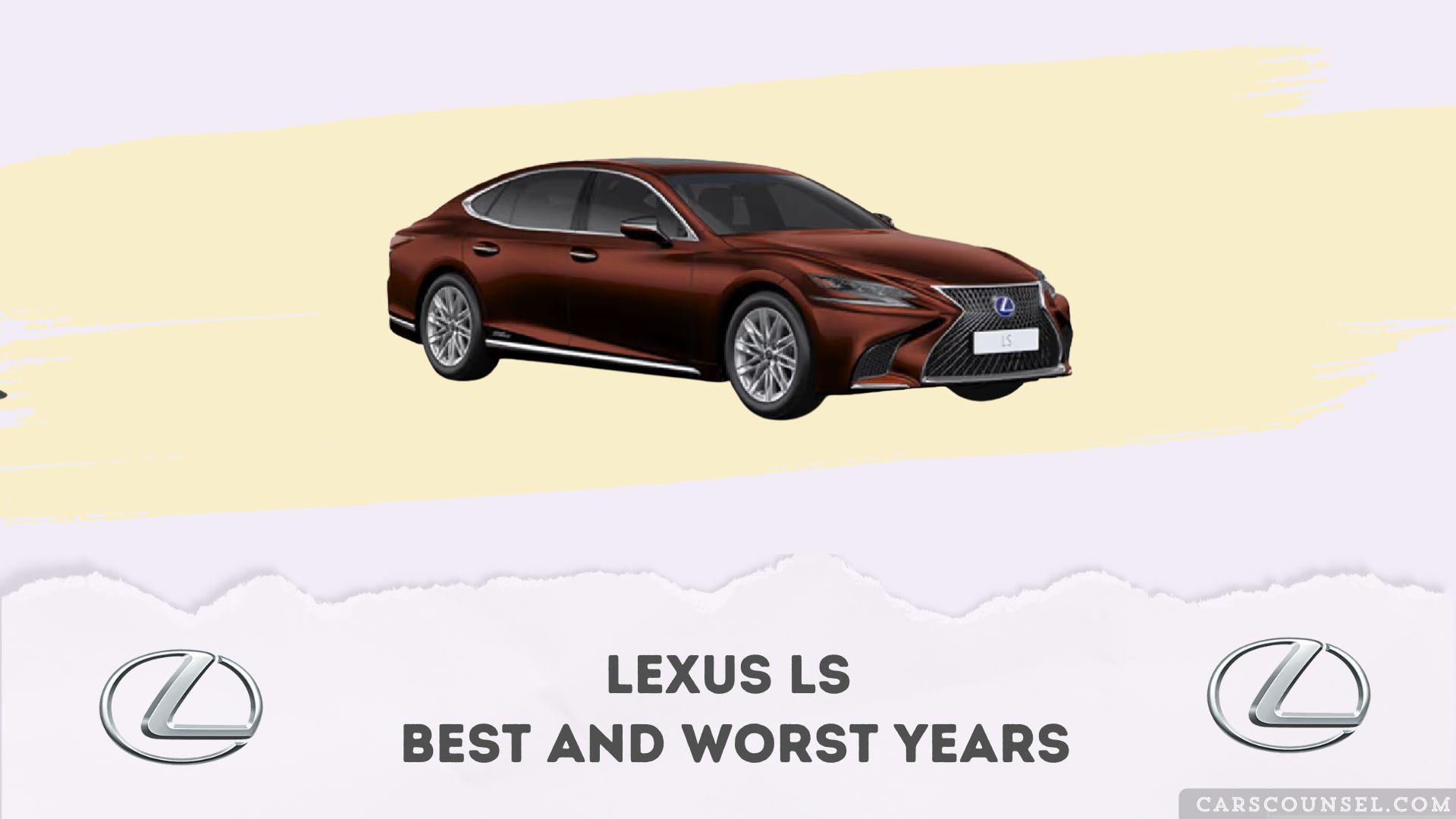
The best Lexus LS years are the 2001–2006 LS 430 and the refreshed 2013–2017 LS 460 models. Buyers should avoid the first-year 2007 LS 460 due to expensive brake and suspension defects.
Rankings are comparative, as no luxury vehicle is flawless. Long-term reliability heavily depends on strict maintenance records, rust-free condition, and addressing aging electronics before purchase.
Reliability varies significantly by generation and powertrain. The V8-powered LS 400 and LS 430 are legendary, while early fourth-generation and hybrid models demand careful pre-purchase inspections.
Quick Navigation
Best and Worst Lexus LS Years at a Glance
| Model Year Range | Verdict | Main Reason | Buyer Guidance |
|---|---|---|---|
| 1990–2000 | Best Older Choice | Legendary V8 reliability | Inspect for age-related wear |
| 2001–2006 | Best Choice | Exceptional build quality | Verify air suspension condition |
| 2007 | Avoid | Brake actuator and control arm failures | Skip this first-year redesign |
| 2008–2012 | Approach Carefully | Lingering brake and suspension issues | Demand repair records |
| 2013–2017 | Best Late-Generation Choice | Major refresh resolved major flaws | Top pick for modern V8 luxury |
| 2018–2021 | Approach Carefully | Early infotainment and transmission quirks | Test drive extensively |
| 2022–2026 | Too New to Judge | Limited long-term ownership data | Rely on warranty and inspections |
Key Takeaways
- The 2001–2006 LS 430 represents the peak of traditional Lexus V8 reliability.
- Avoid the 2007 LS 460 due to costly brake actuator and lower control arm failures.
- The 2013–2017 LS 460 models offer modern features with significantly improved mechanical dependability.
- Hybrid LS 600h L and LS 500h models carry high repair costs for complex electrical components.
- Always verify VINs for open recalls, especially regarding fuel pumps and braking systems.
- A pre-purchase inspection is mandatory to check for aging suspension and electrical gremlins.
How We Evaluated the Lexus LS Model Years
Our analysis reviews official recalls, manufacturer service campaigns, and consumer complaint databases. We also track powertrain changes, generation redesigns, and long-term ownership costs.
Consumer complaints indicate trends but are not confirmed failure rates. A recall does not automatically make a vehicle unreliable, provided the official remedy was completed.
Recent model years have less road exposure, limiting long-term data. “Best” indicates comparatively stronger reliability within the lineup, not a guarantee of zero repairs.
Best Lexus LS Years
2001–2006: The Pinnacle of V8 Luxury (Best Choice)
The third-generation LS 430 is widely considered one of the most over-engineered vehicles ever built. Its 4.3-liter V8 engine and six-speed automatic transmission are exceptionally durable.
Build quality peaked during this era, resulting in a remarkably quiet cabin and smooth ride. Buyers should primarily inspect the optional air suspension system for age-related leaks.
2013–2017: The Modern Sweet Spot (Best Late-Generation Choice)
Following a comprehensive refresh, the 2013–2017 LS 460 models corrected most mechanical grievances from the early fourth generation. The 4.6-liter V8 remains robust and responsive.
These years feature updated styling, improved infotainment, and refined transmission tuning. They offer modern luxury without the severe brake actuator liabilities of earlier models.
1990–2000: The Legendary Foundation (Best Older Choice)
The first and second-generation LS 400 models established the brand’s reputation. The 4.0-liter V8 engine is famous for reaching high mileage with basic, consistent maintenance.
While mechanically bulletproof, these classics require careful inspection of aging wiring, power steering components, and original interior materials before purchase.
Best Year by Buyer Type
- Best Overall: 2006 LS 430 (Final year of the third generation with fully sorted mechanics).
- Best Budget Option: 1998–2000 LS 400 (Incredible durability at a low entry price, though aging).
- Best Modern Alternative: 2016 LS 460 (Modern safety features and reliable V8 performance).
- Best Enthusiast Choice: 2018+ LS 500 F Sport (Twin-turbo V6 offers engaging dynamics, though long-term data is pending).
Years to Approach Carefully
2008–2012 LS 460 (Approach Carefully)
While improved over the 2007 model, these years still suffer from premature lower control arm bushing wear and expensive brake actuator failures.
The 2010 facelift brought cosmetic and minor mechanical updates, but the core braking system design remained a costly vulnerability until the 2013 refresh.
2018–2021 LS 500 (Approach Carefully)
The fifth generation introduced a twin-turbo V6 and a complex 10-speed automatic transmission. Early models faced criticism for transmission hunting and the frustrating Remote Touch trackpad.
Lexus replaced the trackpad with a touchscreen for 2022. Buyers of these earlier years should ensure software updates were performed and test the transmission thoroughly.
Worst Lexus LS Years
2007 LS 460 (Avoid)
The inaugural year of the fourth generation is the most problematic. It introduced a new 4.6-liter V8 and a complex brake actuator system that frequently fails.
Replacing the brake actuator often exceeds $2,000. Combined with widespread lower control arm failures and early transmission software glitches, this year demands strict avoidance.
Lexus LS Reliability by Generation
First and Second Generations (1990–2000)
The original Lexus LS 400 set the global standard for luxury reliability. Its 1UZ-FE V8 engine is remarkably resilient, though age is now the primary enemy of rubber seals and electronics.
Third Generation (2001–2006)
The Lexus LS 430 expanded on its predecessor’s success with a larger 4.3-liter V8. It remains a benchmark for ride quality, though optional air suspension struts are prone to leaking over time.
Fourth Generation (2007–2017)
The Lexus LS 460 brought modern technology but introduced expensive liabilities like the brake actuator. The 2013 refresh successfully addressed most mechanical flaws, making late models highly desirable.
Fifth Generation (2018–Present)
The current LS 500 shifted to a twin-turbo V6 and a 10-speed automatic. While performance is strong, the hybrid LS 500h and early infotainment systems have drawn mixed owner feedback.
Common Lexus LS Problems
Brake Actuator Failure
Affecting primarily 2007–2012 models, the electronic brake actuator can fail without warning. Symptoms include a stiff brake pedal, warning lights, and a complete loss of power braking assist.
Air Suspension Leaks
Many LS models feature adaptive air suspension. Over time, the air struts and compressors develop leaks, causing the vehicle to sag. Replacing all four corners is highly expensive.
Lower Control Arm Bushings
Early fourth-generation models frequently experience premature wear in the front lower control arm bushings. This causes clunking noises over bumps and uneven tire wear, requiring costly suspension repairs.
Repair-Cost Overview
| Problem | Commonly Affected Years | Approximate Repair Range | Important Notes |
|---|---|---|---|
| Brake Actuator | 2007–2012 | $1,800 – $3,000 | Requires specialized calibration |
| Air Suspension Strut | 2001–2017 | $1,200 – $2,500 per corner | Aftermarket conversions are available |
| Control Arm Replacement | 2007–2012 | $800 – $1,500 per side | Bushings are often not sold separately |
Repair costs vary significantly by region, labor rates, parts selection, and whether you visit a dealership or an independent specialist. Always get multiple quotes for major luxury repairs.
What to Check Before Buying a Used Lexus LS
- Verify the VIN for open recalls, especially fuel pump and brake system campaigns.
- Test the brake pedal feel and listen for unusual pump noises during startup.
- Inspect the front lower control arms for tearing or excessive play.
- Cycle through all air suspension ride heights to check for compressor strain or leaks.
- Review service records for timing belt replacements on 1990–2006 V8 models.
- Scan for hidden diagnostic codes, as aging modules can store silent faults.
- Arrange an independent pre-purchase inspection focusing on electronics and suspension.
Related Buying Guides
- Lexus LC best and worst years: Explore the reliability of Lexus’s flagship luxury coupe.
- Lexus GX 470 best and worst years: Discover which model years of this rugged SUV offer the best longevity.
- Lexus NX best and worst years: Find out which compact crossover years to target for daily commuting.
Frequently Asked Questions
What is the most reliable Lexus LS year?
The 2006 LS 430 is widely considered the most reliable, combining the peak of third-generation engineering with fully sorted components before the 2007 redesign.
Are Lexus LS 460 models expensive to maintain?
They can be, particularly 2007–2012 models prone to brake actuator and suspension failures. Later 2013–2017 models are more predictable but still carry luxury repair costs.
Does the Lexus LS 500 require premium fuel?
Yes, the twin-turbo V6 in the LS 500 requires premium unleaded fuel to prevent engine knock and maintain optimal performance and longevity.
How long do Lexus LS engines last?
Well-maintained V8 engines, especially the 1UZ-FE and 3UZ-FE, frequently reach high mileage. Longevity depends entirely on strict adherence to fluid changes and timing belt services.
Is the LS 600h L a good used buy?
The LS 600h L is generally an Approach Carefully choice. Its complex hybrid system and unique all-wheel-drive components can lead to exceptionally high repair bills out of warranty.
Do all Lexus LS models have air suspension?
No, air suspension was often an optional upgrade or tied to specific luxury packages. Standard coil-spring models are generally cheaper to maintain as they age.
Choosing the Right Lexus LS Model Year
The best Lexus LS years balance legendary engineering with modern usability. The 2001–2006 LS 430 remains the ultimate benchmark for V8 reliability and ride comfort.
For modern luxury, the refreshed 2013–2017 LS 460 models offer the best compromise of updated technology and resolved mechanical flaws. Strictly avoid the problematic 2007 model year.
Always verify maintenance records, check for open recalls, and secure an independent inspection. A well-chosen LS provides unparalleled luxury, provided its complex systems are properly maintained.

