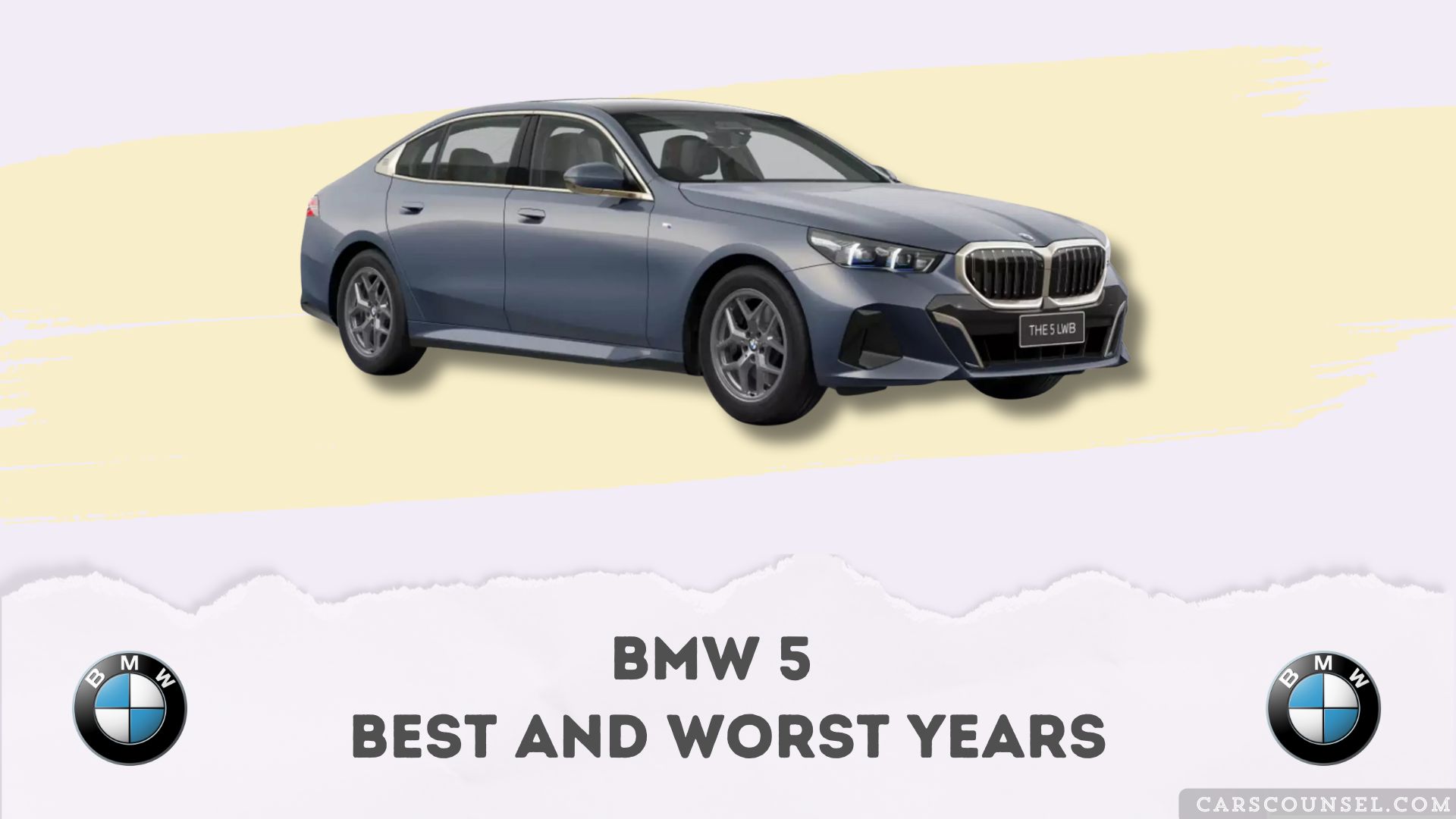
The best BMW 5 Series years are 2017 through 2023, featuring the highly reliable G30 generation. Buyers should avoid the 2004–2010 E60 generation and the 2011–2016 F10 V8 models due to severe engine and electrical defects.
These rankings are comparative, and no used luxury sedan is flawless. Proper maintenance history and a pre-purchase inspection remain essential for any German vehicle.
Reliability varies significantly by engine configuration. Inline-six models generally outperform their V8 and four-cylinder counterparts, making powertrain selection just as important as the model year.
Quick Navigation
Best and Worst BMW 5 Series Years at a Glance
| Model Year Range | Verdict | Main Reason | Buyer Guidance |
|---|---|---|---|
| 1997–2003 (E39) | Best Older Choice | Excellent chassis, reliable inline-6 and V8 | Inspect cooling system and VANOS |
| 2004–2010 (E60) | Avoid | Frequent electrical gremlins, costly V8 repairs | Look for newer or older alternatives |
| 2011–2016 (535i) | Good Choice | N55 engine is solid with proper maintenance | Check charge pipe and water pump |
| 2012–2016 (528i) | Approach Carefully | N20 engine timing chain guide issues | Verify timing chain replacement |
| 2011–2016 (550i) | Avoid | N63 V8 suffers from severe heat and reliability issues | Avoid the V8 configuration |
| 2017–2023 (G30) | Best Choice | B48 and B58 engines are highly dependable | Best overall modern used option |
| 2024–Present (G60) | Too New to Judge | New generation, long-term data unavailable | Wait for ownership history |
Key Takeaways
- The 2017–2023 G30 generation is the top choice for modern reliability.
- Avoid the 2004–2010 E60 generation and all F10 V8 configurations.
- The N55 inline-six engine is generally the most dependable used option.
- Early F10 four-cylinder models suffer from timing chain guide failures.
- Always verify recall completion and maintenance records before purchasing.
How We Evaluated the BMW 5 Series Model Years
Our analysis reviews official NHTSA recalls, manufacturer service campaigns, and consumer complaint patterns. We weigh powertrain differences, generation changes, and repair complexity heavily.
Complaints are not confirmed failure rates, and a recall does not automatically make a year unreliable. Recent models have less ownership history, and “best” means comparatively stronger, not flawless.
Best BMW 5 Series Years
2017–2023 (G30 Generation)
The G30 generation represents a massive leap forward in BMW reliability. The introduction of the modular B48 four-cylinder and B58 inline-six engines resolved many historical issues.
These powertrains feature closed-deck blocks and improved thermal management. Owners report significantly fewer cooling system and gasket failures compared to earlier generations.
Late-model examples with the B58 engine are the safest modern investments. They offer a great balance of luxury, technology, and mechanical dependability.
1997–2003 (E39 Generation)
The E39 is widely celebrated as a high-water mark for BMW driving dynamics. The inline-six and V8 configurations are robust, provided they receive meticulous care.
While older, these cars avoid the overly complex electronics of later generations. They remain a favorite among enthusiasts willing to perform preventative maintenance.
Best Year by Buyer Type
- Best Overall: 2019–2023 540i (G30) for its mature B58 powertrain and updated infotainment.
- Best Budget Option: 1997–2003 528i (E39) for classic handling and lower initial purchase price.
- Best Modern Alternative: 2012–2016 535i (F10) for buyers wanting modern styling without G30 pricing.
Years to Approach Carefully
2012–2016 528i (F10 Generation)
The US-market 528i transitioned to the turbocharged N20 four-cylinder engine. Early versions of this engine are prone to timing chain guide failures.
If the plastic guides break, the chain can slip and cause catastrophic engine damage. Only consider these if documentation proves the updated timing chain components were installed.
2011–2016 535i (F10 Generation)
The 535i uses the N55 inline-six, which is generally reliable. However, it requires strict adherence to maintenance schedules to avoid common wear items.
Buyers must inspect the charge pipe, water pump, and valve cover gasket. Neglected examples can quickly become expensive to own.
Worst BMW 5 Series Years
2004–2010 (E60 Generation)
The E60 generation is plagued by complex electrical gremlins and early iDrive system failures. Modules and sensors frequently cause frustrating warning lights and battery drains.
The V8 models (545i and 550i) use the N62 engine, which is notorious for valve stem seal leaks and coolant transfer pipe failures. Repairs often require engine removal.
Even the inline-six models suffer from costly cooling system and suspension component wear. Most buyers are better served by the older E39 or newer F10.
2011–2016 550i (F10 Generation)
The F10 550i utilizes the N63 twin-turbo V8. This engine runs extremely hot, leading to premature failure of gaskets, seals, and battery life.
Oil consumption and timing chain issues are common. The cost to properly maintain or repair this powertrain frequently exceeds the vehicle’s residual value.
BMW 5 Series Reliability by Generation
E39 (1997–2003)
A benchmark for sport sedans. Mechanicals are stout, but aging rubber and plastic cooling components require immediate replacement upon purchase.
E60 (2004–2010)
A controversial redesign that prioritized styling over reliability. Electrical faults and severe V8 engine defects make this generation a high-risk used purchase.
F10 (2011–2016)
A mixed bag heavily dependent on the engine. The inline-six models are decent, while the four-cylinder and V8 configurations carry significant mechanical liabilities.
G30 (2017–2023)
A return to form for BMW. The B-series engines are highly durable, and the electronics architecture is much more stable than previous iterations.
G60 (2024–Present)
The latest generation features advanced hybrid systems and new interior screens. Long-term reliability data is not yet available for these new powertrains.
Common BMW 5 Series Problems
Engine Timing Chain Failures
The N20 four-cylinder engine (found in 2012–2015 models) uses plastic timing chain guides that become brittle and break. This can lead to complete engine failure.
Cooling System Leaks
From the E39 to the F10, BMW cooling systems use plastic components that crack over time. Water pumps, expansion tanks, and hoses require regular preventative replacement.
V8 Oil Leaks and Consumption
The N62 and N63 V8 engines are notorious for valve stem seal degradation and excessive oil consumption. Repairs are highly labor-intensive and expensive.
What to Check Before Buying a Used BMW 5 Series
- Verify the VIN for open recalls and original build configuration.
- Review service records for cooling system and timing chain replacements.
- Inspect the engine bay for oil leaks around the valve cover and oil filter housing.
- Test all iDrive functions, window regulators, and electronic seat adjustments.
- Check for harsh transmission shifts or differential whining during a test drive.
- Arrange an independent pre-purchase inspection by a BMW specialist.
Related Buying Guides
- BMW 3 Series best and worst years: If you want similar German engineering in a smaller, more agile package.
- BMW X5 years to avoid: For buyers who need more cargo space and all-weather capability without sacrificing performance.
- BMW X3 years to avoid: A practical alternative for those seeking a compact luxury crossover with shared powertrain DNA.
- BMW Z4 years to avoid: An enthusiast alternative for drivers who prefer a two-seat roadster over a four-door sedan.
Frequently Asked Questions
What is the most reliable BMW 5 Series engine?
The B58 turbocharged inline-six, found in 2017–2023 models, is widely considered the most reliable modern BMW engine due to its robust closed-deck design.
Is the BMW 5 Series expensive to maintain?
Yes, maintenance and repair costs are above average for the segment. Budgeting for preventative cooling and gasket services is essential for ownership.
Which 5 Series years have timing chain issues?
The 2012–2015 models equipped with the N20 four-cylinder engine are prone to timing chain guide failures. The inline-six and newer four-cylinder engines avoid this.
Are V8 BMW 5 Series models reliable?
Generally, no. The N62 and N63 V8 engines suffer from severe heat-related degradation, oil leaks, and timing chain issues that are very costly to repair.
How long can a well-maintained 5 Series last?
With meticulous care and timely replacement of wear items, examples equipped with reliable inline-six engines can reach high mileage, though individual outcomes vary greatly.
Is the G30 generation a good used buy?
Yes, the 2017–2023 G30 generation is the best modern choice. It offers excellent build quality, updated technology, and highly dependable B-series powertrains.
Which BMW 5 Series Year Should You Buy?
The 2017–2023 G30 generation stands out as the best overall choice for used buyers. Its B-series engines provide a rare blend of performance and long-term dependability.
Buyers on a budget should look for a well-maintained E39 inline-six, while avoiding the E60 generation and all F10 V8 configurations entirely.
Always verify the exact engine configuration, review maintenance records, and complete a thorough independent inspection before finalizing your purchase.

