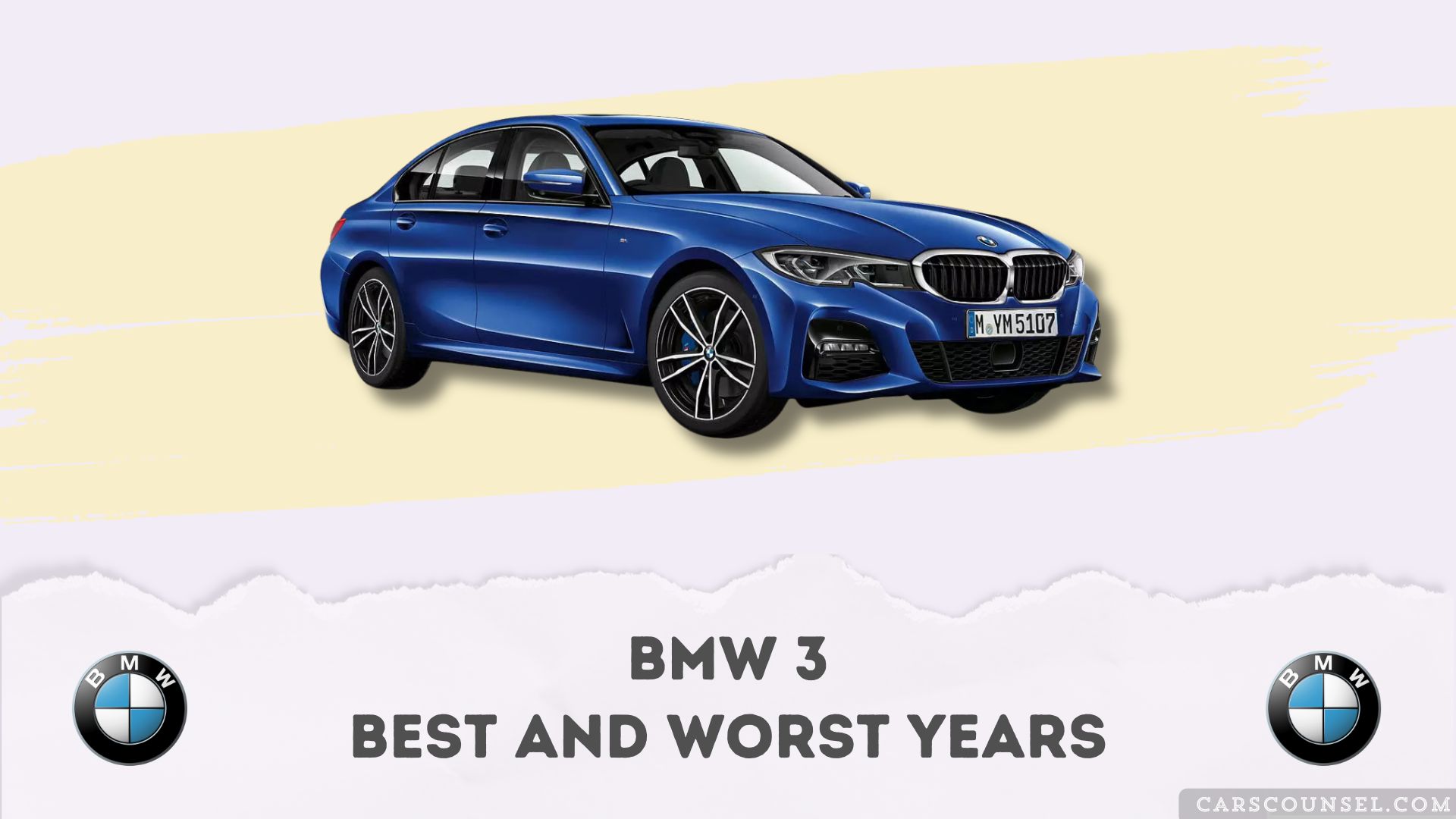
The best BMW 3 Series years are 2016 through 2018 and 2019 through 2023. These models feature the reliable B48 and B58 engines. Buyers should avoid 2007 through 2010 335i models and 2012 through 2015 four-cylinder models due to severe engine defects.
Reliability rankings are comparative, and no used BMW is entirely flawless. Maintenance history, overall condition, and proper care heavily influence long-term durability.
Meaningful reliability differences exist depending on the engine. The six-cylinder B58 and four-cylinder B48 engines are robust, while the older N54 and N20 engines require extreme caution.
Quick Navigation
Best and Worst BMW 3 Series Years at a Glance
| Model Year or Range | Verdict | Main Reason | Buyer Guidance |
|---|---|---|---|
| 2019-2023 | Best Late-Generation Choice | B48/B58 engines are robust | Verify maintenance and open recalls |
| 2016-2018 | Best Older Choice | Improved engine reliability | Check for oil leaks and cooling system health |
| 2012-2015 (4-cyl) | Avoid | N20 timing chain guide failure | Avoid unless engine was replaced |
| 2011 (335i) | Approach Carefully | Early N55 engine improvements | Inspect for valve cover and water pump leaks |
| 2007-2010 (335i) | Avoid | N54 fuel pump and turbo issues | High repair costs make these risky |
| 2006-2011 (6-cyl) | Good With Inspection | N52 cooling and gasket leaks | Budget for water pump and gasket replacements |
Key Takeaways
- The 2016-2018 and 2019-2023 model years offer the strongest reliability.
- Avoid 2012-2015 four-cylinder models due to timing chain defects.
- Avoid 2007-2010 335i models due to high-pressure fuel pump failures.
- Engine choice matters more than the badge; verify the exact powertrain.
- Recent models have limited long-term ownership data.
- Always check the VIN for open recalls before purchasing.
- A pre-purchase inspection by a BMW specialist is essential.
How We Evaluated the BMW 3 Series Model Years
We analyzed official recalls, manufacturer service campaigns, and consumer complaints.
Our review weighs defect severity, repair complexity, and recurrence rates.
Complaints are not confirmed failure rates, and a recall does not automatically ruin a vehicle’s reputation.
Recent models have less road exposure, making long-term predictions difficult.
Best means comparatively stronger, not completely trouble-free.
Best BMW 3 Series Years
2019-2023 (G20 Generation)
The current generation features the highly regarded B48 and B58 engines.
These powertrains have proven robust in real-world ownership.
Long-term data remains limited, but early reliability signals are favorable.
Buyers should still verify maintenance records and check for open recalls.
2016-2018 (Late F30 Generation)
BMW transitioned to the B48 and B58 engines during this period.
This change resolved many earlier four-cylinder and six-cylinder issues.
The 340i with the B58 engine is particularly desirable for enthusiasts.
Inspect for standard wear items and confirm the timing chain is quiet.
Best Year by Buyer Type
- Best Overall: 2018 BMW 340i (Mature platform with the excellent B58 engine).
- Best Budget Option: 2009 BMW 328i (Requires strict maintenance but avoids the worst engines).
- Best Enthusiast Choice: 2017 BMW 340i (Combines modern reliability with strong performance).
- Best Modern Alternative: 2020 BMW 330i (Offers updated tech with a proven four-cylinder engine).
Years to Approach Carefully
2011 BMW 335i (N55 Engine)
The N55 engine improved upon the older N54 design.
It uses a single twin-scroll turbo, reducing wastegate rattle complaints.
However, it remains prone to valve cover gasket and oil filter housing leaks.
Budget for these common maintenance items before purchasing.
2006-2011 BMW 325i and 328i (N52 Engine)
The naturally aspirated N52 engine avoids turbo-related failures.
It is generally reliable but suffers from electric water pump failures.
Oil leaks from the valve cover and oil filter housing are also common.
A thorough inspection of the cooling system is mandatory.
Worst BMW 3 Series Years
2012-2015 Four-Cylinder Models (N20 Engine)
These years suffer from frequent timing chain guide failures.
The plastic guides can break, causing the timing chain to skip or snap.
This often results in catastrophic engine damage requiring a full replacement.
Avoid these years entirely unless the engine and timing chain were already replaced.
2007-2010 BMW 335i (N54 Engine)
The twin-turbo N54 engine is known for expensive failures.
High-pressure fuel pump defects and wastegate rattle are widespread.
Fuel injectors and ignition coils also require frequent, costly replacements.
The financial risk makes these specific model years a poor used-car investment.
BMW 3 Series Reliability by Generation
Fifth Generation (E90: 2006-2011)
This generation introduced complex electronics and turbocharging to the mainstream lineup.
While the N52 six-cylinder is manageable, the N54 twin-turbo is highly problematic.
Buyers must separate the reliable naturally aspirated models from the risky turbocharged ones.
If you prefer a smaller sports car from this era, research the BMW Z4 carefully.
Sixth Generation (F30: 2012-2018)
The F30 generation is a tale of two distinct eras.
Early models with the N20 four-cylinder engine suffer severe timing chain defects.
Later models equipped with the B48 and B58 engines represent a massive reliability improvement.
Always verify the exact engine code before purchasing an F30 chassis.
Seventh Generation (G20: 2019-Present)
The G20 generation benefits from modern engine architecture.
Both the four-cylinder and six-cylinder options show strong initial reliability.
As these vehicles age, long-term electronics and suspension data will become clearer.
For a larger luxury sedan, compare these findings with our BMW 5 Series guide.
Common BMW 3 Series Problems
Timing Chain Guide Failure
The N20 engine uses plastic timing chain guides that degrade prematurely.
When they fail, the timing chain loses tension and can destroy the engine.
This primarily affects 2012 through 2015 four-cylinder models.
Listen for a distinct whining noise from the engine bay during cold starts.
High-Pressure Fuel Pump (HPFP) Defects
The N54 engine relies on a high-pressure fuel pump that frequently fails.
Symptoms include long cranking times, rough idling, and sudden power loss.
This issue heavily impacts 2007 through 2010 335i models.
Replacing the pump is a known expense for owners of these vehicles.
Cooling System and Oil Leaks
Many engines use plastic components in the cooling system that become brittle.
Electric water pumps and thermostat housings often fail around 80,000 miles.
Valve cover gaskets and oil filter housing gaskets are also prone to leaking.
Regular visual inspections can catch these leaks before they cause secondary damage.
What to Check Before Buying a Used BMW 3 Series
- Verify the exact engine code (N20, N54, B48, B58).
- Check the VIN for open safety recalls and service campaigns.
- Review service records for water pump and gasket replacements.
- Listen for timing chain whine or turbo wastegate rattle on cold starts.
- Inspect the engine bay for oil residue around the valve cover.
- Test the transmission for smooth shifts and proper engagement.
- Scan the vehicle for hidden diagnostic trouble codes.
- Arrange a pre-purchase inspection with a BMW-certified technician.
Related Buying Guides
- BMW 4 Series best and worst years: The 4 Series shares many powertrains with the 3 Series but offers a coupe body style.
- BMW M3 best and worst years: Explore the high-performance variant of the 3 Series platform for track-focused reliability data.
- BMW X3 years to avoid: Check the compact SUV alternative if you need more cargo space and ground clearance.
Frequently Asked Questions
Which BMW 3 Series engine is the strongest?
The B58 inline-six and B48 inline-four are currently the strongest options. They feature improved cooling systems and robust internal components compared to older designs.
Should I avoid the BMW 335i?
You should avoid the 2007 through 2010 335i models with the N54 engine. Later 335i models with the N55 engine and 340i models are much safer choices.
Why are 2012-2015 BMW 3 Series models problematic?
These years often feature the N20 four-cylinder engine, which suffers from premature timing chain guide failure. This defect can cause catastrophic engine damage without warning.
Do all BMW 3 Series models have oil leaks?
Not all models, but many older generations are prone to valve cover and oil filter housing gasket leaks. Regular maintenance and updated gasket materials can mitigate these issues.
Is a used BMW 3 Series expensive to maintain?
Yes, maintenance and repair costs are generally higher than average. Budgeting for cooling system refreshes, gasket replacements, and specialized diagnostic tools is essential for ownership.
How do I check for open recalls on a used 3 Series?
Enter the vehicle identification number on the official NHTSA website. This free tool will display any open safety recalls or manufacturer service campaigns requiring attention.
Choosing the Right BMW 3 Series Model Year
The best used models feature the modern B48 or B58 engines.
Target the 2016 through 2018 and 2019 through 2023 model years for the strongest reliability.
Avoid the 2012 through 2015 four-cylinder models and the 2007 through 2010 335i.
Always verify the exact engine code and secure a specialized pre-purchase inspection.

