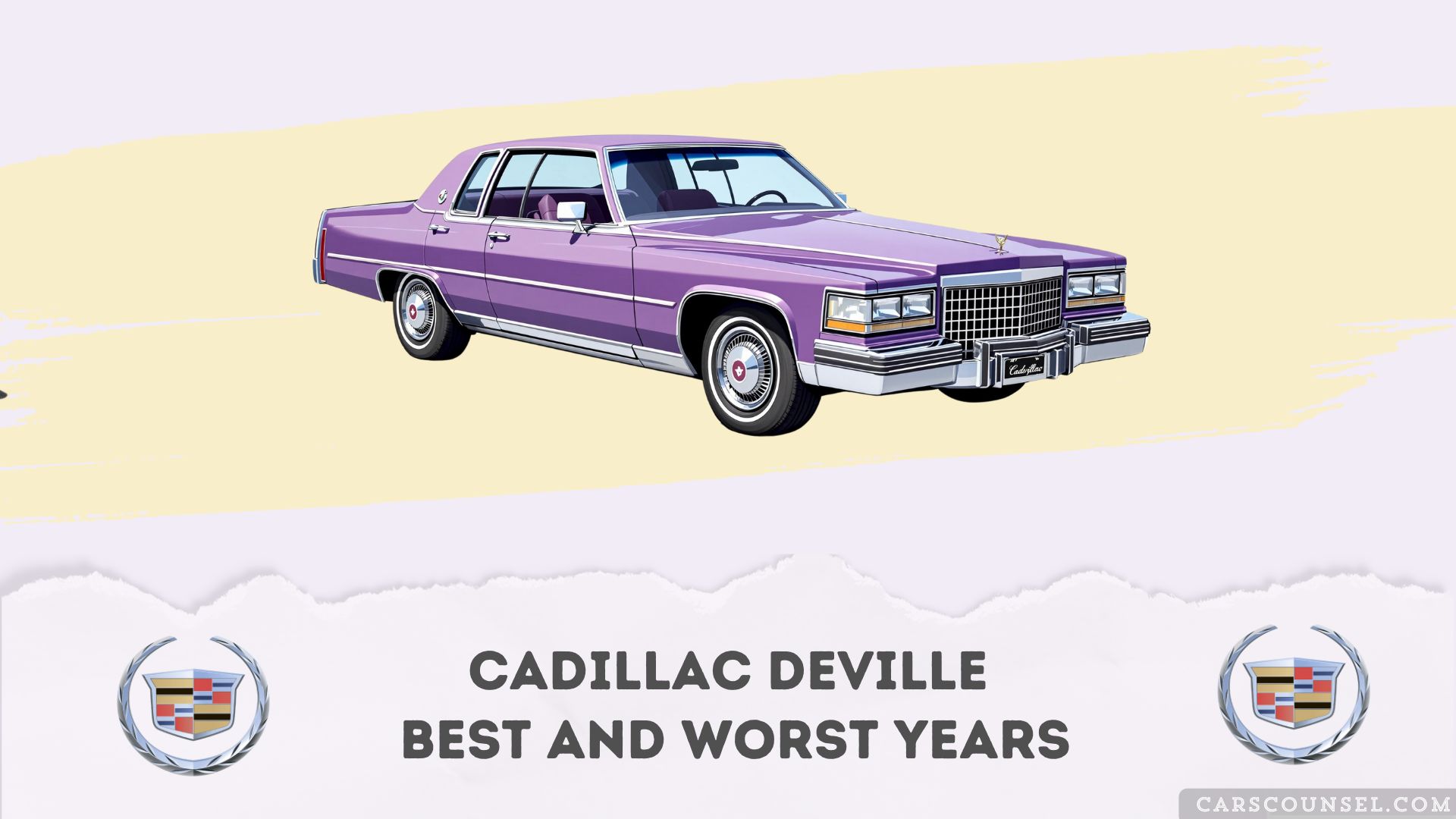
The best Cadillac DeVille years are 2004 and 2005, which feature improved engine hardware. Buyers should avoid the 2000 through 2002 models due to severe engine gasket failures. The 1985 through 1993 models also warrant avoidance due to notorious early powertrain defects.
These rankings are strictly comparative. No vintage or modern DeVille is entirely flawless. A thorough maintenance history and current mechanical condition matter far more than the badge or the specific model year when evaluating any used luxury sedan.
Reliability varies significantly by generation and engine. The Northstar V8 requires specific inspection for cooling system integrity. Earlier V8 engines present different mechanical risks. Always verify the exact powertrain and generation before making a final purchase decision.
Quick Navigation
Best and Worst Cadillac DeVille Years at a Glance
| Model Year Range | Verdict | Main Reason | Buyer Guidance |
|---|---|---|---|
| 2004-2005 | Best Choice | Revised Northstar engine hardware | Prioritize low-mileage examples with service records |
| 2003 | Approach Carefully | Lingering Northstar gasket risks | Verify cooling system and head bolt integrity |
| 2000-2002 | Avoid | Severe Northstar head gasket failures | Look for newer models or different sedans |
| 1994-1999 | Good With Inspection | Older Northstar design | Require a professional block test before buying |
| 1985-1993 | Avoid | Unreliable HT-4100 V8 engine | Avoid for daily driving or reliable transport |
| 1949-1984 | Best Enthusiast Choice | Classic collector appeal | Buy only as a hobby or weekend vehicle |
Key Takeaways
- Best Choices: 2004 and 2005 models offer the most reliable Northstar V8 configurations.
- Years to Avoid: 2000-2002 and 1985-1993 models suffer from catastrophic engine design flaws.
- Powertrain Distinction: The Northstar V8 requires strict cooling system maintenance to prevent head gasket failure.
- Major Concern: Excessive oil consumption and blown head gaskets plague many 2000-2003 examples.
- Recent Years: Production ended in 2005, so all examples are aging and require careful inspection.
- VIN Reminder: Always check the VIN for open recalls and verify the exact engine build date.
- Inspection: A professional pre-purchase inspection is mandatory for any DeVille with a Northstar V8.
How We Evaluated the Cadillac DeVille Model Years
We evaluated every DeVille generation by analyzing official safety recalls, manufacturer service campaigns, and long-term ownership data. We also cross-referenced consumer complaints and verified repair complexities for each specific powertrain configuration.
Complaints are not confirmed failure rates, and a single recall does not automatically condemn a model year. Because production ended in 2005, recent years simply have less new data. Our verdicts reflect comparative reliability, meaning the best years are stronger than their peers, not entirely flawless.
Best Cadillac DeVille Years
2004-2005: Best Choice
The final production years represent the most reliable DeVille configurations. Cadillac revised the Northstar V8 hardware, installing longer head bolts to improve clamping force and reduce gasket failures. These updates make the 2004 and 2005 models the safest choices for daily driving.
Buyers should still prioritize examples with documented cooling system maintenance. While the block and head bolt issues were largely addressed, normal aging affects all rubber and plastic components. A clean service history remains essential for these final models.
1994-1999: Good With Inspection
The earlier Northstar V8 models avoid the severe head bolt thread issues of the early 2000s. However, they still require meticulous cooling system maintenance to prevent overheating and subsequent gasket damage. These years can be solid choices if properly preserved.
A professional block test is mandatory before purchasing any 1994-1999 example. You must verify that the cooling system has been flushed regularly and that the water pump and tensioner are functioning correctly. Neglected examples will quickly become expensive financial liabilities.
Best Year by Buyer Type
Best Overall: 2005
The 2005 model year benefits from all late-generation engineering revisions and represents the final iteration of the nameplate. It offers the most refined Northstar V8 experience, provided the previous owners adhered to strict maintenance schedules.
Best Enthusiast Choice: 1949-1984
Classic DeVille models from the first seven generations offer immense collector appeal and traditional American luxury. They are not recommended for daily commuting, but they serve as excellent weekend cruisers or restoration project vehicles for dedicated hobbyists.
Years to Approach Carefully
2003: Approach Carefully
The 2003 model year sits on the borderline of the problematic early-2000s Northstar era. While some examples survive without major engine work, the risk of head gasket failure and excessive oil consumption remains higher than in the 2004-2005 models.
If you consider a 2003 DeVille, demand proof of recent engine work or a pristine maintenance history. Check for white smoke from the exhaust and test the cooling system for combustion gases. Without documented evidence, this year carries significant mechanical risk.
Worst Cadillac DeVille Years
2000-2002: Avoid
These years are notorious for catastrophic Northstar V8 head gasket failures. The engine block casting and head bolt thread design were inadequate, leading to stripped threads and blown gaskets under normal operating temperatures. Repairs are exceptionally labor-intensive and costly.
Many examples from these years also suffer from severe oil consumption and main seal leaks. Unless the engine has been completely rebuilt using aftermarket stud kits, these models represent a massive financial risk. Buyers are strongly advised to look elsewhere.
1985-1993: Avoid
This generation introduced the infamous HT-4100 V8 engine. This powertrain is widely considered one of the most unreliable engines ever produced, suffering from premature camshaft wear, intake manifold gasket failures, and complete internal destruction.
Finding parts and qualified mechanics for the HT-4100 is increasingly difficult. Even low-mileage survivors are prone to sudden, catastrophic engine failure. Avoid this generation entirely unless you are acquiring it strictly for scrap or a complete engine swap project.
Cadillac DeVille Reliability by Generation
Eighth Generation (2000-2005)
This final generation introduced modern styling and advanced features but was initially plagued by the flawed Northstar V8 assembly. The 2004-2005 models received crucial hardware revisions that significantly improved longevity. When evaluating this generation, the exact build year dictates the reliability verdict.
Seventh Generation (1994-1999)
This generation featured a slightly different Northstar V8 configuration. While it avoided the worst head bolt thread stripping issues, it still demanded rigorous cooling system maintenance. Reliability is highly dependent on how previous owners treated the fragile aluminum engine components.
Sixth Generation (1985-1993)
The shift to front-wheel drive and the introduction of the HT-4100 V8 resulted in a dramatic drop in reliability. This generation is best avoided by anyone seeking dependable transportation. It serves primarily as a cautionary tale in automotive engineering.
Classic Generations (1949-1984)
Earlier generations utilized robust, traditional pushrod V8 engines and rear-wheel-drive architectures. While they lack modern safety features and fuel efficiency, their mechanical simplicity makes them more durable and easier to repair than the later, complex aluminum engines.
Common Cadillac DeVille Problems
Engine Problems
The Northstar V8 is famous for head gasket failures, primarily caused by overheating or stripped head bolt threads. Symptoms include white exhaust smoke, coolant loss, and rough running. Repairing this requires removing the engine and installing specialized thread inserts or stud kits.
The earlier HT-4100 V8 suffers from fragile internal components, including weak timing chains and prone-to-failure aluminum blocks. Oil consumption is also a major issue across many Northstar years, requiring frequent top-offs and potentially leading to catalytic converter damage.
Cooling System Problems
The Northstar engine is highly sensitive to coolant loss or air pockets. The water pump is driven by a belt connected to an idler pulley that frequently seizes. If the pulley fails, the water pump stops, leading to rapid overheating and immediate engine destruction.
Electrical and Suspension Issues
Later models feature complex air suspension systems that frequently leak or fail, resulting in a sagging rear end. Converting to standard coil springs is a common, cost-effective repair. Dashboard pixelation and failing climate control displays are also common electrical annoyances.
Repair-Cost Overview
| Problem | Commonly Affected Years | Approximate Repair Range | Important Notes |
|---|---|---|---|
| Head Gasket Replacement | 2000-2003 | $2,500 – $4,500 | Requires block thread inserts or stud kits |
| Water Pump and Pulley | 1994-2005 | $600 – $1,100 | Must be addressed immediately to prevent overheating |
| Air Suspension Conversion | 2000-2005 | $400 – $800 | Replaces failing air shocks with standard coils |
| HT-4100 Engine Swap | 1985-1993 | $3,000 – $5,000 | Often necessary due to complete engine failure |
Repair costs vary significantly by region, labor rate, parts choice, vehicle configuration, damage severity, and whether you use a dealer or independent shop. These estimates are approximate and should only be used as a general budgeting guide.
What to Check Before Buying a Used Cadillac DeVille
- Verify the VIN for open recalls and confirm the exact engine build date.
- Perform a chemical block test to check for combustion gases in the coolant.
- Inspect the water pump pulley and tensioner for smooth operation and noise.
- Check the oil level and condition, looking for signs of excessive consumption or coolant mixing.
- Test the air suspension system and listen for a failing compressor.
- Inspect the transmission fluid for dark color or burnt smells.
- Scan for diagnostic trouble codes, even if the check engine light is off.
- Arrange an independent pre-purchase inspection by a mechanic familiar with Northstar engines.
Related Buying Guides
- Cadillac DTS best and worst years: The DTS directly replaced the DeVille in 2006, offering similar luxury with updated styling and slightly refined Northstar reliability.
- Cadillac CTS best and worst years: For buyers who want a more modern, sport-oriented Cadillac sedan with better overall reliability and handling dynamics.
- Cadillac XTS, Cadillac XT5, Cadillac XT6, and Cadillac Lyriq: Explore these contemporary alternatives that avoid the aging Northstar V8 engines found in the older DeVille models.
Frequently Asked Questions
What is the most reliable Cadillac DeVille year?
The 2005 model year is the most reliable, benefiting from late-generation Northstar V8 hardware revisions that reduced head gasket failures. However, all examples require strict maintenance verification.
Why are 2000-2002 Cadillac DeVilles considered bad?
These years suffer from severe Northstar V8 head gasket failures due to weak engine block thread designs. Repairs are exceptionally expensive, making these models a major financial risk for used buyers.
Did the Cadillac DeVille have transmission problems?
The four-speed automatic transmissions are generally robust compared to the engines. However, neglect or overheating from a failing cooling system can lead to premature transmission wear and harsh shifting.
Is the Northstar engine completely unreliable?
The Northstar engine is not completely unreliable, but it is highly intolerant of neglect. If the cooling system is perfectly maintained and head bolt issues are addressed, it can provide smooth, powerful service.
What replaced the Cadillac DeVille?
Cadillac retired the DeVille nameplate after the 2005 model year. It was directly replaced by the Cadillac DTS for the 2006 model year, which continued using a revised version of the Northstar V8.
Should I buy a classic 1960s DeVille for daily driving?
Classic DeVilles offer immense style but lack modern safety, braking, and fuel efficiency. They are best suited as weekend hobby cars rather than reliable daily drivers for modern traffic conditions.
Choosing the Right Cadillac DeVille Model Year
The 2004 and 2005 Cadillac DeVille models offer the best combination of luxury and revised engine reliability. Buyers must avoid the 2000 through 2002 models due to catastrophic engine design flaws.
Because production ended long ago, maintenance history is your most critical factor. Always verify the VIN, demand comprehensive service records, and require a professional block test before purchasing any Northstar-equipped vehicle.