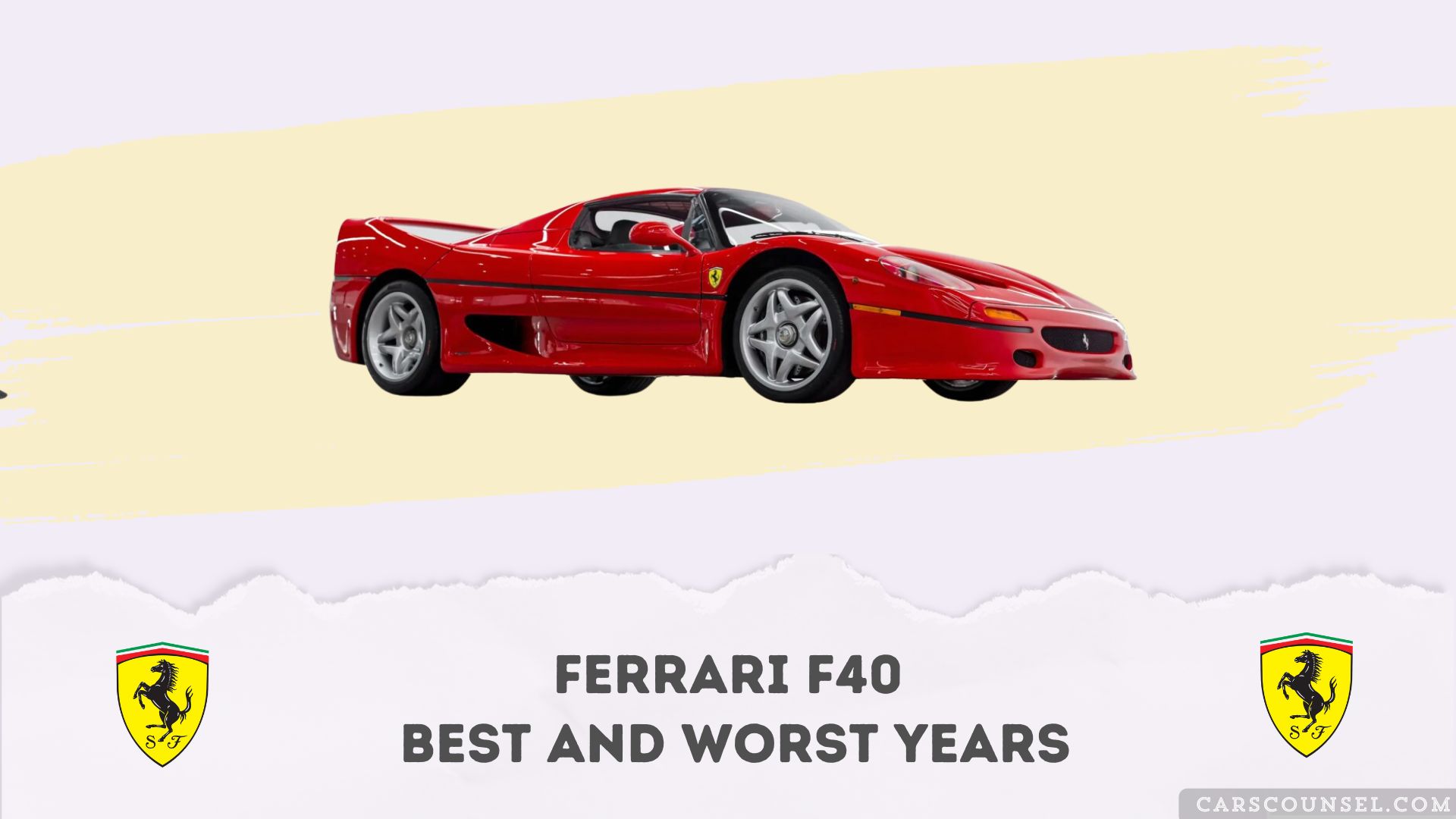
The 1990 Ferrari F40 is the Best Choice for collectors seeking the strongest balance of raw performance and build quality, particularly non-catalytic converter examples. The 1987 through 1989 models are Best Enthusiast Choices for their unfiltered driving dynamics.
Rankings for this ultra-low-volume supercar are based on collector desirability and factory specifications rather than traditional reliability metrics. No F40 is a daily driver, and all require meticulous, cost-no-object maintenance to preserve their multi-million-dollar value.
Meaningful differences exist between early and late production runs. Early cars feature non-adjustable suspensions and fixed or sliding windows, while 1991 and 1992 models added catalytic converters, adjustable suspension, and wind-down windows, slightly altering the raw experience.
Quick Navigation
Best and Worst Ferrari F40 Years at a Glance
| Model Year | Verdict | Main Reason | Buyer Guidance |
|---|---|---|---|
| 1987-1989 | Best Enthusiast Choice | Raw, non-adjustable suspension, early window designs | Ideal for purists seeking the most unfiltered driving experience. |
| 1990 | Best Choice | Peak build quality, highly sought-after non-cat configurations | The most desirable year for serious collectors and investors. |
| 1991-1992 | Good Choice | Added catalytic converters, adjustable suspension, wind-down windows | Slightly less raw but offers improved usability and refinement. |
Key Takeaways
- The 1990 model year is the most sought-after by collectors, especially examples without catalytic converters or adjustable suspension.
- Early 1987-1989 models deliver the rawest, most unassisted driving experience, making them top choices for driving purists.
- Later 1991-1992 models introduced catalytic converters and adjustable suspension, which slightly diluted the original track-focused formula.
- The F40 is a low-volume homologation special, meaning traditional reliability metrics and consumer complaints do not apply.
- Every F40 requires rigorous, specialist maintenance, and a thorough pre-purchase inspection by a Ferrari classic expert is mandatory.
- Buyers must verify the vehicle’s VIN, originality, and matching numbers, as modifications heavily impact market value.
How We Evaluated the Ferrari F40 Model Years
Evaluating the Ferrari F40 requires a different approach than mainstream vehicles. Because only 1,311 examples were built, traditional consumer complaints, NHTSA recalls, and standard reliability scores do not apply.
Instead, our analysis focuses on factory specifications, production evolution, collector desirability, and mechanical originality.
We differentiate between early non-adjustable suspensions and later adjustable setups, as well as the presence of catalytic converters.
A recall or service campaign does not automatically make a classic supercar unreliable, and low complaint counts simply reflect the car’s extreme rarity and limited road use.
Best means comparatively stronger in terms of collector value and driving purity, not flawless daily usability.
Best Ferrari F40 Years
1990: Best Choice
The 1990 model year represents the sweet spot for F40 collectors. By this time, Ferrari had refined the build quality and resolved some early production quirks.
The most valuable 1990 examples are those that retained the non-catalytic converter exhaust and non-adjustable suspension.
These specific configurations offer the purest engine response and a highly desirable collector pedigree.
Buyers should prioritize matching-numbers examples with documented service history from recognized Ferrari specialists.
1987-1989: Best Enthusiast Choice
The earliest F40s were built to celebrate Ferrari’s 40th anniversary and deliver an uncompromised, race-car-like experience.
These models lack catalytic converters and feature non-adjustable suspensions, providing the most direct and unfiltered driving dynamics.
Early European models often featured lightweight sliding Lexan windows instead of traditional wind-down glass.
While highly desirable to purists, these early cars may require more careful inspection of early-build materials and lightweight components.
1991-1992: Good Choice
The final production years introduced changes mandated by emissions regulations and customer requests for slightly better usability.
These models received catalytic converters, which slightly muted the exhaust note and reduced peak performance marginally.
Ferrari also added an adjustable suspension system and traditional wind-down windows to improve daily drivability and prevent chin spoiler scraping.
While slightly less raw than earlier cars, they remain highly valuable collector vehicles.
Best Year by Buyer Type
- Best Overall: 1990 (Non-cat, non-adjustable configuration)
- Best Enthusiast Choice: 1987-1989 (Rawest driving experience)
- Best Modern Alternative: Ferrari LaFerrari (For those seeking a newer hybrid hypercar)
Years to Approach Carefully
There are no truly bad F40 model years, but buyers seeking the purest track-focused experience should approach the 1991 and 1992 models with specific expectations.
The addition of catalytic converters and adjustable suspension added weight and slightly softened the car’s extreme edges.
If your goal is the purest, unassisted analog supercar experience, these later years may feel slightly diluted compared to the 1989 or 1990 examples.
However, they are still exceptional collector cars and do not carry any inherent mechanical flaws that warrant avoidance.
Common Ferrari F40 Problems
Fuel System and Bladder Tanks
The F40 utilizes aircraft-style rubber fuel bladder tanks that have a strict expiration date.
These bladders typically require replacement every five to ten years, regardless of mileage.
Failure to replace them can lead to fuel leaks and severe fire hazards.
This is a known maintenance requirement rather than a defect, but it is an expensive and mandatory service item for all model years.
Turbocharger and Exhaust Maintenance
The 2.9-liter twin-turbocharged V8 operates under extreme stress and heat.
Turbochargers and exhaust manifolds require careful inspection for cracks or fatigue, especially on cars that have been driven hard or tracked.
Early non-catalytic converter exhaust systems are highly prized but require specialized care to preserve their originality and value.
Lightweight Body Panel Care
The F40’s body is constructed from Kevlar, carbon fiber, and fiberglass to save weight.
While incredibly strong, these panels can suffer from stress cracks, gel coat crazing, or poor repair work if the car has been damaged.
Inspecting the body panels for original weave patterns and factory-correct paint thickness is crucial during a pre-purchase evaluation.
What to Check Before Buying a Used Ferrari F40
- Verify the VIN and confirm the car is a genuine, matching-numbers example.
- Check the expiration date on the aircraft-style fuel bladder tanks.
- Review the complete service history from recognized Ferrari Classic specialists.
- Inspect the Kevlar and carbon fiber body panels for stress cracks or improper repairs.
- Confirm the originality of the exhaust system, especially on non-catalytic converter models.
- Test the turbochargers for excessive shaft play or wastegate rattle.
- Inspect the lightweight interior components, including the seats and dashboard materials.
- Arrange a comprehensive pre-purchase inspection by a marque expert.
Related Buying Guides
- Ferrari Testarossa best and worst years: Explore Ferrari’s iconic flat-12 flagship from the same era.
- Ferrari 296 GTB best and worst years: Review Ferrari’s modern twin-turbo V6 hybrid sports car.
Frequently Asked Questions
What is the best Ferrari F40 model year?
The 1990 model year is widely considered the best, particularly examples without catalytic converters or adjustable suspension. It offers peak build quality while retaining the raw, unfiltered performance that defines the F40 legacy.
Are there any Ferrari F40 years to avoid?
No F40 year should be avoided, as all are highly valuable collector cars. However, purists seeking the most extreme, unassisted driving experience may prefer the 1987-1989 models over the slightly heavier, catalytic-equipped 1991-1992 versions.
How many Ferrari F40s were produced?
Ferrari produced approximately 1,311 examples of the F40 between 1987 and 1992. Of those, only 213 were officially built for the United States market, making US-spec examples exceptionally rare.
Do Ferrari F40s have catalytic converters?
Early European models and some 1990 examples were built without catalytic converters, which is highly desirable for performance and sound. Later models, including most US-spec cars, received them to meet emissions regulations.
What maintenance does a Ferrari F40 require?
The F40 requires cost-no-object specialist maintenance. Critical items include replacing the aircraft-style fuel bladders every few years, rebuilding the turbochargers, and inspecting the Kevlar body panels for stress cracks.
Is the Ferrari F40 a reliable daily driver?
The F40 is a race car for the road and is not designed for daily driving. It lacks power steering, ABS, and sound deadening, making it exhausting and impractical for regular street use.
Which Ferrari F40 Year Should You Buy?
The 1990 Ferrari F40 remains the strongest choice for collectors seeking a balance of build quality and raw, unassisted performance.
Early 1987 through 1989 models are ideal for driving purists who demand the most direct, track-focused experience available.
Later 1991 and 1992 models offer slightly more usability but sacrifice some of the original analog edge.
Regardless of the year, every F40 demands rigorous, specialist maintenance and a thorough inspection by a Ferrari classic expert.
Always verify the vehicle’s originality, matching numbers, and fuel bladder service history before making a purchase.

