The Lamborghini Miura was produced from 1966 to 1973, establishing the mid-engine layout for supercars. A total of 753 Miuras were built across three main variants: the P400, P400 S, and P400 SV.
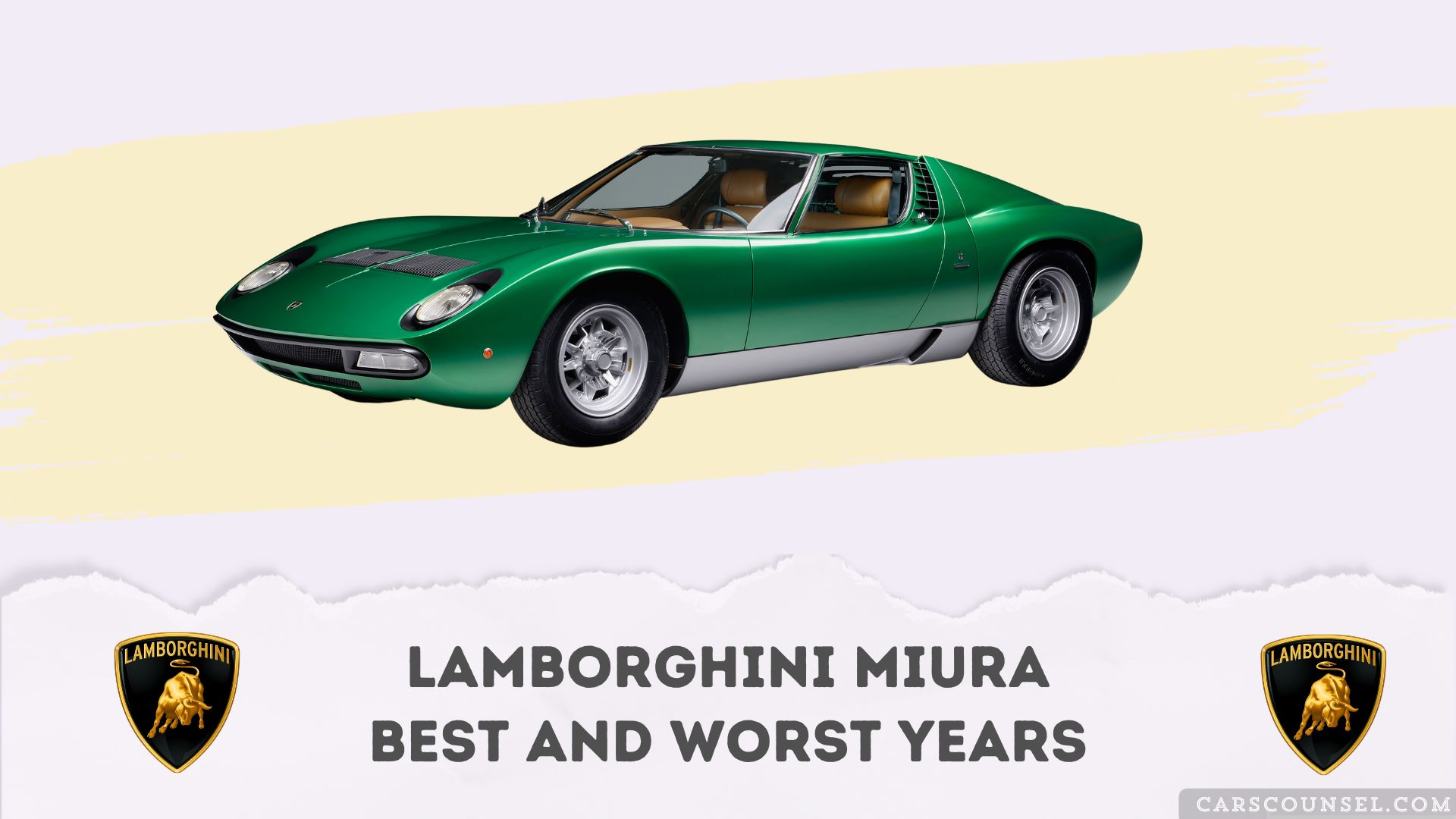
This article breaks down the best and worst model years of the Lamborghini Miura based on reliability, performance, owner complaints, and long-term dependability. The Miura featured a transversely-mounted V12 engine and suffered from specific design issues that varied by production year.
Quick Navigation
Lamborghini Miura Generational Overview
P400 (1966 – 1968)
The original P400 debuted in 1966 with a 3.9-liter V12 engine producing 350 horsepower. Between 1966 and 1968, 265 P400 cars were produced.
Early P400 models had a thinner chassis that exhibited flex under hard driving conditions. The car went on sale prematurely, and a factory mechanic accompanied every delivery to solve issues. The original P400 suffered from aerodynamic problems and was known for instability at high speeds, with reports of the front end lifting at 170 mph.
P400 S (1969 – 1971)
The P400 S launched in 1969 with 338 units sold through 1971. This generation received a stiffer chassis to address the flex issues of the original P400.
The engine received new intake manifolds and different camshafts, producing an additional 20 horsepower for a total of 370 horsepower. The P400 S featured a locking glove box and new chrome trim around the window locking strip. Around 140 cars were produced before the SV replaced the model in March 1971.
P400 SV (1971 – 1973)
The Miura SV was sold between 1971 and 1973, with 150 cars delivered. The SV represented the final and most developed version of the Miura.
The engine was upgraded to produce 385 horsepower at 7850 rpm with a compression ratio of 10.7:1. Wider wheels were fitted, measuring 7 inches in front and 9 inches in the rear. The SV featured improved suspension tuning and felt more planted than earlier models, though it was slightly heavier.
Best Years for the Lamborghini Miura
The best Miura years offered improved engineering, better component quality, and fewer design flaws.
1971-1973 (P400 SV): The SV is the most refined and reliable Miura variant. It featured the most powerful engine at 385 horsepower, wider wheels for better stability, and improved suspension. The SV addressed many of the chassis and handling issues present in earlier models. With only 150 units produced, the SV commands the highest values but represents the best engineering execution.
1970-1971 (Late P400 S): The later P400 S models benefited from the stiffer chassis and refined carburetor setup. These cars offered 370 horsepower and avoided the early production issues of the original P400. The late S models provided a balance between performance and improved build quality compared to the earliest Miuras.
Worst Years for the Lamborghini Miura
The worst Miura years suffered from engineering oversights, premature release, and dangerous design flaws.
1966-1967 (Early P400): The earliest P400 models had a thin chassis that flexed during spirited driving. The car was released prematurely, requiring a factory mechanic to accompany each delivery to address issues. Early cars were notorious for fire hazards caused by Weber 40 IDL 3C1 carburetors that overflowed fuel at idle in city driving. The aerodynamic failings became legendary, with the front end lifting dangerously at high speeds.
1968 (Late P400): While slightly improved over the earliest models, 1968 P400s still suffered from chassis flex and carburetor overflow issues. Labor unrest in Europe after 1968 made it a struggle to build cars consistently, affecting quality control. These models retained the aerodynamic problems that made high-speed driving hazardous.
Common Problems Across the Lamborghini Miura Lineup
Fuel System Fires
The Miura’s fuel system posed a serious fire hazard. The original flexible fuel hoses hardened and cracked over time, and ethanol in modern fuel eats the rubber. The Weber 40 IDL 3C1 carburetors overflowed fuel at idle in city driving, leading to fires. Fuel leaking onto the exhaust would start engine fires, and front-mounted fuel pumps near the battery could empty tank contents onto electrical components.
Aerodynamic Instability
The Miura suffered from dangerous aerodynamic problems at high speeds. At approximately 170 mph, the front end would lift off the ground due to poor aerodynamic design. This instability made the car difficult and dangerous to drive at its top speed capabilities.
Chassis Flex
Early P400 models had a thin chassis that flexed under hard driving. This flex compromised handling and structural integrity during spirited driving. The issue was addressed in later P400 S and SV models with a stiffer chassis design.
Heavy and Unresponsive Steering
The Miura featured unassisted rack and pinion steering that was heavy and lacked self-centering. Drivers had to constantly make course corrections due to the steering’s propensity to follow every surface and camber change. The steering alignment was configured for high-speed stability, making the car tiring to drive.
Electrical System Failures
The Miura’s electrical components were unreliable. Ducellier switches were prone to failure, and turn signals would intermittently stop working. Power windows frequently failed to operate.
Poor Visibility and Ground Clearance
The Miura had minimal ground clearance, no bumpers, no side mirrors, and poor rear visibility. The low ground clearance made the car impractical for normal road use and susceptible to damage from speed bumps and uneven surfaces.
Cooling System Issues
The Miura’s mid-engine layout created cooling challenges. The engine used cross-flow radiators and twin electric fans, but heat buildup in the engine bay could lead to overheating. The transverse engine mounting complicated maintenance access.
Reliability Breakdown by Year
1973 Lamborghini Miura Reliability Rating
The 1973 model represented the final year of SV production with the most refined engineering. These late SVs had the benefit of factory improvements and carburetor modifications that reduced fire risks. Build quality remained a concern due to low-volume production, but mechanical components were at their most developed state.
1972 Lamborghini Miura Reliability Rating
The 1972 SV offered 385 horsepower and improved handling with wider wheels. The stiffer chassis and refined suspension made these models more reliable for spirited driving. Fuel system fire risks persisted but were better managed than in earlier years.
1971 Lamborghini Miura Reliability Rating
The 1971 model year marked the introduction of the SV variant in March. Early 1971 cars were late-production P400 S models, while later ones were SVs. Both variants benefited from the stiffer chassis, but SV models offered the best overall reliability.
1970 Lamborghini Miura Reliability Rating
The 1970 P400 S featured the refined 370-horsepower engine and stiffer chassis. Carburetor issues were better controlled than in early P400 models, though fuel system maintenance remained critical. The aerodynamic problems persisted, requiring caution at high speeds.
1969 Lamborghini Miura Reliability Rating
The 1969 model introduced the P400 S with 20 additional horsepower and chassis improvements. The stiffer chassis reduced flex problems, but the fuel system fire hazard remained a serious concern. Build quality improved over the original P400.
1968 Lamborghini Miura Reliability Rating
The 1968 P400 retained the thin chassis and problematic carburetors of earlier models. Labor unrest in Europe affected build quality during this period. The aerodynamic instability and fuel overflow issues made these cars less reliable than later variants.
1967 Lamborghini Miura Reliability Rating
The 1967 P400 suffered from the same premature release issues as the 1966 model. The thin chassis flexed during hard driving, and the Weber carburetors frequently overflowed fuel. Factory mechanics often accompanied deliveries to address persistent problems.
1966 Lamborghini Miura Reliability Rating
The 1966 P400 was released prematurely with numerous unresolved issues. The thin chassis, dangerous aerodynamics, and fire-prone fuel system made these the least reliable Miuras. Each delivery required a factory mechanic to solve problems on-site.
Warranty & Ownership Costs
Classic Lamborghini ownership involves substantial maintenance expenses. Annual service costs for exotic cars typically range from $1,500 to $3,000, including oil changes, filter replacements, and comprehensive inspections.
Major services for high-performance vehicles can cost $3,500 to $6,000. Tire replacement for performance vehicles runs approximately $3,000 to $6,000 for a complete set. Brake pad replacement can cost $2,000 to $4,000 including labor.
The Miura’s original warranty coverage was limited, and modern owners should budget significantly for specialist maintenance. Fuel system maintenance is critical to prevent fire hazards, requiring regular inspection of fuel lines and carburetors. Owners should use ethanol-free fuel and maintain a fire extinguisher in the vehicle.
Buying Guide: What to Look For
Best Value Years
The 1971-1973 SV models offer the best engineering and performance but command the highest prices at $1.25 million to $2.475 million. The 1970-1971 P400 S provides a balance of refinement and relatively lower cost.
Years to Avoid
Avoid 1966-1968 P400 models due to chassis flex, fire hazards, and premature release issues. These early cars require extensive safety modifications to be driven safely.
Key Components to Inspect
Inspect all fuel lines for cracking and deterioration, as fuel leaks pose a severe fire risk. Check the chassis for flex, particularly on P400 models. Verify that carburetors have been modified or replaced to prevent fuel overflow. Test the electrical system, including switches, turn signals, and power windows. Examine the front fuel tank and pump mounting for leaks.
Expected Condition Considerations
The Miura was not designed for daily transportation and has minimal ground clearance. Expect poor visibility, no side mirrors, and challenging low-speed maneuverability. Budget for specialist maintenance and keep the car on ethanol-free fuel. Be prepared for heavy steering without power assist and constant course corrections.
Known Trouble Spots
The fuel system is the most critical area, with many Miuras having burned due to fuel leaks. The front-mounted fuel tank affects weight distribution and handling based on fuel level. Electrical components, particularly Ducellier switches, are prone to failure. The transverse engine layout complicates maintenance access.
When looking at performance cars, make sure to check out our guides on models like the Lamborghini Huracán, Lamborghini Aventador, Lamborghini Countach and Lamborghini Urus. Knowing which model years to target and which to avoid is crucial. Our expert reviews break down these models, providing insights into the years that are celebrated for their engineering excellence and driving satisfaction, as well as those that are best to avoid due to potential issues.
FAQs
Is the Lamborghini Miura reliable?
The Miura’s reliability varies significantly by model year, with the 1971-1973 SV being the most dependable. Early P400 models from 1966-1968 suffered from serious safety and reliability issues including fire hazards and chassis flex. All Miuras require careful maintenance and specialist knowledge to remain safe and operational.
What year of the Lamborghini Miura is most dependable?
The 1971-1973 P400 SV is the most dependable Miura variant. The SV featured a stiffer chassis, wider wheels, 385 horsepower, and addressed many issues present in earlier models. Only 150 SVs were produced, making them the most refined but also the most expensive.
What year should you avoid?
Avoid 1966-1967 P400 models due to premature release, thin chassis, and dangerous fuel system fires. These early cars required factory mechanics to accompany each delivery to solve problems. The combination of chassis flex, carburetor overflow, and aerodynamic instability makes early P400s the riskiest to own.
What are the most common problems?
The most common problems include fuel system fires from cracked hoses and overflowing carburetors, chassis flex on early models, aerodynamic instability at high speeds, heavy non-self-centering steering, and electrical system failures. Many Miuras have burned due to fuel leaking onto hot exhaust components.
How long does a Lamborghini Miura last?
With proper maintenance and safety modifications, a Miura can last indefinitely as a collector vehicle. The car was not designed for daily transportation and requires specialist care. Critical maintenance includes replacing fuel lines with modern materials, using ethanol-free fuel, and addressing carburetor overflow issues.
What is the difference between P400, P400 S, and P400 SV?
The P400 (1966-1968) had 350 horsepower and a thin chassis prone to flex. The P400 S (1969-1971) added 20 horsepower for 370 total and featured a stiffer chassis. The P400 SV (1971-1973) produced 385 horsepower with wider wheels and the most refined suspension.
Conclusion
The best Lamborghini Miura years are the 1971-1973 P400 SV models, offering 385 horsepower, improved chassis rigidity, and better handling. The worst years are 1966-1968 P400 models due to chassis flex, premature release, and dangerous fuel system fires.
The Miura’s overall dependability profile requires specialist maintenance, particularly fuel system inspection and modification. Buyers should prioritize SV or late P400 S models and budget for substantial annual maintenance costs. All Miuras require careful ownership and are unsuitable for daily transportation.

