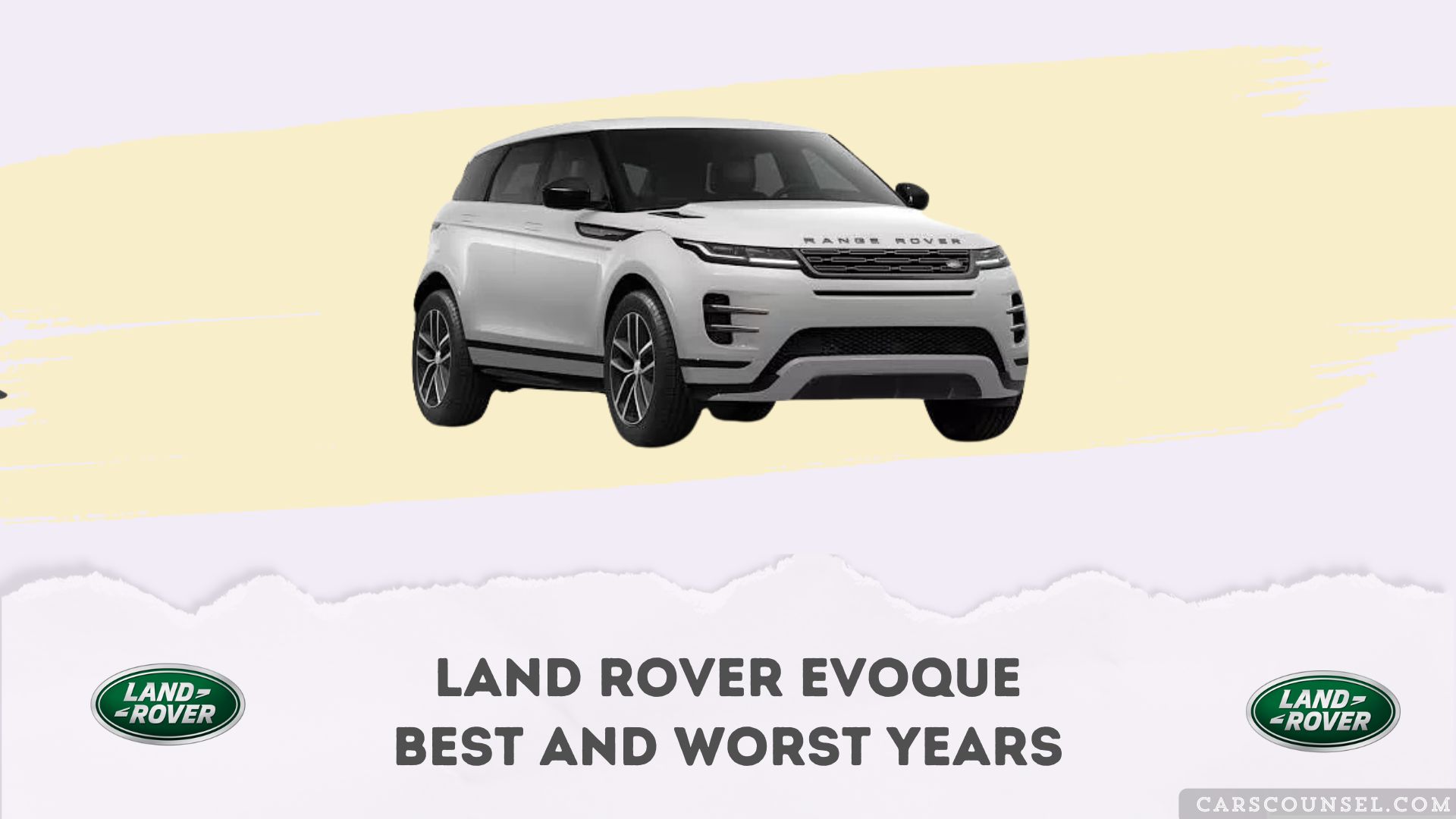
The best Land Rover Evoque years are 2018 and 2019. These models feature the updated Ingenium engine and refined transmission software, offering comparatively better reliability than earlier versions.
The worst years to avoid are 2012 through 2014. These early models suffer from frequent timing chain tensioner failures, turbocharger defects, and exhaust manifold cracking.
Rankings are comparative, and no used luxury SUV is flawless. Maintenance history, rust, and previous repair quality heavily influence individual vehicle condition.
Buyers must note that powertrain configurations changed significantly. The switch from the Ford-derived engine to the JLR Ingenium engine, and later the 48-volt mild-hybrid system, created distinct reliability patterns.
Quick Navigation
Best and Worst Land Rover Evoque Years at a Glance
| Model Year | Verdict | Main Reason | Buyer Guidance |
|---|---|---|---|
| 2012-2014 | Avoid | Timing chain and turbo failures | Seek later models |
| 2015-2017 | Approach Carefully | ZF 9-speed transmission issues | Test drive for shifting hesitation |
| 2018-2019 | Good Choice | Ingenium engine improvements | Verify timing chain service history |
| 2020 | Approach Carefully | First-year redesign, MHEV recalls | Check for 48V system recall completion |
| 2021-2024 | Too New to Judge | Limited long-term data | Budget for potential hybrid repairs |
Key Takeaways
- The 2018 and 2019 model years are the strongest choices for used buyers.
- Avoid 2012 through 2014 due to severe engine and turbocharger defects.
- The 2020 redesign introduced a complex 48-volt mild-hybrid system with early electrical recalls.
- Always verify the VIN for open recalls, especially concerning the junction block and airbags.
- Long-term reliability data for 2021 and newer models remains limited.
- An independent pre-purchase inspection is essential for any used Land Rover.
How We Evaluated the Land Rover Evoque Model Years
Our analysis considers official NHTSA recalls, manufacturer service campaigns, and verified owner complaints. We evaluate powertrain differences, generation changes, and repair complexity.
Consumer complaints are not confirmed failure rates, and a recall does not automatically make a vehicle unreliable. Recent models have limited long-term ownership data, and a top ranking indicates comparatively stronger reliability, not a flawless vehicle.
Best Land Rover Evoque Years
2018-2019: Good Choice
These years mark the end of the first generation and the introduction of the JLR Ingenium 2.0L engine. While early Ingenium engines still require careful timing chain monitoring, they resolved many of the severe turbocharger and manifold defects found in the earlier Ford-derived powerplants.
The ZF 9-speed transmission software was also heavily refined by this point. This significantly reduced the harsh shifting complaints that plagued previous model years, making these the most dependable options for used buyers.
Best Year by Buyer Type
Best Overall Choice: 2019
The 2019 model represents the most mature version of the first generation. It benefits from years of software updates to the transmission and infotainment systems, making it the most dependable option before the complex 48-volt hybrid systems were introduced.
Years to Approach Carefully
2015-2017: Approach Carefully
Land Rover introduced the ZF 9-speed automatic transmission during this period. Many owners reported harsh shifting, hesitation from a stop, and software-related drivability issues. While the 2.0L EcoBoost engine remained largely unchanged, the transmission behavior requires a thorough test drive.
Buyers should ensure the vehicle has received all necessary transmission control module updates from a dealer. Without these software revisions, the driving experience can be frustrating and unpredictable.
2020: Approach Carefully
The 2020 model year launched the second generation with a new platform and a 48-volt mild-hybrid system. First-year models experienced electrical gremlins and specific recalls, including an issue with the 48V junction block that required dealer intervention.
Buyers must verify that all software updates and recall repairs have been completed. Out-of-warranty repairs for the mild-hybrid system and complex infotainment architecture can be expensive.
Worst Land Rover Evoque Years
2012-2014: Avoid
The earliest US-market Evoques are prone to expensive mechanical failures. The 2.0L turbocharged engine is susceptible to timing chain tensioner failure, which can lead to catastrophic engine damage if ignored by previous owners.
Additionally, turbocharger failures and cracking exhaust manifolds are common complaints. Combined with early infotainment and electrical faults, these years present a high risk of costly and disruptive repairs.
Land Rover Evoque Reliability by Generation
First Generation (2012-2019)
The original Evoque debuted with a 2.0L Ford-derived EcoBoost engine and a six-speed automatic transmission. While stylish, the early powertrain suffered from timing chain and turbo issues. In 2014, the ZF 9-speed transmission was added, bringing new software complaints.
When shopping for a used Land Rover, the 2018 refresh introduced the Ingenium engine, improving the overall reliability profile. Contextually, buyers looking at this architecture might also research the Land Rover Discovery Sport, which shares related platform components and powertrains.
Second Generation (2020-Present)
The current generation moved to a new platform and introduced 48-volt mild-hybrid and plug-in-hybrid powertrains. While the interior technology and ride quality improved significantly, the added electrical complexity means long-term out-of-warranty reliability remains unproven.
Common Land Rover Evoque Problems
Engine and Timing Chain Issues
The 2.0L turbocharged engines in both the early EcoBoost and later Ingenium variants have been associated with timing chain stretch and tensioner failure. Symptoms include a rattling noise on cold starts and illuminated check engine lights.
If left unaddressed, this can cause severe internal engine damage. Buyers should always listen for cold-start rattles and review service records for previous timing chain replacements.
Transmission Shifting Hesitation
Models equipped with the ZF 9-speed automatic transmission often exhibit hesitation when accelerating from a stop or harsh gear hunting. This is frequently tied to transmission control module software rather than mechanical failure, but it requires dealer updates to resolve.
Electrical and Infotainment Faults
Land Rover vehicles feature complex electrical architectures. Owners frequently report issues with the InControl infotainment system freezing, digital instrument clusters going blank, and parasitic battery drains caused by control modules failing to sleep properly.
What to Check Before Buying a Used Land Rover Evoque
- Verify the VIN for open NHTSA recalls, particularly for the 48V junction block and airbag systems.
- Listen for timing chain rattle during a cold start.
- Test the transmission for smooth shifting and hesitation from a stop.
- Scan for hidden diagnostic trouble codes in all control modules.
- Inspect the turbocharger and exhaust manifold for cracks or leaks.
- Inspect the fuel pumps and fuel injectors for leaks or electrical faults.
- Review service records for software updates and transmission fluid services.
- Arrange an independent pre-purchase inspection by a Land Rover specialist.
Related Buying Guides
- Land Rover Discovery best and worst years: A larger, family-focused alternative with different powertrain configurations.
- Land Rover Range Rover best and worst years: The flagship luxury option for buyers needing more space and premium features.
- Land Rover LR3 years to avoid: An older, body-on-frame alternative for buyers prioritizing rugged off-road capability over modern fuel economy.
Frequently Asked Questions
What is the most reliable Land Rover Evoque year?
The 2019 model year is generally the most reliable. It represents the final, most refined version of the first generation before the introduction of complex 48-volt hybrid systems.
Are Land Rover Evoques expensive to maintain?
Yes, maintenance and repair costs are higher than average for compact SUVs. Out-of-warranty repairs, especially for turbochargers and hybrid components, can be very costly.
Did Land Rover fix the timing chain issues?
Later Ingenium engines improved upon the early EcoBoost designs, but timing chain stretch remains a potential concern. Buyers should listen for cold-start rattles and verify service history.
Why is the 2020 Evoque rated with caution?
The 2020 model was the first year of a major redesign. It introduced a new 48-volt mild-hybrid system that was subject to early electrical recalls and software glitches.
Is the 9-speed transmission in the Evoque reliable?
The ZF 9-speed transmission is mechanically sound, but early software calibrations caused harsh shifting and hesitation. Ensure the vehicle has received all manufacturer transmission updates.
Do I need a pre-purchase inspection?
An independent inspection by a Land Rover specialist is highly recommended. They can identify pending timing chain failures, turbo leaks, and hidden electrical faults.
Which Land Rover Evoque Year Should You Buy?
For used buyers, the 2018 and 2019 model years offer the best balance of style and mechanical maturity. Avoid the 2012 through 2014 models due to severe engine defects.
If considering a newer 2020 or later model, verify that all 48-volt hybrid recalls are complete and budget for potential electrical repairs. Always perform a VIN check and arrange an independent inspection before purchasing.

