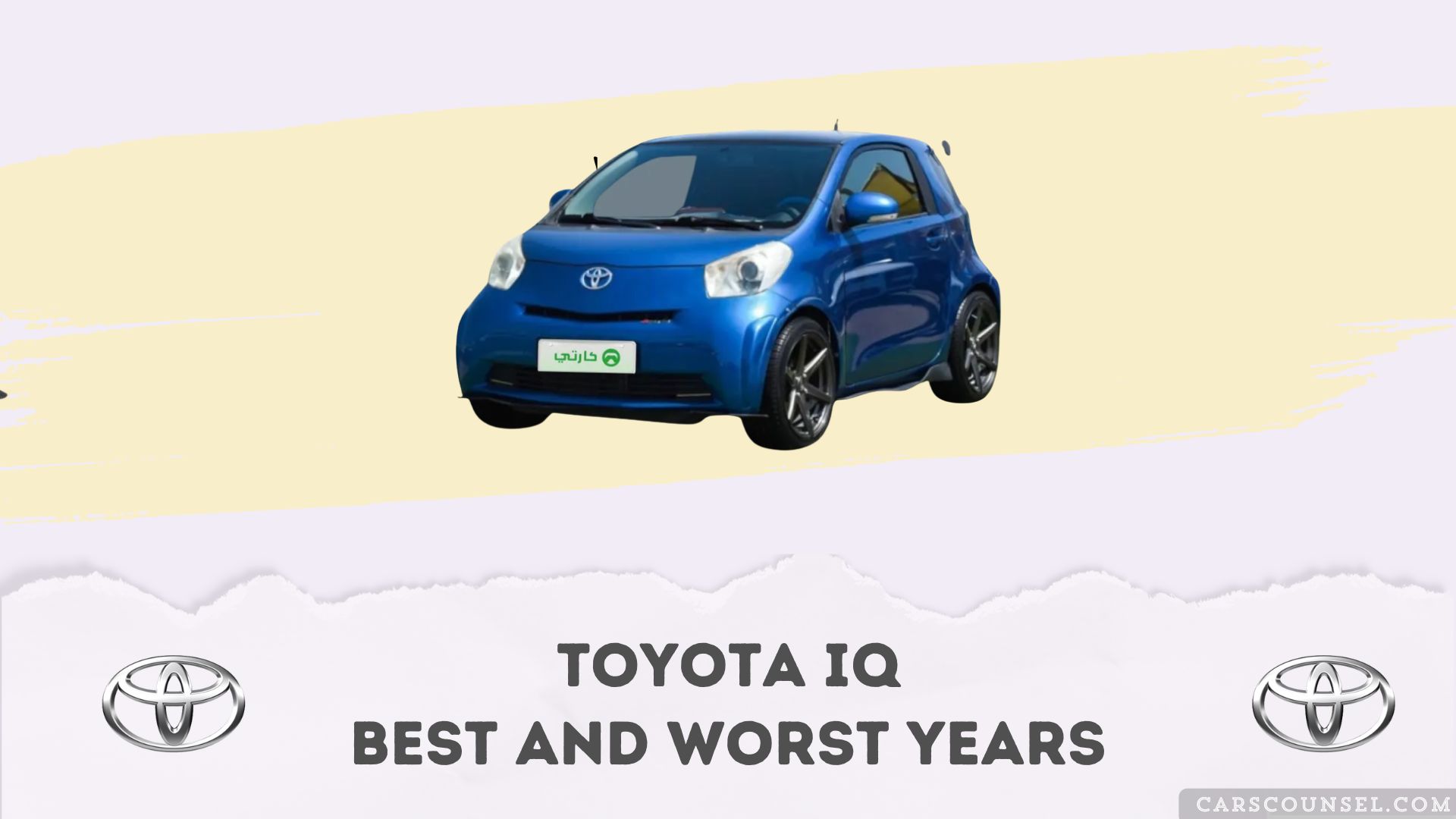
The best Toyota iQ years for US buyers are 2014 and 2015, sold here as the Scion iQ. These final production years offer the most sorted experience with minimal mechanical complaints.
Rankings are comparative within the microcar segment. Because the US model run was short, no year is flawless, and long-term dependability relies heavily on strict maintenance and rust prevention.
Meaningful differences exist between the global Toyota iQ and the US-market Scion iQ. The US version exclusively uses a 1.3-liter engine and CVT, avoiding the turbocharged issues found overseas.
Quick Navigation
Best and Worst Toyota IQ Years at a Glance
| Model Year or Range | Verdict | Main Reason | Buyer Guidance |
|---|---|---|---|
| 2014–2015 | Best Choice | Mature production, fewest complaints | Verify Takata airbag recall completion |
| 2012–2013 | Good Choice | Reliable but has minor first-year recalls | Check fuel door and wiper switch repairs |
| 2008–2011 | US Market Excluded | Not officially sold in the United States | Import rules and parts availability vary |
Key Takeaways
- Strongest choices: 2014 and 2015 Scion iQ models.
- Caution years: 2012 models require verification of early recalls.
- Powertrain distinction: US models use a 1.3L engine, not the global 1.0L turbo.
- Major concern: Takata passenger airbag inflator recalls.
- Recent limitation: The US model was discontinued after 2015.
- Always verify the VIN for open safety recalls.
- Demand a pre-purchase inspection focusing on CVT fluid and rust.
How We Evaluated the Toyota IQ Model Years
Our analysis examines NHTSA records, manufacturer service campaigns, and ownership patterns. We help buyers understand which model years to avoid and which offer the best experience for this microcar.
Consumer complaints are not confirmed defects. A recall does not automatically make a vehicle unreliable. Because the US model run ended in 2015, long-term data is established. Best means comparatively stronger.
Best Toyota IQ Years
2014 and 2015: Best Choice
The 2014 and 2015 model years represent the end of the US production run. By this time, Toyota had resolved early assembly quirks, resulting in a highly dependable city car.
The 1.3-liter engine and CVT combination proved robust. Owners report excellent fuel economy and minimal powertrain complaints, making these final years the safest used purchases.
Best Year by Buyer Type
Best Urban Commuter Configuration
Any 2014 or 2015 model offers the ultimate urban commuter setup. The compact footprint, tight turning radius, and reliable CVT make it ideal for dense city driving.
Years to Approach Carefully
2012 and 2013: Good Choice
The 2012 launch year in the US saw a few minor service campaigns. Issues included a potentially faulty windshield wiper switch and a fragile fuel filler door hinge.
These are not catastrophic failures, but buyers should verify that the dealer performed the necessary updates. The 2013 model carries over with similar minor early-production caveats.
Worst Toyota IQ Years
No US-market year earns a strict Avoid verdict. However, early 2012 models require the most rigorous inspections to ensure first-year service campaigns were completed by a certified dealer.
Global market years like 2009 faced turbocharger recalls overseas. These do not apply to the naturally aspirated US models but frequently confuse buyers reading international reliability forums.
Toyota IQ Reliability by Generation
First Generation (2008–2015 Global / 2012–2015 US)
The iQ rides on a unique front-wheel-drive platform designed to maximize interior space within a minimal footprint. It features a flat fuel tank and compact HVAC system.
In the US, it was sold exclusively as the Scion iQ. It joins a lineage of compact Toyota vehicles, though its US powertrain differs significantly from global variants.
Common Toyota IQ Problems
Airbag and Safety-System Problems
Like many vehicles from this era, the Scion iQ is affected by the massive Takata airbag recall. The passenger-side inflator can rupture, posing a severe safety risk.
Buyers must check the VIN to ensure this critical recall was performed. Do not purchase an affected vehicle unless the dealer has already installed the official remedy.
Electrical Problems
Early models experienced issues with the windshield wiper switch assembly. The internal contacts could wear out, causing the wipers to fail intermittently or stop working entirely.
Corrosion Problems
Owners in regions using heavy road salt may notice corrosion on the undercarriage and exhaust components. The compact design leaves some rear suspension components vulnerable to winter weather.
What to Check Before Buying a Used Toyota IQ
- Verify the VIN for open recalls, especially the Takata airbag campaign.
- Review maintenance records for CVT fluid exchanges.
- Test the windshield wipers on all speed settings.
- Inspect the fuel filler door hinge for stress cracks.
- Check the undercarriage for severe rust in cold-weather regions.
- Arrange a pre-purchase inspection by a qualified technician.
Related Buying Guides
- Toyota C-HR best and worst years: A subcompact crossover that offers more cargo space and modern safety features for buyers who have outgrown the microcar segment.
- Toyota GR86 best and worst years: A performance-oriented coupe for enthusiasts who want Toyota reliability but prioritize driving dynamics over urban fuel economy.
- Toyota Land Cruiser best and worst years: A legendary off-road SUV for buyers who need maximum towing capacity and rugged durability instead of city maneuverability.
- Toyota Wish best and worst years: A compact minivan primarily sold in Asian markets, offering family passenger space that the microcar segment simply cannot provide.
Frequently Asked Questions
Is the Toyota iQ reliable?
Yes, the US-market Scion iQ is generally reliable. The 1.3-liter engine and CVT are proven Toyota components, though age and maintenance history now dictate overall dependability.
What year of the Scion iQ is most dependable?
The 2014 and 2015 model years are the most dependable. As the final years of production, they benefited from resolved early assembly quirks and established reliability patterns.
What year should you avoid?
No US year is strictly avoided, but approach 2012 models carefully. As the first US production year, they are more prone to minor electrical and fuel door recalls.
What are the most common problems?
The most critical issue is the Takata passenger airbag recall. Other minor complaints include wiper switch failures, fuel door hinge cracks, and CVT shuddering if fluid is neglected.
Was the Toyota iQ sold as a hybrid?
No, the US-market Scion iQ was never sold as a hybrid. It used a standard 1.3-liter gasoline engine. Hybrid and electric variants were limited to specific global markets.
How long does a Scion iQ last?
Well-maintained examples can reach high mileage. Longevity depends entirely on strict adherence to CVT fluid changes, rust prevention, and addressing minor electrical gremlins promptly before they worsen.
Which Toyota IQ Year Should You Buy?
Target the 2014 and 2015 model years for the most sorted ownership experience. These final production years offer the best balance of urban efficiency and proven mechanical durability.
Approach 2012 models with realistic expectations regarding first-year service campaigns. Always verify the VIN for open airbag recalls and arrange an independent pre-purchase inspection before finalizing your purchase.