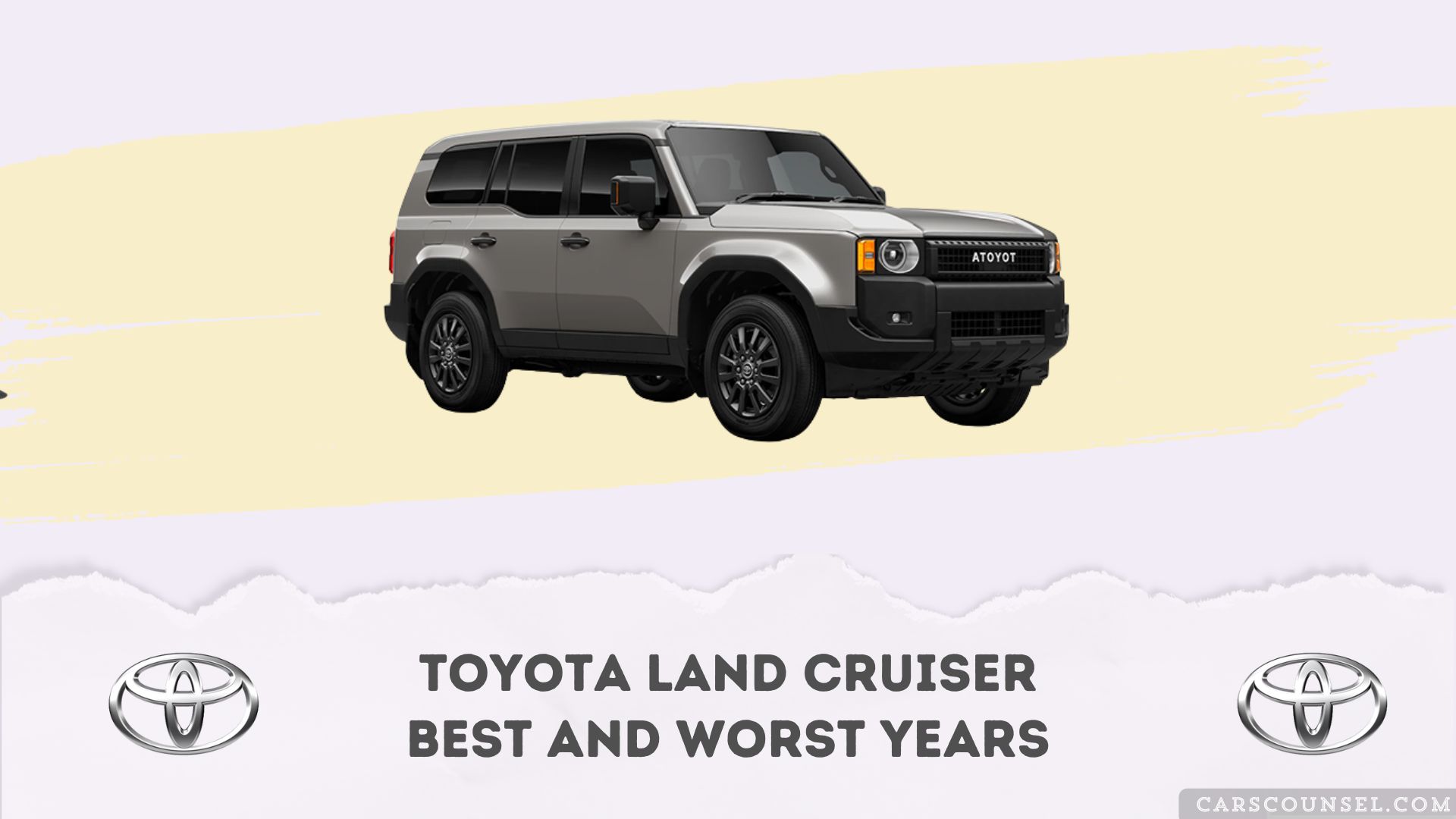
The best Toyota Land Cruiser years are 2016 through 2021, offering a highly sorted 5.7L V8 and mature reliability. Buyers should approach early 1998 to 2002 models carefully due to age-related suspension and maintenance risks.
These rankings are comparative. No used off-road SUV is flawless, and long-term survival depends entirely on rigorous maintenance, rust prevention, and verifying previous repair records before purchase.
Reliability varies significantly by generation. The 100 Series requires strict timing belt adherence, while the 200 Series demands water pump and suspension inspections. The newest turbo-hybrid models remain unproven.
Quick Navigation
Best and Worst Toyota Land Cruiser Years at a Glance
| Model Year Range | Verdict | Main Reason | Buyer Guidance |
|---|---|---|---|
| 2016-2021 | Best Choice | Mature 5.7L V8, updated safety | Ideal for daily driving and off-roading |
| 2008-2015 | Good Choice | Reliable powertrain, aging tech | Inspect water pump and KDSS |
| 1998-2007 | Good With Inspection | Durable 4.7L V8 | Verify timing belt and ball joints |
| 1993-1997 | Best Older Choice | Solid axles, inline-6 | Inspect for rust and age |
| 2024-Present | Too New to Judge | Turbo hybrid platform | Long-term data is unavailable |
Key Takeaways
- Late-model 200 Series examples (2016-2021) offer the strongest blend of reliability and modern safety.
- The 100 Series (1998-2007) demands strict adherence to timing belt and lower ball joint maintenance intervals.
- Toyota did not sell the traditional Land Cruiser in the United States for the 2022 and 2023 model years.
- The 2024 turbo-hybrid model is entirely new to the market, leaving long-term durability unproven.
- Always verify open recalls and inspect the KDSS suspension system on equipped models.
How We Evaluated the Toyota Land Cruiser Model Years
Our analysis reviews official recalls, manufacturer service campaigns, and consumer complaint databases.
We evaluate powertrain differences, generation changes, and repair complexity across the US market.
Complaints are not confirmed failure rates, and a recall does not automatically make a vehicle unreliable.
Recent models have limited ownership history, while older models require careful condition assessments.
A top ranking indicates a comparatively stronger option, not a flawless vehicle.
Best Toyota Land Cruiser Years
2016-2021 (Best Choice)
The late 200 Series represents the most refined version of the traditional 5.7L V8 Land Cruiser.
Toyota resolved most early-production quirks, resulting in a highly durable platform with excellent safety ratings.
These models benefit from updated infotainment, standard Toyota Safety Sense, and proven long-term powertrain stability.
Buyers should still inspect the suspension and verify that previous owners used premium fluids.
2008-2015 (Good Choice)
The early and mid-cycle 200 Series models share the same robust 5.7L V8 engine as later years.
They offer exceptional off-road capability and interior space, making them excellent family haulers.
However, aging components like water pumps, alternators, and KDSS hydraulic lines require careful inspection.
Infotainment systems in these years also feel dated compared to modern standards.
Best Year by Buyer Type
- Best Overall: 2018-2021 (Mature platform, excellent safety features, proven V8 reliability).
- Best Older Choice: 1993-1997 (Solid front axle, simple inline-six engine, high enthusiast appeal).
- Best Family Alternative: Buyers needing more modern third-row space and better fuel economy should consider the Toyota Highlander.
Years to Approach Carefully
1998-2007 (Good With Inspection)
The 100 Series introduced independent front suspension and a powerful 4.7L V8 engine to the US market.
While the engine block is incredibly durable, age-related rubber and suspension components demand attention.
Neglected timing belts can cause catastrophic engine failure, and worn lower ball joints can collapse the front suspension.
Purchase only if extensive service records confirm these critical maintenance items were addressed.
Are There Any Toyota Land Cruiser Years to Avoid?
The Land Cruiser lineup does not have any true “Avoid” model years based on systemic mechanical failures.
Instead of avoiding specific years, buyers must avoid neglected examples of older generations.
A 1999 or 2002 model with no service history poses a massive financial risk due to deferred maintenance.
Always prioritize condition and maintenance records over the specific manufacturing year on older models.
Toyota Land Cruiser Reliability by Generation
J80 Generation (1993-1997)
The 80 Series is highly prized for its solid front axle and rugged 4.5L inline-six engine.
These models offer exceptional off-road articulation but lack modern safety features and fuel efficiency.
Rust and aging wiring harnesses are the primary concerns for surviving examples.
J100 Generation (1998-2007)
This generation shifted to a more comfortable independent front suspension and introduced the 4.7L V8.
It shares underlying architecture and powertrain concepts with the Lexus GX, though the GX utilizes a smaller V8.
Rack and pinion steering leaks and lower ball joint wear are the most common age-related failures.
J200 Generation (2008-2021)
The 200 Series utilizes the 5.7L V8, an engine family also found in the Toyota Tundra.
This generation is widely regarded for exceptional longevity, often reaching high mileage with basic maintenance.
KDSS suspension leaks and water pump weeping are the most frequent repair expenses.
J250 Generation (2024-Present)
Toyota reintroduced the Land Cruiser to the US market with a smaller, turbocharged four-cylinder hybrid powertrain.
This platform prioritizes fuel efficiency and modern technology over the massive displacement of previous V8 models.
Long-term reliability data for this new hybrid system remains unavailable.
Common Toyota Land Cruiser Problems
Lower Ball Joint Wear (1998-2007)
The 100 Series front lower ball joints endure immense stress during off-road use and heavy hauling.
If the protective boots tear or the joints wear out, the front wheel assembly can separate from the control arm.
Proactive replacement is highly recommended for any high-mileage example.
Water Pump Leaks (2008-2015)
The 5.7L V8 engine is known for developing slow weeps from the water pump seal.
While not an immediate failure risk, ignoring low coolant levels can lead to severe engine damage.
Replacement requires significant labor due to the engine’s size and accessory routing.
KDSS Hydraulic Leaks (2008-2021)
The Kinetic Dynamic Suspension System uses hydraulic cylinders to manage body roll without sacrificing articulation.
Over time, the hydraulic lines and accumulators can develop leaks, triggering dashboard warning lights.
Repairs are complex and require specialized diagnostic equipment and fluid bleeding procedures.
What to Check Before Buying a Used Toyota Land Cruiser
- Verify the VIN for any open safety recalls, including older Takata airbag campaigns.
- Confirm the timing belt and water pump were replaced on 1998-2007 models within the last 90,000 miles.
- Inspect the front lower ball joints for play or torn rubber boots.
- Check the KDSS system for hydraulic fluid leaks around the cylinders and accumulators.
- Test the four-wheel-drive system, including the center and rear locking differentials.
- Inspect the undercarriage for severe structural rust, particularly in salt-belt states.
- Scan the vehicle for hidden diagnostic codes related to the ABS or suspension systems.
- Arrange an independent pre-purchase inspection with a technician familiar with Toyota trucks.
Related Buying Guides
- Toyota 4Runner best and worst years: A smaller, more affordable body-on-frame alternative with a simpler V6 powertrain.
- Toyota Sequoia best and worst years: A larger, V8-powered family hauler that shares engines with the 200 Series Land Cruiser.
Frequently Asked Questions
What is the most reliable Toyota Land Cruiser year?
The 2018 through 2021 model years are the most reliable. They feature the fully sorted 5.7L V8 engine, updated safety technology, and minimal manufacturing defects compared to earlier production runs.
Why was the Land Cruiser not sold in the US in 2022?
Toyota paused US sales of the traditional Land Cruiser after 2021. The global 300 Series was reserved for other markets, while the US received the Lexus LX 600 instead until the 2024 hybrid model arrived.
Do Toyota Land Cruisers have frame rust issues?
While surface rust is common on older models, the Land Cruiser did not suffer from the same catastrophic frame rot that affected contemporary Tacomas and Tundras. Proper undercarriage maintenance prevents severe structural corrosion.
Is the 5.7L V8 engine reliable?
Yes, the 3UR-FE 5.7L V8 is highly durable. With regular oil changes and timely water pump replacements, these engines routinely reach high mileage without requiring major internal engine repairs.
What is the KDSS system?
KDSS stands for Kinetic Dynamic Suspension System. It uses hydraulic cylinders to disconnect the sway bars off-road for maximum articulation, while stiffening them on-road to reduce body roll during cornering.
Can a Land Cruiser reach high mileage?
Well-maintained examples frequently reach high mileage. Longevity depends entirely on strict adherence to service intervals, rust prevention, and addressing minor fluid leaks before they cause secondary component damage.
Which Toyota Land Cruiser Year Should You Buy?
The 2016 through 2021 models offer the best combination of proven V8 reliability and modern safety features.
Buyers seeking older models must prioritize maintenance records over the specific year, particularly for timing belts and ball joints.
Always verify the VIN, inspect the suspension, and confirm the vehicle suits your specific towing and off-road needs.

