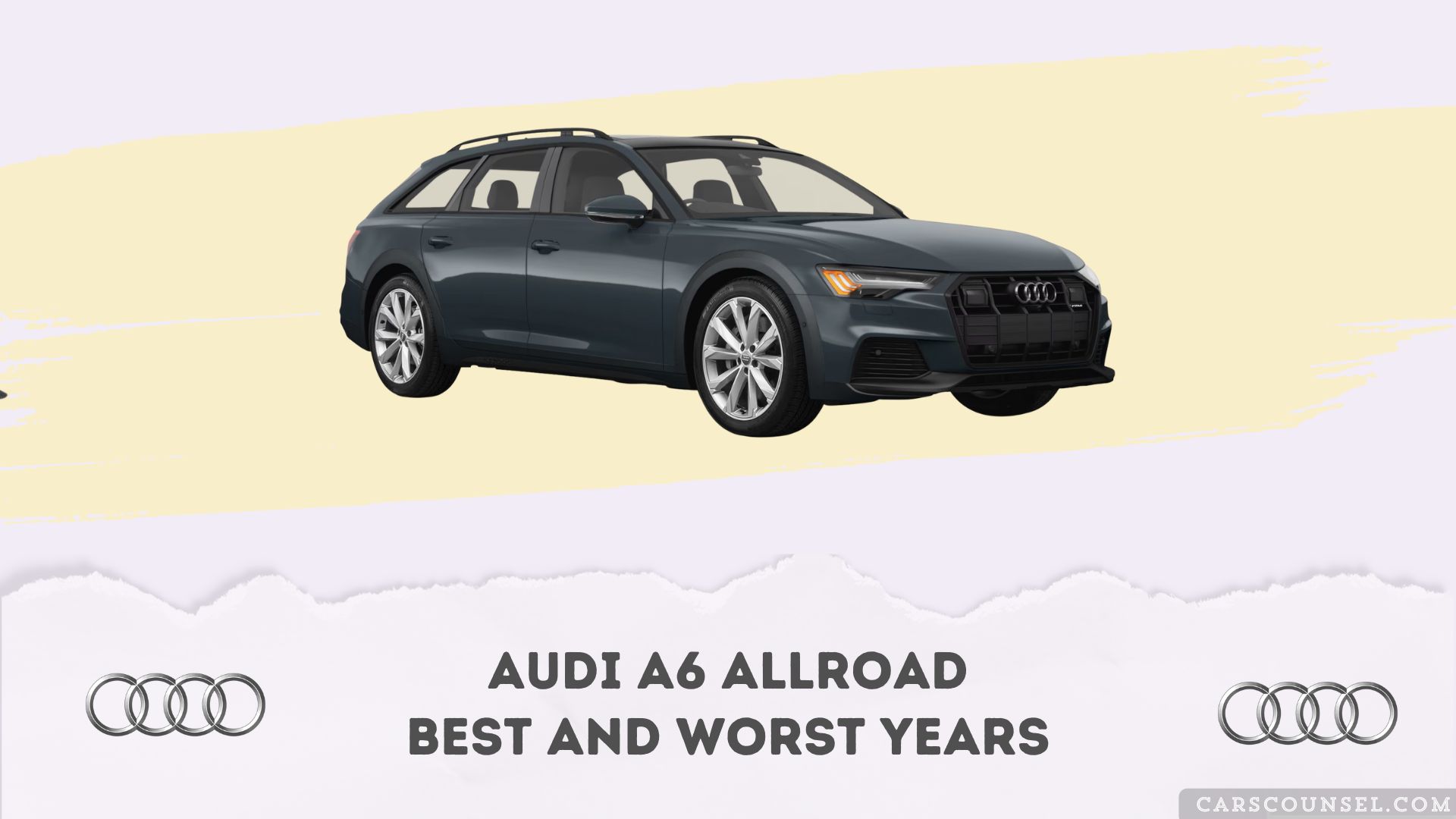
The best Audi A6 allroad model years are 2014 through 2018, benefiting from a mature 3.0T V6 and resolved first-year glitches. Buyers should avoid the 2003-2005 4.2L V8 models due to catastrophic timing chain guide failures.
Rankings are comparative, and no luxury wagon is entirely flawless. Long-term reliability depends heavily on strict adherence to dealership maintenance schedules and addressing air suspension warnings immediately.
Meaningful differences exist between the early 2.7T V6, the 4.2L V8, and the modern 3.0T V6 configurations. The mild-hybrid system in recent models also introduces new electrical complexities.
Quick Navigation
Best and Worst Audi A6 Allroad Years at a Glance
| Model Year or Range | Verdict | Main Reason | Buyer Guidance |
|---|---|---|---|
| 2001-2005 (2.7T) | Good With Inspection | Timing belt and air suspension risks | Verify belt service and suspension |
| 2003-2005 (4.2L) | Avoid | Timing chain guide failure | Look for alternative configurations |
| 2013 | Approach Carefully | First-year C7 platform gremlins | Inspect cooling system and electronics |
| 2014-2018 | Best Choice | Mature 3.0T V6, refined platform | Confirm carbon cleaning and fluid services |
| 2020-2026 | Too New to Judge | Mild-hybrid complexity, limited data | Monitor long-term ownership reports |
Key Takeaways
- The 2014-2018 models are the strongest choices, offering the reliable 3.0T V6 and refined C7 platform.
- Avoid the 2003-2005 4.2L V8 models due to the extremely expensive timing chain guide failure.
- The 2001-2005 2.7T models are acceptable only if the timing belt and air suspension have been recently serviced.
- First-year 2013 models require careful inspection of the thermostat housing and early electronics.
- Recent 2020 and newer models feature a mild-hybrid system, limiting long-term reliability data.
- Always verify the complete VIN for open campaigns and arrange an independent pre-purchase inspection.
How We Evaluated the Audi A6 Allroad Model Years
Our analysis examines NHTSA records, manufacturer service campaigns, and enthusiast ownership patterns across the C5, C7, and C8 platforms. We weigh the impact of the complex air suspension, supercharged versus turbocharged powertrains, and early-build refinements.
Consumer complaints are not confirmed defects or failure rates. A recall does not automatically make a vehicle unreliable, but luxury wagons require meticulous documentation of fluid changes and supercharger maintenance.
Best Audi A6 Allroad Years
2014-2018: Best Choice
These model years represent the most refined iteration of the C7 platform. The supercharged 3.0T V6 engine is exceptionally robust when properly maintained, avoiding the catastrophic failures of the older V8.
Buyers should still verify that the water pump and thermostat housing have been inspected, as the plastic components are prone to cracking and causing coolant leaks over time.
Best Year by Buyer Type
Best Performance Configuration: The 2014-2018 models with the 3.0T V6 offer the best balance of supercharged torque and reliable ZF eight-speed automatic transmission operation.
Practical Alternative: Buyers seeking a similar luxury sedan with lower maintenance costs and standard ground clearance may cross-shop the Audi A6, which shares the C7 architecture but lacks the complex air suspension.
Years to Approach Carefully
2013: Approach Carefully
As the inaugural model year of the C7 generation in the United States, the 2013 A6 allroad experienced typical first-year teething issues. Early examples reported more frequent electrical gremlins and cooling system leaks.
Purchase only if the vehicle’s service records confirm the thermostat housing and water pump have been updated or replaced with improved components.
2001-2005 (2.7T V6): Good With Inspection
The original C5 allroad with the 2.7T V6 is an enthusiast favorite, but it requires strict maintenance. The timing belt must be replaced at specific intervals to prevent engine destruction.
Additionally, the pneumatic air suspension system is prone to leaking air struts and failing compressors, which are expensive to replace with OEM parts.
Worst Audi A6 Allroad Years
2003-2005 (4.2L V8): Avoid
The 4.2L V8 configuration in the C5 allroad is plagued by a severe timing chain guide defect. The plastic guides break apart, causing the chains to jump and destroying the engine.
Because the timing chains are located at the rear of the engine, the repair requires removing the entire powertrain, making it a massive financial risk for used buyers.
Audi A6 Allroad Reliability by Generation
First Generation (2001-2005)
Originally badged simply as the allroad quattro, this C5-based wagon introduced adjustable air suspension and rugged cladding to the US market. While the 2.7T V6 is manageable, the 4.2L V8 is a major liability.
Second Generation (2013-2018)
Returning to the US on the C7 platform, this generation utilized the supercharged 3.0T V6. It offers excellent daily drivability, though the plastic cooling system components and carbon buildup require proactive maintenance.
Third Generation (2020-Present)
The current C8 platform introduced a turbocharged 3.0T V6 with a 48-volt mild-hybrid system. While the interior technology is vastly superior, the complex electrical architecture limits long-term reliability predictions.
Common Audi A6 Allroad Problems
Air Suspension Failures
Across all generations, the adaptive air suspension is a known wear item. Air struts develop leaks, causing the vehicle to sag overnight, which eventually burns out the air compressor.
Cooling System Leaks
The 3.0T V6 engines in the C7 generation use plastic thermostat housings and water pumps that become brittle over time. Coolant leaks can lead to overheating and severe engine damage if ignored.
Carbon Buildup
Direct injection engines, including the 3.0T and 2.7T, are prone to carbon accumulation on the intake valves. This causes rough idling and misfires, requiring manual walnut blasting to resolve.
What to Check Before Buying a Used Audi A6 Allroad
- Verify the VIN to ensure all safety recalls and software updates are completed.
- Confirm strict adherence to timing belt intervals on 2.7T models or timing chain inspections on V8s.
- Inspect the air suspension by cycling through ride heights and checking for overnight sagging.
- Pressure test the cooling system and inspect the thermostat housing for crusty coolant residue.
- Check for records of recent intake valve carbon cleaning services.
- Arrange an independent pre-purchase inspection by a certified Audi technician.
Related Buying Guides
- Audi S6 best and worst years: A high-performance alternative for buyers seeking supercharged or twin-turbo V8 acceleration without the raised suspension and off-road cladding.
- Audi Q8 best and worst years: A modern luxury SUV alternative for buyers who need more cargo space and contemporary infotainment technology than the A6 allroad provides.
Frequently Asked Questions
What is the most reliable Audi A6 allroad year?
The 2014 through 2018 models are comparatively stronger, benefiting from a mature 3.0T V6 and resolved first-year C7 platform glitches. Recent mild-hybrid models lack long-term data.
Does the Audi A6 allroad have timing belt or chain issues?
The 2.7T V6 uses a timing belt that requires strict replacement intervals. The 4.2L V8 has catastrophic timing chain guide failures. The 3.0T V6 uses chains that are generally reliable.
Is the air suspension expensive to fix?
Yes, replacing OEM air struts and compressors is very expensive. Many owners opt for aftermarket conversion kits to switch to standard coil springs to eliminate future air leaks.
Why should I avoid the 2003-2005 4.2L V8?
The timing chain guides on the 4.2L V8 are prone to breaking. Because the chains are at the back of the engine, the repair requires engine removal, making it financially devastating.
Do the modern A6 allroad models have hybrid issues?
The 2020 and newer models use a 48-volt mild-hybrid system. While it improves efficiency, the complex electrical architecture and battery placement add new variables to long-term ownership costs.
Does the A6 allroad share parts with the standard A6?
Yes, the A6 allroad shares its underlying chassis and powertrains with the contemporary Audi A6 sedan and Avant. However, the allroad features unique air suspension and body cladding.
Which Audi A6 Allroad Year Should You Buy?
Target the 2014 through 2018 models for the most proven ownership experience, benefiting from the robust 3.0T V6 and excellent ZF transmission. These years offer the best balance of modern luxury and established reliability.
Approach the early C5 models with realistic expectations regarding air suspension and timing belt maintenance. Always verify the VIN for open campaigns, demand comprehensive service records, and arrange a specialized pre-purchase inspection.

