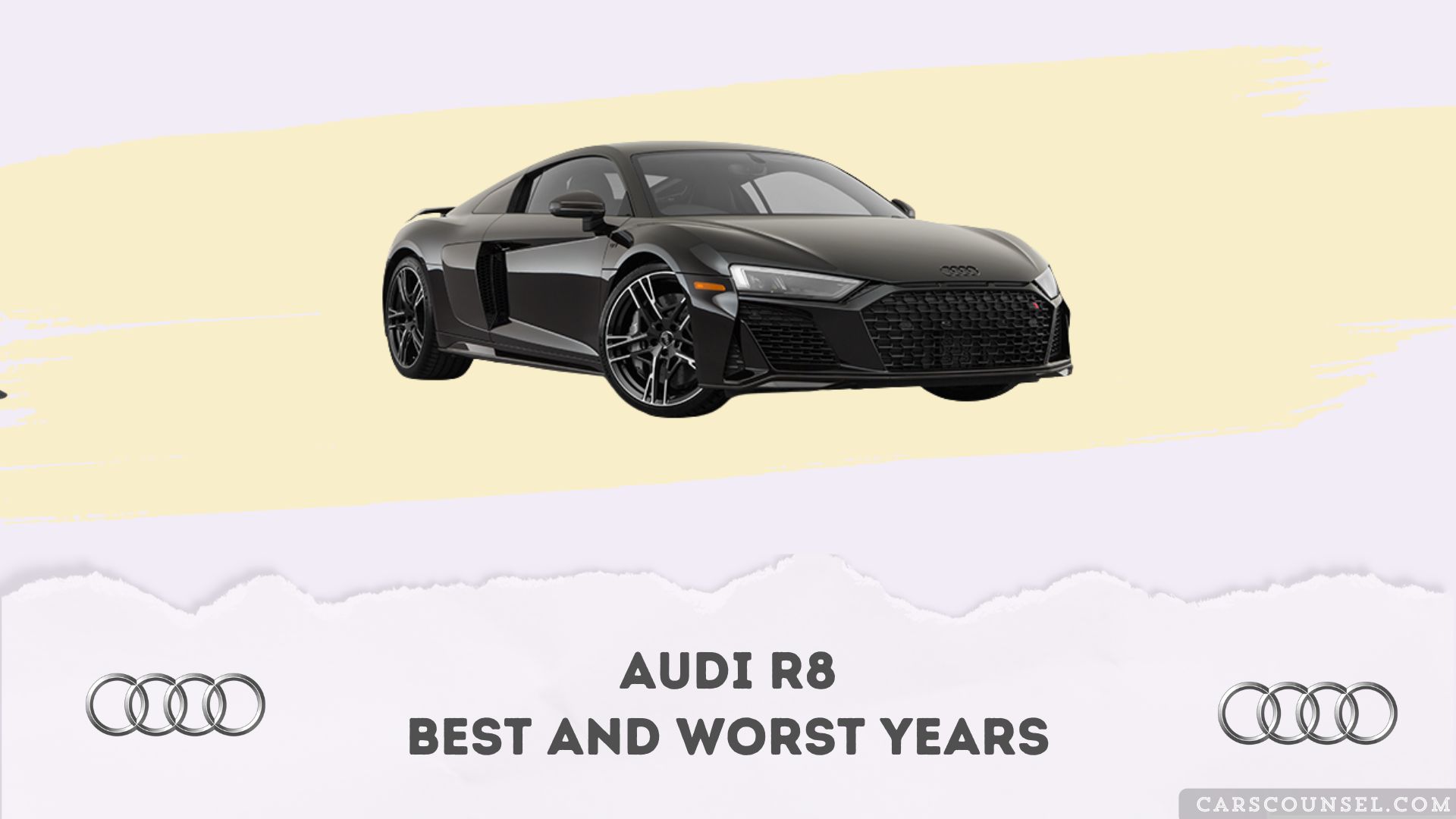
The best Audi R8 model years are the 2014–2015 first-generation facelift and the 2020–2023 second-generation facelift. These years feature the highly reliable S-Tronic dual-clutch transmission and the naturally aspirated 5.2-liter V10 engine.
No Audi R8 model year is entirely flawless, as supercar ownership inherently demands rigorous maintenance. Rankings are comparative, and long-term reliability depends heavily on documented service history and careful previous ownership.
Buyers must note significant powertrain differences across generations. The early V8 engines and R-Tronic automated manual transmissions require much stricter inspection than later V10 configurations.
Quick Navigation
Best and Worst Audi R8 Years at a Glance
| Model Year | Verdict | Main Reason | Buyer Guidance |
|---|---|---|---|
| 2020–2023 | Best Late-Generation Choice | Sorted Gen 2 facelift with V10 and S-Tronic. | Verify recall completion and magnetic ride condition. |
| 2014–2015 | Best Older Choice | Gen 1 facelift introduced the superior S-Tronic transmission. | Prioritize V10 models with complete service records. |
| 2017–2019 | Good Choice | Strong Gen 2 performance with minor early-production recalls. | Ensure transmission fluid and gearbox recalls were performed. |
| 2010–2013 (V10) | Good With Inspection | Robust V10 engine, but R-Tronic transmission is jerky. | Have the clutch and transmission thoroughly evaluated. |
| 2008–2013 (V8) | Approach Carefully | Prone to timing chain guide wear and carbon buildup. | Budget for potential engine and transmission repairs. |
Key Takeaways
- The 2014–2015 and 2020–2023 model years offer the strongest blend of reliability and performance.
- Early V8 models and those equipped with the R-Tronic transmission require careful inspection.
- Magnetic Ride suspension failure is a common and expensive issue across most generations.
- Always verify that NHTSA recalls, particularly for Gen 2 gearboxes, have been completed.
- Recent models have limited long-term ownership data compared to the first generation.
- A pre-purchase inspection by an Audi specialist is mandatory.
How We Evaluated the Audi R8 Model Years
Our analysis considers official NHTSA recalls, manufacturer service campaigns, and verified consumer complaints. We also evaluate powertrain differences, generation changes, and repair complexity.
Complaints are not failure rates, and a recall does not automatically make a year unreliable. Recent years have less ownership history, and our best choices represent comparatively stronger options, not flawless vehicles.
Best Audi R8 Years
2020–2023 (Best Late-Generation Choice)
The second-generation facelift represents the pinnacle of R8 engineering. Audi refined the 5.2-liter V10 and standard S-Tronic transmission for exceptional daily drivability and track capability.
Long-term reliability is excellent, though buyers should verify that all gearbox and transmission fluid recalls were performed. These years command a premium on the used market.
2014–2015 (Best Older Choice)
The first-generation facelift introduced the S-Tronic dual-clutch transmission to the US market. This eliminated the jerky low-speed behavior and clutch wear issues of the older R-Tronic.
V10 models from these years are highly desirable. They offer analog supercar feedback combined with modern transmission reliability, making them an outstanding enthusiast choice.
Best Year by Buyer Type
- Best Overall: 2014–2015 V10 S-Tronic offers the perfect balance of analog feel and modern reliability.
- Best Modern Alternative: 2020–2023 models provide cutting-edge technology and peak V10 performance.
- Best Enthusiast Choice: 2010–2013 V10 with the gated six-speed manual transmission.
Years to Approach Carefully
2008–2013 V8 and R-Tronic Models
Early V8 models are prone to expensive timing chain guide wear and carbon buildup. Budget for major engine service if maintenance records are incomplete.
The R-Tronic automated manual transmission is also a concern. It suffers from premature clutch wear and requires expensive specialized repairs when it eventually fails.
Worst Audi R8 Years
No Audi R8 model year carries a strict Avoid verdict. However, the 2008–2009 V8 examples present the highest financial risk due to early production teething issues.
Buyers targeting these earliest models must secure a rigorous pre-purchase inspection and prepare for immediate, costly maintenance to ensure reliable operation.
Audi R8 Reliability by Generation
First Generation (2008–2015)
The first-generation R8 debuted in the US for the 2008 model year with a 4.2-liter V8. Audi introduced the 5.2-liter V10 in 2010.
Early models used the R-Tronic automated manual or a gated six-speed manual. The 2014 facelift replaced the R-Tronic with the vastly superior S-Tronic dual-clutch transmission.
V10 models from 2014 and 2015 represent the pinnacle of first-generation reliability. The S-Tronic transmission dramatically improved daily drivability and long-term durability.
Second Generation (2017–2023)
The second generation arrived in the US for the 2017 model year, dropping the V8 to focus exclusively on the 5.2-liter V10.
These models feature standard S-Tronic transmissions and advanced carbon multi-material structures. A significant facelift for the 2020 model year brought styling and power updates.
Reliability is generally excellent across this generation. Buyers should simply verify that early transmission fluid and gearbox recalls were properly addressed by an authorized dealer.
Common Audi R8 Problems
Magnetic Ride Suspension Failure
Many R8s feature Audi Magnetic Ride suspension. The specialized shocks are prone to leaking and failing as the vehicles age or accumulate track miles.
OEM replacement is extremely expensive. Many owners choose to delete the system and install high-quality aftermarket coilovers to eliminate future repair costs.
R-Tronic Transmission Clutch Wear
The R-Tronic automated manual transmission operates like a standard manual with a computerized clutch. Stop-and-go driving causes premature clutch wear and jerky low-speed behavior.
Replacing the clutch requires specialized equipment and is quite costly. We recommend prioritizing models equipped with the later S-Tronic dual-clutch gearbox instead.
V8 Timing Chain Guide Wear
The early 4.2-liter V8 engines are known to experience timing chain guide wear. This issue can lead to severe engine damage if left unaddressed.
Listen for rattling noises during cold starts. Budget for a major timing chain service if the previous owner lacks documentation confirming the repair.
Ignition Coil and AC Compressor Failures
The 5.2-liter V10 is remarkably robust but occasionally suffers from ignition coil failures. Misfires or check engine lights typically indicate the need for replacement.
Air conditioning compressor failures are also reported across multiple generations. Ensure the cabin cools rapidly during your pre-purchase test drive.
Repair-Cost Overview
| Problem | Commonly Affected Years | Approximate Repair Range | Important Notes |
|---|---|---|---|
| Magnetic Ride Shock Replacement | 2008–2023 | $4,000–$8,000+ | Many owners convert to aftermarket coilovers. |
| R-Tronic Clutch Replacement | 2008–2013 | $3,000–$5,000 | Automated manual clutches wear like standard manuals. |
| Timing Chain Guide Service | 2008–2012 (V8) | $4,000–$6,000 | Requires significant labor or engine removal. |
Repair costs vary widely by region, labor rate, parts choice, and vehicle configuration. Dealer repairs are typically more expensive, and independent specialists may offer alternative solutions like coilover conversions.
What to Check Before Buying a Used Audi R8
- Verify the VIN for open NHTSA recalls, particularly for Gen 2 gearbox and transmission fluid issues.
- Inspect Magnetic Ride shocks for leaks or confirm if a coilover conversion was professionally performed.
- Check R-Tronic clutch life percentage using an Audi-specific diagnostic tool.
- Review service history for V8 timing chain guide replacements or V10 ignition coil service.
- Test cold-start behavior to listen for timing chain rattle or excessive exhaust smoke.
- Arrange an independent pre-purchase inspection with a marque specialist or exotic car dealership.
Related Buying Guides
- Audi A6 Allroad best and worst years: A practical luxury wagon alternative with standard Quattro all-wheel drive.
- Audi S7 best and worst years: A high-performance four-door alternative sharing Audi’s advanced engineering.
- Audi S6 best and worst years: A comfortable daily-driver alternative with potent twin-turbo V6 performance.
- Audi RS3 best and worst years: A compact, track-capable alternative for enthusiasts seeking aggressive styling.
Frequently Asked Questions
Is the Audi R8 reliable?
The Audi R8 is comparatively reliable for a mid-engine supercar, particularly models with the 5.2-liter V10 and S-Tronic transmission. Routine maintenance remains essential to prevent expensive failures.
What year of the Audi R8 is most dependable?
The 2014–2015 and 2020–2023 model years are the most dependable. They benefit from the superior S-Tronic dual-clutch transmission and refined V10 engine engineering.
Should I avoid the R-Tronic transmission?
The R-Tronic automated manual is not strictly forbidden, but it is jerky at low speeds and requires expensive clutch replacements. The S-Tronic dual-clutch is vastly superior.
What are the most common Audi R8 problems?
Common issues include Magnetic Ride suspension leaks, R-Tronic clutch wear, V8 timing chain guide failure, and occasional ignition coil or AC compressor faults.
How much does it cost to maintain an Audi R8?
Annual maintenance costs easily exceed standard vehicles, often ranging from $1,500 to $3,000. Major repairs like suspension or transmission service can cost several thousand dollars.
Did Audi discontinue the R8?
Yes, Audi officially ended R8 production in early 2024. The 2023 model year serves as the final regular production year for the United States market.
Which Audi R8 Year Should You Buy?
Target the 2014–2015 or 2020–2023 model years for the most dependable ownership experience. These years feature the excellent V10 engine and S-Tronic transmission.
Approach early V8 models and R-Tronic equipped cars with extreme caution. Budget for potential timing chain or clutch repairs if you choose these configurations.
Always verify the VIN for open recalls and review the service history. An independent pre-purchase inspection by an Audi specialist is mandatory before buying.

