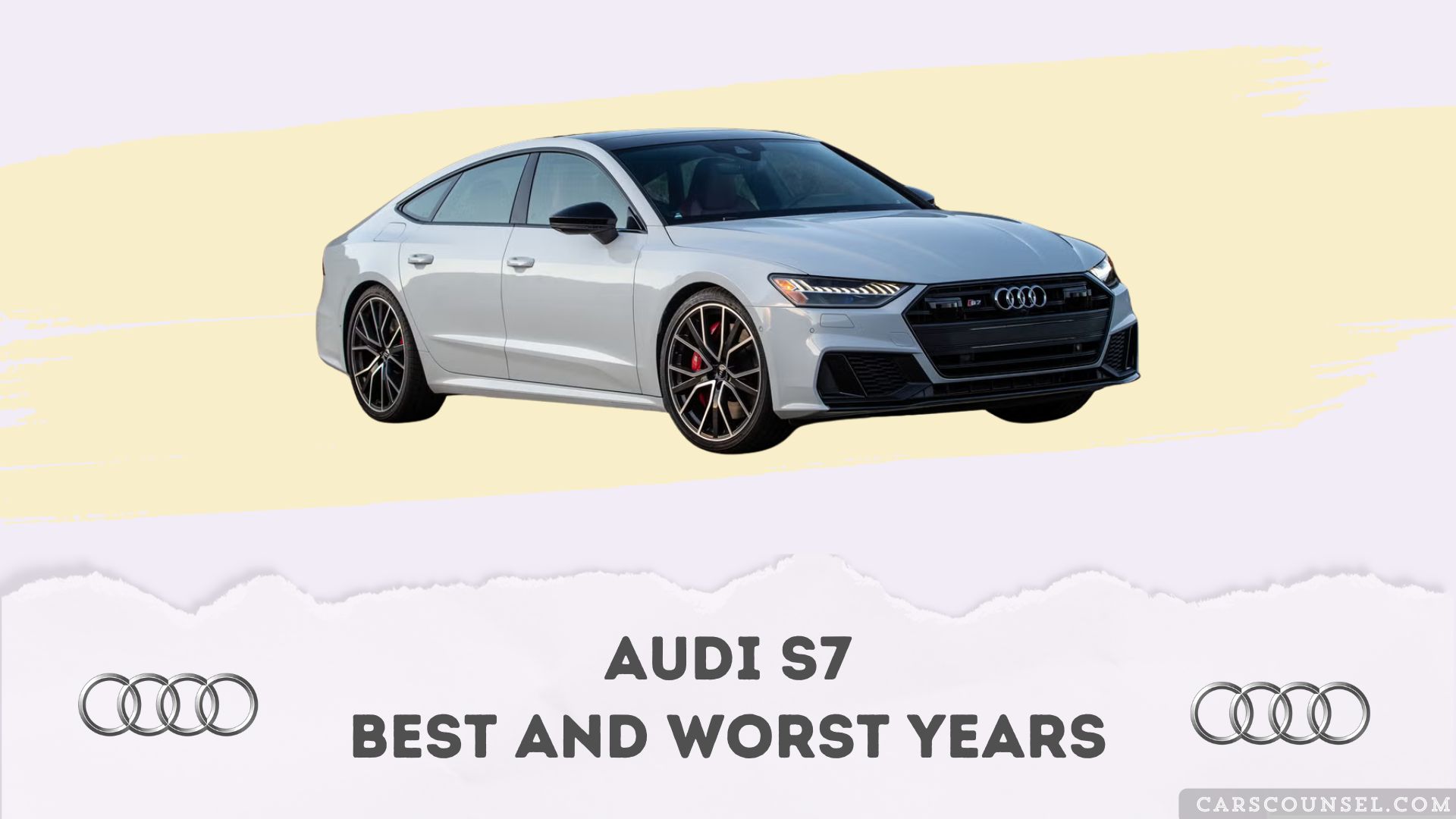
The best Audi S7 years are the 2018 model and the 2020 through 2025 models. These years offer comparatively stronger reliability and refined powertrains. Buyers should strictly avoid the 2013 and 2014 model years due to severe engine and transmission vulnerabilities.
Rankings are comparative, and no German performance sedan is flawless. Long-term reliability depends heavily on strict maintenance, previous ownership care, and the completion of all manufacturer recalls.
Meaningful differences exist between generations. The first generation uses a complex twin-turbo V8, while the second generation switches to a twin-turbo V6 with a 48-volt mild-hybrid system.
Quick Navigation
Best and Worst Audi S7 Years at a Glance
| Model Year Range | Verdict | Main Reason | Buyer Guidance |
|---|---|---|---|
| 2020–2025 | Best Late-Generation Choice | More robust V6 engine, updated tech | Verify MHEV battery health and recall status |
| 2018 | Best Older Choice | Final C7 year, most V8 bugs resolved | Check turbo and suspension condition |
| 2015–2017 | Approach Carefully | Improved but still carries V8 repair risks | Confirm turbo recall completion |
| 2013–2014 | Avoid | Timing chain and turbo oil starvation risks | Look at newer alternatives instead |
Key Takeaways
- The 2018 and 2020–2025 model years are the strongest choices for used buyers.
- Avoid 2013 and 2014 models due to timing chain and turbocharger oil starvation defects.
- The 2019 model year was not sold in the United States.
- First-generation V8 models require meticulous maintenance to avoid catastrophic repair bills.
- Second-generation models use a 48-volt mild-hybrid system that demands specialized electrical diagnostics.
- Always verify the VIN to ensure all critical safety recalls have been performed.
How We Evaluated the Audi S7 Model Years
Our analysis reviews official NHTSA recalls, manufacturer service campaigns, and consumer complaint patterns. We weigh problem severity, repair complexity, and long-term ownership costs.
Complaints are not confirmed failure rates, and a recall does not automatically ruin a vehicle’s reliability. Recent models have less long-term exposure, while older models carry age-related wear risks. Best means comparatively stronger, not trouble-free.
Best Audi S7 Years
2020–2025: Best Late-Generation Choice
The second-generation C8 S7 arrived in the U.S. for the 2020 model year. It replaces the V8 with a 2.9-liter twin-turbo V6 paired with a 48-volt mild-hybrid system.
This powertrain is generally more robust than the early V8. It avoids the severe timing chain and oil starvation issues that plagued earlier models.
However, the complex electrical system and mild-hybrid components require specialized diagnostic tools. Buyers should prioritize examples with complete dealership service records and verified software updates.
2018: Best Older Choice
The 2018 model year represents the final iteration of the first-generation C7 platform. By this year, Audi had resolved many of the early V8 engine and transmission teething issues.
It produces 450 horsepower and offers a more engaging exhaust note than the newer V6. While maintenance remains expensive, the 2018 model is the safest entry point for V8 enthusiasts.
Best Year by Buyer Type
Best Overall: 2021–2025
These years benefit from the latest infotainment updates and early-production C8 bug fixes. They offer the best balance of modern technology, daily usability, and comparative powertrain reliability.
Best Enthusiast Choice: 2018
Buyers who prioritize the sound and character of a V8 will prefer the 2018 model. It represents the most refined version of the 4.0-liter twin-turbo engine before the platform redesign.
Years to Approach Carefully
2015–2017: Approach Carefully
These middle years of the C7 generation offer improved reliability over the launch models. However, they still carry the inherent maintenance burdens of the 4.0-liter V8.
The turbocharger oil supply strainer recall affects many of these vehicles. Buyers must verify that the dealer completed this critical repair before purchasing. Water pump and thermostat housing leaks remain common inspection points.
Worst Audi S7 Years
2013–2014: Avoid
The launch years of the S7 are plagued by expensive mechanical vulnerabilities. Early 4.0-liter V8 engines are prone to premature timing chain stretch and tensioner failure.
Repairing the timing chain requires engine removal, resulting in massive labor costs. Additionally, these years suffer from turbocharger oil starvation if the factory strainer blocks. We recommend avoiding these years entirely.
Audi S7 Reliability by Generation
First Generation (C7: 2013–2018)
The C7 generation is defined by its 4.0-liter twin-turbo V8. Early years struggled with severe engine lubrication and timing chain defects. Later years improved, but the platform remains highly complex.
The seven-speed S tronic dual-clutch transmission is also vulnerable to mechatronic unit failures. Buyers must budget for premium synthetic oil changes and specialized European repair shop labor rates.
Second Generation (C8: 2020–Present)
Audi skipped the 2019 model year in the U.S. before launching the C8 generation for 2020. This generation uses a Porsche-developed 2.9-liter V6 and a 48-volt electrical architecture.
While the engine block is stronger, the advanced mild-hybrid system introduces new electrical failure points. Infotainment glitches and sensor faults are the most common complaints on these newer models.
Common Audi S7 Problems
Engine and Turbocharger Issues
Early V8 models can suffer from blocked turbocharger oil strainers, leading to bearing wear and turbo failure. Audi issued a recall to address this, but unrepairable damage may have already occurred.
Timing chain tensioner failure is another catastrophic risk on 2013 and 2014 models. Repairing this issue requires complete engine removal and specialized tools.
Transmission Mechatronic Failures
The DL501 seven-speed automatic transmission relies on a mechatronic unit to control shifting. Internal solenoid wear or circuit board cracks can cause harsh shifts, hesitation, or sudden limp-mode activation.
Replacement requires specialized transmission programming and is highly expensive. Buyers should test drive the vehicle extensively to check for low-speed shudders or delayed engagement.
Cooling System and Oil Leaks
Both generations use plastic cooling components that become brittle under high engine bay temperatures. Water pumps, thermostat housings, and coolant flanges are frequent leak sources.
V8 models also commonly develop oil leaks from the valley pan and valve cover gaskets. Addressing these leaks involves significant labor due to engine bay packaging.
Air Suspension and Electrical Gremlins
Air suspension struts and compressors wear out over time, causing corner sagging and dashboard warning lights. Replacement parts are costly and require system recalibration.
Newer C8 models occasionally experience 48-volt mild-hybrid battery faults or MMI touchscreen freezes. These issues typically require dealership software resets or module replacements to resolve.
Repair-Cost Overview
| Problem | Commonly Affected Years | Approximate Repair Range | Important Notes |
|---|---|---|---|
| Timing Chain Replacement | 2013–2014 | $4,000 – $7,000 | Requires engine removal |
| Turbocharger Replacement | 2013–2017 | $5,000 – $8,000 | Often requires replacing both turbos |
| Mechatronic Unit | 2013–2018 | $3,500 – $5,500 | Requires specialized coding |
| Air Suspension Strut | All Years | $1,200 – $2,000 | Price is per corner |
| Water Pump / Thermostat | All Years | $1,500 – $2,500 | Plastic housings crack easily |
Repair costs vary significantly by region, labor rates, parts choice, and vehicle configuration. Dealership repairs typically cost more than independent European specialists, but specialized software access is often required for modern Audi models.
What to Check Before Buying a Used Audi S7
- Verify the VIN to confirm all open recalls, especially the turbocharger oil strainer campaign.
- Review service records for consistent oil changes and transmission fluid services.
- Listen for engine rattles during a cold start, which may indicate timing chain wear.
- Test the transmission for smooth shifts and hesitation under hard acceleration.
- Inspect the engine bay for coolant and oil leaks around the valley pan and water pump.
- Cycle the air suspension through all ride heights to check for compressor strain or leaks.
- Scan the vehicle for hidden electrical or mild-hybrid fault codes using an OEM-level diagnostic tool.
Related Buying Guides
- Audi S6 best and worst years: The S6 shares a similar platform and powertrain lineage, offering a traditional sedan body style for buyers who prefer a conventional trunk over a Sportback hatch.
- Audi RS3 best and worst years: For buyers seeking aggressive performance in a smaller, more agile package, the RS3 provides a compelling alternative to the heavy S7.
- Audi Q8 best and worst years: The Q8 delivers similar luxury and performance credentials in a modern SUV footprint, appealing to buyers needing more cargo space and ground clearance.
- Audi Q7 best and worst years: Families prioritizing three-row passenger capacity over Sportback styling will find the Q7 to be a highly capable luxury alternative.
Frequently Asked Questions
What is the most reliable Audi S7 year?
The 2018 model year is the most reliable first-generation option, while the 2021 through 2025 models offer the strongest comparative reliability for the newer V6 generation.
Is the Audi S7 expensive to maintain?
Yes, the S7 is a complex German performance vehicle. Routine maintenance, premium fluids, and specialized European labor rates make ownership significantly more expensive than mainstream sedans.
Did Audi sell the S7 in 2019?
No, Audi did not sell the S7 in the United States for the 2019 model year. The second-generation C8 model arrived in the U.S. market for the 2020 model year.
What engine is in the new Audi S7?
The second-generation S7 uses a 2.9-liter twin-turbo V6 engine paired with a 48-volt mild-hybrid system, replacing the older 4.0-liter twin-turbo V8 found in previous models.
Do Audi S7 models have transmission problems?
First-generation models equipped with the DL501 dual-clutch transmission can experience mechatronic unit failures. This causes rough shifting and requires an expensive, specialized replacement.
Should I buy an Audi S7 with high mileage?
High-mileage examples carry severe financial risk unless they have exhaustive service records. Major components like the timing chain, turbos, and air suspension often require replacement past 80,000 miles.
Choosing the Right Audi S7 Model Year
The Audi S7 offers incredible performance and luxury, but reliability varies drastically by generation. The 2018 and 2020 through 2025 model years provide the safest ownership experiences for used buyers.
Avoid the 2013 and 2014 models due to severe engine vulnerabilities. Always verify the VIN for open recalls, demand complete maintenance records, and arrange an independent pre-purchase inspection before finalizing your purchase.

