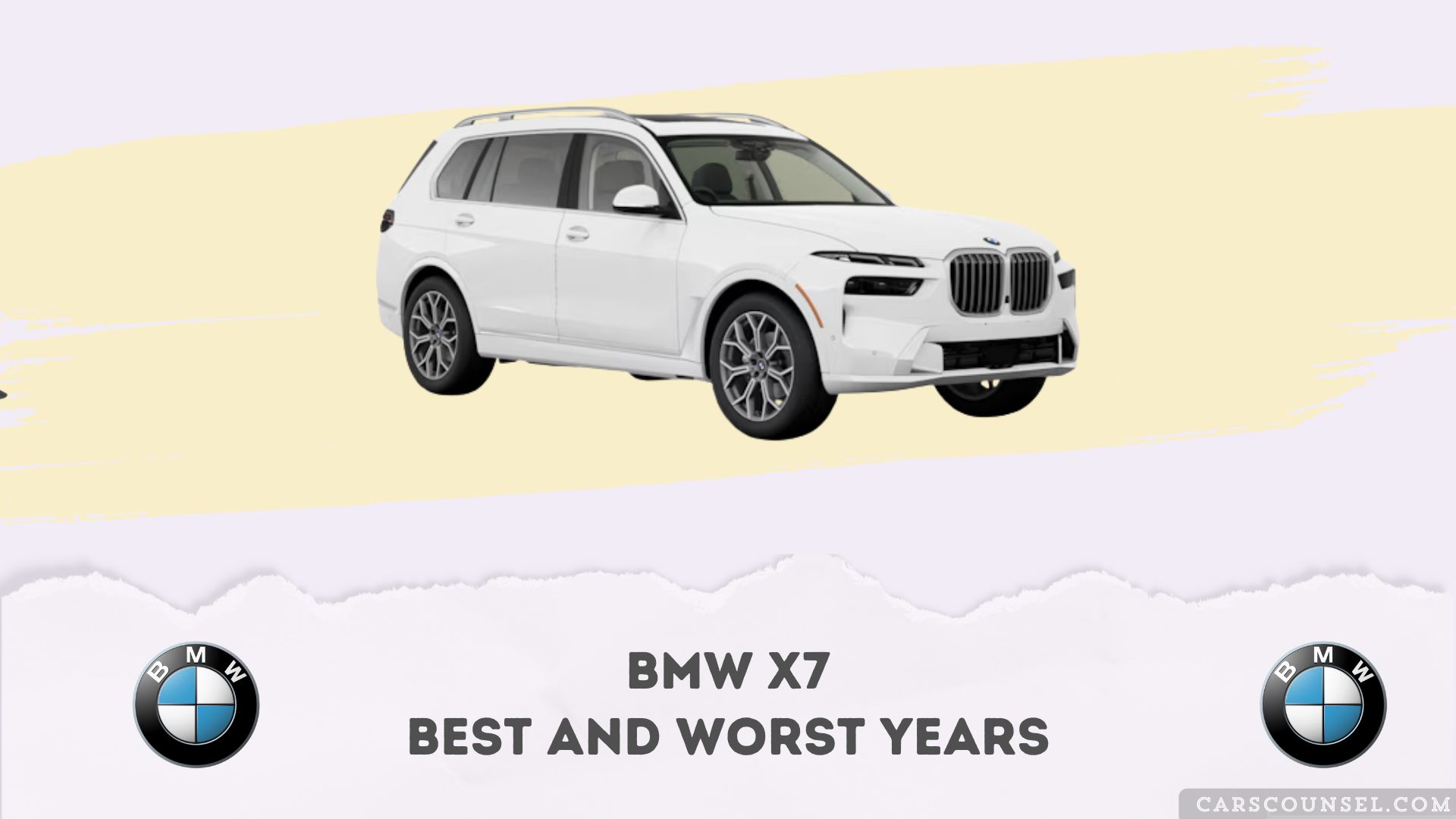
The 2022 BMW X7 is the best model year, offering peak reliability for the first generation before major powertrain changes. Buyers should avoid the 2019 debut year due to first-year software glitches and higher recall volumes.
These rankings are comparative. No luxury SUV is flawless, and long-term reliability heavily depends on strict maintenance, service history, and overall vehicle condition.
Reliability varies significantly by engine choice. The inline-six models are generally more dependable than the V8 configurations, which carry higher complexity and maintenance requirements.
Quick Navigation
Best and Worst BMW X7 Years at a Glance
| Model Year | Verdict | Main Reason | Buyer Guidance |
|---|---|---|---|
| 2019 | Avoid | First-year bugs, higher recalls | Skip for better alternatives |
| 2020-2021 | Good Choice | Matured inline-six reliability | Verify service history |
| 2022 | Best Choice | Peak pre-refresh reliability | Top recommendation |
| 2023 | Mixed | New electronics, braking recall | Check recall completion |
| 2024-2025 | Too New to Judge | Limited long-term data | Proceed with inspection |
Key Takeaways
- Best Choice: The 2022 model year offers the most refined first-generation experience.
- Avoid: The 2019 debut year carries higher recall volumes and early software issues.
- Powertrain Note: The B58 turbocharged inline-six is vastly preferred over the complex V8 options.
- Safety Recall: Certain 2023 and 2024 models require VIN verification for an integrated braking system update.
- Recent Models: The 2024 and 2025 model years lack sufficient long-term ownership data.
How We Evaluated the BMW X7 Model Years
Our analysis reviews official recalls, manufacturer service campaigns, and consumer complaint patterns. We also track powertrain changes and generation updates to identify reliability trends.
Consumer complaints are not confirmed failure rates. A recall does not automatically make a vehicle unreliable, and recent models naturally have less long-term exposure.
Best BMW X7 Years
2022 (Best Choice)
The 2022 model year represents the most mature version of the pre-refresh X7. By this year, the manufacturer had resolved most early software quirks and assembly inconsistencies.
The turbocharged inline-six engine remains highly dependable. Owners report fewer electrical gremlins and better overall build quality compared to the debut model.
2020-2021 (Good Choice)
These years offer solid reliability, especially in xDrive40i trims. The initial first-year bugs were largely addressed through over-the-air updates and dealer service campaigns.
Buyers should prioritize examples with complete service records. Regular oil changes and software updates are essential to maintain the complex infotainment and safety systems.
Best Year by Buyer Type
- Best Overall: 2022 (Peak first-generation reliability)
- Best Budget Option: 2020 (Lower depreciation, matured platform)
Years to Approach Carefully
2023 (Mixed)
The 2023 model year introduced a major mid-cycle refresh. This brought new split-headlight designs, the iDrive 8 system, and a 48-volt mild-hybrid setup.
New electronics and powertrain additions often bring early-adopter bugs. Additionally, certain 2023 models were included in a braking system recall that requires immediate verification.
2024-2025 (Too New to Judge)
The latest model years feature the updated S68 V8 and revised inline-six engines. While initial impressions are positive, long-term durability data remains unavailable.
Buyers should treat these years as unproven. Rely on comprehensive warranty coverage and insist on a pre-purchase inspection before committing.
Worst BMW X7 Years
2019 (Avoid)
As the debut model year, the 2019 X7 experienced typical first-year production issues. Owners reported numerous electrical gremlins, sensor failures, and infotainment freezing.
This year also accumulated a higher volume of official recalls. This makes it one of the top years to avoid for used luxury shoppers.
BMW X7 Reliability by Generation
First Generation (2019-Present)
The X7 rides on the CLAR platform, sharing underlying architecture with the BMW X5. However, the X7 is significantly longer and heavier.
Early models relied on the B58 inline-six and N63 V8. As a flagship BMW model, the inline-six proved robust, while the V8 demanded strict maintenance.
The 2023 refresh brought the iDrive 8 curved display and 48-volt mild-hybrid systems. These updates improved performance but added electrical complexity that is still maturing.
Common BMW X7 Problems
Electrical and Software Glitches
Early model years frequently suffered from iDrive system freezes and sensor errors. Features like the automatic headlights and driver-assistance cameras occasionally malfunctioned.
Most of these issues were addressed through software updates. Buyers should verify that the latest firmware has been installed by a certified dealer.
Fuel Pump Failures
Certain early production models experienced fuel pump impeller issues. This defect could cause the engine to stall or fail to start under specific conditions.
The manufacturer issued official recalls to replace the affected fuel pumps. Always check the vehicle identification number to ensure this critical repair was completed.
Braking System Recalls
Some 2023 and 2024 models faced a recall regarding the integrated braking system. A software error could potentially reduce power brake assist functionality.
This issue requires a dealer software update or module replacement. Verify the recall status before purchasing any refreshed model year.
What to Check Before Buying a Used BMW X7
- Verify open recalls using the VIN.
- Confirm fuel pump and braking system repairs.
- Review complete dealer service history.
- Test all iDrive infotainment functions.
- Inspect air suspension for leaks.
- Check for uneven tire wear.
- Scan for hidden diagnostic trouble codes.
- Arrange an independent pre-purchase inspection.
Related Buying Guides
- BMW 7 Series best and worst years: Shares the flagship CLAR platform and luxury DNA, but offers a traditional sedan experience.
- BMW X6 best and worst years: The coupe-like SUV sibling that shares powertrains but sacrifices third-row utility for styling.
- BMW i4 best and worst years: A practical electric alternative for buyers seeking modern technology without the fuel costs.
- BMW M5 best and worst years: The high-performance sedan option for enthusiasts who prioritize track capability over family hauling.
- BMW 2 Series best and worst years: A compact alternative for buyers who want sporty handling without the massive footprint of the X7.
Frequently Asked Questions
What is the best year for a used BMW X7?
The 2022 model year is the best choice. It represents the most refined version of the first generation before major powertrain and electronic changes.
Should I avoid the 2019 BMW X7?
Yes, the 2019 debut year is best avoided. It has higher recall counts and more reported electrical and software issues than later model years.
Is the BMW X7 inline-six engine reliable?
The B58 turbocharged inline-six is widely regarded as highly dependable. It generally requires less maintenance and faces fewer severe issues than the V8 options.
Do recent BMW X7 models have braking problems?
Certain 2023 and 2024 models were recalled for integrated braking system software errors. Always verify recall completion using the VIN before purchasing.
How expensive is it to maintain a used X7?
Maintenance costs are significantly higher than average. Complex air suspension, advanced electronics, and premium parts make out-of-warranty repairs very expensive.
Can the BMW X7 reach high mileage?
Well-maintained inline-six examples can reach high mileage. However, longevity heavily depends on strict adherence to service schedules and addressing minor issues promptly.
Which BMW X7 Year Should You Buy?
The 2022 BMW X7 offers the best balance of luxury and proven reliability. It avoids the first-year bugs of the 2019 model and the unproven electronics of the 2023 refresh.
Always prioritize the xDrive40i inline-six configuration for the best ownership experience. Verify all recall work, demand a complete service history, and secure an independent inspection.

