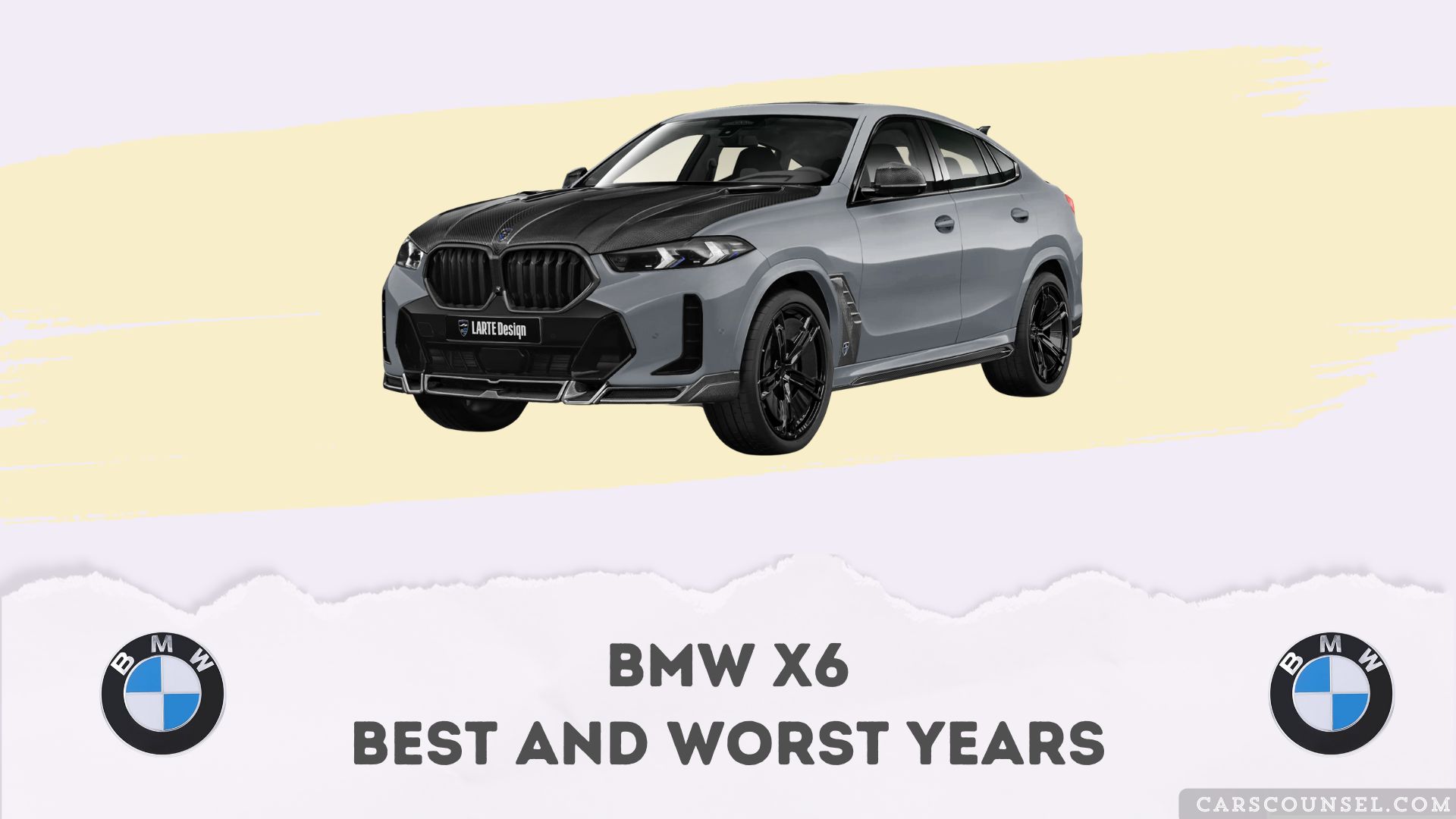
The best BMW X6 years are 2020 through 2026 models equipped with the 40i inline-six engine, which offer excellent reliability. Buyers should avoid the 2008 through 2013 xDrive50i V8 models due to severe and expensive engine defects.
Rankings are comparative, and no luxury SUV is flawless. Maintenance history, proper storage, and timely fluid services matter more than the specific model year when evaluating these vehicles.
Meaningful differences exist between the inline-six and V8 configurations. The six-cylinder models provide dependable daily driving, while the V8 and M models demand significantly higher maintenance budgets.
Quick Navigation
Best and Worst BMW X6 Years at a Glance
| Model Year & Configuration | Verdict | Main Reason | Buyer Guidance |
|---|---|---|---|
| 2024-2026 (40i I6) | Best Late-Generation Choice | B58 I6 with mild-hybrid system | Verify software updates |
| 2020-2023 (40i I6) | Best Choice | Mature B58 I6 engine | Inspect for minor coolant leaks |
| 2015-2019 (35i I6) | Good Choice | N55 I6 is dependable | Check service records for gaskets |
| 2011-2014 (35i I6) | Good With Inspection | N55 I6 aging components | Verify charge pipe and water pump |
| 2020-2023 (M50i V8) | Good With Inspection | N63 V8 is maintenance-heavy | Confirm customer care packages |
| 2015-2019 (50i V8) | Mixed | N63TU V8 is complex | Budget for timing chain repairs |
| 2008-2010 (35i I6) | Approach Carefully | N54 I6 fuel system issues | Inspect HPFP and injectors |
| 2014 (50i V8) | Approach Carefully | Early N63TU V8 risks | Verify timing chain health |
| 2008-2013 (50i V8) | Avoid | Original N63 V8 severe defects | Strictly avoid unless rebuilt |
| X6 M (All Years) | Best Enthusiast Choice | High performance upkeep | M specialist inspection mandatory |
Key Takeaways
- Strongest choices are the 2020-2026 40i inline-six models.
- Avoid the 2008-2013 xDrive50i V8 models due to the original N63 engine flaws.
- The 2015-2019 35i inline-six models offer good value with proper gasket maintenance.
- V8 configurations require strict adherence to service intervals and larger repair budgets.
- Air suspension components across all generations are prone to costly failures.
- Always verify the VIN for open recalls and completed service actions.
- An independent pre-purchase inspection by a BMW specialist is essential.
How We Evaluated the BMW X6 Model Years
Analysis considers NHTSA records, manufacturer service bulletins, engine-specific reliability patterns, and long-term ownership costs.
Complaints and forum reports are not confirmed defects. A recall does not automatically make a year unreliable.
Recent models have limited long-term exposure. Best means comparatively stronger for the configuration, not flawless.
Best BMW X6 Years
2020-2026 (40i Inline-Six)
The third-generation G06 X6 equipped with the sDrive40i or xDrive40i badge uses the B58 3.0L turbocharged inline-six.
This engine is widely considered one of BMW’s most reliable modern powertrains, avoiding the severe issues of earlier V8s.
Later models feature a 48-volt mild-hybrid system that improves efficiency and smoothness.
Buyers should still inspect for minor coolant loss and ensure all software updates are current.
2015-2019 (35i Inline-Six)
The second-generation F16 X6 with the 35i badge uses the N55 3.0L inline-six.
While not as robust as the newer B58, the N55 is a dependable engine when properly maintained.
Owners must budget for eventual valve cover gasket, oil filter housing gasket, and electric water pump replacements.
These years offer strong value for buyers willing to address standard aging BMW maintenance items.
Best Year by Buyer Type
Best Modern Alternative: 2020-2026 40i Models
Buyers seeking modern technology, advanced safety features, and reliable daily driving should target the B58-equipped G06 models.
Best Family Alternative: BMW X7
Buyers needing third-row seating and similar luxury can explore the BMW X7, which shares the CLAR platform and powertrains.
Best Smaller Alternative: BMW X4
Those wanting a more compact coupe-like SUV can consider the BMW X4, which offers similar styling cues in a smaller footprint.
Years to Approach Carefully
2015-2019 (50i V8) and 2020-2023 (M50i V8)
The V8-powered F16 and early G06 models use updated versions of the 4.4L twin-turbo V8.
While improved over the earliest versions, these engines still feature a complex design that cooks surrounding components.
Expect expensive repairs for coolant leaks, valve stem seals, and timing chain components as mileage climbs.
These configurations receive a Mixed to Good With Inspection verdict, requiring a dedicated repair fund.
2008-2010 (35i Inline-Six)
The first-generation E71 models from these years use the N54 twin-turbo inline-six.
This engine is prone to high-pressure fuel pump failures, injector issues, and wastegate rattle.
Approach these years carefully and verify that all fuel system components have been replaced or updated.
2024-2026 (M60i and V8 MHEV)
The newest V8 models feature the S68 engine and a 48-volt mild-hybrid system.
Long-term evidence remains limited for this complex new powertrain configuration.
These years are Too New to Judge for long-term dependability.
X6 M (All Years)
The X6 M offers incredible performance but carries extreme maintenance and repair costs.
It receives a Best Enthusiast Choice verdict for buyers with dedicated budgets and access to specialized M technicians.
Worst BMW X6 Years
2008-2013 (xDrive50i V8)
The early first-generation V8 models use the original N63 4.4L twin-turbo engine.
This engine is notorious for severe timing chain stretch, excessive oil consumption, and rapid battery drain.
BMW issued a customer care package to replace certain components, but fundamental design flaws remain.
Repairing the timing chain requires removing the engine, leading to massive financial risk.
These years receive an Avoid verdict for all but the most dedicated restoration experts.
2014 (xDrive50i V8)
The 2014 model received an engine update that improved some reliability aspects.
However, it still carries significant risks for coolant leaks and oil consumption compared to inline-six alternatives.
Buyers should approach this specific year and configuration with extreme caution.
BMW X6 Reliability by Generation
First Generation E71 (2008-2014)
The original X6 introduced the Sports Activity Coupe concept to the luxury market.
Inline-six models transitioned from the troublesome N54 to the more reliable N55 in 2011.
V8 models from this era suffer from the most severe engine defects in the history of the model.
Second Generation F16 (2015-2019)
Built on the contemporary X5 platform, this generation improved interior quality and technology.
The 35i models are solid choices, while the 50i V8 models remain maintenance-heavy.
Adaptive air suspension components are a common failure point across this generation.
Third Generation G06 (2020-Present)
Riding on the modern CLAR platform, the G06 offers superior refinement and advanced safety systems.
The switch to the B58 inline-six for the 40i models dramatically improved baseline reliability.
Recent V8 and M models continue to demand high upkeep costs despite their advanced engineering.
Common BMW X6 Problems
Engine Timing Chain and Oil Consumption (2008-2013 V8)
The original N63 V8 suffers from timing chain stretch that can lead to catastrophic engine failure.
Excessive oil consumption is also common due to piston ring and valve stem seal design.
Repairing the timing chain is highly complex and requires complete engine removal.
Cooling System and Gasket Leaks (2011-2019 Inline-Six)
The N55 inline-six is known for valve cover and oil filter housing gasket leaks.
The electric water pump has a limited lifespan and can fail without warning.
Plastic charge pipes on earlier models are prone to cracking under boost pressure.
Air Suspension Failures (All Generations)
Models equipped with adaptive air suspension frequently experience air spring and compressor failures.
Replacement parts are expensive, and the system requires specialized diagnostic equipment.
Infotainment and Electrical Glitches (2015-Present)
Owners report occasional system freezes and sensor warnings across recent generations.
Software updates from the dealer usually resolve these minor electrical quirks.
What to Check Before Buying a Used BMW X6
- Verify the VIN for open recalls and completed service actions.
- Confirm whether the N63 Customer Care Package was performed on early V8 models.
- Inspect the engine valley and undercarriage for oil and coolant leaks.
- Test the air suspension by cycling through ride height settings.
- Scan for stored diagnostic codes, even if the check engine light is off.
- Review service records for water pump, gasket, and timing chain replacements.
- Arrange an independent pre-purchase inspection by a certified BMW specialist.
Related Buying Guides
- BMW X7 best and worst years: A larger family alternative sharing the CLAR platform and modern powertrains.
- BMW X4 best and worst years: A smaller coupe-like SUV alternative for buyers who do not need mid-size dimensions.
- BMW 5 Series best and worst years: A luxury sedan alternative sharing similar inline-six and V8 engine architectures.
- BMW 4 Series best and worst years: A luxury coupe alternative for buyers who prefer a traditional two-door profile over an SUV.
- BMW i8 best and worst years: A high-performance hybrid alternative for enthusiasts seeking cutting-edge technology rather than SUV utility.
- BMW Isetta best and worst years: A classic microcar alternative for collectors interested in BMW’s historical urban mobility concepts.
Frequently Asked Questions
Is the BMW X6 reliable?
Reliability depends entirely on the engine configuration. The modern 40i inline-six models are highly dependable, while early V8 models are notoriously expensive to maintain.
What year of the BMW X6 is most dependable?
The 2020 through 2026 models equipped with the 40i inline-six engine are the most dependable. The B58 powertrain offers excellent longevity with standard maintenance.
What year should you avoid?
Avoid the 2008 through 2013 xDrive50i V8 models. The original N63 engine suffers from severe timing chain and oil consumption issues that lead to massive repair bills.
What are the most common problems?
Common issues include N63 V8 timing chain stretch, N55 inline-six gasket leaks, electric water pump failures, and expensive air suspension component replacements.
How long does a BMW X6 last?
Longevity depends heavily on the engine and maintenance. Well-maintained inline-six models can reach high mileage, while neglected V8 models often face catastrophic engine failure early.
Are repairs expensive on the BMW X6?
Yes, the X6 is a premium luxury SUV. Parts are costly, and complex systems like the air suspension and twin-turbo V8 engines require specialized labor.
Which BMW X6 Year Should You Buy?
The 2020 through 2026 40i models offer the best combination of modern technology, daily usability, and reliable inline-six performance.
Budget-conscious buyers can find good value in the 2015 through 2019 35i models, provided they budget for standard gasket and cooling system maintenance.
Strictly avoid the 2008 through 2013 xDrive50i V8 models unless you are prepared for extreme repair costs.
Always verify the VIN, review the service history, and arrange an independent inspection before purchasing any used luxury SUV.

