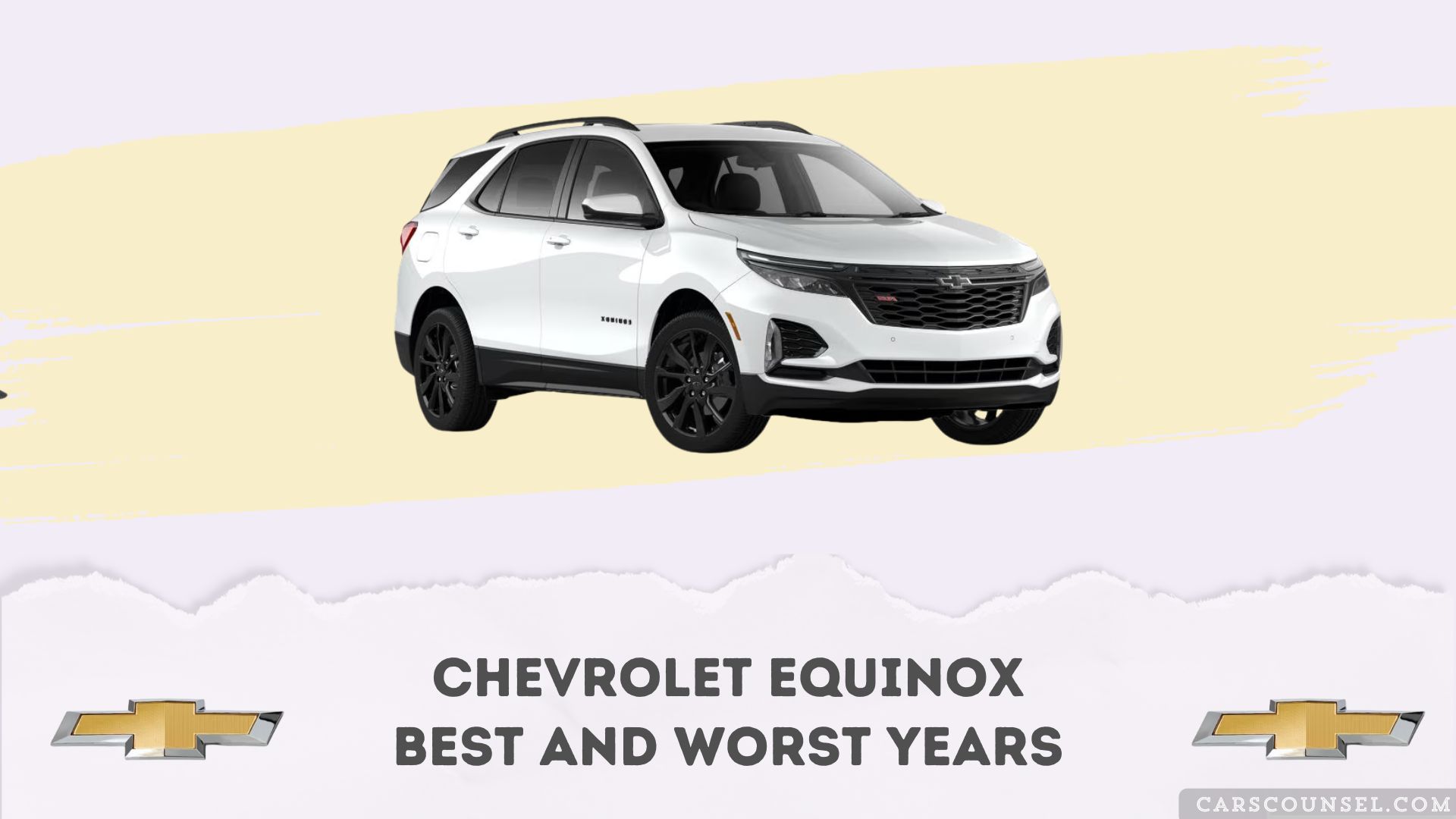
The best Chevrolet Equinox years are 2018-2023, featuring a mature turbocharged powertrain and modern safety. Buyers should avoid 2010-2013 models due to severe 2.4-liter engine oil consumption and timing chain failures.
These rankings are comparative, and no compact SUV is entirely flawless. Strict maintenance history, previous ownership, and rust prevention heavily influence long-term reliability and ownership costs.
Significant differences exist between the early V6 engines, the problematic 2.4-liter inline-four, and the modern turbocharged configurations. The transition to the third generation vastly improved daily drivability and overall dependability.
Quick Navigation
Best and Worst Chevrolet Equinox Years at a Glance
| Model Year Range | Verdict | Main Reason | Buyer Guidance |
|---|---|---|---|
| 2005-2006 | Approach Carefully | 3.4L V6 gasket leaks | Inspect cooling system |
| 2007-2009 | Good With Inspection | 3.6L V6 timing chain | Listen for cold-start rattle |
| 2010-2013 | Avoid | 2.4L I4 oil consumption | High repair costs, bypass |
| 2014-2016 | Approach Carefully | 2.4L I4 lingering issues | Check oil records strictly |
| 2017 | Good Choice | 1.5L Turbo introduced | Verify turbo health |
| 2018-2023 | Best Choice | Mature 3rd-gen platform | Top pick for daily driving |
| 2024 | Best Late-Generation Choice | Final year of 3rd gen | Limited long-term data |
| 2025 | Too New to Judge | 4th-gen redesign | Wait for reliability data |
Key Takeaways
- The 2018-2023 models represent the best choices, featuring reliable turbocharged engines and updated safety technology.
- Avoid 2010-2013 models due to the notorious 2.4-liter Ecotec engine suffering from extreme oil consumption and timing chain stretch.
- The 2014-2016 models require careful inspection, as the 2.4-liter engine still exhibits lingering oil and fuel system issues.
- Early first-generation models require strict maintenance verification regarding V6 coolant leaks and timing chain wear.
- Always verify the vehicle identification number for open recalls and insist on a pre-purchase inspection.
How We Evaluated the Chevrolet Equinox Model Years
Our analysis reviews official recalls, manufacturer service campaigns, technical service bulletins, and long-term ownership data. We weigh the severity of mechanical failures against repair costs and daily usability.
Complaints are not failure rates, and a recall does not automatically make a year unreliable. Recent models have less ownership history, so best means comparatively stronger, not flawless.
Best Chevrolet Equinox Years
2018-2023 (Third Generation)
The third-generation models benefit from a complete redesign and the introduction of reliable turbocharged engines. The 1.5-liter and 2.0-liter turbocharged inline-four engines offer excellent fuel economy and strong daily performance.
These compact SUVs feature modern infotainment and advanced driver assistance systems. Buyers should verify that all software updates have been applied and that the turbocharger operates without hesitation.
2017 (Late Second Generation)
The final year of the second generation introduced the much-improved 1.5-liter turbocharged engine, replacing the problematic 2.4-liter naturally aspirated unit. This powertrain change significantly reduced the risk of catastrophic engine failure.
While the underlying chassis remains older, the powertrain upgrade makes this a solid budget-friendly option. Buyers must confirm the turbocharger and direct injection system have been properly maintained.
Best Year by Buyer Type
Best Overall
The 2018-2023 models provide the best balance of modern technology, daily comfort, and reliable turbocharged performance for most used compact SUV buyers.
Best Budget Option
The 2009 model with the 3.6-liter V6 offers classic SUV utility for buyers on a strict budget, provided the timing chain and cooling system have been recently serviced.
Years to Approach Carefully
2014-2016 (2.4L Inline-Four)
These mid-cycle models continue to use the 2.4-liter Ecotec engine, which remains prone to excessive oil consumption and high-pressure fuel pump failures. While improved over earlier years, the risk remains.
Buyers must demand extensive oil change records and perform a compression test. If the engine burns oil between changes, bypass the vehicle entirely to avoid expensive internal repairs.
2007-2009 (3.6L V6)
The first-generation models equipped with the 3.6-liter V6 offer strong towing capability but suffer from timing chain stretch. This issue is caused by poor oil flow design to the chain tensioners.
Listen carefully for a rattling noise during cold starts. If the timing chain has not been replaced with updated components, budget for an immediate and expensive engine teardown.
2005-2006 (3.4L V6)
The inaugural models use the older 3.4-liter V6, which is notorious for lower intake manifold gasket failures and coolant leaks. These leaks can lead to overheating and severe engine damage.
Inspect the coolant reservoir for oil contamination and check the ground for sweet-smelling drips. A thorough cooling system pressure test is mandatory before purchasing these early examples.
Worst Chevrolet Equinox Years
2010-2013 (2.4L Ecotec Era)
The 2010-2013 models are plagued by the 2.4-liter Ecotec direct-injection engine, which suffers from severe piston ring defects leading to extreme oil consumption. Owners frequently report needing to add oil every few hundred miles.
This excessive oil consumption leads to timing chain stretch, low oil pressure, and complete engine seizure. Due to the high cost of engine replacement and frequent class-action lawsuits, these years should be avoided.
Chevrolet Equinox Reliability by Generation
First Generation (2005-2009)
The original Equinox shared the Theta platform with related compact crossovers. While the V6 engines are robust, age-related gasket leaks and timing chain wear now dictate reliability.
Second Generation (2010-2017)
This generation introduced the problematic 2.4-liter Ecotec engine, which tarnished the nameplate’s reputation. Only the 2017 model year, which received the updated 1.5-liter turbo, offers acceptable reliability for used buyers.
Third Generation (2018-2024)
Built on a modern global platform, the third generation prioritized fuel efficiency and safety. The switch to turbocharged engines and a refined automatic transmission resulted in a highly dependable compact SUV.
Fourth Generation (2025-Present)
The current generation features a complete redesign and a standard 1.5-liter turbocharged engine. Long-term ownership evidence remains limited, making it too early to judge its comparative reliability against the previous generation.
Common Chevrolet Equinox Problems
Excessive Oil Consumption
Affecting the 2010-2016 models with the 2.4-liter Ecotec engine, defective piston rings allow oil to bypass into the combustion chamber. This causes extreme oil burn-off, requiring frequent top-offs to prevent engine destruction.
Timing Chain Stretch
Found on both the 3.6-liter V6 and the 2.4-liter inline-four engines, the timing chains are prone to stretching prematurely. This triggers a check engine light and can cause catastrophic valve interference if ignored.
Lower Intake Manifold Gasket Leaks
Affecting the 2005-2006 models with the 3.4-liter V6, the lower intake manifold gaskets degrade and leak coolant into the engine block. This requires immediate replacement to prevent hydrolock and severe internal damage.
What to Check Before Buying a Used Chevrolet Equinox
- Verify the VIN for open recalls, especially regarding fuel pump and airbag campaigns.
- Perform an oil consumption test on 2010-2016 2.4-liter models to check for piston ring defects.
- Listen for timing chain rattle on cold starts across all V6 and early four-cylinder engines.
- Inspect the cooling system and lower intake manifold for leaks on 2005-2006 models.
- Test the turbocharger for hesitation or wastegate rattle on 2017 and newer models.
- Arrange a pre-purchase inspection with a qualified technician.
Related Buying Guides
- Chevrolet Blazer best and worst years – Midsize SUV alternative for buyers requiring more rear-seat space and a larger cargo area without stepping up to a truck-based platform.
- Chevrolet Trax best and worst years – Subcompact sibling alternative for urban buyers prioritizing a smaller footprint and better fuel economy over maximum passenger volume.
- Toyota RAV4 years to avoid – Direct compact SUV competitor for buyers seeking a proven naturally aspirated powertrain and historically stronger long-term resale value.
- Chevrolet Colorado best and worst years – Midsize pickup alternative for buyers who realize they need an open truck bed for hauling gear instead of an enclosed cargo area.
- Chevrolet Captiva best and worst years – Discontinued compact SUV alternative for buyers seeking a slightly older, budget-friendly platform with similar dimensions to the early Equinox.
- Chevrolet Camaro best and worst years – Performance coupe alternative for buyers willing to sacrifice rear-seat practicality and cargo space for engaging driving dynamics and V8 power.
- Chevrolet Bolt best and worst years – Electric hatchback alternative for buyers prioritizing zero-emissions commuting and minimal fuel costs over traditional SUV ride height and towing capability.
Frequently Asked Questions
Which Chevrolet Equinox year is most reliable?
The 2018-2023 models offer the strongest reliability records. They benefit from the mature third-generation platform and reliable turbocharged engines, avoiding the severe flaws of the earlier 2.4-liter naturally aspirated powertrain.
Does the Chevrolet Equinox have engine problems?
The 2010-2016 models with the 2.4-liter Ecotec engine are prone to catastrophic oil consumption and timing chain failures. The 3.4-liter and 3.6-liter V6 engines also suffer from age-related gasket and chain issues.
Is the Chevrolet Equinox expensive to maintain?
Maintenance costs are average for the segment, but neglected 2.4-liter engines and V6 timing chain repairs can be financially devastating. Strict adherence to oil change intervals is mandatory for longevity.
What causes the timing chain rattle?
The 3.6-liter V6 and 2.4-liter inline-four engines suffer from poor oil flow to the tensioners, causing the chains to stretch. This creates a distinct rattling noise on cold starts and requires immediate replacement.
Are there any common transmission issues?
The early six-speed automatic transmissions are generally robust, but the nine-speed automatic in newer models requires strict fluid maintenance. Some owners report rough shifting if the software modules are not updated.
Is the Equinox a good daily driver?
Yes, especially the 2018-2023 models. They offer an excellent blend of fuel efficiency, modern safety features, and comfortable seating for daily commuting, provided the turbocharged engine has been properly maintained.
Choosing the Right Chevrolet Equinox Model Year
Choosing the right Chevrolet Equinox requires paying close attention to the engine configuration and generation. The 2018-2023 models provide the most secure and refined ownership experience for modern compact SUV buyers.
Buyers must strictly avoid 2010-2013 examples due to the severe 2.4-liter oil consumption risks. Ensuring the cooling system and timing chains have been serviced is mandatory for all older V6 models.
Before purchasing, verify the VIN for open recalls and hire a specialist for a thorough inspection. Knowing which models stand out ensures driving satisfaction rather than severe financial consequences.

