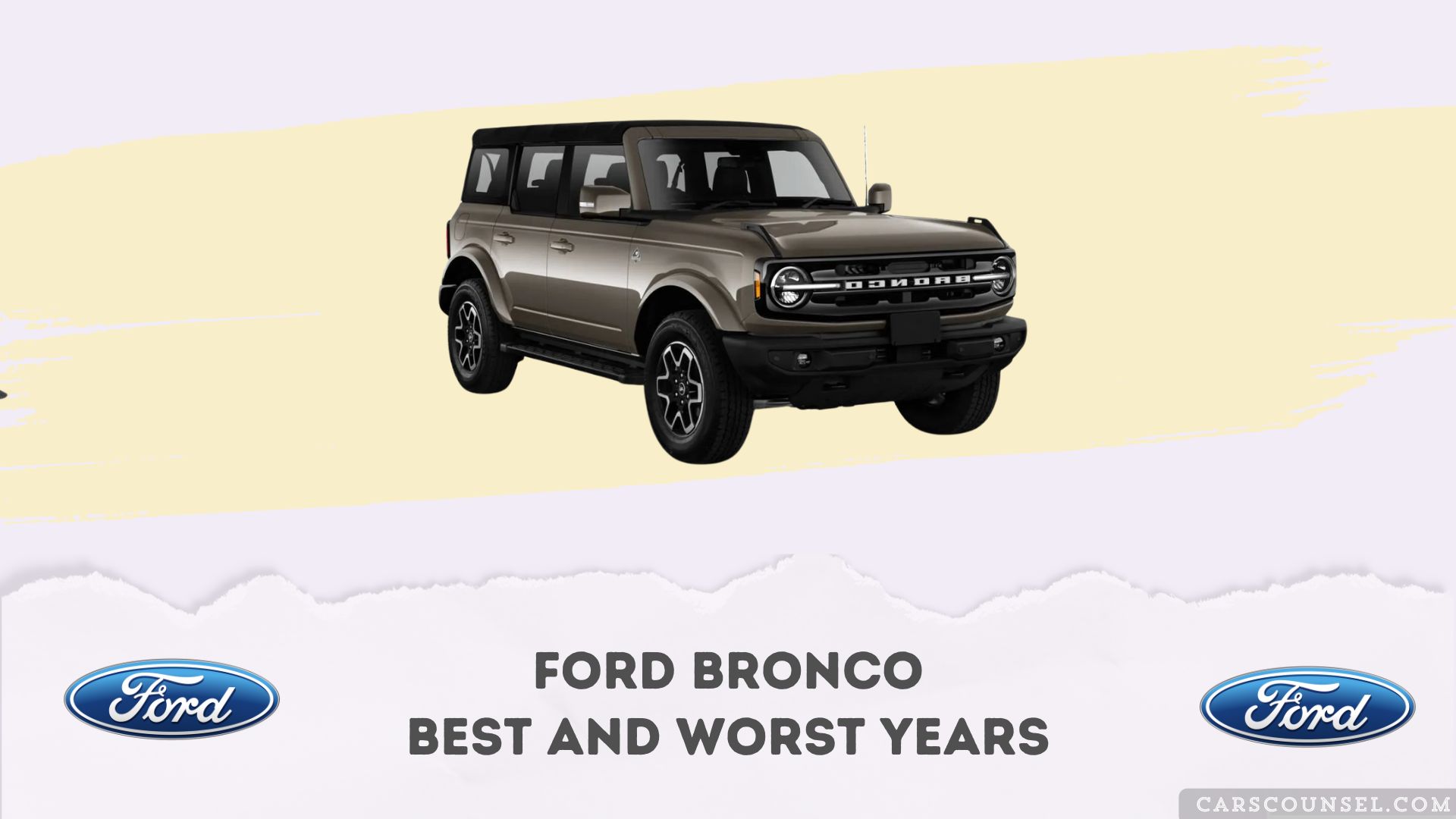
The best Ford Bronco years are the 1977 classic and the 1995 fifth-generation model. Buyers should steer clear of the worst offenders, including the 1978-1979 second-generation trucks and the 2021 revival models equipped with the 2.7L engine.
These rankings are comparative. No vintage or modern Bronco is flawless. Long-term reliability depends heavily on maintenance records, rust prevention, and whether previous owners completed necessary recall repairs.
Verdicts change significantly based on the engine and generation. The 2.7L EcoBoost V6 carries different risks than the 2.3L four-cylinder. Classic models require entirely different inspections than modern daily drivers.
Quick Navigation
Best and Worst Ford Bronco Years at a Glance
| Model Year | Verdict | Main Reason | Buyer Guidance |
|---|---|---|---|
| 1966-1976 | Best Enthusiast Choice | Classic styling, simple mechanics | Inspect heavily for rust |
| 1977 | Best Enthusiast Choice | Peak first-generation refinement | Verify frame and body mounts |
| 1978-1979 | Avoid | Heavy, complex emissions, rust | Look at later generations instead |
| 1980-1986 | Approach Carefully | Early IFS and vacuum hub issues | Check front suspension and 4WD engagement |
| 1987-1991 | Approach Carefully | Early E4OD transmission concerns | Review transmission service history |
| 1992-1996 | Good With Inspection | Solid V8s, but TTB suspension wear | Inspect front end and steering box |
| 2021 | Avoid | 2.7L engine failures, roof leaks | Avoid 2.7L models; check 2.3L carefully |
| 2022 | Approach Carefully | Improved build quality, lingering bugs | Verify recall completion and roof seals |
| 2023-2025 | Too New to Judge | Limited long-term ownership data | Wait for more reliability data |
Key Takeaways
- The 1977 model represents the best of the classic era, offering refined V8 options.
- Avoid 2021 models equipped with the 2.7L EcoBoost V6 due to catastrophic engine failure risks.
- Fifth-generation models (1992-1996) are solid but require strict front suspension inspections.
- The Bronco Sport is a separate unibody crossover with its own distinct reliability profile.
- Always check the VIN for open recalls, especially regarding roof panels and engine software on newer models.
- Rust is the primary enemy of any Bronco built before 1997.
How We Evaluated the Ford Bronco Model Years
Our analysis reviews official NHTSA recalls, manufacturer service campaigns, and verified owner complaints. We separate confirmed mechanical defects from isolated incident reports.
Complaints are not failure rates, and a recall does not automatically make a vehicle unreliable. We also account for generation changes and powertrain differences.
Recent models receive conservative verdicts because they lack long-term ownership data. “Best” indicates a comparatively stronger choice, not a flawless vehicle.
Our methodology also applies to other notable vehicles. You can explore our findings on the Ford Pinto, Ford Edsel, Ford Excursion, and Ford Fiesta.
Best Ford Bronco Years
1977: The Final Classic
The 1977 model year represents the peak of the first generation. Ford refined the platform, offering the 302-cubic-inch V8 and improved power steering options. It remains a top choice for collectors.
However, a 1977 Bronco is a vintage vehicle. Buyers must prioritize frame rust inspection over modern conveniences. Long-term reliability depends entirely on storage conditions and restoration quality.
1995: The Fifth-Generation Peak
The 1995 model benefits from late-production refinements to the 5.8L V8 and the E4OD transmission. Ford addressed many early electrical and interior build issues found in the 1992 launch models.
These trucks offer classic body-on-frame capability. The Twin Traction Beam front suspension still requires regular maintenance. Buyers should verify that the steering box and ball joints are in good condition.
Best Year by Buyer Type
- Best Enthusiast Choice: 1977 (Peak classic styling and V8 availability)
- Best Modern Alternative: 2023 (Improved build quality over the 2021 launch year)
- Best Budget Option: 1994-1995 (Affordable entry into classic 4×4 ownership, if rust-free)
Years to Approach Carefully
1980-1991 (Third and Fourth Generations)
These generations introduced independent front suspension and aerodynamic styling. The vacuum-operated automatic locking hubs are notorious for failing to engage the front axle properly.
The fourth generation also introduced the E4OD automatic transmission. Early versions of this transmission were prone to overheating and harsh shifting. A thorough inspection of the 4WD system is mandatory.
2022 (Early Sixth Generation)
The 2022 model year saw improvements over the problematic 2021 launch. Ford implemented assembly line fixes for roof panel alignment and electrical gremlins.
However, early 2022 builds still carry some of the same 2.7L engine risks. Buyers should prefer the 2.3L EcoBoost four-cylinder or verify that the 2.7L has received all critical updates.
Worst Ford Bronco Years
1978-1979 (Second Generation)
Ford moved the Bronco to the larger F-100 chassis. The result was a heavier, less agile vehicle that struggled with early emissions equipment and severe rust issues.
The short production run means parts can be harder to source than the first or fifth generations. Most buyers are better served by a classic 1977 or a later 1990s model.
2021 (2.7L EcoBoost Configurations)
The 2021 revival year was plagued by severe build quality issues. The primary concern involves the 2.7L EcoBoost V6, which suffered from oil pump drive assembly failures leading to total engine seizure.
Many owners also reported significant roof panel leaks and windshield molding failures. If you must consider a 2021 model, strictly avoid the 2.7L engine and inspect the roof seals meticulously.
Ford Bronco Reliability by Generation
First Generation (1966-1977)
These early Broncos are simple, rugged, and highly desirable SUVs. They lack modern safety features and emissions controls. Rust is the primary structural threat, particularly on the frame and body mounts.
Second Generation (1978-1979)
Based on the F-Series truck platform, these are heavy and complex. They are generally considered the least desirable generation for daily driving or reliable trail use due to rust and emissions failures.
Third Generation (1980-1986)
Ford downsized the Bronco and introduced independent front suspension. While it improved on-road manners, the early Twin Traction Beam setup requires frequent alignment and component replacement to prevent uneven tire wear.
Fourth Generation (1987-1991)
This era brought flush aerodynamic styling and the 5.0L V8. The introduction of the E4OD transmission late in this generation introduced new reliability concerns for owners who frequently tow heavy loads.
Fifth Generation (1992-1996)
Famous for its pop-culture history, this generation refined the 5.8L V8. The front suspension and steering boxes remain weak points, but overall mechanicals are robust if previous owners maintained them properly.
Sixth Generation (2021-Present)
The modern Bronco shares architecture with the Ranger. While highly capable, early production years suffered from engine and assembly defects. Later years show improvement, but long-term data remains limited for buyers.
Common Ford Bronco Problems
2.7L EcoBoost Engine Failures
Affecting primarily 2021 and early 2022 models, the 2.7L V6 experienced catastrophic failures. The oil pump drive assembly could fail, starving the engine of oil and causing seized internal components.
Twin Traction Beam Suspension Wear
Affecting 1980-1996 models, the TTB front suspension is notoriously difficult to keep aligned. Worn ball joints, tie rods, and radius arm bushings lead to uneven tire wear and wandering steering.
Roof Panel and Windshield Leaks
Affecting 2021-2022 models, the modular hardtop design suffered from poor sealing. Water intrudes into the cabin and onto electronic modules, causing secondary electrical faults and interior damage.
What to Check Before Buying a Used Ford Bronco
- Verify the VIN for open recalls, especially roof and engine software campaigns.
- Inspect the frame, body mounts, and rear wheel wells for structural rust on pre-1997 models.
- Test the 4WD engagement and check for binding in the front hubs on older trucks.
- Review service records for Twin Traction Beam alignments and ball joint replacements.
- Inspect the roof seals and headliner for water stains on 2021 and 2022 models.
- Scan for diagnostic codes to check for hidden cam phaser or oil pressure faults on EcoBoost engines.
- Verify seatbelts and airbag systems on 1990s models for recall completion.
- Arrange an independent pre-purchase inspection by a specialist familiar with the specific generation.
Related Buying Guides
- Jeep Wrangler years to avoid: The Bronco’s primary modern and historical off-road rival.
- Toyota 4Runner years to avoid: A highly reliable body-on-frame alternative for family off-roading.
- Ford F-150 years to avoid: Shares underlying architecture and powertrains with the modern Bronco.
- Ford Bronco Sport best and worst years: The unibody crossover sibling with a distinct reliability profile.
Frequently Asked Questions
What is the most reliable Ford Bronco generation?
The fifth generation (1992-1996) offers the best balance of classic V8 reliability and modern usability, provided the front suspension is maintained. The first generation is reliable but requires constant rust prevention.
Should I avoid the 2.7L EcoBoost engine?
Yes, particularly in 2021 and early 2022 models. The 2.7L V6 suffered from oil pump and valve stem defects that caused catastrophic engine failures. The 2.3L four-cylinder is a safer choice for these years.
Are classic Broncos good daily drivers?
No. Classic Broncos lack modern safety features, fuel efficiency, and highway stability. They are best suited as weekend enthusiast vehicles or dedicated off-road rigs, requiring constant maintenance to prevent rust and mechanical wear.
Did the Ford Bronco have transmission problems?
Fourth and fifth-generation models equipped with the early E4OD automatic transmission experienced overheating and harsh shifting issues. Proper maintenance and auxiliary coolers are necessary for these trucks, especially when towing heavy loads.
Is the Ford Bronco Sport the same as the Bronco?
No. The Bronco Sport is a separate unibody crossover based on the Ford Escape platform. It lacks the body-on-frame capability of the main Bronco and has its own distinct set of reliability concerns and recalls.
Why do modern Broncos have roof leaks?
The 2021 and 2022 models featured a modular hardtop with poorly designed weather stripping. Water bypassed the seals and entered the cabin, sometimes damaging electronic modules. Ford issued service campaigns to address the molding and sealant.
Choosing the Right Ford Bronco Model Year
The best Ford Bronco depends entirely on your intended use. Collectors should target the 1977 model for its first-generation refinement. Daily drivers and trail riders are better served by a well-maintained 1995 fifth-generation truck.
Avoid the 1978-1979 second generation and the 2021 models equipped with the 2.7L EcoBoost engine. Always verify the VIN for open recalls and arrange an independent inspection before finalizing your purchase.

