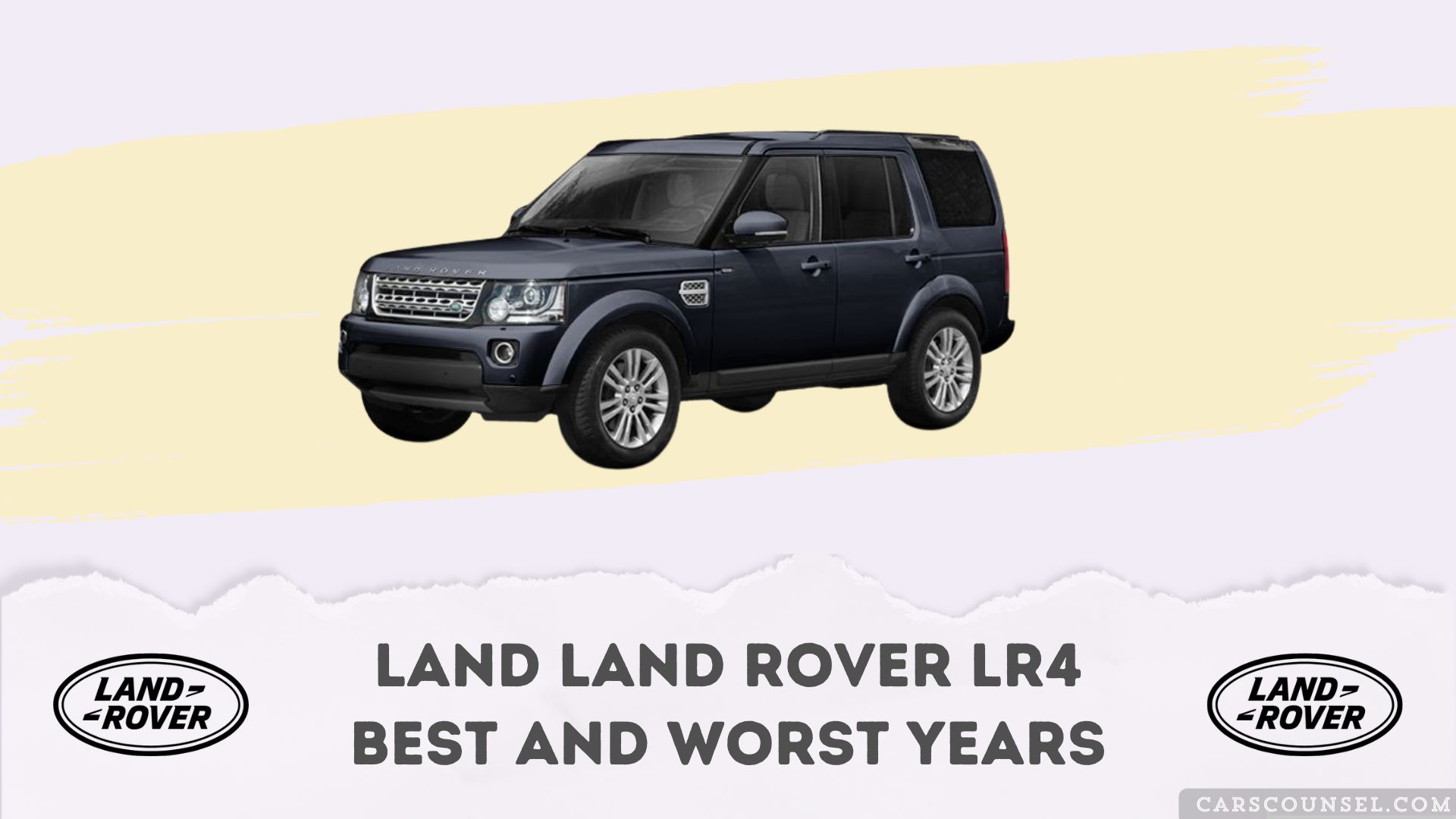
The best Land Rover LR4 years are 2015 and 2016, which feature the more reliable supercharged V6. Buyers should avoid 2010 through 2012 models due to catastrophic timing chain guide failures on the early V8 engine.
Our rankings are comparative, meaning no LR4 model year is entirely flawless. Routine maintenance, rust prevention, and overall vehicle condition heavily influence long-term dependability for any used luxury SUV.
Meaningful differences exist between the early 5.0-liter V8 and later 3.0-liter supercharged V6 engines. Trim levels and mid-cycle infotainment updates also separate earlier models from the final production years.
Quick Navigation
Best and Worst Land Rover LR4 Years at a Glance
| Model Year | Verdict | Main Reason | Buyer Guidance |
|---|---|---|---|
| 2015–2016 | Best Late-Generation Choice | Refined 3.0L V6 and final production updates | Verify water pump and suspension condition |
| 2014 | Good With Inspection | First year of the 3.0L V6 with early teething issues | Inspect timing chain tensioners and cooling system |
| 2013 | Approach Carefully | Late 5.0L V8 with improved but present chain risks | Demand proof of updated timing chain guides |
| 2010–2012 | Avoid | High risk of catastrophic 5.0L V8 timing chain failure | Look elsewhere unless engine was recently replaced |
Key Takeaways
- 2015 and 2016 are the strongest choices for used buyers.
- Avoid 2010 through 2012 models due to severe V8 engine risks.
- The 2014 engine swap introduced a new supercharged V6.
- Air suspension failures remain a costly reality across all years.
- Always verify open recalls using the vehicle identification number.
- An independent pre-purchase inspection is strictly necessary.
How We Evaluated the Land Rover LR4 Model Years
We analyze official recalls, manufacturer service campaigns, and consumer complaint databases. We also track powertrain changes, generation updates, and repair complexity to determine true ownership costs.
Complaints are not confirmed failure rates, and a single recall does not automatically ruin a model year. Recent vehicles naturally have less long-term ownership data available for review.
Best means comparatively stronger within this specific lineup. No luxury SUV is immune to expensive repairs, and maintenance history always dictates individual vehicle reliability.
Best Land Rover LR4 Years
2015–2016
These final production years benefit from Land Rover refining the 3.0-liter supercharged V6 engine. Infotainment systems and interior materials received noticeable upgrades over earlier models.
While generally the most dependable options, buyers must still budget for aging air suspension components. Water pump housings on the V6 can crack, requiring proactive cooling system inspections.
2014
This year marks the transition from the 5.0-liter V8 to the 3.0-liter supercharged V6. Fuel economy improved significantly, making daily driving slightly more manageable.
As a first-year powertrain redesign, some early tensioner and cooling system issues emerged. A thorough mechanical inspection is essential before purchasing this transitional model year.
Best Land Rover LR4 Year by Buyer Type
Best Overall Choice
The 2016 model year represents the most refined version of this SUV. It carries the fewest engine-related complaints and features the most updated interior technology.
Years to Approach Carefully
2013
This year continues to use the 5.0-liter V8 engine but benefits from late-production manufacturing tweaks. Timing chain risks remain, though slightly mitigated compared to earlier models.
Buyers should only consider this year if extensive service records prove the timing chain guides were updated. Otherwise, the financial risk remains substantial.
Worst Land Rover LR4 Years
2010–2012
These early model years are plagued by a notorious 5.0-liter V8 timing chain guide defect. The original plastic guides become brittle, break, and allow the timing chain to jump.
This failure frequently destroys the engine, resulting in massive replacement costs. Unless the previous owner already installed updated metal-backed guides, these years are strictly best avoided.
Land Rover LR4 Reliability by Generation
2010–2013 (5.0L V8 Era)
This generation launched with a powerful but fragile naturally aspirated V8. While off-road capability and towing capacity were impressive, the engine required meticulous oil change intervals.
The platform shares underlying architecture with the Land Rover Range Rover and Range Rover Sport of the same era. However, shared architecture does not guarantee identical long-term reliability patterns.
2014–2016 (3.0L Supercharged V6 Era)
Land Rover replaced the V8 with a supercharged V6 to improve efficiency and reduce weight. This engine proved generally more robust, though it introduced new water pump vulnerabilities.
These later years represent the end of the line before the nameplate transitioned. For global markets, this vehicle was known as the Land Rover Discovery 4.
Common Land Rover LR4 Problems
Timing Chain Guide Failure
This catastrophic issue primarily affects the 2010 through 2013 models equipped with the 5.0-liter V8. Plastic chain guides degrade over time, eventually shattering inside the engine block.
Symptoms include a loud rattling noise on cold starts or a sudden check engine light. If the chain jumps, the engine will likely require complete replacement.
Air Suspension Leaks
All model years utilize a complex air suspension system that is highly prone to leaks. Air struts dry out and crack, while the main compressor eventually burns out from overwork.
Owners frequently report sagging corners and harsh ride quality. Replacing all four corners with modern coil-over conversion kits is a common, cost-effective alternative.
Water Pump Leaks
The 2014 through 2016 models equipped with the 3.0-liter V6 frequently experience water pump failures. The plastic housing becomes brittle and cracks under normal engine bay temperatures.
Coolant leaks can quickly lead to severe overheating. Buyers should inspect the front of the engine for crusty residue or low coolant warnings.
Electronic Gremlins
Luxury SUVs from this era suffer from various electrical faults. Infotainment screens freeze, battery drains occur overnight, and terrain response sensors occasionally throw false warning codes.
Keeping a battery tender connected during storage helps prevent module corruption. Diagnosing these issues often requires specialized dealer software and expensive diagnostic time.
Repair-Cost Overview
| Problem | Commonly Affected Years | Approximate Repair Range | Important Notes |
|---|---|---|---|
| Timing Chain Replacement | 2010–2013 | $3,500 – $6,000 | Engine removal is often required |
| Air Suspension Conversion | All Years | $1,200 – $2,500 | Aftermarket coil-over kits save money |
| Water Pump Replacement | 2014–2016 | $800 – $1,400 | Requires draining the cooling system |
| Air Compressor Replacement | All Years | $600 – $1,100 | Often fails due to leaking struts |
Repair costs vary significantly by region, local labor rates, and parts availability. Independent Land Rover specialists usually offer better pricing than franchised dealerships for these complex repairs.
What to Check Before Buying a Used Land Rover LR4
- Verify the vehicle identification number for open safety recalls.
- Listen for engine rattling during a completely cold start.
- Inspect the air suspension by cycling through all height settings.
- Check the coolant reservoir for proper levels and crusty leaks.
- Review service records for prior timing chain or suspension work.
- Scan the OBD2 port for hidden terrain response fault codes.
- Arrange an independent inspection by a dedicated European SUV specialist.
Related Buying Guides
- Land Rover Discovery Sport best and worst years: A smaller, more fuel-efficient alternative for buyers who do not need three rows of seating.
- Land Rover Defender best and worst years: Offers rugged off-road capability with a more utilitarian focus than the luxury-oriented LR4.
Frequently Asked Questions
Is the Land Rover LR4 a reliable SUV?
The LR4 offers incredible off-road capability but carries high maintenance costs. Later models with the supercharged V6 are comparatively stronger, but no year is immune to expensive repairs.
What is the best Land Rover LR4 model year?
The 2015 and 2016 model years are the strongest choices. They feature the more reliable supercharged V6 engine and benefit from late-production interior refinements.
What Land Rover LR4 years should you avoid?
Buyers should avoid 2010 through 2012 models. The early 5.0-liter V8 engine is notorious for plastic timing chain guide failures that can destroy the motor.
Do all Land Rover LR4 models have air suspension?
Yes, all US-market LR4 models feature an adaptive air suspension system. The air struts and compressors are common failure points across every production year.
Did the Land Rover LR4 get a new engine?
Land Rover replaced the 5.0-liter V8 with a 3.0-liter supercharged V6 for the 2014 model year. This change improved fuel economy and reduced severe timing chain risks.
How long can a Land Rover LR4 last?
Longevity depends entirely on strict maintenance and rust prevention. Well-maintained examples can reach high mileage, but deferred repairs will quickly exceed the vehicle’s actual market value.
Which Land Rover LR4 Year Should You Buy?
Target the 2015 and 2016 models for the most refined ownership experience. These final production years utilize the stronger supercharged V6 and feature updated technology.
Avoid the 2010 through 2012 models unless the engine has been professionally rebuilt. The early V8 timing chain defect poses an unacceptable financial risk for most used buyers.
Regardless of the year, demand extensive service records and verify the vehicle identification number. Always secure an independent inspection to evaluate the complex air suspension and cooling systems.