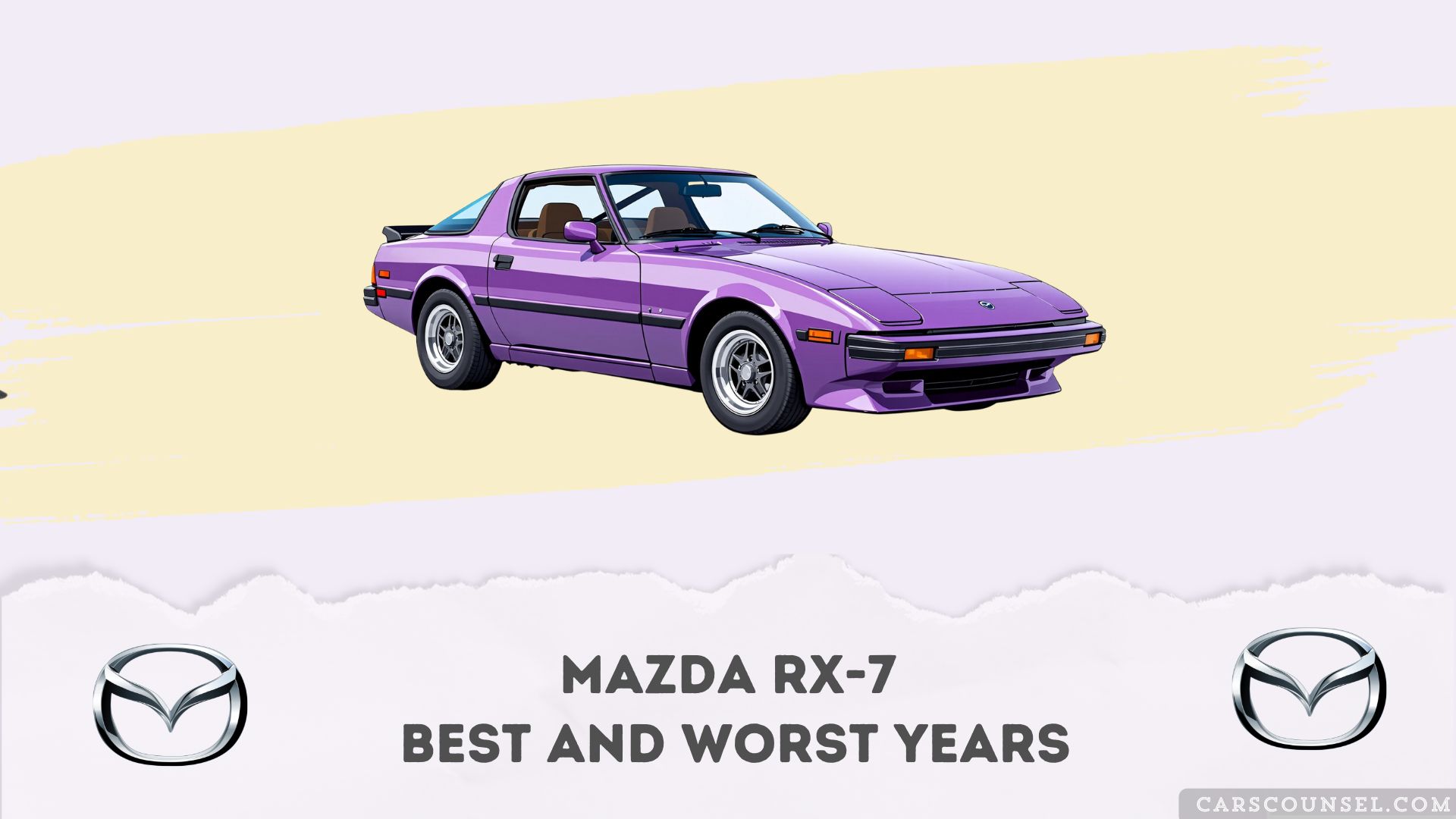
The best Mazda RX-7 years for enthusiasts are the 1993–1995 FD generation and the 1989–1992 FC Series 4 and 5 models. These years offer the most refined rotary performance and updated styling.
Early first-generation models from 1979 and 1980 are the least desirable. They suffer from early emissions equipment that restricted power and lower build quality compared to later years.
Rankings are comparative, and no rotary engine is flawless. Maintenance history, compression test results, and rust prevention matter far more than the model year alone.
Meaningful differences exist between naturally aspirated and turbocharged engines. The twin-turbo FD requires meticulous vacuum line and cooling system maintenance, while naturally aspirated models are simpler to preserve.
Quick Navigation
Best and Worst Mazda RX-7 Years at a Glance
| Model Year | Verdict | Main Reason | Buyer Guidance |
|---|---|---|---|
| 1993-1995 | Best Enthusiast Choice | Iconic FD styling and twin-turbo 13B-REW | Verify sequential turbo health and wiring harness |
| 1989-1992 | Best Older Choice | Refined FC styling and robust Turbo II | Inspect for soft dashes and differential wear |
| 1984-1985 | Good Choice | GSL-SE introduces fuel-injected 13B engine | Check for rust and early fuel injection quirks |
| 1981-1983 | Mixed | Improved 12A engine over launch years | Confirm emissions equipment and carburetor health |
| 1986-1988 | Mixed | Heavier FC chassis with early turbo options | Inspect rear subframe and interior electronics |
| 1979-1980 | Approach Carefully | Early emissions gear choked the 12A rotary | Expect lower power and higher maintenance needs |
Key Takeaways
- The 1993–1995 FD generation remains the most desirable for collectors and enthusiasts.
- Late FC models offer a great balance of classic styling and improved reliability.
- Early SA models are the least desirable due to restrictive emissions equipment.
- Apex seal wear is a reality for all rotary engines; a compression test is mandatory.
- Heat management is critical, especially for the twin-turbo FD engine bay.
- Always verify the VIN to ensure matching numbers and authentic trim packages.
- Specialist knowledge is required; general mechanics often misdiagnose rotary quirks.
How We Evaluated the Mazda RX-7 Model Years
Our analysis considers manufacturer service campaigns and the broader Mazda enthusiast community. We evaluate powertrain differences, generation updates, and long-term survivability.
This methodology is essential when determining the best and worst years for any classic sports car. Consumer complaints are less relevant than mechanical inspections.
Best means comparatively stronger within the rotary lineage. It does not mean the vehicle is free from the inherent maintenance demands of a Wankel engine.
Best Mazda RX-7 Years
1993–1995: The FD Generation
The FD RX-7 represents the pinnacle of rotary sports cars. The 13B-REW sequential twin-turbo engine produced 255 horsepower and 217 lb-ft of torque.
Its lightweight chassis and double-wishbone suspension deliver exceptional handling. The 1995 model is particularly rare in the United States.
Buyers must inspect the complex vacuum lines and engine wiring harness, which suffer from heat degradation over time.
1989–1992: FC Series 4 and 5
The updated FC generation received a styling refresh and improved mechanicals. The Turbo II models offer robust performance without the extreme complexity of the later FD sequential turbo system.
These years benefit from stronger differentials and better interior materials than early FC models. They remain highly capable grand touring cars.
Best Mazda RX-7 Years by Buyer Type
Best Enthusiast Choice: 1993–1995 FD
Ideal for collectors and track-day drivers seeking peak rotary performance and iconic nineties styling.
Best Older Choice: 1989–1992 FC Turbo II
Perfect for drivers wanting classic eighties aesthetics with a simpler, more reliable single-turbo setup.
Best Budget Classic: 1984–1985 GSL-SE
Suited for vintage collectors wanting the first fuel-injected 13B engine in a lightweight, affordable package.
Years to Approach Carefully
1986–1988: Early FC Generation
The initial FC models introduced a heavier, more complex platform. Early examples suffer from soft dashboards, fading paint, and weaker rear differentials compared to later years.
While Turbo models are desirable, naturally aspirated versions feel sluggish due to the added weight. Thorough inspection of the rear subframe is necessary.
1981–1983: Mid-Cycle FB
These years improved upon the launch models but still rely on carbureted or early fuel-injected 12A engines. They require meticulous tuning to run smoothly.
Worst Mazda RX-7 Years
1979–1980: Early SA Generation
The earliest RX-7 models are the least desirable for regular driving. Strict early emissions regulations forced restrictive exhaust plumbing that choked the 12A rotary engine.
These models produce roughly 100 horsepower and suffer from early build-quality quirks. While historically significant, they demand the most patience and specialist maintenance.
Mazda RX-7 Reliability by Generation
SA and FB (1979–1985)
The first generation established the lightweight rotary formula. Rust is the primary enemy of the unibody structure. Mechanically, the engines are simple but require frequent oil top-offs.
FC (1986–1992)
The FC grew larger to compete with cars like the Toyota Supra and Nissan 300ZX. This added weight stressed early drivetrains.
FD (1993–1995)
The FD returned to lightweight roots but added complex twin-turbo plumbing. Reliability hinges entirely on cooling system upgrades and vacuum line maintenance.
For modern alternatives, buyers often cross-shop newer models. Our guides cover the Mazda MX-5, Mazda RX-8, Mazda 2, and Mazda 5.
Common Mazda RX-7 Problems
Apex Seal and Compression Loss
All rotary engines consume oil by design to lubricate the apex seals. Infrequent oil changes or overheating will cause seal failure, resulting in low compression.
Engine Bay Heat Damage
The FD engine bay runs exceptionally hot. Factory rubber vacuum lines become brittle and crack, causing boost leaks. The main engine wiring harness can also degrade.
Engine Flooding
Rotary engines can flood easily if cranked without starting. Unburned fuel washes the rotor housing, stripping oil and preventing the engine from firing.
Repair-Cost Overview
Rotary engine repairs vary wildly based on specialist availability. A standard apex seal rebuild requires specialized machining that most general repair shops lack. Costs depend heavily on your region and parts sourcing.
What to Check Before Buying a Used Mazda RX-7
- Perform a hot and cold rotary compression test to verify apex seal health.
- Inspect all rubber vacuum lines for brittleness, especially on twin-turbo FD models.
- Check the engine wiring harness for cracked insulation or previous repair splices.
- Verify the service history to ensure frequent oil changes and proper coolant maintenance.
- Inspect the rear subframe and differential mounts for rust and stress cracking.
- Test the sequential turbo transition on FD models to ensure the secondary turbo engages smoothly.
- Arrange an independent inspection by a certified rotary specialist.
Related Buying Guides
- Toyota Supra best and worst years: The FD RX-7’s primary historical rival, offering a legendary inline-six alternative.
- Nissan 350Z best and worst years: A modern, accessible alternative for buyers seeking Japanese sports car thrills without rotary maintenance.
- Honda NSX best and worst years: The contemporary V6 flagship that competed directly with the RX-7 for nineties sports car supremacy.
Frequently Asked Questions
Is the Mazda RX-7 a reliable daily driver?
No, the RX-7 is not a reliable daily driver for most buyers. It requires frequent oil checks, specialized maintenance, and careful warm-up procedures that do not suit commuting.
Why did Mazda stop selling the RX-7 in the US?
Mazda discontinued the US-market RX-7 after 1995 due to declining sales and increasingly strict emissions standards that were difficult for the twin-turbo rotary engine to meet.
Do all RX-7s have turbochargers?
No, many first and second-generation RX-7s were naturally aspirated. The FD generation sold in the US featured a sequential twin-turbo setup on all models.
How often should I change the oil in an RX-7?
Enthusiasts recommend changing the oil every 3,000 miles or less. Rotary engines inject small amounts of oil into the combustion chamber to lubricate the apex seals.
Can a regular mechanic fix a rotary engine?
Most general mechanics lack the specific tools and knowledge to rebuild a Wankel engine. You should seek a specialist familiar with rotary compression testing and machining.
Are JDM RX-7s legal in the United States?
Yes, Japanese domestic market RX-7 models that are at least 25 years old can be legally imported under federal classic vehicle exemptions, provided they clear customs properly.
Choosing the Right Mazda RX-7 Model Year
The 1993–1995 FD models remain the ultimate choice for collectors seeking peak performance. The 1989–1992 FC Turbo II offers a more accessible entry point with classic styling.
Avoid early 1979–1980 models unless you are prepared for restrictive emissions equipment and low power. Regardless of the year, rotary ownership demands strict maintenance.
Always verify the vehicle history, confirm matching numbers, and hire a rotary specialist for the pre-purchase inspection. Condition and maintenance records matter far more than the badge.