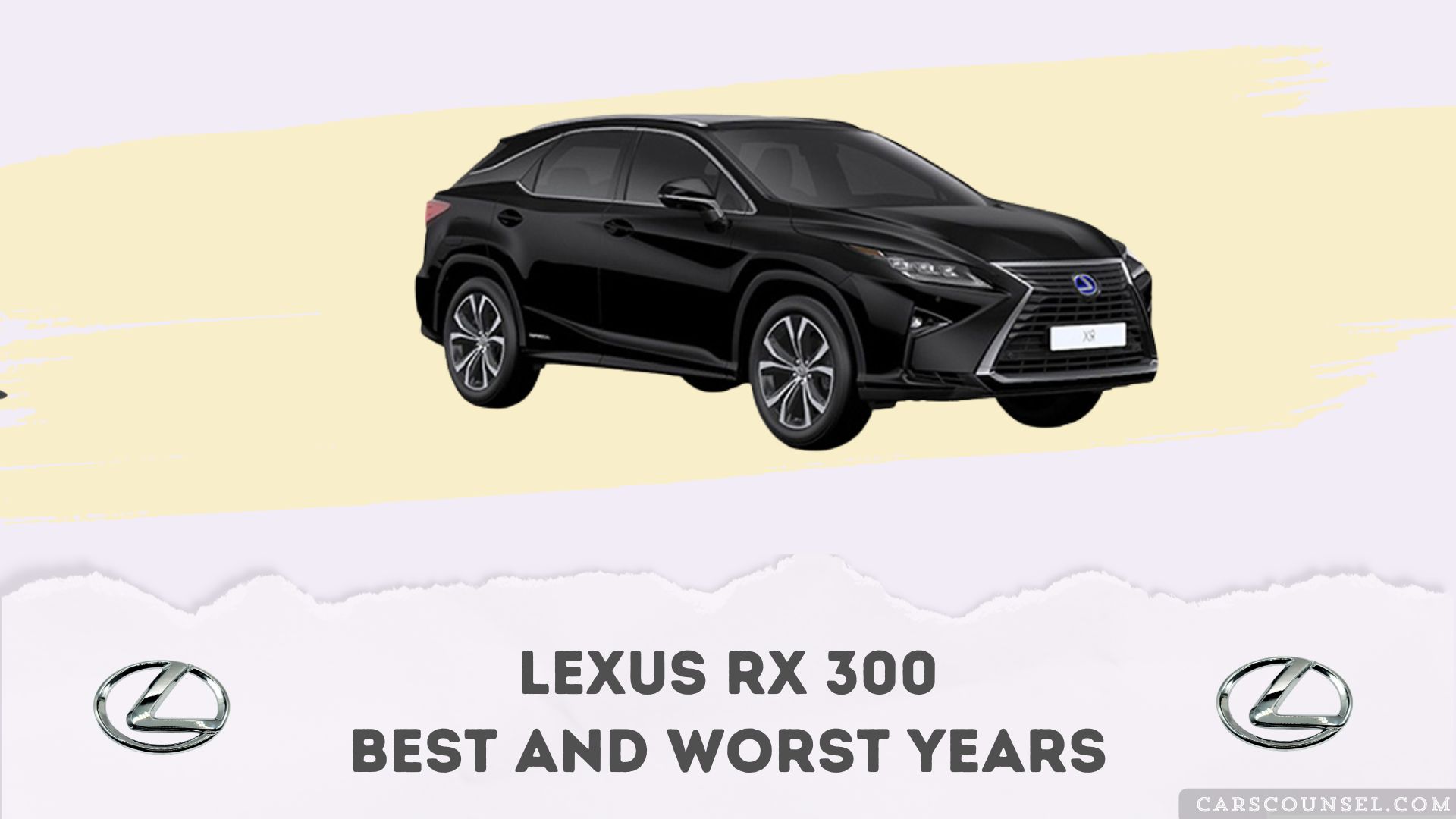
The best Lexus RX 300 model years are 2002 and 2003. These final production years offer the most refined experience and comparatively fewer powertrain complaints.
Buyers should avoid the 1999 and 2000 model years. These early examples suffer from higher rates of transmission failure and severe engine sludge buildup.
Rankings are comparative, and no used luxury SUV is flawless. Proper maintenance history is critical, as neglected oil changes can destroy the V6 engine in any year.
Quick Navigation
Best and Worst Lexus RX 300 Years at a Glance
| Model Year | Verdict | Main Reason | Buyer Guidance |
|---|---|---|---|
| 1999 | Avoid | First-year powertrain issues | Seek later models |
| 2000 | Avoid | High engine sludge risk | Check maintenance records |
| 2001 | Good With Inspection | Facelift year, dash cracks | Inspect dashboard and engine |
| 2002 | Best Choice | Mature production quality | Verify timing belt service |
| 2003 | Best Choice | Final year, most reliable | Confirm transmission fluid changes |
Key Takeaways
- The 2002 and 2003 model years are the best choices for used buyers.
- Avoid 1999 and 2000 models due to higher transmission and engine complaints.
- The 3.0L V6 engine is prone to severe sludge if oil changes are delayed.
- Dashboard cracking is a widespread cosmetic issue across all model years.
- Always verify the VIN for open recalls and warranty enhancement eligibility.
- An independent pre-purchase inspection is essential to check for engine sludge.
How We Evaluated the Lexus RX 300 Model Years
Our analysis reviews official recalls, manufacturer service campaigns, and consumer complaint patterns. We weigh the severity and recurrence of mechanical failures against the vehicle’s age.
Consumer complaints are not confirmed failure rates. A recall does not automatically make a vehicle unreliable. The RX 300 is a discontinued model with a complete ownership history.
Best Lexus RX 300 Years
2003
The 2003 model year represents the final iteration of the first-generation RX 300. It benefits from years of manufacturing refinements and remains the most reliable option.
While the V6 engine still requires strict maintenance, 2003 models generally show lower powertrain complaint volumes than earlier years in the generation.
2002
The 2002 model year is another strong choice, offering a mature platform with established reliability patterns. It shares the same mechanical foundation as the 2003 model.
Buyers should prioritize examples with documented timing belt and water pump replacements. The transmission is generally robust if the fluid was changed regularly.
Best Year by Buyer Type
Best Overall
The 2003 Lexus RX 300 is the best overall choice. It offers the most refined first-generation experience with the lowest relative risk of major powertrain failures.
Best Budget Option
The 2001 model year serves as a budget-friendly alternative. It received a mild exterior refresh and updated interior features, though it requires careful mechanical inspection.
Years to Approach Carefully
2001 (Good With Inspection)
The 2001 model year introduced a styling refresh and improved interior amenities. However, it remains susceptible to the generation’s common engine and dashboard issues.
Buyers must verify that the engine is free of sludge and that the dashboard has not suffered from severe cracking or melting.
Worst Lexus RX 300 Years
1999 and 2000 (Avoid)
The 1999 and 2000 model years are the most problematic. As first-generation launch models, they exhibit higher rates of automatic transmission failures and severe engine sludge.
The V6 engine in these early years is particularly vulnerable to oil starvation if maintenance is deferred. Transmission solenoid and gear wear complaints are also notably higher.
Lexus RX 300 Reliability by Generation
First Generation (1999–2003)
The first-generation RX 300 pioneered the luxury crossover segment. It shares related architecture with the Toyota Highlander, though its luxury appointments add complexity.
While the platform is fundamentally sound, the V6 engine’s oil return passages were too small, leading to widespread sludge issues across the entire generation.
Common Lexus RX 300 Problems
Engine Sludge
The 3.0L V6 engine is notorious for oil sludge buildup. Infrequent oil changes cause the oil to gel, blocking pickup tubes and leading to catastrophic engine failure.
Dashboard Cracking
Many models suffer from severe dashboard cracking, melting, and glare issues. Toyota previously offered a warranty enhancement program for this defect, but coverage has largely expired.
Knock Sensor Failure
Failing knock sensors frequently trigger the check engine light. Replacing them requires removing the intake manifold, making labor costs disproportionately high compared to the part price.
Repair-Cost Overview
| Problem | Commonly Affected Years | Approximate Repair Range | Important Notes |
|---|---|---|---|
| Engine Sludge Damage | 1999–2003 | $3,000–$6,000 | Often requires full engine replacement |
| Dashboard Replacement | 1999–2003 | $800–$1,500 | OEM dashboards may also crack over time |
| Knock Sensor Replacement | 1999–2003 | $600–$900 | High labor cost due to manifold removal |
| Transmission Solenoid | 1999–2000 | $400–$800 | Fluid flush may prevent some failures |
Costs vary significantly by region, labor rate, and repair facility. Independent mechanics typically offer lower rates than dealerships. Always get multiple quotes for major repairs.
What to Check Before Buying a Used Lexus RX 300
- Remove the oil filler cap to inspect for thick, black sludge.
- Verify the timing belt and water pump were replaced every 90,000 miles.
- Check the dashboard for severe cracking, melting, or sticky surfaces.
- Scan for diagnostic codes, specifically knock sensor circuit faults.
- Test the transmission for harsh shifts or delayed engagement.
- Inspect the power steering rack for fluid leaks.
- Verify the VIN for any outstanding safety recalls.
Related Buying Guides
- Lexus RX 330 best and worst years: The direct successor to the RX 300, featuring a larger 3.3L V6 engine and updated styling.
- Lexus GS 350 best and worst years: A rear-wheel-drive luxury sedan alternative for buyers who prefer a traditional driving dynamic over a crossover.
- Lexus ES 330 best and worst years: Shares the same underlying platform and V6 powertrain as the RX 330, offering a comfortable sedan alternative.
- Lexus IS 300 best and worst years: A compact sport sedan option for buyers seeking a smaller, more agile Lexus vehicle.
Frequently Asked Questions
Is the Lexus RX 300 a reliable SUV?
The RX 300 can be reliable if meticulously maintained. However, the V6 engine is highly prone to destructive oil sludge if oil changes are delayed.
What is the most common Lexus RX 300 problem?
Engine sludge and dashboard cracking are the most widespread issues. Sludge can destroy the engine, while the dashboard defect causes severe cosmetic and glare problems.
How long does a Lexus RX 300 last?
Well-maintained examples can reach high mileage. Longevity depends entirely on strict adherence to oil change intervals and timing belt service schedules.
Did Lexus fix the engine sludge issue?
Lexus revised the oil cap to reduce condensation, but the fundamental oil passage design remained. Strict 3,000-mile oil intervals are still recommended by many mechanics.
Is the 2003 RX 300 better than the 1999 model?
Yes, the 2003 model is generally better. It benefits from late-production refinements and typically shows fewer powertrain complaints than the 1999 launch model.
Should I buy an RX 300 or an RX 330?
The RX 330 is generally preferred. It replaced the RX 300 in 2004, offering a more powerful V6 engine and updated interior features.
Which Lexus RX 300 Year Should You Buy?
The 2002 and 2003 Lexus RX 300 model years are the safest choices for used buyers. They offer the most refined experience with comparatively lower complaint volumes.
Avoid the 1999 and 2000 models due to higher transmission and engine risks. Regardless of the year, an independent inspection for engine sludge is mandatory.


Comments are closed.