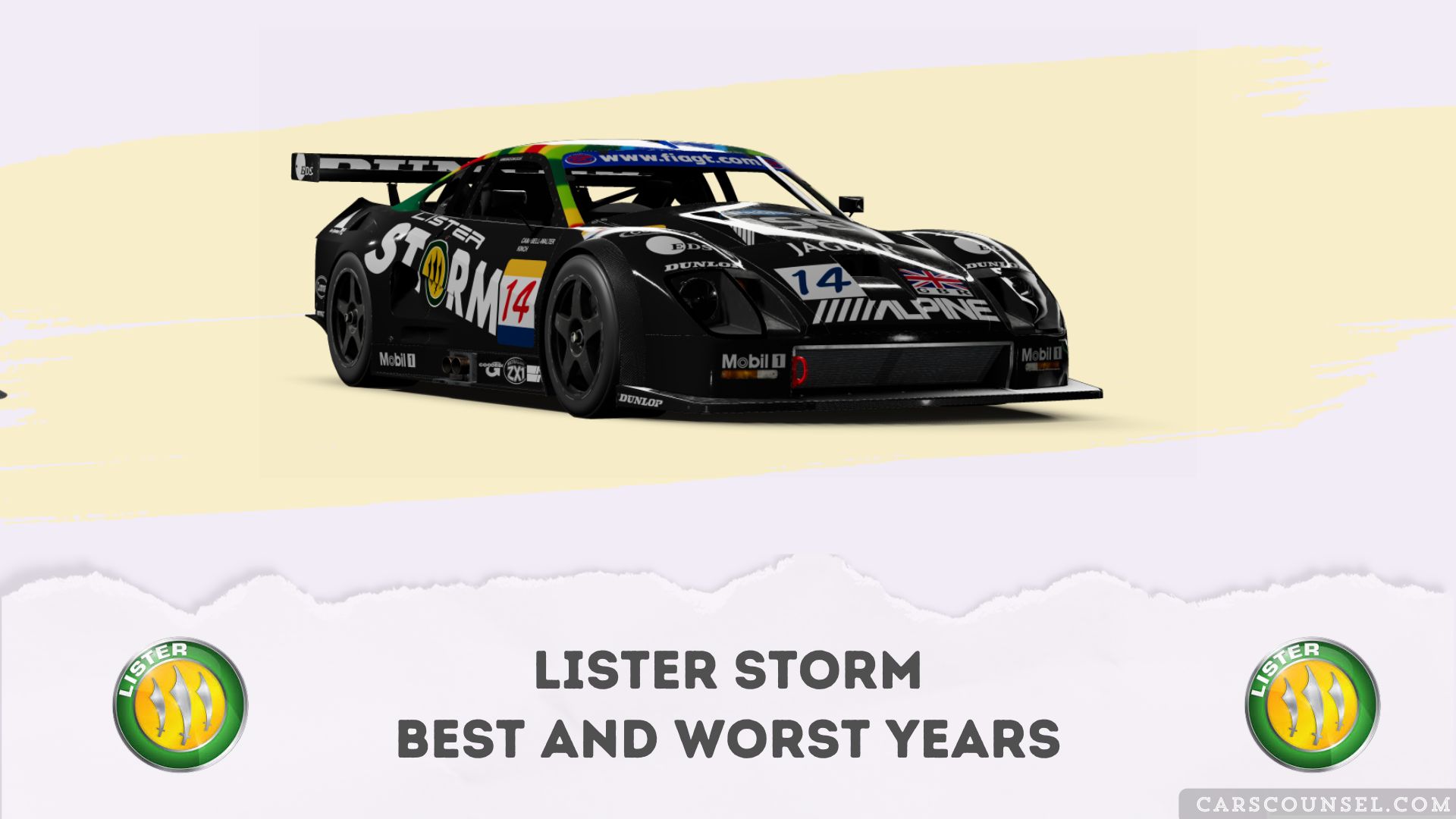
The best Lister Storm years are the 1996 through 2000 models, representing the mature, homologation-special road cars. Buyers should approach the early 1993 through 1995 examples carefully due to their prototype nature and extreme rarity of replacement parts.
Rankings for this ultra-low-volume British supercar are strictly comparative. With fewer than thirty road cars ever built, individual condition, bespoke maintenance, and complete racing provenance matter far more than the specific model year.
Meaningful differences exist between the early developmental chassis and the later FIA GT homologation models. The massive 7.0-liter Jaguar V12 requires specialized, aerospace-level servicing regardless of the badge year.
Quick Navigation
Best and Worst Lister Storm Years at a Glance
| Model Year | Verdict | Main Reason | Buyer Guidance |
|---|---|---|---|
| 1993-1995 | Good With Inspection | Early production and prototype elements. | Verify chassis development and bespoke parts. |
| 1996-2000 | Best Enthusiast Choice | Mature FIA GT homologation road cars. | Confirm Jaguar V12 maintenance and racing provenance. |
Key Takeaways
- The 1996-2000 models represent the definitive FIA GT homologation road cars.
- Early 1993-1995 examples require careful inspection due to prototype components.
- The 7.0-liter Jaguar V12 produces 546 horsepower and 582 pound-feet of torque.
- Fewer than thirty road-going examples were ever constructed.
- Parts scarcity makes specialist support absolutely mandatory.
- Always verify the chassis number and complete bespoke service history.
- Arrange an independent inspection by a specialist familiar with Group C and GT1 prototypes.
How We Evaluated the Lister Storm Model Years
Our analysis considers historical racing records, homologation requirements, and the unique ownership realities of ultra-low-volume supercars. We evaluate the Jaguar-sourced powertrain, bespoke chassis construction, and the severe impact of parts scarcity.
Complaints and traditional reliability metrics do not apply to a thirty-car production run. Collector sales and racing provenance provide the only tangible evidence of long-term survivability.
Best Lister Storm Years
1996-2000 Lister Storm GT
The 1996 through 2000 model years represent the definitive, mature road cars built to homologate the Storm for FIA GT racing. These examples feature the fully developed 7.0-liter Jaguar V12 and refined aerodynamics.
Buyers must verify the complex cooling circuits and the structural integrity of the bespoke chassis. These cars offer unparalleled exclusivity for serious collectors.
Best Year by Buyer Type
Best Enthusiast Choice: 1996-2000 Lister Storm GT
For collectors seeking a piece of eccentric British motorsport history, the later Storm GT models offer unparalleled exclusivity. Their raw, analog driving experience and Group C-derived V12 provide a driving experience unlike any contemporary European supercar.
Years to Approach Carefully
Good With Inspection: 1993-1995 Lister Storm
The earliest road-going examples encompass pre-production prototypes and initial customer cars. These early builds feature developmental components that differ from the finalized FIA GT homologation specifications.
Buyers should approach these initial cars carefully, ensuring that the bespoke suspension and electrical systems have been thoroughly sorted by a specialist.
Worst Lister Storm Years
Buyers searching for years to avoid will find no definitively bad model years, as every Lister Storm is a priceless collector’s item. However, avoid examples lacking verifiable service histories or featuring unsafe track modifications.
Neglecting the experimental Jaguar V12 will result in catastrophic repair bills. Always prioritize documented mechanical sorting over low mileage alone.
Lister Storm Reliability by Generation
First Generation (1993-2000)
The Lister Storm exists as a single, highly experimental generation. Conceived to dominate GT racing, it utilized a bespoke chassis and a massive 7.0-liter Jaguar V12 derived from the XJR-14 Group C prototypes.
Production ceased around 2000 as the company shifted focus entirely to racing and later prototype projects, making long-term factory support entirely non-existent.
Common Lister Storm Problems
Cooling System Overheating
The massive Jaguar V12 generates immense heat within a tightly packaged engine bay. Early testing documented severe overheating issues, requiring owners to constantly monitor custom radiator setups and auxiliary oil coolers.
Bespoke Component Failures
Given the custom carbon-fiber bodywork and bespoke electrical harnesses, component gremlins are frequent. Sourcing replacement screens, custom gauges, or specific suspension components is nearly impossible, often requiring bespoke fabrication by specialized restorers.
Jaguar V12 Maintenance
While the 7.0-liter V12 is fundamentally robust in a racing environment, it requires meticulous, race-prep-level maintenance for street use. Timing chain guides, custom exhaust headers, and specialized ECU tuning demand expert attention.
What to Check Before Buying a Used Lister Storm
- Verify the chassis number and confirm the car’s original homologation specification.
- Inspect the custom cooling system for leaks, corrosion, and auxiliary fan operation.
- Test the Jaguar V12 for smooth idle and proper oil pressure under load.
- Review service records to ensure the bespoke electrical harness has been maintained.
- Check the carbon-fiber bodywork for stress cracks or improper track-day repairs.
- Arrange an independent inspection by a specialist familiar with GT1 prototypes.
Related Buying Guides
- Aston Martin DB5 best and worst years: Explore another iconic piece of British automotive history that offers classic grand touring prestige with slightly more established classic car support networks.
- Ferrari F40 best and worst years: Discover the legendary European homologation special that defined the late-1980s supercar era alongside the Storm’s ambitious racing debut.
- Porsche 911 best and worst years: A more practical, mass-market sports car alternative for buyers who want track-capable performance without the extreme financial risks of a bespoke prototype.
Frequently Asked Questions
Is the Lister Storm reliable?
It is an experimental, hand-built prototype that requires constant specialist attention. Traditional reliability metrics do not apply, and ownership is a massive financial and mechanical undertaking.
What engine is in the Lister Storm?
It features a 7.0-liter Jaguar V12 engine derived from the XJR-14 Group C race car. In its highest state of tune, it produces 546 horsepower and 582 pound-feet of torque.
How many Lister Storms were made?
Fewer than thirty road-going examples were constructed, alongside a small number of dedicated GT1 and GT2 race cars. This extreme scarcity makes it one of the rarest British supercars.
Why did Lister stop making the Storm?
The company shifted its focus entirely to motorsport and later Le Mans Prototype projects. The immense cost of hand-building road cars and evolving GT1 regulations ultimately ended road car production.
Did the Lister Storm win any championships?
Yes, the Lister Storm GT achieved significant success in motorsport, most notably winning the FIA GT Championship in 2000 and securing multiple British GT Championship titles.
Can I daily drive a Lister Storm?
It is entirely unsuitable for daily driving due to the lack of modern safety features, extreme repair costs, bespoke electrical gremlins, and the severe lack of dealership support or ground clearance.
Choosing the Right Lister Storm Model Year
The 1996 through 2000 Lister Storm GT models are the definitive choices for serious collectors. They represent the finalized, FIA GT-homologated versions of Britain’s most eccentric supercar.
Avoid any example with an incomplete service history or neglected cooling system. The bespoke nature of these vehicles demands meticulous, verifiable maintenance to ensure they remain operational.
Always verify the chassis number and arrange an independent inspection. Checking the experimental Jaguar V12 and custom chassis is essential for securing a piece of authentic automotive history.