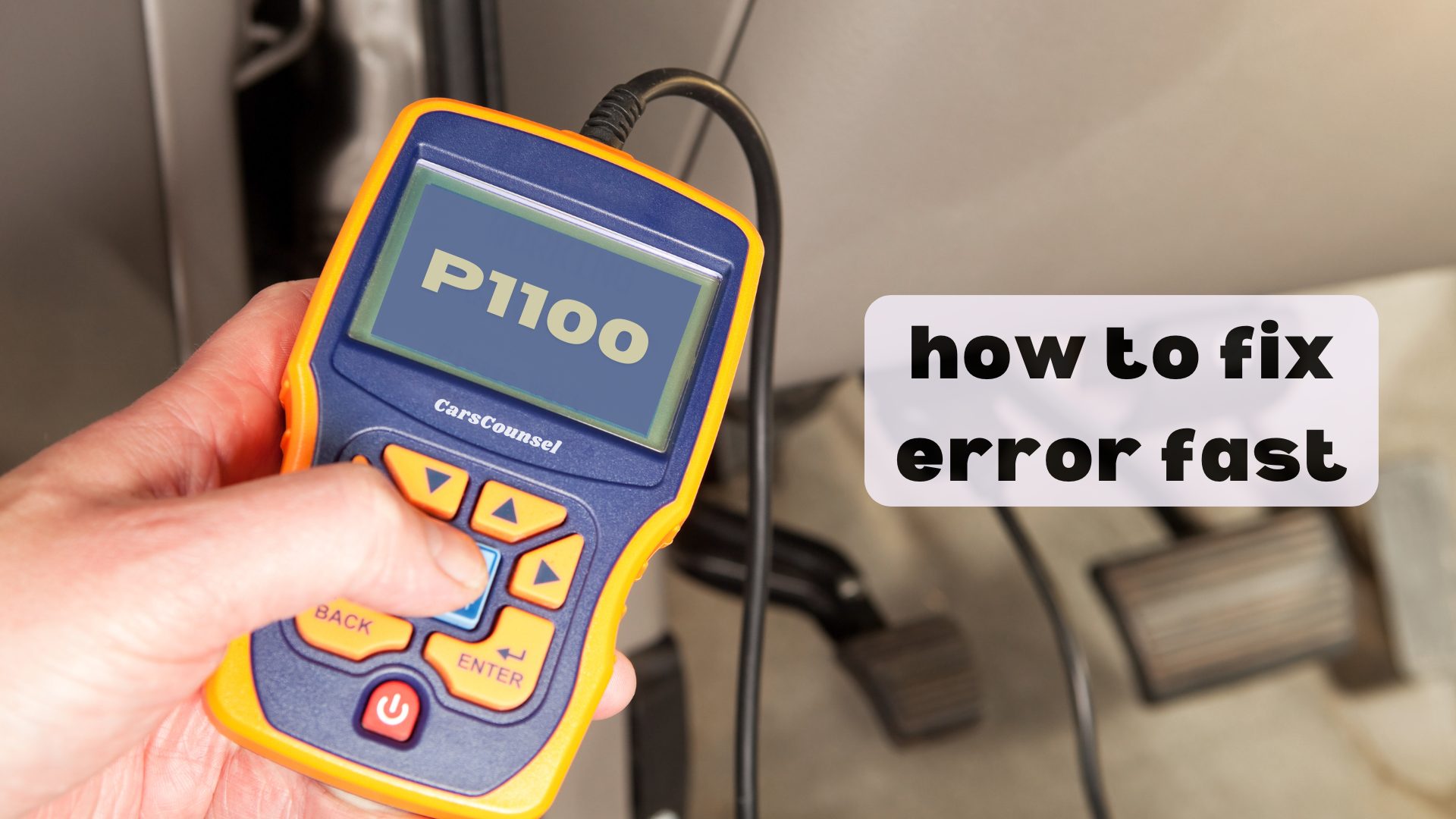
P1100 is a manufacturer-specific powertrain diagnostic trouble code. Because it is not a generic OBD-II code, its exact definition and monitored system depend entirely on the vehicle application.
Because this trouble code can indicate a Mass Air Flow sensor fault, a Barometric Pressure sensor issue, or a Manifold Absolute Pressure sensor problem, the exact application must be verified.
Quick Navigation
Key Takeaways
- P1100 is a manufacturer-specific code with no single universal definition.
- On Ford, Mazda, and Jaguar applications, it typically indicates an intermittent Mass Air Flow (MAF) sensor circuit fault.
- On Toyota and Lexus applications, it points to a Barometric Pressure (BARO) sensor circuit malfunction.
- Diagnosis requires confirming the exact factory definition before testing any specific sensors or wiring.
P1100 Code Description and Implications
P1100 is a manufacturer-specific diagnostic trouble code. Its definition varies significantly across different vehicle makes.
Some Ford, Mazda, and Jaguar applications: P1100 indicates a Mass Air Flow (MAF) sensor circuit intermittent fault. The powertrain control module detects that the MAF sensor signal is erratic or dropping out momentarily.
Certain Toyota and Lexus applications: P1100 indicates a Barometric Pressure (BARO) sensor circuit malfunction. The PCM monitors the atmospheric pressure sensor, which may be integrated into the PCM or located externally.
Specific Hyundai and Kia applications: P1100 may indicate a Manifold Absolute Pressure (MAP) sensor circuit intermittent fault or an EGR-related MAP circuit issue.
Always verify the exact definition for your specific make, model, and year.
Common Causes of the P1100 Code
For Ford, Mazda, and Jaguar MAF applications:
- A dirty or contaminated MAF sensor element.
- Damaged wiring, loose pins, or corrosion in the MAF sensor connector.
- Intake air leaks between the MAF sensor and the throttle body.
For Toyota and Lexus BARO applications:
- A failed external BARO sensor, if equipped.
- Damaged wiring or poor connections at the BARO sensor or PCM.
- An internal PCM failure affecting the integrated BARO sensor circuit.
For Hyundai and Kia MAP applications:
- A failing MAP sensor or damaged sensor connector.
- Vacuum leaks or a restricted intake manifold.
- Wiring faults in the MAP sensor reference, signal, or ground circuits.
Symptoms Associated With P1100
Symptoms vary based on the affected system. MIL behavior also depends on the specific manufacturer calibration.
Ford, Mazda, and Jaguar applications:
- Illuminated Check Engine Light.
- Engine hesitation, stumbling, or stalling during acceleration.
- Rough idle or erratic transmission shifting due to incorrect load calculations.
Toyota and Lexus applications:
- Illuminated Check Engine Light.
- The engine may enter a fail-safe or limp mode.
- Incorrect fuel trim adaptations due to faulty atmospheric pressure readings.
Hyundai and Kia applications:
- Illuminated Check Engine Light.
- Poor engine performance and reduced fuel economy.
Diagnosing the P1100 Trouble Code
Diagnosis must begin by confirming the exact factory definition for your specific vehicle make, model, and year.
For MAF sensor applications:
Inspect the intake tract for unmetered air leaks. Check the MAF sensor wiring and connector for damage. Use a scan tool to monitor live MAF data for erratic dropouts.
For BARO sensor applications:
Verify the BARO sensor reading against a known good barometer. Inspect the sensor wiring and connectors. If the sensor is internal to the PCM, follow the manufacturer procedure for PCM testing.
For MAP sensor applications:
Inspect the MAP sensor vacuum hose for leaks or blockages. Test the MAP sensor reference voltage, ground, and signal circuits according to the manufacturer procedure.
Repairing the P1100 Issue
Repairs must follow confirmed diagnostic testing.
If the MAF sensor is confirmed dirty, clean it using an approved MAF sensor cleaner. If the sensor element is damaged or fails testing, replace the MAF sensor.
If the BARO sensor is confirmed failed, replace the external sensor or follow the PCM replacement procedure if the sensor is internally integrated.
If wiring damage or intake leaks are found, repair the harness or replace the damaged intake ducting.
Cost Considerations for P1100 Repairs
Cost depends on diagnostic time, component accessibility, required parts, programming requirements, and labor.
Cleaning a MAF sensor involves minimal cost. Replacing a MAF or MAP sensor requires standard parts and labor. Replacing a PCM involves higher parts costs and requires programming.
Prevention Strategies for Future Occurrences
Replacing the engine air filter at the manufacturer’s recommended intervals helps prevent dirt and debris from contaminating the MAF sensor element.
Inspecting exposed intake ducting and sensor wiring can help identify developing damage or vacuum leaks before they trigger a circuit fault.
Troubleshooting Tips and Best Practices
Do not immediately replace the PCM when a BARO circuit code appears on a Toyota or Lexus. Verify the external sensor and wiring first if applicable.
On MAF applications, ensure the air filter is properly seated and the airbox is fully sealed. An unsealed airbox can allow unmetered, dirty air to bypass the filter.
Always check for technical service bulletins related to MAF or BARO sensor updates for your specific vehicle.
More OBD-II Codes
| P1098 | P1096 | P1094 | P1092 |
| P1090 | P1088 | P1102 | P1103 |
| P1104 | P1105 | P1106 | P1107 |
| P0100 | P0101 | P1101 | P1108 |
| P1109 | P0171 | P0174 | P0300 |
| P0420 | P0700 | P0011 | P0014 |
Frequently Asked Questions
Is P1100 a generic or manufacturer-specific code?
No. P1100 is a manufacturer-specific code. Its exact definition depends entirely on the vehicle make, monitoring systems ranging from MAF sensors to BARO circuits.
Can a dirty air filter cause a P1100 code?
Yes. On applications monitoring the MAF sensor, a severely clogged or improperly seated air filter can allow dirt to contaminate the sensor element, triggering an intermittent circuit fault.
Will disconnecting the battery clear a P1100 code?
Disconnecting the battery may temporarily clear the code, but it does not repair the underlying electrical fault. The code will return if the contaminated sensor or damaged wire remains uncorrected.
Can I drive my car with a P1100 code?
It depends on the application. An intermittent MAF or MAP signal can cause severe hesitation or stalling, making the vehicle unsafe to drive. Verify the exact symptoms before driving.
Does P1100 mean my PCM is definitely broken?
No. While an internal PCM fault is possible on some Toyota BARO applications, P1100 usually points to external issues like a dirty MAF sensor, damaged wiring, or intake air leaks.
What Should You Do About the P1100 Code?
Confirm the exact factory definition for your specific vehicle application before attempting any repairs. Because P1100 monitors entirely different systems across manufacturers, applying the wrong diagnostic path will waste time.
Once the correct system is identified, inspect the relevant sensors and their circuits according to the manufacturer procedure. Repair or replace the confirmed failed components, then retest the system to verify the repair.

