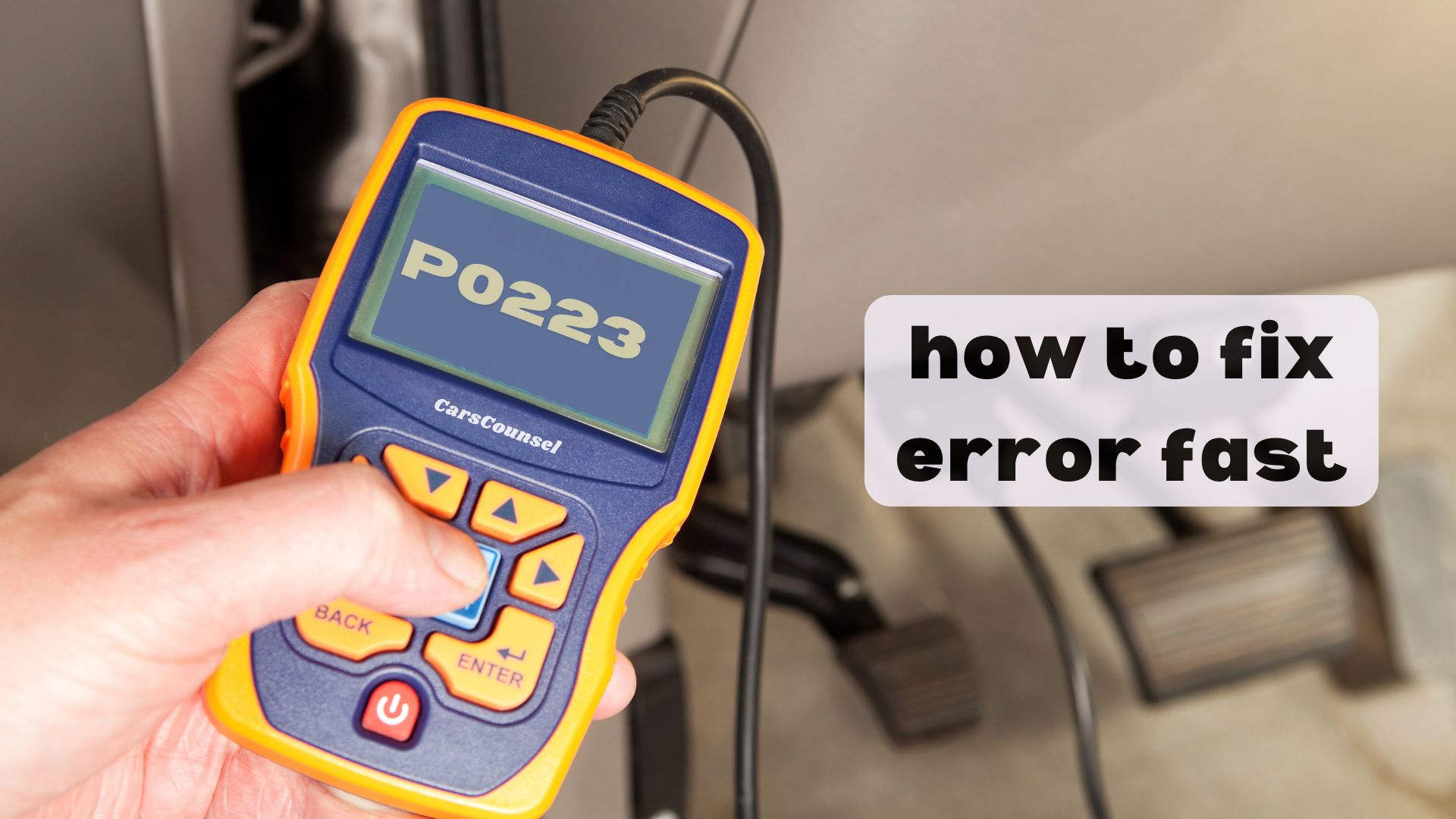
Diagnostic trouble code P0223 is a generic OBD-II powertrain fault code. It indicates that the powertrain control module has detected a high voltage condition in the throttle or pedal position sensor/switch “B” circuit.
Exact vehicle application must be verified before diagnosis. The code identifies an electrical fault in the sensor circuit, but further testing is required to identify the root cause.
Quick Navigation
Key Takeaways
- P0223 is a generic OBD-II code indicating a high voltage condition in the throttle/pedal position sensor/switch “B” circuit.
- Possible causes include damaged wiring, poor electrical connections, a failed throttle/pedal position sensor, or a faulty control module.
- Symptoms often include an illuminated Check Engine Light, reduced engine power, limp mode, and poor acceleration.
- Diagnosis requires inspecting the sensor circuit wiring and testing the sensor signal voltage and reference circuits.
- Repairs involve fixing damaged wiring or replacing the confirmed failed sensor or control module components.
P0223 Code Description and Implications
P0223 is a generic OBD-II diagnostic trouble code. It indicates that the powertrain control module (PCM) has detected a voltage in the throttle or pedal position sensor/switch “B” circuit that is higher than the expected operating range.
Modern vehicles use multiple throttle or pedal position sensors to provide redundant data for the electronic throttle control system. Sensor “B” is one of these redundant circuits.
A circuit high condition means the module is seeing voltage where it should not, often indicating a short to power or an open ground in the sensor wiring. This error code requires electrical diagnosis to identify the exact point of failure.
Common Causes of the P0223 Code
Possible causes for a circuit high condition include damaged, chafed, or melted wiring in the throttle or pedal position sensor “B” circuit that is shorting to a voltage source.
Corroded, loose, or pushed-back pins in the electrical connectors at the sensor or the control module can also disrupt the circuit.
A failed throttle position sensor or accelerator pedal position sensor with an internal short may also trigger this code.
In rare cases, a faulty powertrain control module may fail to properly read the sensor circuit.
Symptoms Associated With P0223
The most immediate symptom is an illuminated Check Engine Light. Because the electronic throttle control system relies on redundant sensor data, a fault in sensor “B” will typically trigger a fail-safe or limp mode.
This can result in severely reduced engine power, poor acceleration, and an inability to increase engine RPM.
The engine may also idle roughly or stall, and the electronic throttle body may not respond to accelerator pedal inputs.
Diagnosing the P0223 Trouble Code
Diagnosis begins by verifying the exact wiring diagram for the specific vehicle to identify the throttle/pedal position sensor “B” circuit path, reference voltage, and ground pins.
Technicians inspect the wiring harness and connectors at the sensor and control module for visible damage, corrosion, or chafing.
Using a digital multimeter or scan tool, they monitor the live data for the sensor “B” voltage while operating the throttle or pedal to check for dropouts or high voltage spikes.
They also test the 5-volt reference and ground circuits to ensure the sensor is receiving proper power.
Repairing the P0223 Issue
If wiring damage or a short to power is found, the affected harness section must be repaired, soldered, and properly insulated.
If the sensor fails live data testing or electrical testing, the confirmed failed throttle position sensor or accelerator pedal position sensor assembly must be replaced.
If all external circuits and the sensor test correctly, follow the manufacturer diagnostic procedure to evaluate the powertrain control module.
Cost Considerations for P0223 Repairs
Cost depends on diagnostic time, component accessibility, required parts, programming requirements, and labor.
Replacing an accelerator pedal position sensor involves standard labor times, while replacing a throttle body assembly may require additional calibration or relearn procedures.
Prevention Strategies for Future Occurrences
Inspecting exposed engine and cabin wiring harnesses for chafing, heat damage, or moisture intrusion can help prevent intermittent circuit faults.
Keeping electrical connectors clean and ensuring protective seals are intact may reduce moisture intrusion and terminal corrosion on the sensor circuits.
Troubleshooting Tips and Best Practices
Never assume the sensor has failed just because a circuit code is present. P0223 specifically identifies an electrical fault in the control wiring, reference voltage, or ground.
Do not ignore a reduced power warning. Driving with a compromised electronic throttle control system can be unsafe, especially when merging or crossing intersections.
Check for technical service bulletins related to updated wiring harnesses, revised sensors, or control module software updates for your specific model year and configuration.
More OBD-II Codes
| P0222 | P0261 | P0121 | P0300 |
| P0220 | P0262 | P0122 | P0420 |
| P0206 | P0264 | P0123 | P0171 |
| P0205 | P0265 | P0201 | P0174 |
| P0204 | P0267 | P0430 | P0440 |
| P0203 | P0268 | P0455 | P0456 |
Frequently Asked Questions
Is P0223 a generic or manufacturer-specific code?
Yes. P0223 is a generic OBD-II code, meaning its definition as a throttle/pedal position sensor “B” circuit high fault is standardized across all vehicle makes and models.
Can I drive my car with a P0223 code?
It is not recommended. The vehicle will likely enter a reduced power or limp mode, making it unsafe to drive in traffic or merge onto highways.
Will disconnecting the battery clear the P0223 code?
Disconnecting the battery may temporarily clear the code, but it does not repair the underlying electrical short or component failure. It also resets readiness monitors.
Can a bad throttle body cause a P0223 code?
Yes. If the throttle position sensor is integrated into the throttle body, an internal short in the sensor can trigger this circuit high code, requiring throttle body replacement.
Does P0223 always mean the sensor is bad?
No. While a failed sensor is a possible cause, the code can also be triggered by damaged wiring, poor connections, a short to power, or a failed control module.
What Should You Do About the P0223 Code?
Confirm the exact wiring diagram and diagnostic procedure for your specific vehicle application. Because P0223 identifies an electrical circuit fault, tracing the sensor “B” circuit is mandatory.
Follow the applicable diagnostic steps to test the wiring, connectors, and sensor signals. Once the root cause is confirmed, repair or replace the failed components and verify system operation.

