You’ve probably noticed the tiny seam on your VW key fob, but many owners never figure out how to access the battery without cracking the case.
By locating that 1–2 mm groove and applying the right amount of pressure, you can open both older and newer fobs safely.
Follow the precise steps, and you’ll avoid costly damage while swapping the CR2032.
Quick Navigation
Key Takeaways
- Identify fob type: older models need a tool; newer models open by pressing the seam with a fingertip.
- For older fobs, locate the faint seam 1–2 mm from the edge and insert a 2 mm flat‑head screwdriver at a 45° angle.
- Apply light pressure (≤0.5 kg) and rotate ≤15° to create a 0.5 mm gap, then slide the screwdriver along the seam to separate the halves.
- For newer fobs, press the back seam firmly; the halves will click open without tools.
- After opening, support the opposite side with your thumb, avoid excessive force, and re‑snap the halves together until you hear a secure click.
Open Your VW Key Fob in 30 Seconds
How quickly can you replace a VW key‑fob battery?
You’ll perform a speedy procedure that takes thirty seconds.
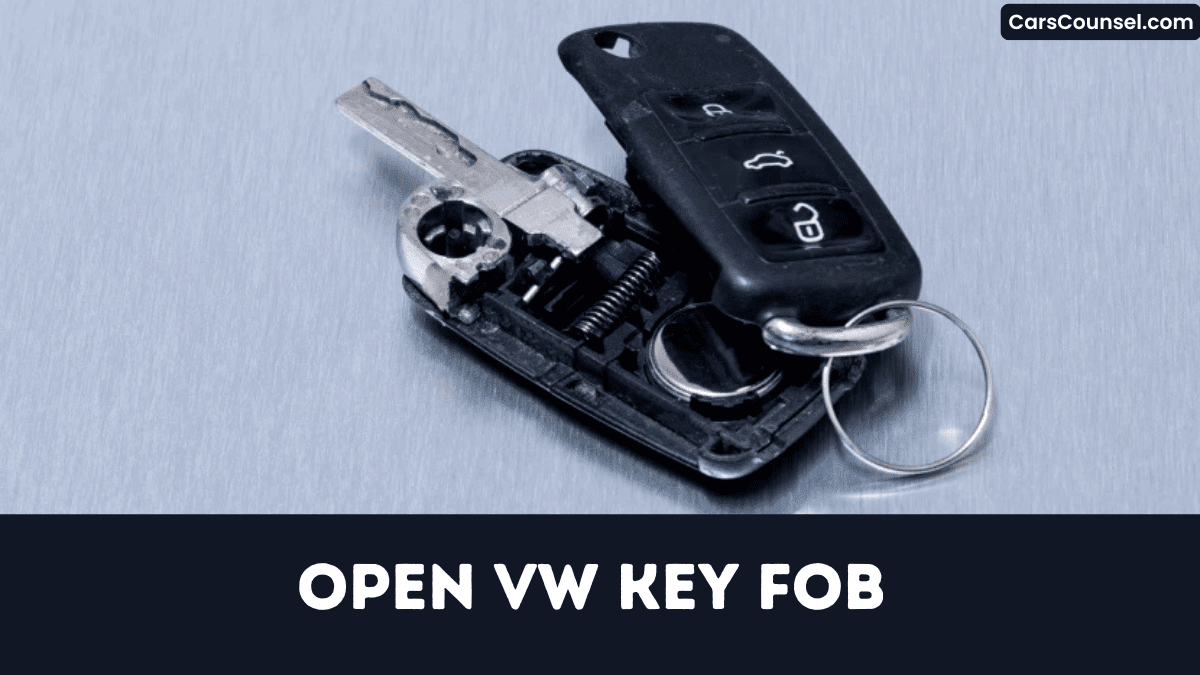
First, press the emergency‑key release button, pull the metal key, and locate the seam on the fob’s side.
Press the emergency‑key release, pull the metal key, then locate the seam on the fob’s side.
Wedge a screwdriver to snap the halves apart in ten seconds; newer fobs open by pressing the seam, popping open in five seconds.
Lift the CR2032 lithium coin battery with the screwdriver tip—three volts, twenty‑millimeter diameter—in three seconds.
Insert the replacement with positive side up, align it, and snap the shell back, hearing a click.
This efficient method readies the fob for testing.
Gather the Required Tools for a VW Key Fob
You’ll need a 2‑3 mm flat‑head screwdriver, a small plastic pry tool (or a fingernail), optional tweezers, and a lint‑free cloth.
The sole replacement component is a CR2032 lithium coin battery—≈3 V, 20 mm diameter, 3 mm thick.
Use the correctly sized screwdriver to pry the fob halves apart, then lift the old battery with tweezers before inserting the new one.
Essential Tools Checklist
Two items make up the core toolkit for swapping a VW key fob battery: a CR2032 lithium coin cell (≈3 V, 20 mm diameter) and a tiny flat‑head screwdriver with a 0.5–1 mm tip.
You’ll also want a spare battery stored in a protective mat to avoid scratches, plus a small cloth to catch debris.
Press the emergency‑key release button, then use the screwdriver to pry the halves apart gently.
Lift the old cell, note its orientation, and replace it with the fresh CR2032.
Snap the shell back, verify button response, and stash the spare for future swaps.
Keep tools organized always.
CR2032 Battery Details
One essential specification of the CR2032 is its 3 V nominal voltage, 20 mm diameter, 3.2 mm thickness, and roughly 225 mAh capacity, which matches the VW key fob’s battery compartment precisely.
You’ll notice the capacity rating of about 225 mAh, enough for years of remote use.
The cell’s temperature tolerance ranges from –20 °C to +60 °C, ensuring operation in climates.
When you replace the old unit, insert the new coin with the positive (+) side up toward interior to keep polarity.
Store spares in a place; they hold charge for three to four years.
Check contact alignment before sealing fob to prevent signal loss.
Flat‑Head Screwdriver Size
Because the seam is only about 2 mm wide, a 1.5 mm (≈ #0) flat‑head screwdriver is the ideal tool for prying apart a VW key fob.
If you don’t have a 1.5 mm tip, use a 2 mm (≈ #1) precision flat‑head and apply light pressure; the larger tip still fits the 1.8–2.2 mm gap but exceeds the ideal proper size tolerance, so avoid forcing it.
Tips under 1 mm lack surface area, and their tip geometry strips the seam.
Anything above 3 mm will pry the plastic clips and crack the housing.
Keep a dedicated set—0.8 mm, 1.2 mm, 1.5 mm, 2 mm—to stay within tolerances and preserve the fob.
Release the Emergency Key and Pull Out the Blade
Push the small release button on the fob’s side to eject the emergency key; it slides out with a firm click.
| Step | Action |
|---|---|
| 1 | Press release |
| 2 | Pull blade |
| 3 | Check tension |
| 4 | Slide out |
| 5 | Store safely |
After the key pops out, grasp the thin metal rod and pull straight upward. Maintain steady blade tension; avoid jerking to protect the release latch. The blade separates cleanly, then slide it fully from the slot, exposing the battery seam. Keep the blade in a secure spot; losing it means ordering a new emergency set for future maintenance and quick replacement.
How to Split an Older VW Key Fob Without Breaking It
You’ll locate the seam between the fob halves after releasing the emergency key and pulling out the blade, then inspect the joint line.
You insert a tiny flat‑head screwdriver into the top edge of the seam and twist no more than 15° to create a narrow gap.
You apply a gentle prising motion, sliding the tool along the seam with less than 0.5 kg of force and don’t exceed that pressure, allowing the halves to separate.
Locate Seam Carefully
When you examine an older VW key fob, you’ll notice a faint indentation that runs the full length of the case about 1–2 mm from the outer edge; this is the seam you need to locate before attempting to split the fob.
Perform a visual inspection along the perimeter, looking for a subtle line where the molding meets.
Then use tactile detection: run your fingertip slowly around the edge, feeling for the slight groove.
Confirm the seam aligns with the emergency‑key release slot.
Mark the start point mentally; precise identification prevents stress on internal clips during opening and maintain safety.
Insert Flat‑Head Screwdriver
Having found the seam, slip a 2 mm flat‑head screwdriver into it at about a 45° angle, keeping the tip parallel to the fob’s surface.
Select a screwdriver with smooth edges; proper tool ergonomics give a screwdriver grip.
Apply light pressure until a 0.5 mm gap appears, then wiggle the tip to widen it.
Keep the blade flush while you slide it around the perimeter, avoiding force.
When the gap widens, lift the edge and support the opposite side with your thumb, keeping the board level.
Stop once the halves separate, release the tool, and replace the CR2032 battery before reassembly.
Apply Gentle Prising Motion
How can you split an older VW key fob without cracking the housing?
Place the tiny flat‑head tip 2 mm behind the emergency‑key release.
With hand steadiness and pressure control, push upward about 0.5 kgf and rotate 15–20° to open a 1–2 mm gap.
Rest the fob on a microfiber cloth to absorb force.
If the plastic resists, stop, reposition, and repeat the gentle prising motion.
- Insert screwdriver tip 2 mm from edge, just behind the main release button.
- Apply 0.5 kgf upward pressure, rotate 15–20°, and maintain light, even force throughout.
- Slide tool along seam on cloth; cease immediately if any resistance appears.
How to Pop Open a Newer VW Key Fob Easily
Snap the two halves apart by pressing the seam on the back of the newer VW key fob with a fingertip; the case will click open without any tools.
Place your thumb on the seam while your index finger braces the opposite side; this hand positioning creates a lever advantage that separates the halves.
Apply pressure until you hear the click.
Keep the fob oriented so the emergency key remains accessible.
Once open, inspect the interior for debris and confirm tabs are intact before reassembly.
When ready, align the halves and press until the latch engages with a snap.
Replace the CR2032 Battery in Your VW Key Fob
After you pop the halves open, you’ll replace the CR2032 battery with a tiny flat‑head screwdriver and a fresh 3‑V lithium coin cell.
Use the screwdriver to lift the old cell, note the “+” side, and press the new battery in place. Snap the fob halves together, then test each button to confirm the original 30‑ft range returns.
Lift the old cell, note the polarity, insert the new CR2032, snap the fob together, then test the range.
The battery costs $5‑$8, so a quick price comparison shows it’s cheaper than dealer service. Selecting a reputable brand also reduces environmental impact by extending lifespan and minimizing waste.
- Lift old battery
- Insert new CR2032
- Close fob test
Confirm Battery Orientation and Secure Contact
When you place the CR2032, make sure the raised dome (+) faces up toward the metal pad and the flat side rests against the spring‑loaded pin.
Perform a quick polarity check by confirming the “+” symbol printed inside the cavity matches the dome orientation.
The battery’s 3.2 mm thickness should sit flush, leaving no gap.
Verify contact pressure: the spring‑loaded pin must press firmly against the flat side, producing a slight click when you depress the battery.
If the pin is bent, straighten it gently with a needle‑nosed tool before confirming a secure electrical connection.
Then proceed to reassembly safely.
Reassemble the Fob and Verify a Tight Fit
If you’ve just placed the CR2032, align the two fob halves so the seam and button openings match exactly before you press them together.
After inserting the CR2032, align the fob halves precisely before snapping them together.
Then press firmly until you hear a single click, confirming clip engagement.
Inspect the seam; there must be no gap, ensuring seal integrity and preventing moisture ingress.
Re‑insert the emergency key, making sure its slot seats fully.
If any button feels loose, reopen, realign, and repeat the snapping process.
- Apply even pressure across the case surface.
- Listen for the audible click that signals clip engagement.
- Verify that the seam is flush with no visible wobble.
Test Remote Functions and Troubleshoot Any Issues
How can you confirm that your VW key fob is functioning correctly? Verify each button—lock, open, trunk, panic—by watching vehicle response and listening for clicks, noting any button latency or missed actions.
Activate Keyless Entry diagnostic mode (hold lock and open for five seconds) to flash status LED, which indicates battery health.
If the fob doesn’t operate, measure its signal strength with a 433 MHz RF detector; it should exceed 0.5 mW.
Should range drop below ten meters, replace CR2032 battery, then re‑learn the unit by inserting it into driver’s door lock, ignition on, and pressing lock immediately within ten seconds.
How to Open Key Fobs by Brand: Hidden Key Release, Battery Type & Case Separation
| Toyota Key Fob | Honda Key Fob | Hyundai Key Fob |
| Chevy Key Fob | Ford Key Fob | Jeep Key Fob |
| Subaru Key Fob | Kia Key Fob | Mercedes Key Fob |
| Audi Key Fob | Volvo Key Fob |
Frequently Asked Questions
How Do You Open the Volkswagen Key Fob?
You’ve opened the Volkswagen key fob by releasing the emergency key, tool selection—either a tiny flat‑head screwdriver for older models or simply pressing the seam for newer ones—observing safety precautions carefully, thoroughly, properly exactly throughout.
How to Remove Key Fob Cover VW?
Did you know 73% of owners replace fob batteries themselves? You’re removing the VW key fob cover by locating the Snap latch, applying a Toolless pry at the seam, and gently carefully separating the halves.
How to Change Battery in Volkswagen Key Fob 2017?
To change the battery in your 2017 Volkswagen key fob, remove the emergency key, pry the case, swap the CR2032, snap it back, and test; battery lifespan’s about three years, replacement cost’s modest generally low.
How Do I Open the Back of My Key Fob?
You’re opening the back of your key fob by selecting a small flat‑head screwdriver, applying gentle pressure to the seam, and following safety precautions; then pry the halves apart until they click cleanly open completely.
Conclusion
You’ve now split the fob, swapped the CR2032, and snapped the halves back together. Check the battery polarity—positive up—then press the remote buttons; the LED should flash and the car respond. If the signal falters, reseat the contacts or try a fresh cell. Remember, treat the case like a delicate parchment scroll from the Renaissance: gentle pressure, precise angles, and you’ll avoid cracks. Your VW key will function flawlessly for years ahead without fuss ever.